
Simple Plex Assays for Cell Potency and QC Release Testing
Potency assays and QC release testing require reliable, reproducible measurement of protein biomarkers to evaluate the functional activity and consistency of cell therapies throughout development and manufacturing.
Powered by R&D Systems reagents, Simple Plex assays on the Ella automated immunoassay platform provide a rapid, consistent, and reproducible solution for protein biomarker quantification in potency assays and QC release testing. The automated microfluidic cartridge design minimizes user variability, while reagents manufactured in an ISO 13485-certified facility and supported by stringent lot-to-lot quality control help ensure consistent performance across operators, instruments, and assay lots.
Potency Assays
IFN-γ: the primary potency specification for CAR-T cell therapies
IFN-γ release is the most widely used measure of biological activity across FDA-approved CAR-T therapies. Because IFN-γ secretion correlates directly with anti-tumor response upon target cell engagement, it has become the most common potency specification assessed at final lot release — typically alongside cell viability and other product-specific metrics.
Quantifying potency specification reliably is as important as the biology behind it. Powered by R&D Systems reagents, Simple Plex assay for the Ella system is purpose-built to deliver fast, consistent IFN-γ quantification at every stage of release testing. Its microfluidic cartridge design minimizes hands-on steps and user-introduced variability, so results are consistent regardless of laboratory, instrument, or operator.
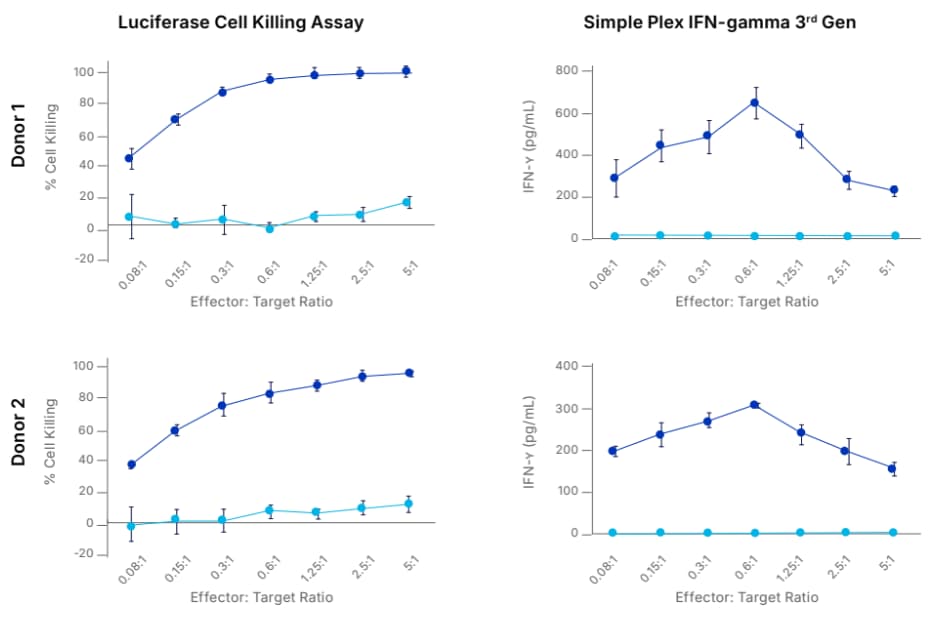
IFN- γ secretion aligns with orthogonal potency readouts: Anti-CD19 CAR-T cells from 2 independent donors were co-cultured with CD19-expressing Nalm-6 cells (dark blue) or CD19-negative K562 cells (light blue) at varying E:T ratios. Following overnight incubation, supernatants were collected, cells were lysed and luminescence was measured after addition of assay buffer and substrate (left panels). Supernatants were analyzed using IFN-γ 3rd Gen Simple Plex cartridges on the Ella System (right panels).
The Gold Standard IFN-γ ELISA Kits
Not ready to commit to a new automated platform? R&D systems also offers a QuicKit™ version of the gold standard Quantikine™ ELISA kit for improved ease of workflow. With only one wash step and 90 minutes incubation time, you can effectively streamline your ELISA results with this shortened format. Same quality, no compromises.
Building a potency strategy that reflects your biology: Moving beyond single-analyte potency testing
Cell therapies can achieve therapeutic effects through multiple active pathways simultaneously, including cytotoxicity, cytokine secretion, targeted tissue homing, and paracrine signaling. No single analyte can fully represent the biological complexity and therapeutic relevance. Regulatory authorities, including the FDA, have recognized that reliance on a single-analyte potency assay can result in requests for extensive revisions and approval delays. These agencies are increasingly expecting potency strategies that reflect the full mechanism of action of the product. A well-designed multianalyte panel that captures the key functional activities of the cell therapy can provide a comprehensive potency assurance strategy that regulatory submissions desire.
Multiparametric potency assays: How Ella can support a matrixed potency strategy
Ella's multianalyte Simple Plex cartridges are purpose-built for this approach, measuring up to eight analytes simultaneously from a single sample. With a menu of 400+ validated targets to choose from, Simple Plex multianalyte panels cover the most clinically relevant combinations for cell therapy potency testing while providing every program the flexibility to build a panel matched to its specific mechanism of action. The result is a potency testing workflow that is scientifically justified, analytically robust, and is backed by the validated precision, reproducibility, and 21 CFR Part 11-compliant data integrity that Quality by Design (QbD) strategies and global regulatory submissions demand.
Potency markers across every major cell type
Cell therapy platforms can have distinct mechanisms of action and require unique potency panels. The analytes that define CAR-T cytotoxicity are not the same as those that characterize CAR-NK degranulation, MSC paracrine immunomodulation, or CD34+ angiogenic activity. Selecting the right markers for your platform is the foundation of a scientifically justified, regulatory-aligned potency strategy.
CAR-T
Key Markers: IFN-γ, Granzyme B, IL-2, TNF-α, Perforin, GM-CSF, Granzyme A, MIP-1β/CCL4
CAR-NK
Key Markers: Granzyme A, CCL4/MIP-1beta, Granzyme B, TNF-α, IFN-γ, CCL3/MIP1alpha, CCL5/RANTES, Perforin
TILs (Tumor-infiltrating lymphocytes)
Key Markers: IFN-γ, IL-2, TNF-α, Perforin, Granzyme B, GM-CSF, IP10/CXCL10
CD34+ /Stem Cells
Key Markers: VEGF, EGF, IL-6, SCF
MSC (Mesenchymal stem cells)
Key Markers: VEGF-A, CCL2/MCP-1, IL_6, TNF-α, IL-10, HGF
Tregs (Regulatory T cells)
Key Markers: IL-10, TGF-beta
CAR-T
Key Markers: IFN-γ, Granzyme B, IL-2, TNF-α
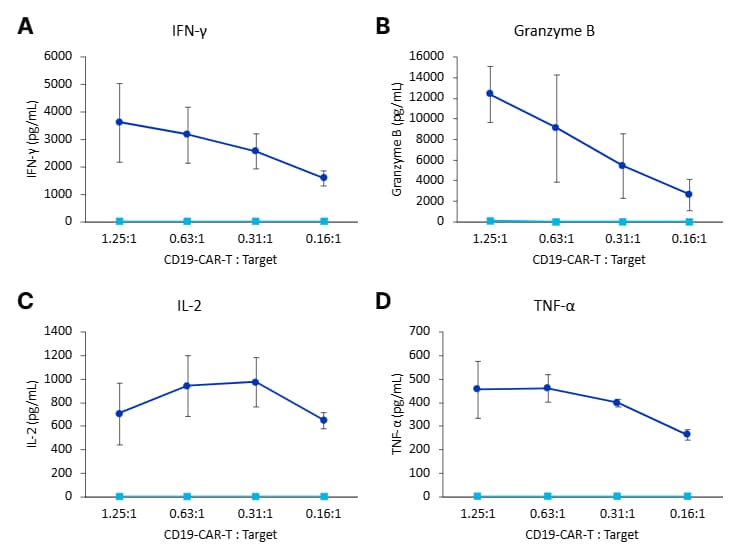
Figure: Anti-CD19-CAR-T cells (dark blue) were co-cultured with CD19-expressing Nalm-6 cells at varying E:T ratios. Unedited T cells (light blue) were co-cultured with target cells as controls. Following overnight incubation, supernatants were collected and analyzed using Simple Plex Cell Activation Panel 1 on the Ella System to quantify IFN-γ 3rd gen (A), Granzyme B (B), IL-2 (C) and TNF-α 2nd gen (D). To generate anti-CD19-CAR-T cells, enriched CD4+ and CD8+ T cells were activated, transduced to express CD19-CAR and expanded in G-Rex 100M-CS bioreactors with GMP Human T Cell Media supplemented with 5% GMP Human AB Serum and ProPak™ Recombinant Human IL-7 and Human IL-15 GMP Proteins to 10 ng/mL. Data is the average of 3 donors (circle, square and triangle), error bars ±SD.
CAR-NK
Key Markers: Granzyme B, TNF-α, IFN-γ, Perforin
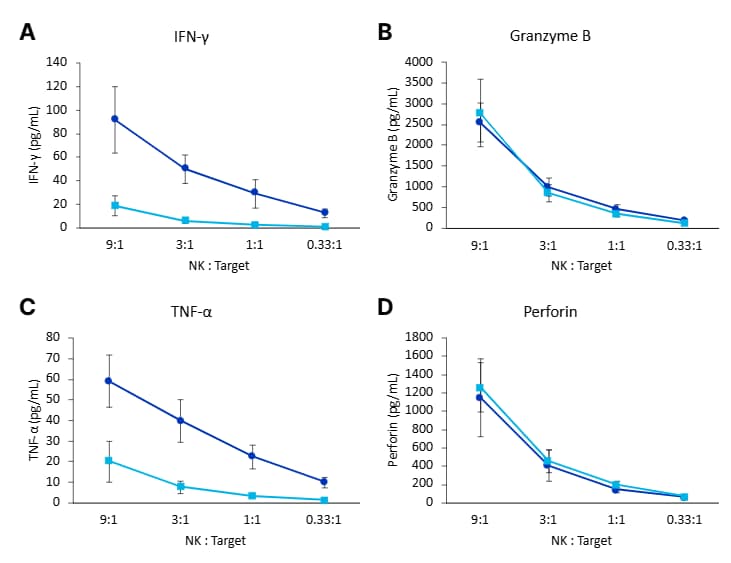
Figure: NK cells were co-cultured with CD19-expressing Nalm-6 cells at varying E:T ratios. Following overnight incubation, supernatants were collected and analyzed using Simple Plex Cell Activation Panel 2 on the Ella System to quantify IFN-γ 3rd gen (A), Granzyme B (B) TNF-α 2nd gen (C) and Perforin (D). To generate anti-CD19-CAR-NK cells (dark blue), enriched CD3- CD16+ NK cells were activated, transposed with TcBuster-M transposase to express CD19-CAR and expanded in G-Rex 6 well bioreactors with ExCellerate™ Human NK Cell Expansion Media supplemented with Recombinant Human IL-2 GMP Protein to 50 IU/mL. Non-CD19-CAR-expressing NK cells (light blue) were grown in parallel and used as a control. Data is the average of 4 donors ±SD.
From characterization to release: one validated method, carried forward
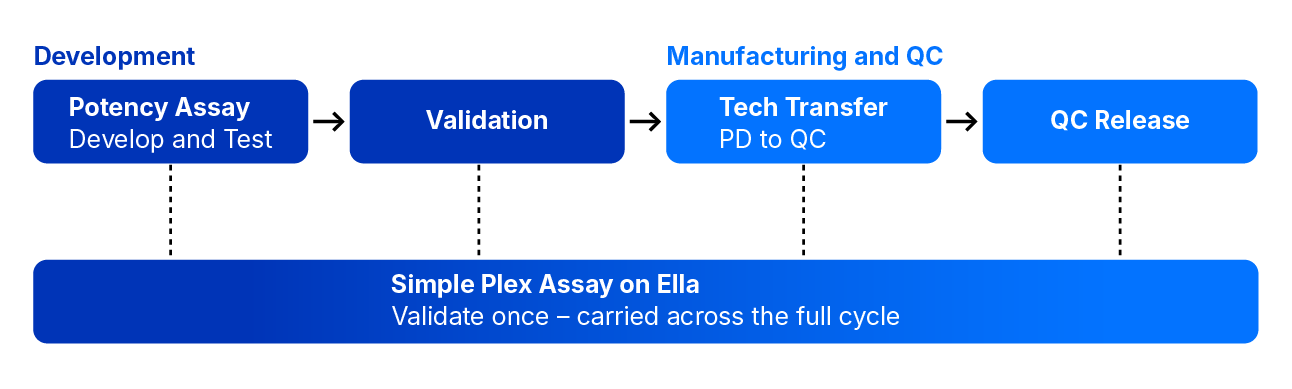
With Ella you can run the same factory-calibrated Simple Plex cartridge from early characterization through GMP release. The fully automated Ella method you qualify during process development is the method you deploy at lot release: no re-optimization, no platform switch, no re-bridging of standard curves. This method continuity with Ella allows you to quickly and efficiently turn your validated potency assay into a release-ready QC assay, de-risking your development workflow.
QC Release Testing
QC release testing: speed, precision, and regulatory confidence
For cell and gene therapy products, QC release testing is the final analytical gatekeeper before a batch is released to the patient. Critical quality attributes including potency, identity, and safety must be verified against pre-defined specifications with data precise enough to withstand regulatory scrutiny from IND filing through commercial manufacturing. For autologous therapies, the turnaround time of QC release testing directly affects patient access, necessitating quick and precise assays.
Simple Plex Assays in the QC release workflow
Immunoassays are central to the QC release workflow, providing quantitative measurement of the functional markers that define potency and confirm product activity across the commercialization of Advanced Therapy Medicinal Products (ATMPs). Where traditional plate-based ELISAs introduce variability at every manual step, Ella's automated microfluidic workflow delivers fully analyzed results in under 90 minutes with intra-assay CVs below 12% - consistently, across instruments, operators, reagent lots, and sites. This combination of speed and analytical precision has made Ella a platform of choice for IFN-γ QC release testing in cell therapy manufacturing environments globally, including at the Cell and Gene Therapy Catapult Skills and Training Laboratories, where it was selected as part of a 24-partner consortium applying novel process analytical technologies to a standardized immunotherapy manufacturing process.
Ella and Simple Plex Assays: Built for the GMP Environment
Ella's Simple Plex reagents are manufactured in an ISO 13485-certified facility, where rigorous quality control ensures each new cartridge lot matches prior lots, maintaining long-term consistency with CVs below 12% across instruments and assay lots. Combined with 21 CFR Part 11-compliant software, IQ/OQ qualification packages, Ella is purpose-designed to meet the operational and documentation demands of licensed cell therapy manufacturing, reducing the validation burden when transferring assays from process development to QC release testing.
| 21 CFR Part 11 ISO 9001 ISO 13485 IQ/OQ Support CE-IVD (select EU Countries) |
|
| Catalog Number | Description |
| ST01B-CS-002697 | Simple Plex Human IFN-gamma Cartridge |
| ST01B-CS-000955 | Simple Plex Human IL-2 Cartridge |
| SPCKB-PS-002803 | Simple Plex Human TNF-alpha Cartridge |
| SPCKB-PS-000496 | Simple Plex Human Granzyme B Cartridge |
| SPCKB-PS-006982 | Simple Plex Human Perforin Cartridge |
| ST01C-CS-003222 | Simple Plex Cell Activation Panel 1 (Granzyme B, IL-2, IFN-gamma, and TNF-alpha) |
| ST01C-CS-007366 | Simple Plex Cell Activation Panel 2 (Granzyme B, IFN-gamma, Perforin, and TNF-alpha) |
| Custom | Custom Simple Plex Panel |
| Various | IFN-gamma ELISA Kits |
Webinar: Building a Better Cell Therapy Potency Assay Through Multianalyte Profiling

This webinar presents a data-driven strategy for developing multianalyte potency assays that pairs broad biomarker discovery with sensitive, automated protein quantification. Using CD19 CAR-T and CAR-NK cells from multiple donors, this webinar will show how multiplex profiling identifies the most informative biomarkers and translates them into targeted potency assays that more faithfully reflect effector cell function and advance assay standardization.