
ALCAM, activated leukocyte cell adhesion molecule, is a type I membrane glycoprotein and a member of the immunoglobulin supergene family. It is also known as CD166, MEMD, SC-1/DM-GRASP/BEN in the chicken, and KG-CAM in the rat. ALCAM is expressed on thymic epithelial cells, activated B and T cells, and monocytes. ALCAM can bind itself homotypically and is also capable of binding CD6, NgCAM, and other, as of yet, unidentified brain proteins. The ALCAM/CD6 interaction may be involved in T cell development and T cell regulation. Additionally, ALCAM/CD6 and ALCAM/NgCAM interactions may play roles in the nervous system. ALCAM has also been observed to be upregulated on highly metastasizing melanoma cell lines and may play a role in tumor migration. ALCAM is a 583 amino acid (aa) protein consisting of a 27 aa signal peptide, a 500 aa extracellular domain, a 24 aa transmembrane domain and a 32 aa cytoplasmic domain. The extracellular domain of ALCAM contains 5 Ig-like domains.

Scientific images may be resized, cropped, or adjusted for brightness or contrast for presentation purposes. These updates are limited to presentation and do not affect the underlying scientific interpretation of the data. Where available, additional source data may be provided upon request.
Key Product Details
Species Reactivity
Validated:
Cited:
Applications
Validated:
Cited:
Label
Antibody Source
Product Specifications
Immunogen
Trp28-Ala526
Accession # AAB59499
Specificity
Clonality
Host
Isotype
Endotoxin Level
Scientific Data Images for Human ALCAM/CD166 Antibody
Detection of Human ALCAM/CD166 by Western Blot
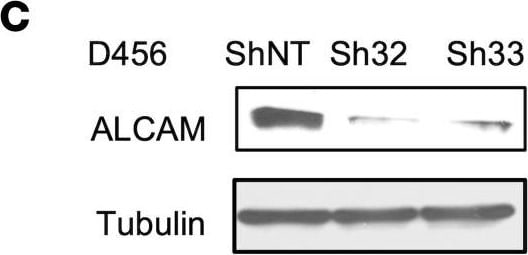
ST6GAL1 targeting decreases levels of a subset of N-glycoproteins that are known BTIC regulators.(A) Schematic of proteomic analysis of D456 BTICs with and without ST6GAL1 KD (n = 4 for each group of shNT, sh32, and sh33). IB with samples independent of the proteomic analysis verified that successful targeting ST6GAL1 resulted in decreased (B) PDGFRB, (C) ALCAM, and (D) NRP1 protein. (E) Schematic of pulldown using SNA-bound Agarose beads. (F) SNA pulldown and protein A/G bound agarose beads as a control demonstrated that PDGFRB, ALCAM, and NRP1 were targets for alpha 2,6 sialylation. (G) SNA pulldown of D456 PDX cells with ST6GAL1 KD compared with NT, illustrating differential pulldown of PDGFRB. (H) PDGF-BB–induced (10 minutes) activation of PDGFRB in D456 GBM PDX cells with ST6GAL1 KD compared with NT; IB for p-PDGFRB and total PDGFRB. The experiments were repeated in at least 3 independent biological replicates. Data from 1 representative experiment are shown. Image collected and cropped by CiteAb from the following open publication (https://pubmed.ncbi.nlm.nih.gov/36345944), licensed under a CC-BY license. Not internally tested by R&D Systems.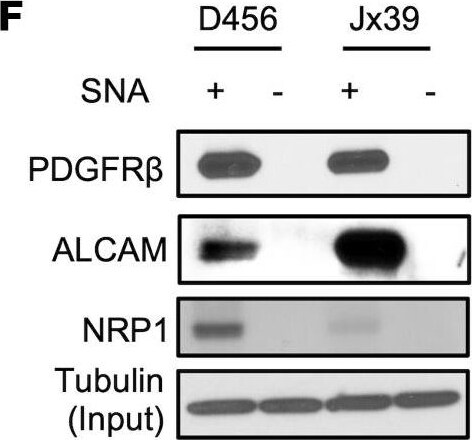
Detection of Human ALCAM/CD166 by Western Blot
ST6GAL1 targeting decreases levels of a subset of N-glycoproteins that are known BTIC regulators.(A) Schematic of proteomic analysis of D456 BTICs with and without ST6GAL1 KD (n = 4 for each group of shNT, sh32, and sh33). IB with samples independent of the proteomic analysis verified that successful targeting ST6GAL1 resulted in decreased (B) PDGFRB, (C) ALCAM, and (D) NRP1 protein. (E) Schematic of pulldown using SNA-bound Agarose beads. (F) SNA pulldown and protein A/G bound agarose beads as a control demonstrated that PDGFRB, ALCAM, and NRP1 were targets for alpha 2,6 sialylation. (G) SNA pulldown of D456 PDX cells with ST6GAL1 KD compared with NT, illustrating differential pulldown of PDGFRB. (H) PDGF-BB–induced (10 minutes) activation of PDGFRB in D456 GBM PDX cells with ST6GAL1 KD compared with NT; IB for p-PDGFRB and total PDGFRB. The experiments were repeated in at least 3 independent biological replicates. Data from 1 representative experiment are shown. Image collected and cropped by CiteAb from the following open publication (https://pubmed.ncbi.nlm.nih.gov/36345944), licensed under a CC-BY license. Not internally tested by R&D Systems.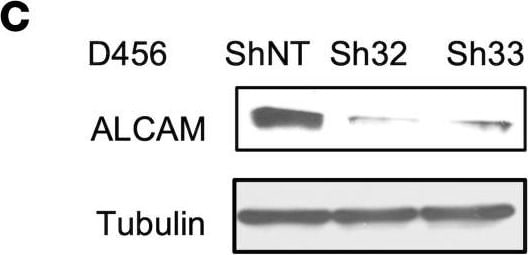
Detection of Human ALCAM/CD166 by Western Blot
ST6GAL1 targeting decreases levels of a subset of N-glycoproteins that are known BTIC regulators.(A) Schematic of proteomic analysis of D456 BTICs with and without ST6GAL1 KD (n = 4 for each group of shNT, sh32, and sh33). IB with samples independent of the proteomic analysis verified that successful targeting ST6GAL1 resulted in decreased (B) PDGFRB, (C) ALCAM, and (D) NRP1 protein. (E) Schematic of pulldown using SNA-bound Agarose beads. (F) SNA pulldown and protein A/G bound agarose beads as a control demonstrated that PDGFRB, ALCAM, and NRP1 were targets for alpha 2,6 sialylation. (G) SNA pulldown of D456 PDX cells with ST6GAL1 KD compared with NT, illustrating differential pulldown of PDGFRB. (H) PDGF-BB–induced (10 minutes) activation of PDGFRB in D456 GBM PDX cells with ST6GAL1 KD compared with NT; IB for p-PDGFRB and total PDGFRB. The experiments were repeated in at least 3 independent biological replicates. Data from 1 representative experiment are shown. Image collected and cropped by CiteAb from the following open publication (https://pubmed.ncbi.nlm.nih.gov/36345944), licensed under a CC-BY license. Not internally tested by R&D Systems.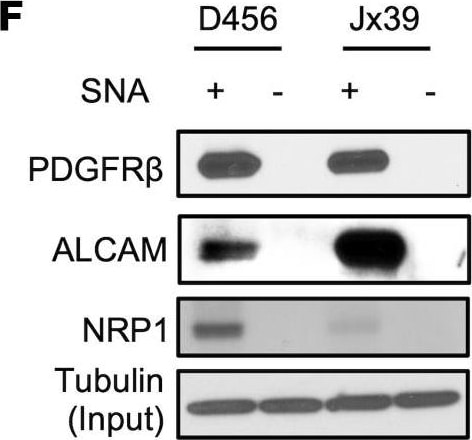
Detection of Human ALCAM/CD166 by Western Blot
ST6GAL1 targeting decreases levels of a subset of N-glycoproteins that are known BTIC regulators.(A) Schematic of proteomic analysis of D456 BTICs with and without ST6GAL1 KD (n = 4 for each group of shNT, sh32, and sh33). IB with samples independent of the proteomic analysis verified that successful targeting ST6GAL1 resulted in decreased (B) PDGFRB, (C) ALCAM, and (D) NRP1 protein. (E) Schematic of pulldown using SNA-bound Agarose beads. (F) SNA pulldown and protein A/G bound agarose beads as a control demonstrated that PDGFRB, ALCAM, and NRP1 were targets for alpha 2,6 sialylation. (G) SNA pulldown of D456 PDX cells with ST6GAL1 KD compared with NT, illustrating differential pulldown of PDGFRB. (H) PDGF-BB–induced (10 minutes) activation of PDGFRB in D456 GBM PDX cells with ST6GAL1 KD compared with NT; IB for p-PDGFRB and total PDGFRB. The experiments were repeated in at least 3 independent biological replicates. Data from 1 representative experiment are shown. Image collected and cropped by CiteAb from the following open publication (https://pubmed.ncbi.nlm.nih.gov/36345944), licensed under a CC-BY license. Not internally tested by R&D Systems.
Human ALCAM / CD166 ELISA Standard Curve
Recombinant Human ALCAM/CD166 Fc Chimera (Catalog # 656-AL) was serially diluted and captured by Mouse Anti-Human ALCAM/CD166 Monoclonal Antibody (Catalog # MAB6561) coated on a Clear Polystyrene Microplate (Catalog # DY990). Goat Anti-Human ALCAM/CD166 Antigen Affinity-purified Polyclonal Antibody (Catalog # AF656) was biotinylated and incubated with the protein captured on the plate. Detection of the standard curve was achieved by incubating Streptavidin-HRP (Catalog # DY998)
Human ALCAM / CD166 ELISA Standard Curve
Recombinant Human ALCAM/CD166 Fc Chimera (Catalog # 656-AL) was serially diluted and captured by Mouse Anti-Human ALCAM/CD166 Monoclonal Antibody (Catalog # MAB6561) coated on a Clear Polystyrene Microplate (Catalog # DY990). Goat Anti-Human ALCAM/CD166 Antigen Affinity-purified Polyclonal Antibody (Catalog # AF656) was biotinylated and incubated with the protein captured on the plate. Detection of the standard curve was achieved by incubating Streptavidin-HRP (Catalog # DY998)Applications for Human ALCAM/CD166 Antibody
Adhesion Blockade
Western Blot
Sample: Recombinant Human ALCAM/CD166 Fc Chimera (Catalog # 656-AL)
Reviewed Applications
Read 1 review rated 5 using AF656 in the following applications:
Formulation, Preparation, and Storage
Purification
Reconstitution
Reconstitute at 0.2 mg/mL in sterile PBS. For liquid material, refer to CoA for concentration.
Formulation
Shipping
Stability & Storage
- 12 months from date of receipt, -20 to -70 °C as supplied.
- 1 month, 2 to 8 °C under sterile conditions after reconstitution.
- 6 months, -20 to -70 °C under sterile conditions after reconstitution.
Calculators
Background: ALCAM/CD166
References
- Bowen, M.A. et al. (1995) J. Exp. Med. 181:2213.
- Aruffo, A. et al. (1997) Immunol. Today 18:498.
- Degen, W.G. et al. (1998) Am. J. Pathol. 152:805.
Long Name
Alternate Names
Gene Symbol
UniProt
Additional ALCAM/CD166 Products
Product Documents for Human ALCAM/CD166 Antibody
Certificate of Analysis
To download a Certificate of Analysis, please enter a lot or batch number in the search box below.
Note: Certificate of Analysis not available for kit components.
Product Specific Notices for Human ALCAM/CD166 Antibody
For research use only
Related Research Areas
Citations for Human ALCAM/CD166 Antibody
 Powered by Bioz
Customer Reviews for Human ALCAM/CD166 Antibody (1)
Have you used Human ALCAM/CD166 Antibody?
Submit a review and receive an Amazon gift card!
$25/€18/£15/$25CAN/¥2500 for a review with an image
$10/€7/£6/$10CAN/¥1110 for a review without an image
Submit a review
Customer Images
-
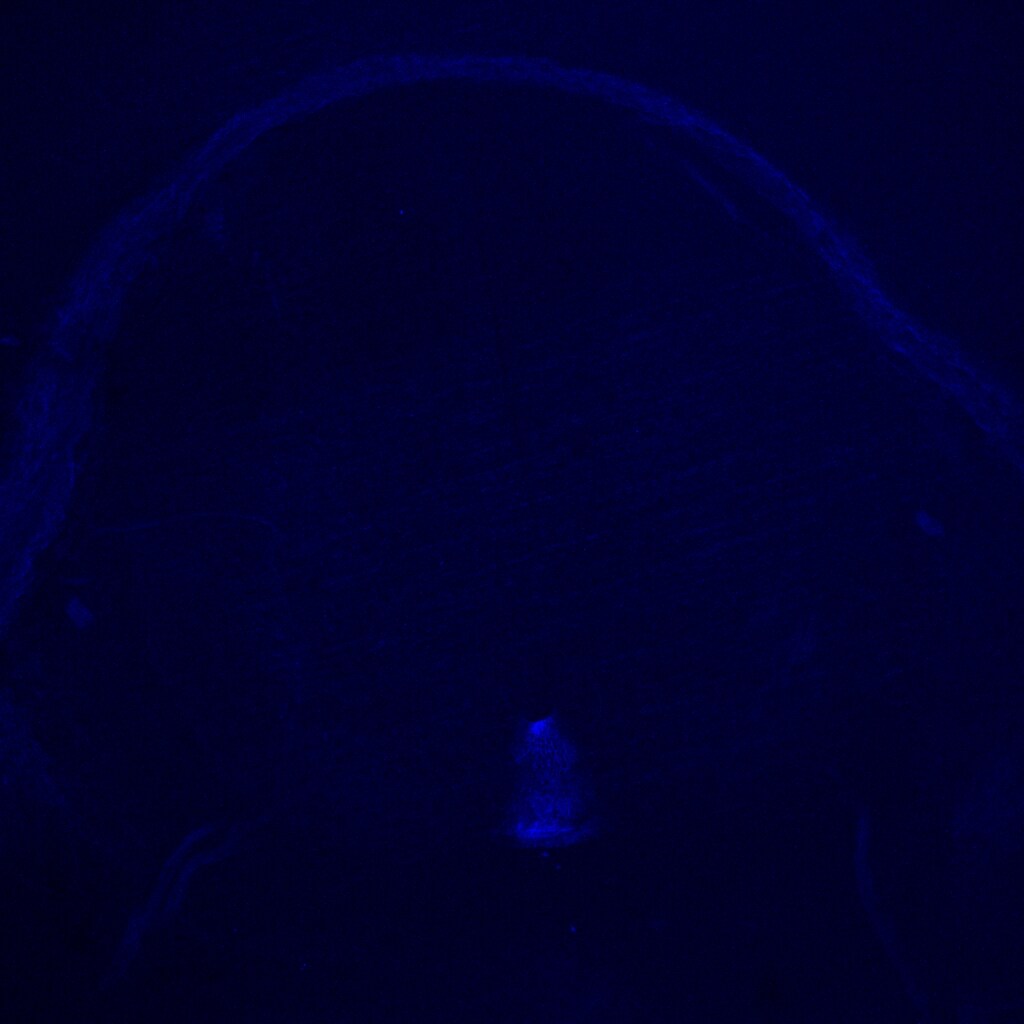
Application: Immunohistochemistry-FrozenSample Tested: Embryonic spinal cordSpecies: MouseVerified Customer | Posted 05/08/2019E12.5 CD1 Mouse Spinal cord. In blue, the floor plate is labelled using Alcam/CD166 antibody.

There are no reviews that match your criteria.
Protocols
Find general support by application which include: protocols, troubleshooting, illustrated assays, videos and webinars.
- Cellular Response to Hypoxia Protocols
- R&D Systems Quality Control Western Blot Protocol
- Troubleshooting Guide: Western Blot Figures
- Western Blot Conditions
- Western Blot Protocol
- Western Blot Protocol for Cell Lysates
- Western Blot Troubleshooting
- Western Blot Troubleshooting Guide
- View all Protocols, Troubleshooting, Illustrated assays and Webinars

