
Mesenchymal Stem Cell Markers
Mesenchymal stem cells (MSCs) are multipotent adult non-hematopoietic stem cells derived from a variety of tissues including umbilical cord, bone marrow, adipose tissue, and dental pulp.
Mesenchymal stem cells (MSCs) are defined by a set of characteristic properties established by the International Society for Cellular Therapy (ISCT). These are:
- Plastic-adherent properties
- Self-renewal capacity
- Multi-lineage differentiation potential (e.g., osteocytes, adipocytes, and chondrocytes)
- Characteristic cell surface marker expression
Although the minimal criteria for MSC identity refers only to the potential for mesodermal differentiation, MSCs may be induced in vitro to transdifferentiate into endodermal (e.g., β-cells and hepatocytes) and ectodermal lineages (e.g., oligodendrocytes and neurons).
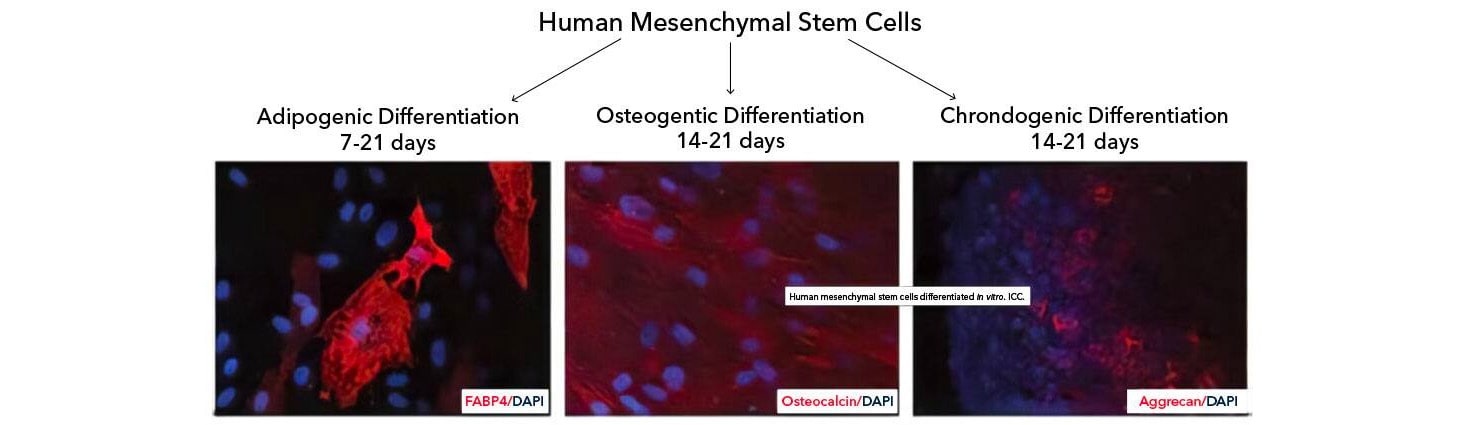
Human mesenchymal stem cells were cultured in StemXVivo™ Mesenchymal Stem Cell Expansion Media (CCM004) and differentiation was induced as indicated using the media supplements included in the Human Mesenchymal Stem Cell Functional Identification Kit (SC006). The kit also contains a Goat Anti-Mouse FABP-4 Antigen Affinity-purified Polyclonal Antibody (adipocytes), a Goat Anti-Human Aggrecan Antigen Affinity-purified Polyclonal Antibody (chondrocytes), and a Mouse Anti-Human Osteocalcin Monoclonal Antibody (osteocytes) for the confirmation of differentiation status. The cells were stained using the NorthernLights(TM) 557-conjugated Donkey Anti-Goat or Anti-Mouse IgG Secondary Antibodies, and the nuclei were counterstained with DAPI (blue).
MSC Markers
Sets of cell surface markers, which must be expressed or absent from MSCs, have been recognized by the ISCT as one of the minimal criteria for human MSC (hMSC) identification. Expressed markers include CD73, CD90 and CD105, and unexpressed markers include CD11b, CD14, CD19, CD34, CD45, CD79a and HLA-DR. A more specific combination of markers to identify MSCs according to their tissue of origin has been published by Ullah et al. 2015.
| hMSCs Origin | Expressed in hMSCs | Not Expressed in hMSCs |
|---|---|---|
| Adipose tissue | CD13, CD29, CD44, CD71, CD73, CD90, CD105, CD166, STRO-1 | CD14, CD31, CD34, CD45 |
| Bone marrow | CD73, CD90, CD105, CD106, CD146, STRO-1 | CD14, CD34, CD45, HLA-DR |
| Dental pulp | CD29, CD44, CD90, CD105 | CD14, CD34, CD45 |
| Peripheral blood | CD44, CD90, CD105, HLA ABC | CD45, CD133 |
| Skin | CD44, CD73, CD90, CD105, CD166, SSEA-4, Vimentin | CD34, CD45, HLA-DR |
Mesenchymal Stem Cell Functions
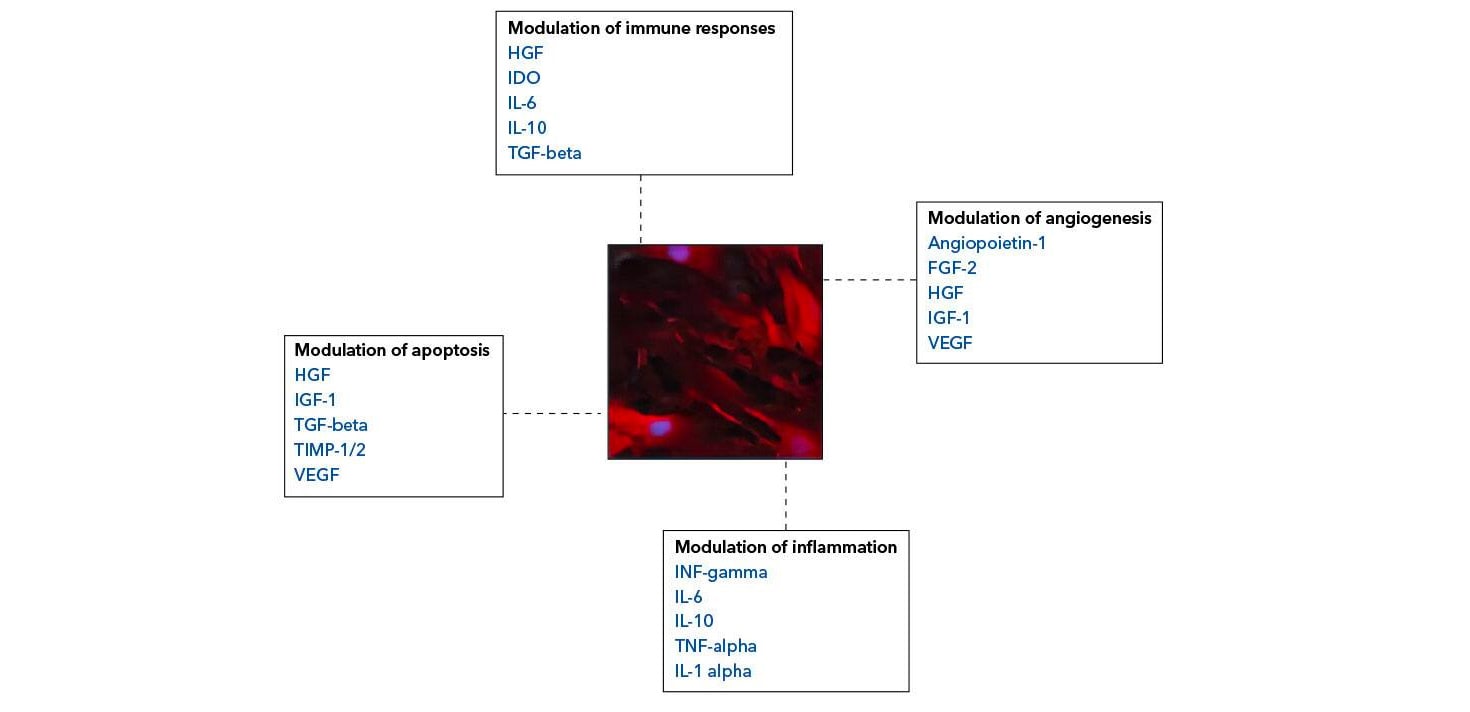
MSCs play a central role in vivo in tissue maintenance and repair. Their potential for differentiation into specific lineages provides a mechanism for tissue self-repair following injury, disease, or senescence. In addition, MSCs have other properties that contribute to their homeostatic functions and make them attractive tools in regenerative medicine. For example, MSCs regulate immune responses through various mechanisms involving cell contact and secreted factors, which impact both innate and adaptive immune effectors. Additionally, MSCs release a variety of bioactive molecules, collectively referred to as the "secretome", including growth factors, enzymes, adhesion proteins, and cytokines which modulate various processes.
Let Our Team of Antibody Experts Provide Personalized Assistance for Your Custom Request
- Custom formulations, conjugates, and sizing.
- Get discounts by bulk ordering high-quality and validated reagents.
- Access to all Bio-Techne brands and connect with our global sales team.
Additional Mesenchymal Stem Cell Markers
Mesenchymal stem cells (MSCs) are multipotent mesoderm-derived progenitor cells. They have the capacity to differentiate into cells that compose adipose, bone, cartilage, and muscle tissue presenting a wide potential for the development of cell-based therapies. Adult mesenchymal stem cells can be isolated from the stroma of the bone marrow. R&D Systems offers products for the identification and isolation of mesenchymal stem cells. These include nucleostemin, an intracellular protein which is expressed in MSCs but not differentiated cells. In addition, cell surface markers for undifferentiated MSCs include receptors for Bone Morphogenetic Proteins (BMPR), Endoglin, Stem Cell Factor Receptor (SCF R), and STRO-1.
- Andrzejewska, A., Lukomska, B., & Janowski, M. (2019). Concise Review: Mesenchymal Stem Cells: From Roots to Boost. Stem Cells. https://doi.org/10.1002/stem.3016
- Cruciani, S., Santaniello, S., Montella, A., Ventura, C., & Maioli, M. (2019). Orchestrating stem cell fate: Novel tools for regenerative medicine. World Journal of Stem Cells. https://doi.org/10.4252/wjsc.v11.i8.464
- Glenn, J. D. (2014). Mesenchymal stem cells: Emerging mechanisms of immunomodulation and therapy. World Journal of Stem Cells. https://doi.org/10.4252/wjsc.v6.i5.526
- Pankajakshan, D., & Agrawal, D. K. (2014). Mesenchymal Stem Cell Paracrine Factors in Vascular Repair and Regeneration. Journal of Biomedical Technology and Research. https://doi.org/10.19104/jbtr.2014.107
- Saeedi, P., Halabian, R., & Imani Fooladi, A. A. (2019). A revealing review of mesenchymal stem cells therapy, clinical perspectives and Modification strategies. Stem Cell Investigation. https://doi.org/10.21037/sci.2019.08.11
- Ullah, I., Subbarao, R. B., & Rho, G. J. (2015). Human mesenchymal stem cells - Current trends and future prospective. Bioscience Reports. https://doi.org/10.1042/BSR20150025