
Goat anti-Rabbit IgG (H+L) Secondary Antibody [Rhodamine]
Novus Biologicals | Catalog # NB7575

Scientific images may be resized, cropped, or adjusted for brightness or contrast for presentation purposes. These updates are limited to presentation and do not affect the underlying scientific interpretation of the data. Where available, additional source data may be provided upon request.
Key Product Details
Species Reactivity
Rabbit
Applications
Western Blot, Fluorophore-linked immunosorbent assay, Flow Cytometry, Immunocytochemistry/ Immunofluorescence, Dot Blot
Label
Rhodamine (Excitation = 570 nm, Emission = 590 nm)
Antibody Source
Polyclonal Goat IgG
Loading...
Product Specifications
Immunogen
Rabbit IgG whole molecule
Clonality
Polyclonal
Host
Goat
Isotype
IgG
Description
For extended storage aliquot contents and freeze at -20C or below. Avoid cycles of freezing and thawing. Centrifuge product if not completely clear after standing at room
This product was prepared from monospecific antiserum by immunoaffinity chromatography using Rabbit IgG coupled to agarose. Assay by immunoelectrophoresis resulted in a single precipitin arc against anti-Goat Serum, Rabbit IgG and Rabbit Serum.
This product was prepared from monospecific antiserum by immunoaffinity chromatography using Rabbit IgG coupled to agarose. Assay by immunoelectrophoresis resulted in a single precipitin arc against anti-Goat Serum, Rabbit IgG and Rabbit Serum.
Scientific Data Images for Goat anti-Rabbit IgG (H+L) Secondary Antibody [Rhodamine]
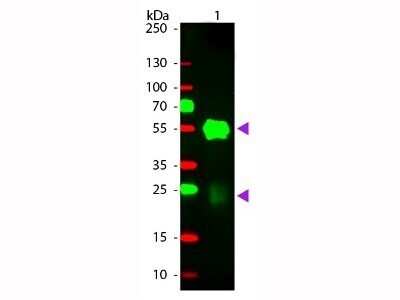
Western Blot: Goat anti-Rabbit IgG (H+L) Secondary Antibody [Rhodamine] [NB7575] - Western Blot of Goat anti-Rabbit IgG (H+L) Secondary Antibody [Rhodamine]. Lane 1: Rabbit IgG. Lane 2: None. Load: 50 ng per lane.Primary antibody: None.Secondary antibody: Goat anti-Rabbit IgG (H+L) Secondary Antibody [Rhodamine] at 1:1000 for 60 min at RT.Block: Fluorescent blocking buffer for 30 min at RT.Predicted/Observed size: 25 & 55 kDa, 25 & 55 kDa for Rabbit IgG. Other band(s): None.
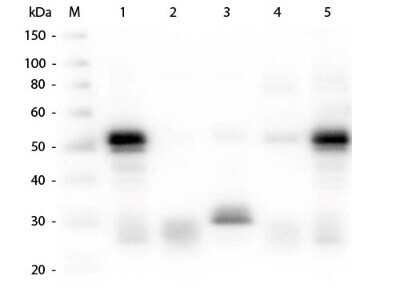
Western Blot: Goat anti-Rabbit IgG (H+L) Secondary Antibody [Rhodamine] [NB7575] - Lane 1: Rabbit IgG whole molecule. Lane 2: Rabbit IgG F(ab) Fragment. Lane 3: Rabbit IgG F(c) Fragment. Lane 4: Rabbit IgM Whole Molecule. Lane 5: Normal Rabbit Serum. All samples were reduced. Load: 50 ng per lane. Block: incubated with blocking buffer for 30 min at RT. Primary Antibody: Anti-Rabbit IgG (H&L) (GOAT) Antibody 1:1,000 for 60 min at RT. Secondary antibody: Anti-Goat IgG (DONKEY) Peroxidase Conjugated Antibody 1:40,000 in incubated with blocking buffer for 30 min at RT. Predicted/Observed Size: 25 and 50 kDa for Rabbit IgG and Serum, 25 kDa for F(c) and F(ab), 70 and 23 kDa for IgM. Rabbit F(c) migrates slightly higher.

Dot Blot: Goat anti-Rabbit IgG (H+L) Secondary Antibody [Rhodamine] [NB7575] - Dot Blot of Goat anti-Rabbit IgG (H+L) Secondary Antibody [Rhodamine].
Antigen: Rabbit IgG.
Load: Lane 1 - 50ng Lane 2 - 16.67ng Lane 3 - 5.56ng Lane 4 - 1.85ng Lane 5 - 0.62ng.
Primary antibody: none.
Secondary antibody: Goat anti-Rabbit IgG (H+L) Secondary Antibody [Rhodamine] at 1:1000 for 60 min at RT.
Block: Fluorescent blocking buffer for 60 min at RT.
Antigen: Rabbit IgG.
Load: Lane 1 - 50ng Lane 2 - 16.67ng Lane 3 - 5.56ng Lane 4 - 1.85ng Lane 5 - 0.62ng.
Primary antibody: none.
Secondary antibody: Goat anti-Rabbit IgG (H+L) Secondary Antibody [Rhodamine] at 1:1000 for 60 min at RT.
Block: Fluorescent blocking buffer for 60 min at RT.
![Goat anti-Rabbit IgG (H+L) Secondary Antibody [Rhodamine]](https://resources.rndsystems.com/images/products/nb7575_goat-polyclonal-goat-anti-rabbit-igg-h-l-secondary-antibody-rhodamine-255202313135123.jpg "Goat anti-Rabbit IgG (H+L) Secondary Antibody [Rhodamine]")
Goat anti-Rabbit IgG (H+L) Secondary Antibody [Rhodamine]
Western Blot of Goat anti-Rabbit IgG (H+L) Secondary Antibody [Rhodamine]Applications for Goat anti-Rabbit IgG (H+L) Secondary Antibody [Rhodamine]
Application
Recommended Usage
Flow Cytometry
1:500 - 1:2500
Fluorophore-linked immunosorbent assay
1:10000 - 1:50000
Immunocytochemistry/ Immunofluorescence
1:1000 - 1:5000
Western Blot
1:1000 - 1:10000
Application Notes
This product has been tested by dot blot and western blot and is designed for immunofluorescence microscopy, fluorescence based plate assays (FLISA) and fluorescent western blotting. This product is also suitable for multiplex analysis, including multicolor imaging, utilizing various commercial platforms.
Use in ICC/IF reported in secitific publication PMID: 32705217
Use in ICC/IF reported in secitific publication PMID: 32705217
Spectra Viewer
Plan Your Experiments
Use our spectra viewer to interactively plan your experiments, assessing multiplexing options. View the excitation and emission spectra for our fluorescent dye range and other commonly used dyes.
Spectra Viewer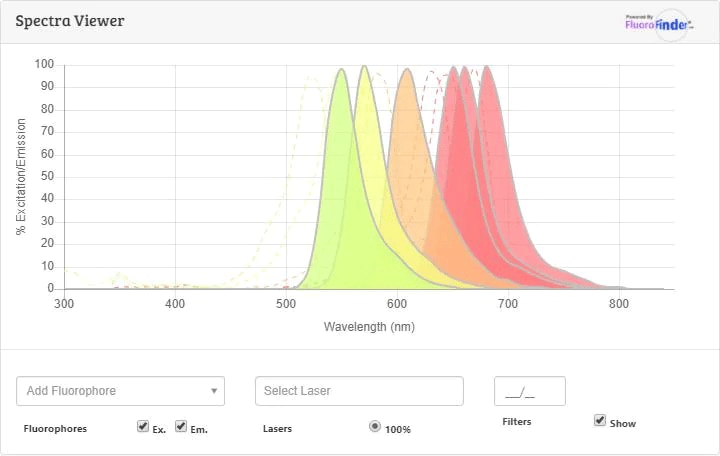
Flow Cytometry Panel Builder
Bio-Techne Knows Flow Cytometry
Save time and reduce costly mistakes by quickly finding compatible reagents using the Panel Builder Tool.
Advanced Features
- Spectra Viewer - Custom analysis of spectra from multiple fluorochromes
- Spillover Popups - Visualize the spectra of individual fluorochromes
- Antigen Density Selector - Match fluorochrome brightness with antigen density

Formulation, Preparation, and Storage
Purification
Immunogen affinity purified
Formulation
0.02 M Potassium Phosphate, 0.15 M Sodium Chloride, pH 7.2, 10 mg/mL Bovine Serum Albumin (BSA) - Immunoglobulin and Protease free
Preservative
0.01% Sodium Azide
Concentration
Please see the vial label for concentration. If unlisted please contact technical services.
Shipping
The product is shipped with polar packs. Upon receipt, store it immediately at the temperature recommended below.
Stability & Storage
Store at 4C short term. Aliquot and store at -20C long term. Avoid freeze-thaw cycles.
Background: IgG (H+L)
The 4 IgG subclasses, sharing 95% amino acid identity, include IgG1, IgG2, IgG3, and IgG4 for humans and IgG1, IgG2a, IgG2b, and IgG3 for mice. The relative abundance of each human subclass is 60% for IgG1, 32% for IgG2, 4% for IgG3, and 4% for IgG4. In an IgG deficiency, there may be a shortage of one or more subclasses (4).
References
1. Painter RH. (1998) Encyclopedia of Immunology (Second Edition). Elsevier. 1208-1211
2. Chapter 9 - Antibodies. (2012) Immunology for Pharmacy. Mosby 70-78
3. Schroeder H, Cavacini, L. (2010) Structure and Function of Immunoglobulins. J Allergy Clin Immunol. 125(2 0 2): S41-S52. PMID: 20176268
4. Vidarsson G, Dekkers G, Rispens T. (2014) IgG subclasses and allotypes: from structure to effector functions. Front Immunol. 5:520. PMID: 25368619
Additional IgG (H+L) Products
Product Documents for Goat anti-Rabbit IgG (H+L) Secondary Antibody [Rhodamine]
Certificate of Analysis
To download a Certificate of Analysis, please enter a lot or batch number in the search box below.
Product Specific Notices for Goat anti-Rabbit IgG (H+L) Secondary Antibody [Rhodamine]
This product is for research use only and is not approved for use in humans or in clinical diagnosis. Secondary Antibodies are guaranteed for 1 year from date of receipt.
Citations for Goat anti-Rabbit IgG (H+L) Secondary Antibody [Rhodamine]
 Powered by Bioz
Customer Reviews for Goat anti-Rabbit IgG (H+L) Secondary Antibody [Rhodamine]
There are currently no reviews for this product. Be the first to review Goat anti-Rabbit IgG (H+L) Secondary Antibody [Rhodamine] and earn rewards!
Have you used Goat anti-Rabbit IgG (H+L) Secondary Antibody [Rhodamine]?
Submit a review and receive an Amazon gift card!
$25/€18/£15/$25CAN/¥2500 for a review with an image
$10/€7/£6/$10CAN/¥1110 for a review without an image
Submit a review
Protocols
Find general support by application which include: protocols, troubleshooting, illustrated assays, videos and webinars.
- 7-Amino Actinomycin D (7-AAD) Cell Viability Flow Cytometry Protocol
- Appropriate Fixation of IHC/ICC Samples
- Cellular Response to Hypoxia Protocols
- ClariTSA™ Fluorophore Kits
- Detection & Visualization of Antibody Binding
- ELISA Sample Preparation & Collection Guide
- ELISA Troubleshooting Guide
- Extracellular Membrane Flow Cytometry Protocol
- Flow Cytometry Protocol for Cell Surface Markers
- Flow Cytometry Protocol for Staining Membrane Associated Proteins
- Flow Cytometry Staining Protocols
- Flow Cytometry Troubleshooting Guide
- How to Run an R&D Systems DuoSet ELISA
- How to Run an R&D Systems Quantikine ELISA
- How to Run an R&D Systems Quantikine™ QuicKit™ ELISA
- ICC Cell Smear Protocol for Suspension Cells
- ICC Immunocytochemistry Protocol Videos
- ICC for Adherent Cells
- Immunocytochemistry (ICC) Protocol
- Immunocytochemistry Troubleshooting
- Immunofluorescence of Organoids Embedded in Cultrex Basement Membrane Extract
- Immunohistochemistry (IHC) and Immunocytochemistry (ICC) Protocols
- Intracellular Flow Cytometry Protocol Using Alcohol (Methanol)
- Intracellular Flow Cytometry Protocol Using Detergents
- Intracellular Nuclear Staining Flow Cytometry Protocol Using Detergents
- Intracellular Staining Flow Cytometry Protocol Using Alcohol Permeabilization
- Intracellular Staining Flow Cytometry Protocol Using Detergents to Permeabilize Cells
- Preparing Samples for IHC/ICC Experiments
- Preventing Non-Specific Staining (Non-Specific Binding)
- Primary Antibody Selection & Optimization
- Propidium Iodide Cell Viability Flow Cytometry Protocol
- Protocol for Liperfluo
- Protocol for VisUCyte™ HRP Polymer Detection Reagent
- Protocol for the Characterization of Human Th22 Cells
- Protocol for the Characterization of Human Th9 Cells
- Protocol for the Fluorescent ICC Staining of Cell Smears - Graphic
- Protocol for the Fluorescent ICC Staining of Cultured Cells on Coverslips - Graphic
- Protocol for the Preparation and Fluorescent ICC Staining of Cells on Coverslips
- Protocol for the Preparation and Fluorescent ICC Staining of Non-adherent Cells
- Protocol for the Preparation and Fluorescent ICC Staining of Stem Cells on Coverslips
- Protocol for the Preparation of a Cell Smear for Non-adherent Cell ICC - Graphic
- Protocol: Annexin V and PI Staining by Flow Cytometry
- Protocol: Annexin V and PI Staining for Apoptosis by Flow Cytometry
- Quantikine HS ELISA Kit Assay Principle, Alkaline Phosphatase
- Quantikine HS ELISA Kit Principle, Streptavidin-HRP Polymer
- R&D Systems Quality Control Western Blot Protocol
- Sandwich ELISA (Colorimetric) – Biotin/Streptavidin Detection Protocol
- Sandwich ELISA (Colorimetric) – Direct Detection Protocol
- TUNEL and Active Caspase-3 Detection by IHC/ICC Protocol
- The Importance of IHC/ICC Controls
- Troubleshooting Guide: ELISA
- Troubleshooting Guide: Fluorokine Flow Cytometry Kits
- Troubleshooting Guide: Western Blot Figures
- Western Blot Conditions
- Western Blot Protocol
- Western Blot Protocol for Cell Lysates
- Western Blot Troubleshooting
- Western Blot Troubleshooting Guide
- View all Protocols, Troubleshooting, Illustrated assays and Webinars
Loading...