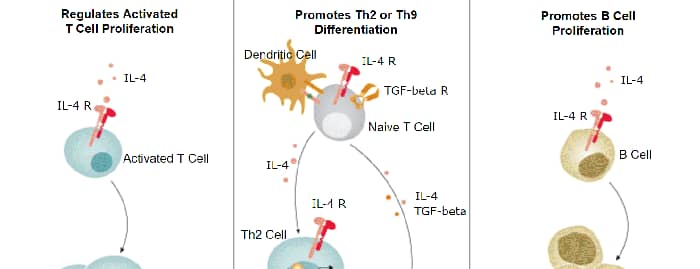
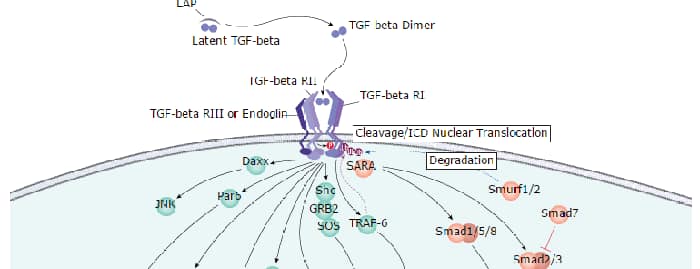
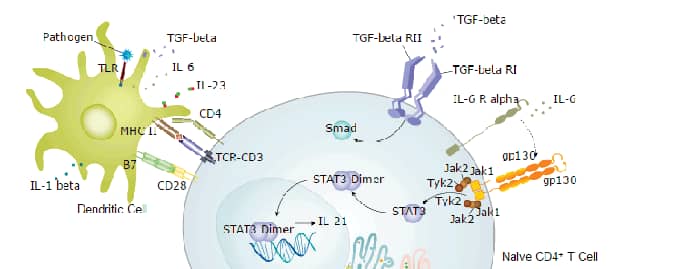
TGF-beta 3 (transforming growth factor beta 3) is one of three closely related mammalian members of the large TGF-beta superfamily that share a characteristic cystine knot structure (1‑7). TGF-beta 1, -2 and -3 are highly pleiotropic cytokines that are proposed to act as cellular switches that regulate processes such as immune function, proliferation and epithelial-mesenchymal transition (1‑4). Each TGF-beta isoform has some non-redundant functions; for TGF-beta 3, mice with targeted deletion show defects palatogenesis and pulmonary development (2). Human TGF-beta 3 cDNA encodes a 412 amino acid (aa) precursor that contains a 20 aa signal peptide and a 392 aa proprotein (8). A furin-like convertase processes the proprotein to generate an N-terminal 220 aa latency-associated peptide (LAP) and a C-terminal 112 aa mature TGF- beta 3 (8, 9). Disulfide-linked homodimers of LAP and TGF-beta 3 remain non-covalently associated after secretion, forming the small latent TGF-beta 3 complex (8‑10). Covalent linkage of LAP to one of three latent TGF-beta binding proteins (LTBPs) creates a large latent complex that may interact with the extracellular matrix (9, 10). TGF-beta is activated from latency by pathways that include actions of the protease plasmin, matrix metalloproteases, thrombospondin 1 and a subset of integrins (10). Mature human TGF-beta 3 shows 100%, 99% and 98% aa identity with mouse/dog/horse, rat and pig TGF-beta 3, respectively. It demonstrates cross-species activity (1). TGF-beta 3 signaling begins with high-affinity binding to a type II ser/thr kinase receptor termed TGF-beta RII. This receptor then phosphorylates and activates a second ser/thr kinase receptor, TGF-beta RI (also called activin receptor-like kinase (ALK) -5), or alternatively, ALK-1.This complex phosphorylates and activates Smad proteins that regulate transcription (3, 11, 12). Contributions of the accessory receptors betaglycan (also known as TGF-beta RIII) and endoglin, or use of Smad-independent signaling pathways, allow for disparate actions observed in response to TGF-beta in different contexts (11).

Scientific images may be resized, cropped, or adjusted for brightness or contrast for presentation purposes. These updates are limited to presentation and do not affect the underlying scientific interpretation of the data. Where available, additional source data may be provided upon request.
Key Product Details
Species Reactivity
Validated:
Cited:
Applications
Validated:
Cited:
Label
Antibody Source
Product Specifications
Immunogen
Ala301-Ser412 (Tyr340Phe)
Accession # P10600
Specificity
Clonality
Host
Isotype
Endotoxin Level
Scientific Data Images for TGF-beta 3 Antibody
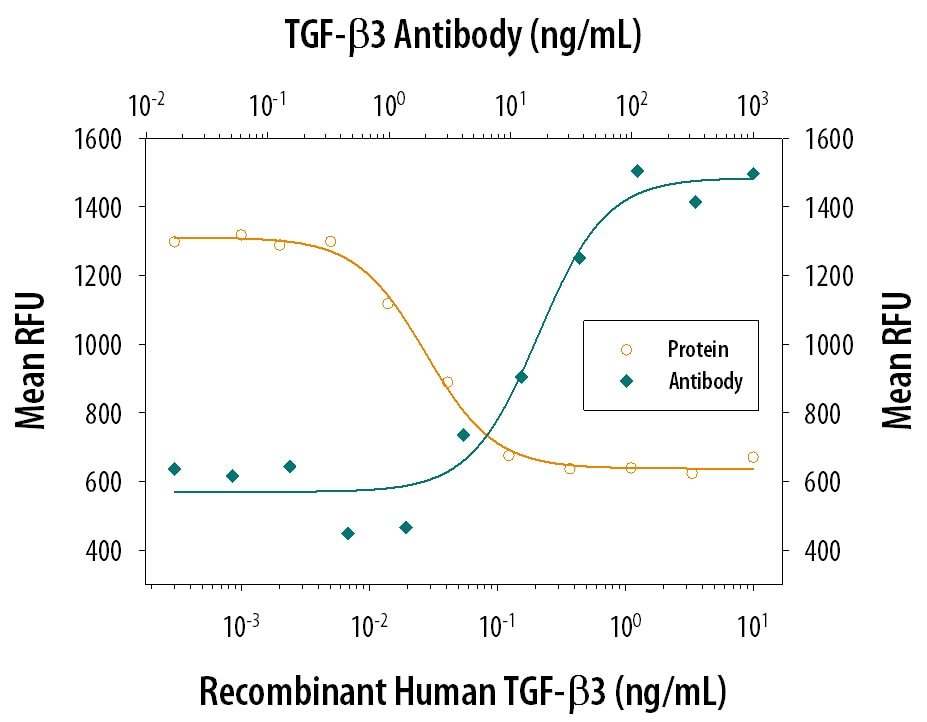
TGF‑ beta 3 Inhibition of IL‑4-dependent Cell Proliferation and Neutralization by TGF‑ beta 3 Antibody.
Recombinant Human TGF-beta 3 (243-B3) inhibits Recombinant Mouse IL-4 (404-ML) induced proliferation in the HT-2 mouse T cell line in a dose-dependent manner (orange line). Inhibition of Recombinant Mouse IL-4 (7.5 ng/mL) activity elicited by Recombinant Human TGF-beta 3 (0.1 ng/mL) is neutralized (green line) by increasing concentrations of TGF-beta 3 Antigen Affinity-purified Polyclonal Antibody (Catalog # AF-243-NA). The ND50 is typically 0.01-0.05 µg/mL.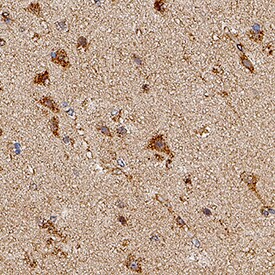
TGF‑ beta 3 in Human Brain.
TGF‑ beta 3 was detected in immersion fixed paraffin-embedded sections of human brain using Goat Anti-TGF‑ beta 3 Antigen Affinity-purified Polyclonal Antibody (Catalog # AF-243-NA) at 5 µg/mL for 1 hour at room temperature followed by incubation with the Anti-Goat IgG VisUCyte™ HRP Polymer Antibody (VC004). Before incubation with the primary antibody, tissue was subjected to heat-induced epitope retrieval using Antigen Retrieval Reagent-Basic (CTS013). Tissue was stained using DAB (brown) and counterstained with hematoxylin (blue). Specific staining was localized to neuronal cell bodies. Staining was performed using our protocol for IHC Staining with VisUCyte HRP Polymer Detection Reagents.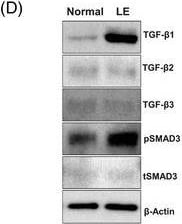
Detection of Human TGF-beta 3 by Western Blot
BCRL results in increased TGF‐ beta 1 expression and signaling. (A) Representative IF localisation of TGF‐ beta 1 (top) and pSMAD3 (bottom) in normal and lymphedematous (labelled LE) tissues. (B) Quantification of TGF‐ beta 1 (top) and pSMAD3 (bottom) IF staining areas in tissue sections of patients with unilateral BCRL. Each circle represents an average of three HPF views per patient (N = 8). (C) mRNA expression of TGF‐ beta isoforms and TGF‐ beta RI comparing normal and lymphedematous limb of patients with unilateral BCRL. Each circle represents an individual patient (N = 14). (D) Representative Western blot of TGF‐ beta isoforms, pSMAD3 and tSMAD3 in normal and lymphedematous limbs of patients with unilateral BCRL. (E) Quantification of Western blots with relative changes comparing normal and lymphedematous limb of each patient. Each circle represents an average of two separate Western blots per patient (N = 8). BCRL, breast cancer‐related lymphedema; TGF‐ beta 1, transforming growth factor‐beta 1; IF, immunofluorescence; LE, lymphedema; HPF, high‐power field; TGF‐ beta R‐I, transforming growth factor‐beta receptor I Image collected and cropped by CiteAb from the following open publication (https://pubmed.ncbi.nlm.nih.gov/35652284), licensed under a CC-BY license. Not internally tested by R&D Systems.
Human TGF-beta 3 ELISA Standard Curve
Recombinant Human TGF‑ beta 3 (Catalog # 243-B3) was serially diluted and captured by Mouse Anti-TGF‑ beta 3 Monoclonal Antibody (Catalog # MAB643) coated on a Clear Polystyrene Microplate (Catalog # DY990). Goat Anti-TGF‑ beta 3 Antigen Affinity-purified Polyclonal Antibody (Catalog # AF-243-NA) was biotinylated and incubated with the protein captured on the plate. Detection of the standard curve was achieved by incubating Streptavidin-HRP (Catalog # DY998)Applications for TGF-beta 3 Antibody
Immunohistochemistry
Sample: Immersion fixed paraffin-embedded sections of human brain
Neutralization
Reviewed Applications
Read 1 review rated 5 using AF-243-NA in the following applications:
Formulation, Preparation, and Storage
Purification
Reconstitution
Reconstitute at 0.2 mg/mL in sterile PBS. For liquid material, refer to CoA for concentration.
Formulation
Shipping
Stability & Storage
- 12 months from date of receipt, -20 to -70 °C as supplied.
- 1 month, 2 to 8 °C under sterile conditions after reconstitution.
- 6 months, -20 to -70 °C under sterile conditions after reconstitution.
Calculators
Background: TGF-beta 3
References
- Sporn, M.B. (2006) Cytokine Growth Factor Rev. 17:3.
- Dunker, N. and K. Krieglstein (2000) Eur. J. Biochem. 267:6982.
- Wahl, S.M. (2006) Immunol. Rev. 213:213.
- Chang, H. et al. (2002) Endocr. Rev. 23:787.
- Lin, J.S. et al. (2006) Reproduction 132:179.
- Hinck, A.P. et al. (1996) Biochemistry 35:8517.
- Mittl, P.R.E. et al. (1996) Protein Sci. 5:1261.
- Derynck, R. et al. (1988) EMBO J. 7:3737.
- Miyazono, K. et al. (1988) J. Biol. Chem. 263:6407.
- Oklu, R. and R. Hesketh (2000) Biochem. J. 352:601.
- de Caestecker, M. et al. (2004) Cytokine Growth Factor Rev. 15:1.
- Zuniga, J.E. et al. (2005) J. Mol. Biol. 354:1052.
Long Name
Alternate Names
Gene Symbol
UniProt
Additional TGF-beta 3 Products
Product Documents for TGF-beta 3 Antibody
Certificate of Analysis
To download a Certificate of Analysis, please enter a lot or batch number in the search box below.
Note: Certificate of Analysis not available for kit components.
Product Specific Notices for TGF-beta 3 Antibody
For research use only
Citations for TGF-beta 3 Antibody
 Powered by Bioz
Customer Reviews for TGF-beta 3 Antibody (1)
Have you used TGF-beta 3 Antibody?
Submit a review and receive an Amazon gift card!
$25/€18/£15/$25CAN/¥2500 for a review with an image
$10/€7/£6/$10CAN/¥1110 for a review without an image
Submit a review
Customer Images
-
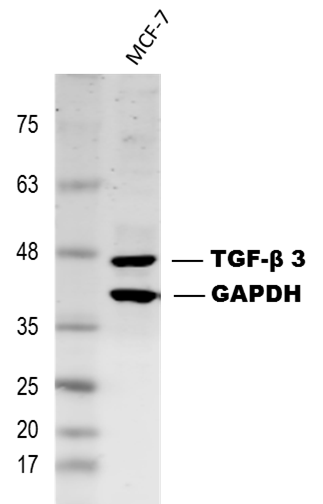
Application: Western BlotSample Tested: Human MCF-7 cell lysateSpecies: HumanVerified Customer | Posted 04/09/2017Expression of TGF-beta 3 in breast cancer cell lysate using Goat anti-Human TGF-beta 3 antibody (#AF-243) at 1 ug/mL, followed by Donkey anti-Goat secondary antibody at 1:1,000 dilution. PVDF membrane blocked with 5% BSA-PBS.

There are no reviews that match your criteria.
Protocols
Find general support by application which include: protocols, troubleshooting, illustrated assays, videos and webinars.
- Antigen Retrieval Protocol (PIER)
- Antigen Retrieval for Frozen Sections Protocol
- Appropriate Fixation of IHC/ICC Samples
- Cellular Response to Hypoxia Protocols
- Chromogenic IHC Staining of Formalin-Fixed Paraffin-Embedded (FFPE) Tissue Protocol
- Chromogenic Immunohistochemistry Staining of Frozen Tissue
- ClariTSA™ Fluorophore Kits
- Detection & Visualization of Antibody Binding
- Fluorescent IHC Staining of Frozen Tissue Protocol
- Graphic Protocol for Heat-induced Epitope Retrieval
- Graphic Protocol for the Preparation and Fluorescent IHC Staining of Frozen Tissue Sections
- Graphic Protocol for the Preparation and Fluorescent IHC Staining of Paraffin-embedded Tissue Sections
- Graphic Protocol for the Preparation of Gelatin-coated Slides for Histological Tissue Sections
- IHC Sample Preparation (Frozen sections vs Paraffin)
- Immunofluorescent IHC Staining of Formalin-Fixed Paraffin-Embedded (FFPE) Tissue Protocol
- Immunohistochemistry (IHC) and Immunocytochemistry (ICC) Protocols
- Immunohistochemistry Frozen Troubleshooting
- Immunohistochemistry Paraffin Troubleshooting
- Preparing Samples for IHC/ICC Experiments
- Preventing Non-Specific Staining (Non-Specific Binding)
- Primary Antibody Selection & Optimization
- Protocol for Heat-Induced Epitope Retrieval (HIER)
- Protocol for Making a 4% Formaldehyde Solution in PBS
- Protocol for VisUCyte™ HRP Polymer Detection Reagent
- Protocol for the Preparation & Fixation of Cells on Coverslips
- Protocol for the Preparation and Chromogenic IHC Staining of Frozen Tissue Sections
- Protocol for the Preparation and Chromogenic IHC Staining of Frozen Tissue Sections - Graphic
- Protocol for the Preparation and Chromogenic IHC Staining of Paraffin-embedded Tissue Sections
- Protocol for the Preparation and Chromogenic IHC Staining of Paraffin-embedded Tissue Sections - Graphic
- Protocol for the Preparation and Fluorescent IHC Staining of Frozen Tissue Sections
- Protocol for the Preparation and Fluorescent IHC Staining of Paraffin-embedded Tissue Sections
- Protocol for the Preparation of Gelatin-coated Slides for Histological Tissue Sections
- TUNEL and Active Caspase-3 Detection by IHC/ICC Protocol
- The Importance of IHC/ICC Controls
- Troubleshooting Guide: Immunohistochemistry
- View all Protocols, Troubleshooting, Illustrated assays and Webinars
Associated Pathways