
ANP32B Antibody
Novus Biologicals | Catalog # NB100-1199

![Western Blot: ANP32B Antibody [NB100-1199]](https://resources.rndsystems.com/images/products/ANP32B-Antibody-Western-Blot-NB100-1199-img0002.jpg "Western Blot: ANP32B Antibody [NB100-1199]")
Loading...
Key Product Details
Validated by
Knockout/Knockdown
Species Reactivity
Validated:
Human, Mouse, Rat, Porcine
Cited:
Rat
Applications
Validated:
Immunohistochemistry, Immunohistochemistry-Paraffin, Western Blot, Peptide ELISA, Immunocytochemistry/ Immunofluorescence, Knockdown Validated
Cited:
Western Blot
Label
Unconjugated
Antibody Source
Polyclonal Goat IgG
Loading...
Product Specifications
Immunogen
Peptide with sequence C-KRKRETDDEGEDD corresponding to C-Terminus according to NP_006392.1.
Reactivity Notes
Rat reactivity reported in scientific literature (PMID: 25034417).
Specificity
This antibody does NOT recognize theTNF family member also known as APRIL - Gene ID number 8741. However this antibody may cross-react with ANP32A (GeneID 8125).
Clonality
Polyclonal
Host
Goat
Isotype
IgG
Scientific Data Images for ANP32B Antibody
Western Blot: ANP32B Antibody [NB100-1199]
Western Blot: ANP32B Antibody [NB100-1199] - 0.1 ug/ml) staining of Human Tonsil (A) and Rat (B) and Pig (C) Spleen lysate (35 ug protein in RIPA buffer). Primary incubation was 1 hour. Detected by chemiluminescence.![Immunocytochemistry/ Immunofluorescence: ANP32B Antibody [NB100-1199]](https://resources.rndsystems.com/images/products/ANP32B-Antibody-Immunocytochemistry-Immunofluorescence-NB100-1199-img0006.jpg "Immunocytochemistry/ Immunofluorescence: ANP32B Antibody [NB100-1199]")
Immunocytochemistry/ Immunofluorescence: ANP32B Antibody [NB100-1199]
ANP32B-Antibody-Immunocytochemistry-Immunofluorescence-NB100-1199-img0006.jpg![Immunohistochemistry: ANP32B Antibody [NB100-1199]](https://resources.rndsystems.com/images/products/ANP32B-Antibody-Immunohistochemistry-NB100-1199-img0005.jpg "Immunohistochemistry: ANP32B Antibody [NB100-1199]")
Immunohistochemistry: ANP32B Antibody [NB100-1199]
ANP32B-Antibody-Immunohistochemistry-NB100-1199-img0005.jpg![Western Blot: ANP32B Antibody [NB100-1199]](https://resources.rndsystems.com/images/products/ANP32B-Antibody-Western-Blot-NB100-1199-img0001.jpg "Western Blot: ANP32B Antibody [NB100-1199]")
Western Blot: ANP32B Antibody [NB100-1199]
Western Blot: ANP32B Antibody [NB100-1199] - (0.1 ug/ml) staining of NIH3T3 cell lysate (35 ug protein in RIPA buffer). Primary incubation was 1 hour. Detected by chemiluminescence.![Immunohistochemistry-Paraffin: ANP32B Antibody [NB100-1199]](https://resources.rndsystems.com/images/products/ANP32B-Antibody-Immunohistochemistry-Paraffin-NB100-1199-img0003.jpg "Immunohistochemistry-Paraffin: ANP32B Antibody [NB100-1199]")
Immunohistochemistry-Paraffin: ANP32B Antibody [NB100-1199]
Immunohistochemistry-Paraffin: ANP32B Antibody [NB100-1199] - Staining of paraffin embedded Human Breast. Steamed antigen retrieval with citrate buffer pH 6, AP-staining.![Knockdown Validated: ANP32B Antibody [NB100-1199]](https://resources.rndsystems.com/images/products/ANP32B-Antibody-Knockdown-Validated-NB100-1199-img0004.jpg "Western Blot: ANP32B Antibody [NB100-1199]")
Immunocytochemistry/ Immunofluorescence: ANP32B Antibody [NB100-1199] -
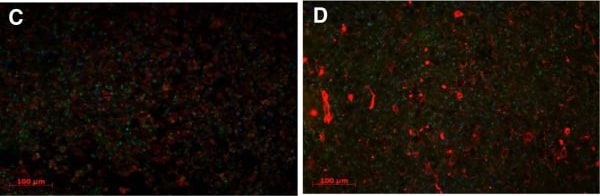
Immunocytochemistry/ Immunofluorescence: ANP32B Antibody [NB100-1199] - Upregulated PAL31 expression was observed not only in microglia/ macrophage but also in glial cells near the injury site. (A) Normal thoracic spinal cord section showing few ED-1 positive cells (red). (B) Normal thoracic spinal cord section showing GFAP positive cells (red). (C) Representative micrograph showing colocalization of upregulated PAL31 (green) with microglia/macrophage (ED1 positive cells) (D) Representative micrograph showing colocalization of upregulated PAL31 with astroglia (GFAP positive cells). (E) High power image showing the colocalization of upregulated PAL31 with ED1 positive macrophage/microglia (arrowhead) (F) High power image demonstrating the colocalization of upregulated PAL31 with GFAP positive astroglia (arrow). Magnification: 200X (A-D) & 1000X (E&F). Image collected & cropped by CiteAb from the following publication (https://pubmed.ncbi.nlm.nih.gov/25034417), licensed under a CC-BY license. Not internally tested by Novus Biologicals.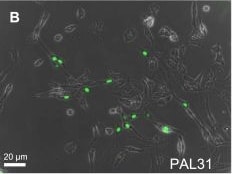
Immunocytochemistry/ Immunofluorescence: ANP32B Antibody [NB100-1199] -
Immunocytochemistry/ Immunofluorescence: ANP32B Antibody [NB100-1199] - Overexpression of PAL31 in C6 did not affect the cell proliferative activity. (A) GFP/bright field-superimposed micrograph in GFP overexpressing cells showing > 50% transfective efficiency (B) GFP-PAL31/bright field-micrograph in PAL31 overexpressing C6 showing correct nuclear localization of GFP-tagged PAL31 & transfection effeciency. (C) Western blot analysis showing the expression of GFP (~27 kDa), GFP-tagged PAL31 (~58 kDa), PCNA (~34 kDa), endogenous PAL31 (~31 kDa) & Actin (~43 kDa) in GFP- or PAL31-C6 cultures. The level of PCNA, a protein expressing in nuclear during DNA synthesis, in cells did not alter after overexpression of GFP or GFP-tagged PAL31. Actin works as a loading control. (D) MTT assay in the transfected cells at 4 different time intervals (from Ctrl to 72 hours). Ctrl represents the cells after subculture & overnight incubation. The data in each time points were analyzed by two-way ANOVA & Bonferroni post hoc test. No significance, compared GFP & GFP tagged PAL31 groups. n = 3. Magnification 100X (A-B). Image collected & cropped by CiteAb from the following publication (https://pubmed.ncbi.nlm.nih.gov/25034417), licensed under a CC-BY license. Not internally tested by Novus Biologicals.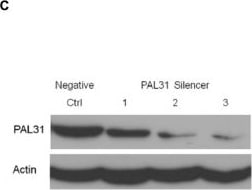
Western Blot: ANP32B Antibody [NB100-1199] -
Western Blot: ANP32B Antibody [NB100-1199] - Effect of overexpression or knockdown of PAL31 in C6 on H2O2-induced toxicity. (A) Representative micrographs showing C6 overexpressing GFP or GFP-tagged PAL31 after being treated with H2O2 (0 ~ 1 mM) for 4 hours. (B) MTT assay in GFP- or GFP-PAL31-overexpressed C6 after H2O2 treatment showing significant difference (cytoprotective effect of PAL31) at 0.5 mM & 1 mM H2O2 treatment between C6/GFP & C6/PAL31 groups. The data in each dosage were analyzed by two-way ANOVA & Bonferroni post hoc test. *P < 0.05, GFP (+H2O2) compared to PAL31 (+H2O2), n = 4, at 0.5 mM & 1 mM. (C) Western blot analysis of pal31 siRNA-treated C6 showing knockdown of PAL31 expression by PAL31 silencer using 41.5 (lane1), 83 (lane2), & 166 (lane 3) picomole of pal31 siRNA or 332 picomole negative control. Actin works as a loading control. (D) MTT assay in Negative- or PAL31 silencer transfected C6 after H2O2 treatment showing significant difference at 1 mM H2O2 treatment between C6/Negative & C6/PAL31 siRNA groups. *P < 0.05, Negative (+H2O2) compared to PAL31 siRNA (+H2O2), n = 4. Magnification 100X (A). Image collected & cropped by CiteAb from the following publication (https://pubmed.ncbi.nlm.nih.gov/25034417), licensed under a CC-BY license. Not internally tested by Novus Biologicals.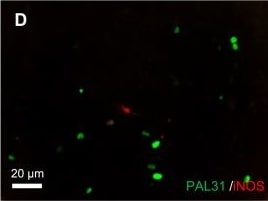
Immunocytochemistry/ Immunofluorescence: ANP32B Antibody [NB100-1199] -
Immunocytochemistry/ Immunofluorescence: ANP32B Antibody [NB100-1199] - Overexpression of PAL31 in mixed glial culture effectively reduced LPS/IFN gamma stimulation after co-culture with spinal cord neuron-glial cultures. (A) ED-1- immunoreactive microglia/macrophage in confluent mixed glial cultures (B) S100- immunoreactive astroglia in confluent mixed glial cultures (C) LPS/IFN gamma -stimulated neuron-glial co-cultures (Glia/GFP + neuron) showing expression of both iNOS & GFP (D) LPS/IFN gamma -stimulated neuron-glial co-cultures (Glia/PAL31+ neuron) showing expression of both iNOS & PAL31. (E) Quantitative analysis of released nitric oxide, as a form of nitrite, in LPS/IFN gamma -stimulated or non-stimulated neuron-glial co-culture. Mixed glial cultures were transfected with pGFP or pPAL31 before seeding spinal cord neurons. Co-cultures were then treated with LPS/IFN gamma for 2 days. Medium were saved for nitrite level determination, while cells were processed for immunostaining with iNOS. *P < 0.05, n = 4. PAL31 overexpressing co-cultures (+LPS/IFN gamma ) compared to GFP overexpressing co-cultures (+LPS/IFN gamma ). Magnification 200X (A-D). Image collected & cropped by CiteAb from the following publication (https://pubmed.ncbi.nlm.nih.gov/25034417), licensed under a CC-BY license. Not internally tested by Novus Biologicals.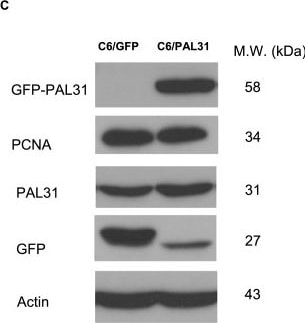
Western Blot: ANP32B Antibody [NB100-1199] -
Western Blot: ANP32B Antibody [NB100-1199] - Overexpression of PAL31 in C6 did not affect the cell proliferative activity. (A) GFP/bright field-superimposed micrograph in GFP overexpressing cells showing > 50% transfective efficiency (B) GFP-PAL31/bright field-micrograph in PAL31 overexpressing C6 showing correct nuclear localization of GFP-tagged PAL31 & transfection effeciency. (C) Western blot analysis showing the expression of GFP (~27 kDa), GFP-tagged PAL31 (~58 kDa), PCNA (~34 kDa), endogenous PAL31 (~31 kDa) & Actin (~43 kDa) in GFP- or PAL31-C6 cultures. The level of PCNA, a protein expressing in nuclear during DNA synthesis, in cells did not alter after overexpression of GFP or GFP-tagged PAL31. Actin works as a loading control. (D) MTT assay in the transfected cells at 4 different time intervals (from Ctrl to 72 hours). Ctrl represents the cells after subculture & overnight incubation. The data in each time points were analyzed by two-way ANOVA & Bonferroni post hoc test. No significance, compared GFP & GFP tagged PAL31 groups. n = 3. Magnification 100X (A-B). Image collected & cropped by CiteAb from the following publication (https://pubmed.ncbi.nlm.nih.gov/25034417), licensed under a CC-BY license. Not internally tested by Novus Biologicals.Applications for ANP32B Antibody
Application
Recommended Usage
Immunohistochemistry
3 - 5 ug/ml
Immunohistochemistry-Paraffin
3-5 ug/ml
Peptide ELISA
Detection limit 1:16000
Western Blot
0.1 - 0.3 ug/ml
Application Notes
WB: Approx. 26 kDa band observed in human tonsil lysates (calculated MW of 28.8 kDa band according to NP_006392.1). IHC-P: Human breast shows nuclear staining in lobular cells.
Formulation, Preparation, and Storage
Purification
Immunogen affinity purified
Formulation
Tris saline (20 mM Tris pH 7.3, 150 mM NaCl), 0.5% BSA
Preservative
0.02% Sodium Azide
Concentration
0.5 mg/ml
Shipping
The product is shipped with polar packs. Upon receipt, store it immediately at the temperature recommended below.
Stability & Storage
Store at -20C. Avoid freeze-thaw cycles.
Background: ANP32B
Alternate Names
acidic (leucine-rich) nuclear phosphoprotein 32 family, member B, acidic leucine-rich nuclear phosphoprotein 32 family member B, Acidic protein rich in leucines, APRILSilver-stainable protein SSP29, Pal31, PHAPI2SSP29, Putative HLA-DR-associated protein I-2
Gene Symbol
ANP32B
UniProt
Additional ANP32B Products
Product Documents for ANP32B Antibody
Certificate of Analysis
To download a Certificate of Analysis, please enter a lot or batch number in the search box below.
Product Specific Notices for ANP32B Antibody
This product is for research use only and is not approved for use in humans or in clinical diagnosis. Primary Antibodies are guaranteed for 1 year from date of receipt.
Citations for ANP32B Antibody
 Powered by Bioz
Customer Reviews for ANP32B Antibody
There are currently no reviews for this product. Be the first to review ANP32B Antibody and earn rewards!
Have you used ANP32B Antibody?
Submit a review and receive an Amazon gift card!
$25/€18/£15/$25CAN/¥2500 Yen for a review with an image
$10/€7/£6/$10CAN/¥1110 Yen for a review without an image
Submit a review
Protocols
Find general support by application which include: protocols, troubleshooting, illustrated assays, videos and webinars.
- Antigen Retrieval Protocol (PIER)
- Antigen Retrieval for Frozen Sections Protocol
- Appropriate Fixation of IHC/ICC Samples
- Cellular Response to Hypoxia Protocols
- Chromogenic IHC Staining of Formalin-Fixed Paraffin-Embedded (FFPE) Tissue Protocol
- Chromogenic Immunohistochemistry Staining of Frozen Tissue
- ClariTSA™ Fluorophore Kits
- Detection & Visualization of Antibody Binding
- ELISA Sample Preparation & Collection Guide
- ELISA Troubleshooting Guide
- Fluorescent IHC Staining of Frozen Tissue Protocol
- Graphic Protocol for Heat-induced Epitope Retrieval
- Graphic Protocol for the Preparation and Fluorescent IHC Staining of Frozen Tissue Sections
- Graphic Protocol for the Preparation and Fluorescent IHC Staining of Paraffin-embedded Tissue Sections
- Graphic Protocol for the Preparation of Gelatin-coated Slides for Histological Tissue Sections
- How to Run an R&D Systems DuoSet ELISA
- How to Run an R&D Systems Quantikine ELISA
- How to Run an R&D Systems Quantikine™ QuicKit™ ELISA
- ICC Cell Smear Protocol for Suspension Cells
- ICC Immunocytochemistry Protocol Videos
- ICC for Adherent Cells
- IHC Sample Preparation (Frozen sections vs Paraffin)
- Immunocytochemistry (ICC) Protocol
- Immunocytochemistry Troubleshooting
- Immunofluorescence of Organoids Embedded in Cultrex Basement Membrane Extract
- Immunofluorescent IHC Staining of Formalin-Fixed Paraffin-Embedded (FFPE) Tissue Protocol
- Immunohistochemistry (IHC) and Immunocytochemistry (ICC) Protocols
- Immunohistochemistry Frozen Troubleshooting
- Immunohistochemistry Paraffin Troubleshooting
- Preparing Samples for IHC/ICC Experiments
- Preventing Non-Specific Staining (Non-Specific Binding)
- Primary Antibody Selection & Optimization
- Protocol for Heat-Induced Epitope Retrieval (HIER)
- Protocol for Making a 4% Formaldehyde Solution in PBS
- Protocol for VisUCyte™ HRP Polymer Detection Reagent
- Protocol for the Fluorescent ICC Staining of Cell Smears - Graphic
- Protocol for the Fluorescent ICC Staining of Cultured Cells on Coverslips - Graphic
- Protocol for the Preparation & Fixation of Cells on Coverslips
- Protocol for the Preparation and Chromogenic IHC Staining of Frozen Tissue Sections
- Protocol for the Preparation and Chromogenic IHC Staining of Frozen Tissue Sections - Graphic
- Protocol for the Preparation and Chromogenic IHC Staining of Paraffin-embedded Tissue Sections
- Protocol for the Preparation and Chromogenic IHC Staining of Paraffin-embedded Tissue Sections - Graphic
- Protocol for the Preparation and Fluorescent ICC Staining of Cells on Coverslips
- Protocol for the Preparation and Fluorescent ICC Staining of Non-adherent Cells
- Protocol for the Preparation and Fluorescent ICC Staining of Stem Cells on Coverslips
- Protocol for the Preparation and Fluorescent IHC Staining of Frozen Tissue Sections
- Protocol for the Preparation and Fluorescent IHC Staining of Paraffin-embedded Tissue Sections
- Protocol for the Preparation of Gelatin-coated Slides for Histological Tissue Sections
- Protocol for the Preparation of a Cell Smear for Non-adherent Cell ICC - Graphic
- Quantikine HS ELISA Kit Assay Principle, Alkaline Phosphatase
- Quantikine HS ELISA Kit Principle, Streptavidin-HRP Polymer
- R&D Systems Quality Control Western Blot Protocol
- Sandwich ELISA (Colorimetric) – Biotin/Streptavidin Detection Protocol
- Sandwich ELISA (Colorimetric) – Direct Detection Protocol
- TUNEL and Active Caspase-3 Detection by IHC/ICC Protocol
- The Importance of IHC/ICC Controls
- Troubleshooting Guide: ELISA
- Troubleshooting Guide: Immunohistochemistry
- Troubleshooting Guide: Western Blot Figures
- Western Blot Conditions
- Western Blot Protocol
- Western Blot Protocol for Cell Lysates
- Western Blot Troubleshooting
- Western Blot Troubleshooting Guide
- View all Protocols, Troubleshooting, Illustrated assays and Webinars
Loading...