
CardioTACS In Situ Apoptosis Detection Kit
R&D Systems | Catalog # 4827-30-K

Key Product Details
Features
Key Benefits
- Performance tested on heart-derived samples.
- Includes both Proteinase K and exclusive Cytonin non-enzymatic permeabilization reagents.
- Includes TACS-Nuclease solution for preparing sample-dependent positive controls.
- Helps resolve unique problems encountered when detecting apoptotic cardiac cells.
Species
Product Summary for CardioTACS In Situ Apoptosis Detection Kit
Scientific Data Images for CardioTACS In Situ Apoptosis Detection Kit
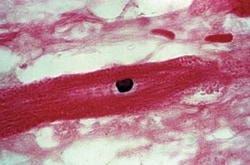
Visualization of an Apoptotic Rat Cardiac Myocyte using the CardioTACS In Situ Apoptosis Detection Kit.
Rat heart tissue was fixed in 4% formaldehyde overnight and paraffin-embedded. Five micron sections were prepared and placed onto glass microscope slides. Samples were processed following the CardioTACS Kit protocol (Catalog # 4827-30-K) and visualized by light microscopy. Photo was provided courtesy of Dr. J. Zhang, FDA.Kit Contents for CardioTACS In Situ Apoptosis Detection Kit
- Proteinase K
- Streptavidin-HRP
- TACS-Blue Label
- Blue Strep-HRP Diluent
- TACS-Nuclease
- TACS-Nuclease Buffer
- Nuclear Fast Red
- TACS 2 TdT Labeling Buffer
- TACS 2 TdT Stop Buffer
- TACS 2 TdT dNTP
- TdT Enzyme
- 50x Manganese Cation
- Cytonin
Formulation, Preparation, and Storage
Shipping
Storage
Product Documents for CardioTACS In Situ Apoptosis Detection Kit
Certificate of Analysis
To download a Certificate of Analysis, please enter a lot or batch number in the search box below.
Note: Certificate of Analysis not available for kit components.
Citations for CardioTACS In Situ Apoptosis Detection Kit
 Powered by Bioz
Customer Reviews for CardioTACS In Situ Apoptosis Detection Kit
There are currently no reviews for this product. Be the first to review CardioTACS In Situ Apoptosis Detection Kit and earn rewards!
Have you used CardioTACS In Situ Apoptosis Detection Kit?
Submit a review and receive an Amazon gift card!
$25/€18/£15/$25CAN/¥2500 for a review with an image
$10/€7/£6/$10CAN/¥1110 for a review without an image
Submit a review
FAQs for CardioTACS In Situ Apoptosis Detection Kit
-
Q: Once the frozen reagents supplied in the Cardio TACS™ In Situ Apoptosis Detection Kit, Catalog # 4827-30-K, are thawed, how should they be stored?
A: Frozen reagents supplied in the Cardio TACS™ In Situ Apoptosis Detection Kit, Catalog # 4827-30-K, should be stored frozen in the original vial after use. These reagents, if handled as instructed in the kit booklet, can undergo multiple freeze thaw cycles provided it is within the kit expiraiton data.