
Carm1 Antibody - BSA Free
Novus Biologicals | Catalog # NB200-342

![Knockdown Validated: Carm1 Antibody [NB200-342]](https://resources.rndsystems.com/images/products/Carm1-Antibody-Knockdown-Validated-NB200-342-img0013.jpg "Western Blot: Carm1 Antibody [NB200-342]")
Scientific images may be resized, cropped, or adjusted for brightness or contrast for presentation purposes. These updates are limited to presentation and do not affect the underlying scientific interpretation of the data. Where available, additional source data may be provided upon request.
Key Product Details
Validated by
Species Reactivity
Validated:
Cited:
Predicted:
Applications
Validated:
Cited:
Label
Antibody Source
Format
Product Specifications
Immunogen
Clonality
Host
Isotype
Scientific Data Images for Carm1 Antibody - BSA Free
Western Blot: Carm1 Antibody [NB200-342]
Western Blot: Carm1 Antibody [NB200-342] - Western blot shows lysates of HEK293T human embryonic kidney parental cell line and Carm1 knockout (KO) HEK293T cell line. PVDF membrane was probed with 1:5000 ug/ml of Rabbit Anti-Human Carm1 Polyclonal Antibody (Catalog # NB200-342) followed by HRP-conjugated Anti-Rabbit IgG Secondary Antibody (Catalog #HAF008). Specific band was detected for Carm1 at approximately 65 kDa (as indicated) in the parental HEK293T cell line, but is not detectable in the knockout HEK293T cell line. This experiment was conducted under reducing conditions.![Western Blot: Carm1 Antibody [NB200-342]](https://resources.rndsystems.com/images/products/Carm1-Antibody-Western-Blot-NB200-342-img0015.jpg "Western Blot: Carm1 Antibody [NB200-342]")
Western Blot: Carm1 Antibody [NB200-342]
Western Blot: Carm1 Antibody [NB200-342] - Whole cell lysate (50 ug) from TCMK-1 and NIH 3T3 cells prepared using NETN lysis buffer. Antibody: Affinity purified rabbit anti-CARM1 antibody used for WB at 0.04 ug/ml. Detection: Chemiluminescence with an exposure time of 30 seconds.![Immunohistochemistry-Paraffin: Carm1 Antibody [NB200-342]](https://resources.rndsystems.com/images/products/Carm1-Antibody-Immunohistochemistry-Paraffin-NB200-342-img0016.jpg "Immunohistochemistry-Paraffin: Carm1 Antibody [NB200-342]")
Immunohistochemistry-Paraffin: Carm1 Antibody [NB200-342]
Immunohistochemistry-Paraffin: Carm1 Antibody [NB200-342] - Detection of human CARM1 by immunohistochemistry. Sample: FFPE section of human breast carcinoma. Antibody: Affinity purified rabbit anti-CARM1 (Cat. No. A300-421A lot 4) used at 1:1,000 (1ug/ml). Detection: DAB![Western Blot: Carm1 Antibody [NB200-342]](https://resources.rndsystems.com/images/products/Carm1-Antibody-Western-Blot-NB200-342-img0014.jpg "Western Blot: Carm1 Antibody [NB200-342]")
Western Blot: Carm1 Antibody [NB200-342]
Western Blot: Carm1 Antibody [NB200-342] - Whole cell lysate (10 ug) from HEK293T, Jurkat, and HeLa cells prepared using NETN lysis buffer. Antibody: Affinity purified rabbit anti-CARM1 antibody used for WB at 0.04 ug/ml. Detection: Chemiluminescence with an exposure time of 75 seconds.![Immunohistochemistry-Paraffin: Carm1 Antibody [NB200-342]](https://resources.rndsystems.com/images/products/Carm1-Antibody-Immunohistochemistry-Paraffin-NB200-342-img0009.jpg "Immunohistochemistry-Paraffin: Carm1 Antibody [NB200-342]")
Immunohistochemistry-Paraffin: Carm1 Antibody [NB200-342]
Immunohistochemistry-Paraffin: Carm1 Antibody [NB200-342] - Section of human stomach carcinoma. Antibody: Affinity purified rabbit anti-used at a dilution of 1:1,000 (1ug/ml). Detection: DAB![Immunoprecipitation: Carm1 Antibody [NB200-342]](https://resources.rndsystems.com/images/products/Carm1-Antibody-Immunoprecipitation-NB200-342-img0012.jpg "Immunoprecipitation: Carm1 Antibody [NB200-342]")
Immunoprecipitation: Carm1 Antibody [NB200-342]
Immunoprecipitation: Carm1 Antibody [NB200-342] - Detection of human CARM1 by western blot of immunoprecipitates. Samples: Whole cell lysate (1.0 mg per IP reaction; 20% of IP loaded) from HEK293T cells prepared using NETN lysis buffer. Antibodies: Affinity purified rabbit anti-CARM1 antibody NB200-342 (lot NB200-342-4) used for IP at 6 ug per reaction. CARM1 was also immunoprecipitated by a previous lot of this antibody (lot NB200-342-3) and another rabbit anti-CARM1 antibody. For blotting immunoprecipitated CARM1, NB200-342 was used at 0.04 ug/ml. Detection: Chemiluminescence with an exposure time of 3 seconds.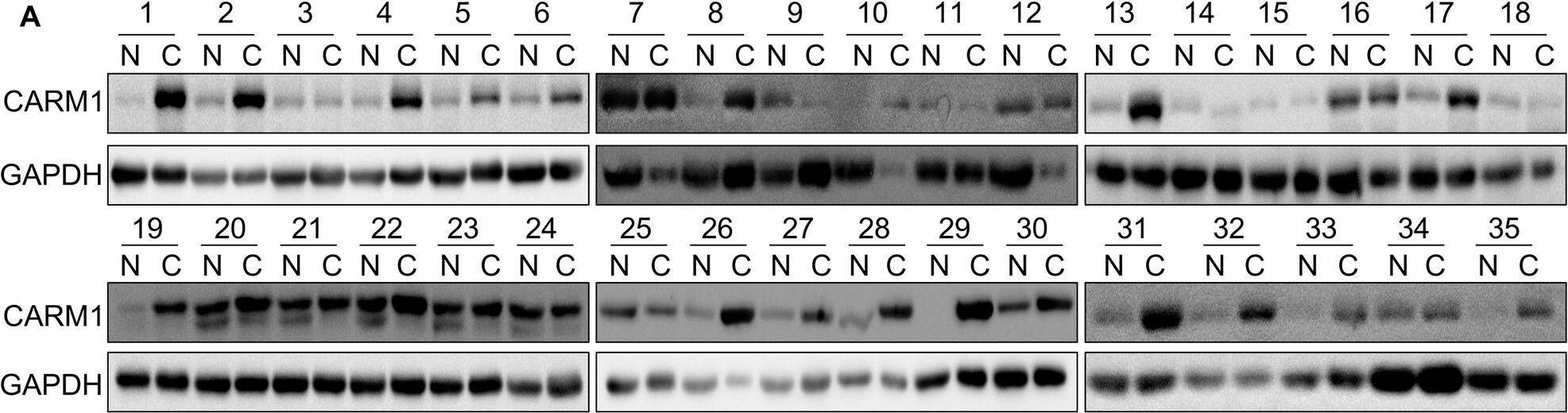
Western Blot: Carm1 Antibody - BSA Free [NB200-342] -
CARM1 is upregulated in HCC tissues and indicates poor clinical outcomes.A Western blotting analysis showed the expression of CARM1 in 35 pairs of HCC and adjacent normal liver tissues. B The expression of CARM1 in 66 pairs of HCC and corresponding adjacent normal liver tissues was examined via an IHC assay. C Kaplan-Meier survival analysis of overall survival in HCC patients stratified by CARM1 expression. Patients with low expression (n = 19) had lower expression values in HCC tissues than in normal tissues, while patients with high expression (n = 47) had higher expression values in HCC tissues than in normal tissues. D CARM1 mRNA levels in normal and primary HCC tumor tissues from the TCGA database. E Kaplan-Meier survival analysis of HCC patients from the TCGA database was performed according to CARM1 mRNA expression. Patients with high CARM1 expression had expression values in the >3rd quantile, while patients with low CARM1 expression had expression values in the <3rd quartile. Image collected and cropped by CiteAb from the following open publication (https://pubmed.ncbi.nlm.nih.gov/40016178), licensed under a CC-BY license. Not internally tested by Novus Biologicals.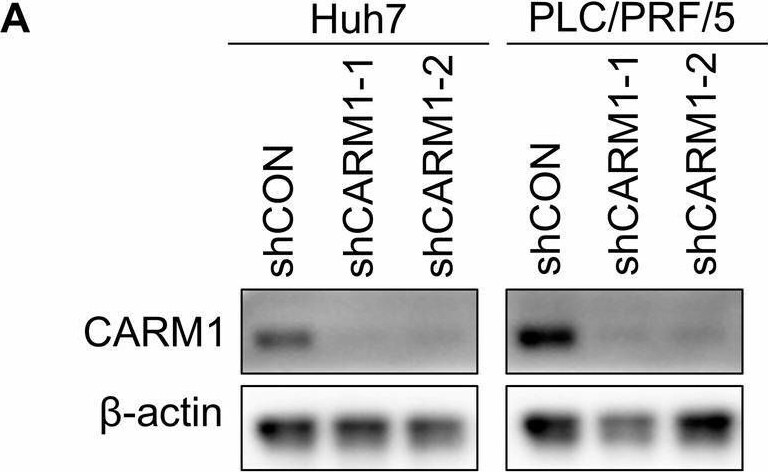
Western Blot: Carm1 Antibody - BSA Free [NB200-342] -
CARM1 promotes the proliferation of HCC cells.A Western blotting analysis showed the knockdown efficacy of CARM1 in Huh7 and PLC/PRF/5 cells infected with lentiviral particles expressing shRNAs targeting CARM1. B Proliferation of control and CARM1-knockdown Huh7 cells was detected by CCK-8 assays on the indicated days. C Colony formation assays were performed to detect the proliferation of control and CARM1-knockdown HCC cells. The data are presented in a bar chart. D Control or CARM1-knockdown Huh7 cells were subcutaneously injected into nude mice for observation of tumor growth. E The tumor volume was measured every three days and is presented as a line graph. F The tumor weights of the xenografts from the different groups were calculated. G Immunohistochemical analysis of mouse subcutaneous tumors was performed with anti-CARM1 and anti-Ki-67 antibodies. (n = 3; *p < 0.05, **p < 0.01, and ***p < 0.001). Image collected and cropped by CiteAb from the following open publication (https://pubmed.ncbi.nlm.nih.gov/40016178), licensed under a CC-BY license. Not internally tested by Novus Biologicals.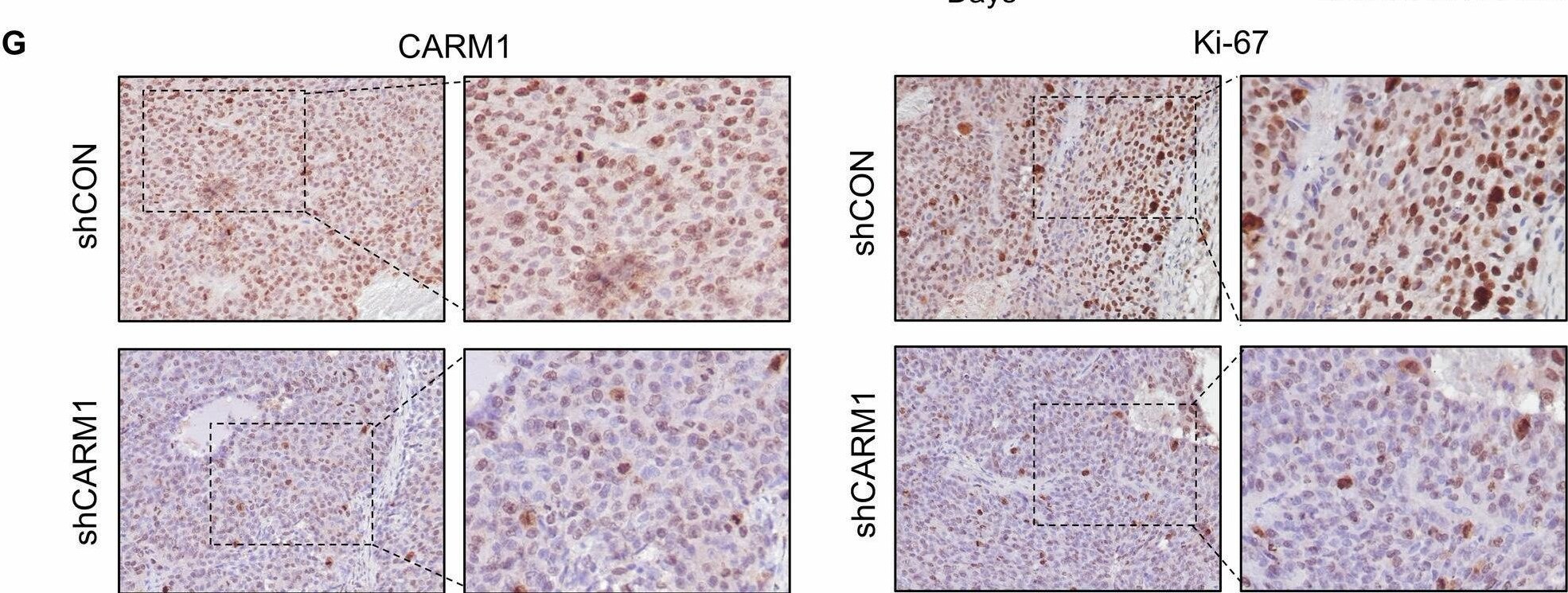
Immunohistochemistry: Carm1 Antibody - BSA Free [NB200-342] -
CARM1 promotes the proliferation of HCC cells.A Western blotting analysis showed the knockdown efficacy of CARM1 in Huh7 and PLC/PRF/5 cells infected with lentiviral particles expressing shRNAs targeting CARM1. B Proliferation of control and CARM1-knockdown Huh7 cells was detected by CCK-8 assays on the indicated days. C Colony formation assays were performed to detect the proliferation of control and CARM1-knockdown HCC cells. The data are presented in a bar chart. D Control or CARM1-knockdown Huh7 cells were subcutaneously injected into nude mice for observation of tumor growth. E The tumor volume was measured every three days and is presented as a line graph. F The tumor weights of the xenografts from the different groups were calculated. G Immunohistochemical analysis of mouse subcutaneous tumors was performed with anti-CARM1 and anti-Ki-67 antibodies. (n = 3; *p < 0.05, **p < 0.01, and ***p < 0.001). Image collected and cropped by CiteAb from the following open publication (https://pubmed.ncbi.nlm.nih.gov/40016178), licensed under a CC-BY license. Not internally tested by Novus Biologicals.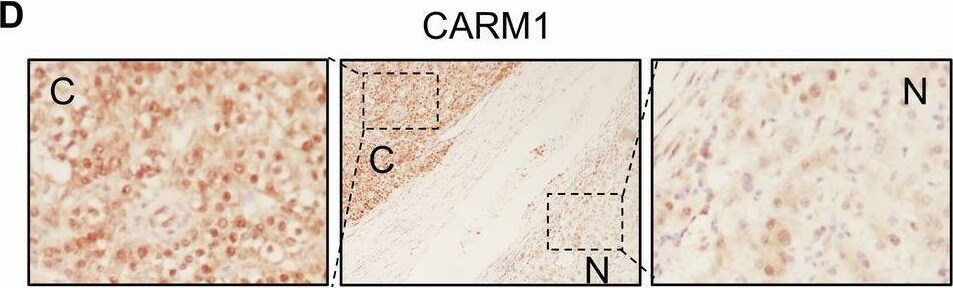
Immunohistochemistry: Carm1 Antibody - BSA Free [NB200-342] -
CARM1 is a downstream effector of PSMD14 that affects the prognosis of HCC patients.A CARM1 was transfected into HCC cells with PSMD14 knockdown. A CCK-8 assay was performed to detect proliferation. B CARM1 was transfected into HCC cells with PSMD14 knockdown. Then, a colony formation assay was conducted. C CARM1 was transfected into HCC cells with PSMD14 knockdown. Then, a transwell assay was performed to detect migration and invasion. Representative images of the transwell assay are shown. The cells in five randomly selected fields were counted under a microscope. D Representative images of immunohistochemical staining of PSMD14 and CARM1 in the same HCC and corresponding adjacent normal liver tissues are shown. E Correlation analysis of PSMD14 and CARM1 in HCC tissues. The data were statistically analyzed by the Chi-square test. R indicates the Pearson correlation coefficient. F Scatter diagram showing a positive correlation between PSMD14 and CARM1 in HCC tissues by IHC. G Survival analysis of HCC patients was conducted using Kaplan-Meier plots and log-rank tests. The patients were categorized into high and low PSMD14 and CARM1 expression groups based on IHC staining. (n = 3; *p < 0.05, **p < 0.01, and ***p < 0.001). Image collected and cropped by CiteAb from the following open publication (https://pubmed.ncbi.nlm.nih.gov/40016178), licensed under a CC-BY license. Not internally tested by Novus Biologicals.Applications for Carm1 Antibody - BSA Free
Immunohistochemistry
Immunohistochemistry-Paraffin
Immunoprecipitation
Knockdown Validated
Western Blot
Formulation, Preparation, and Storage
Purification
Formulation
Format
Preservative
Concentration
Shipping
Stability & Storage
Background: Carm1
Long Name
Alternate Names
Entrez Gene IDs
Gene Symbol
UniProt
Additional Carm1 Products
Product Documents for Carm1 Antibody - BSA Free
Certificate of Analysis
To download a Certificate of Analysis, please enter a lot or batch number in the search box below.
Product Specific Notices for Carm1 Antibody - BSA Free
This product is for research use only and is not approved for use in humans or in clinical diagnosis. Primary Antibodies are guaranteed for 1 year from date of receipt.
Related Research Areas
Citations for Carm1 Antibody - BSA Free
 Powered by Bioz
Customer Reviews for Carm1 Antibody - BSA Free
There are currently no reviews for this product. Be the first to review Carm1 Antibody - BSA Free and earn rewards!
Have you used Carm1 Antibody - BSA Free?
Submit a review and receive an Amazon gift card!
$25/€18/£15/$25CAN/¥2500 for a review with an image
$10/€7/£6/$10CAN/¥1110 for a review without an image
Submit a review
Protocols
Find general support by application which include: protocols, troubleshooting, illustrated assays, videos and webinars.
- Antigen Retrieval Protocol (PIER)
- Antigen Retrieval for Frozen Sections Protocol
- Appropriate Fixation of IHC/ICC Samples
- Cellular Response to Hypoxia Protocols
- Chromogenic IHC Staining of Formalin-Fixed Paraffin-Embedded (FFPE) Tissue Protocol
- Chromogenic Immunohistochemistry Staining of Frozen Tissue
- ClariTSA™ Fluorophore Kits
- Detection & Visualization of Antibody Binding
- Fluorescent IHC Staining of Frozen Tissue Protocol
- Graphic Protocol for Heat-induced Epitope Retrieval
- Graphic Protocol for the Preparation and Fluorescent IHC Staining of Frozen Tissue Sections
- Graphic Protocol for the Preparation and Fluorescent IHC Staining of Paraffin-embedded Tissue Sections
- Graphic Protocol for the Preparation of Gelatin-coated Slides for Histological Tissue Sections
- IHC Sample Preparation (Frozen sections vs Paraffin)
- Immunofluorescent IHC Staining of Formalin-Fixed Paraffin-Embedded (FFPE) Tissue Protocol
- Immunohistochemistry (IHC) and Immunocytochemistry (ICC) Protocols
- Immunohistochemistry Frozen Troubleshooting
- Immunohistochemistry Paraffin Troubleshooting
- Immunoprecipitation Protocol
- Preparing Samples for IHC/ICC Experiments
- Preventing Non-Specific Staining (Non-Specific Binding)
- Primary Antibody Selection & Optimization
- Protocol for Heat-Induced Epitope Retrieval (HIER)
- Protocol for Making a 4% Formaldehyde Solution in PBS
- Protocol for VisUCyte™ HRP Polymer Detection Reagent
- Protocol for the Preparation & Fixation of Cells on Coverslips
- Protocol for the Preparation and Chromogenic IHC Staining of Frozen Tissue Sections
- Protocol for the Preparation and Chromogenic IHC Staining of Frozen Tissue Sections - Graphic
- Protocol for the Preparation and Chromogenic IHC Staining of Paraffin-embedded Tissue Sections
- Protocol for the Preparation and Chromogenic IHC Staining of Paraffin-embedded Tissue Sections - Graphic
- Protocol for the Preparation and Fluorescent IHC Staining of Frozen Tissue Sections
- Protocol for the Preparation and Fluorescent IHC Staining of Paraffin-embedded Tissue Sections
- Protocol for the Preparation of Gelatin-coated Slides for Histological Tissue Sections
- R&D Systems Quality Control Western Blot Protocol
- TUNEL and Active Caspase-3 Detection by IHC/ICC Protocol
- The Importance of IHC/ICC Controls
- Troubleshooting Guide: Immunohistochemistry
- Troubleshooting Guide: Western Blot Figures
- Western Blot Conditions
- Western Blot Protocol
- Western Blot Protocol for Cell Lysates
- Western Blot Troubleshooting
- Western Blot Troubleshooting Guide
- View all Protocols, Troubleshooting, Illustrated assays and Webinars