
Caspase-1 Antibody - BSA Free
Novus Biologicals | Catalog # NB100-56564

![Knockout Validated: Caspase-1 Antibody [NB100-56564]](https://resources.rndsystems.com/images/products/Caspase-1-Antibody-Knockout-Validated-NB100-56564-img0006.jpg "Western Blot: Caspase-1 Antibody [NB100-56564]")
Scientific images may be resized, cropped, or adjusted for brightness or contrast for presentation purposes. These updates are limited to presentation and do not affect the underlying scientific interpretation of the data. Where available, additional source data may be provided upon request.
Loading...
Key Product Details
Validated by
Knockout/Knockdown
Species Reactivity
Validated:
Human, Mouse
Cited:
Mouse, Rat
Predicted:
Rat (90%). Backed by our 100% Guarantee.
Applications
Validated:
Knockout Validated, Immunohistochemistry, Immunohistochemistry-Paraffin, Western Blot
Cited:
Western Blot
Label
Unconjugated
Antibody Source
Polyclonal Rabbit IgG
Format
BSA Free
Loading...
Product Specifications
Immunogen
Caspase-1 Antibody was developed against a synthetic peptide made to an internal portion of the human Caspase-1 protein (between amino acids 15-60) [UniProt P29466].
Reactivity Notes
Porcine (85%), Rabbit (85%) and Canine (70%).
Specificity
Caspase-1 Antibody recognizes full-length Caspase-1.
Clonality
Polyclonal
Host
Rabbit
Isotype
IgG
Theoretical MW
45.2 kDa.
Disclaimer note: The observed molecular weight of the protein may vary from the listed predicted molecular weight due to post translational modifications, post translation cleavages, relative charges, and other experimental factors.
Disclaimer note: The observed molecular weight of the protein may vary from the listed predicted molecular weight due to post translational modifications, post translation cleavages, relative charges, and other experimental factors.
Scientific Data Images for Caspase-1 Antibody - BSA Free
Western Blot: Caspase-1 Antibody [NB100-56564]
Western Blot: Caspase-1 Antibody [NB100-56564] - Human epidermoid carcinoma parental cell line and Caspase-1 knockout (KO) A431 cell line. PVDF membrane was probed with 0.5 ug/ml of Mouse Anti-Human Caspase-1 Monoclonal Antibody (Catalog # NB100-56564) followed by HRP-conjugated Anti-Mouse IgG Secondary Antibody (Catalog #HAF018). Specific band was detected for Caspase-1 at approximately 50 kDa (as indicated) in the parental A431 cell line, but is not detectable in the knockout A431 cell line. This experiment was conducted under reducing conditions.![Western Blot: Caspase-1 Antibody [NB100-56564]](https://resources.rndsystems.com/images/products/Caspase-1-Antibody-Western-Blot-NB100-56564-img0005.jpg "Western Blot: Caspase-1 Antibody [NB100-56564]")
Western Blot: Caspase-1 Antibody [NB100-56564]
Western Blot: Caspase-1 Antibody [NB100-56564] - Analysis of Caspase-1 using a polyclonal antibody. Human HeLa lysate probed with Caspase-1 antibody at 0.5 ug/ml.![Immunohistochemistry-Paraffin: Caspase-1 Antibody [NB100-56564]](https://resources.rndsystems.com/images/products/Caspase-1-Antibody-Immunohistochemistry-Paraffin-NB100-56564-img0004.jpg "Immunohistochemistry-Paraffin: Caspase-1 Antibody [NB100-56564]")
Immunohistochemistry-Paraffin: Caspase-1 Antibody [NB100-56564]
Immunohistochemistry-Paraffin: Caspase-1 Antibody [NB100-56564] - Human reactive lymph node stained for Caspase-1 expression (NB100-56564) using a DAB chromogen and Hematoxylin counterstain. B is a higher magnification of A. Staining in macrophages is observed.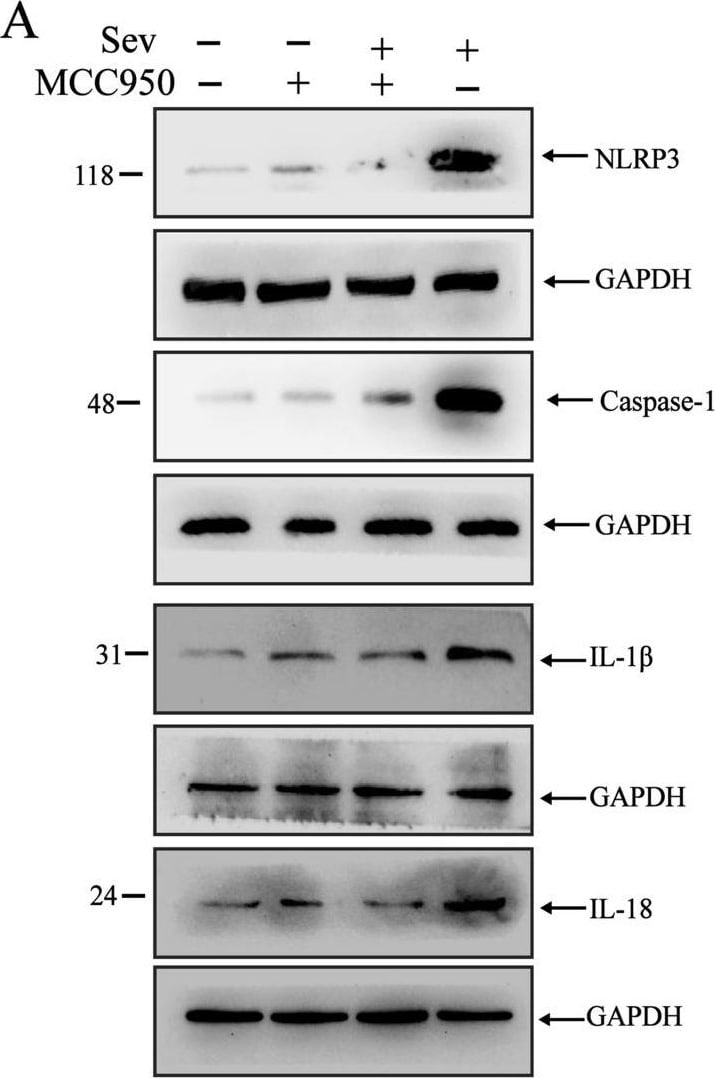
Western Blot: Caspase-1 Antibody - BSA Free [NB100-56564] -
Sevoflurane can increase the protein expression of NLRP3 inflammasome and its downstream inflammatory factors in prefrontal cortex. A–E Expression levels of NLRP3 inflammatory factors, related components, and downstream cytokine proteins. Western blot images were cropped to remove irrelevant sections of the image and display only the proteins of interest. Loading control: protein extracted from prefrontal cortex tissue from sham subjects treated with saline (lane1). Tissue used for Western blot analysis was collected 24-h after the last drug-administration. F–I NLRP3 inflammatory factors, related components, and downstream cytokine PCR results. Data are expressed as mean +/- SD; n = 4 for each experimental group. ***Compared with the Ctrl group, ###compared with the Sev group. P < 0.05 indicated a statistically significant difference Image collected and cropped by CiteAb from the following open publication (https://pubmed.ncbi.nlm.nih.gov/36709248), licensed under a CC-BY license. Not internally tested by Novus Biologicals.Applications for Caspase-1 Antibody - BSA Free
Application
Recommended Usage
Immunohistochemistry
1:10-1:500
Immunohistochemistry-Paraffin
1:10-1:500
Western Blot
0.5-2 ug/ml
Formulation, Preparation, and Storage
Purification
Protein G purified
Formulation
PBS
Format
BSA Free
Preservative
0.05% Sodium Azide
Concentration
1.0 mg/ml
Shipping
The product is shipped with polar packs. Upon receipt, store it immediately at the temperature recommended below.
Stability & Storage
Store at 4C short term. Aliquot and store at -20C long term. Avoid freeze-thaw cycles.
Background: Caspase-1
Given the role of IL-1beta in inflammation, it makes sense that many diseases and pathologies have been associated with dysregulation of caspase-1 activation and the inflammasome (3, 4). The inflammasome is a multiprotein complex comprised of Nod-like receptor (NLR) family members and the adapter ASC (apoptosis-associated speck-like protein containing a CARD) which are crucial for capase-1 activation (3-5). For instance, the neuronal apoptosis inhibitory protein (NAIP)/NLRC4 inflammasome has been associated with colorectal cancer, breast cancer, and glioma pathogenesis (5). Caspase-1 activation and mutations in the inflammasome have also been linked to Chron's disease and Alzheimer's disease (4). In addition to immune and inflammatory related disorder, the inflammasome has been linked to metabolic and obesity related disorders including diabetes and cardiovascular disease (6). Finally, caspase-1 deficient mice exhibit enhanced epithelial cell proliferation in the colon, increased tumor formation, and reduced apoptosis (1). A more thorough understanding of the inflammasome-caspase-1 signaling pathway will be important for understanding disease pathology and potential therapeutic development.
Alternative names for caspase-1 includes CASP1, CASP1 nirs variant 1, EC 3.4.22.36, ICE, IL-1 beta-converting enzyme, IL1BC, IL1BCE, IL1B-converstase, interleukin-1 beta convertase, and p45.
References
1. Shalini, S., Dorstyn, L., Dawar, S., & Kumar, S. (2015). Old, new and emerging functions of caspases. Cell death and differentiation. https://doi.org/10.1038/cdd.2014.216
2. Chang, H. Y., & Yang, X. (2000). Proteases for cell suicide: functions and regulation of caspases. Microbiology and molecular biology reviews: MMBR. https://doi.org/10.1128/mmbr.64.4.821-846.2000
3. Vanaja, S. K., Rathinam, V. A., & Fitzgerald, K. A. (2015). Mechanisms of inflammasome activation: recent advances and novel insights. Trends in cell biology. https://doi.org/10.1016/j.tcb.2014.12.009
4. Franchi, L., Eigenbrod, T., Munoz-Planillo, R., & Nunez, G. (2009). The inflammasome: a caspase-1-activation platform that regulates immune responses and disease pathogenesis. Nature immunology. https://doi.org/10.1038/ni.1703
5. Kay, C., Wang, R., Kirkby, M., & Man, S. M. (2020). Molecular mechanisms activating the NAIP-NLRC4 inflammasome: Implications in infectious disease, autoinflammation, and cancer. Immunological reviews. https://doi.org/10.1111/imr.12906
6. Pham, D., Park, P. (2020). Recent insights on modulation of inflammasomes by adipokines: a critical event for the pathogenesis of obesity and metabolism-associated diseases. Archives of Pharmacal Research. https://doi.org/10.1007/s12272-020-01274-7
Additional Caspase-1 Products
Product Documents for Caspase-1 Antibody - BSA Free
Certificate of Analysis
To download a Certificate of Analysis, please enter a lot or batch number in the search box below.
Product Specific Notices for Caspase-1 Antibody - BSA Free
This product is for research use only and is not approved for use in humans or in clinical diagnosis. Primary Antibodies are guaranteed for 1 year from date of receipt.
Related Research Areas
Citations for Caspase-1 Antibody - BSA Free
 Powered by Bioz
Customer Reviews for Caspase-1 Antibody - BSA Free
There are currently no reviews for this product. Be the first to review Caspase-1 Antibody - BSA Free and earn rewards!
Have you used Caspase-1 Antibody - BSA Free?
Submit a review and receive an Amazon gift card!
$25/€18/£15/$25CAN/¥2500 for a review with an image
$10/€7/£6/$10CAN/¥1110 for a review without an image
Submit a review
Protocols
Find general support by application which include: protocols, troubleshooting, illustrated assays, videos and webinars.
- Antigen Retrieval Protocol (PIER)
- Antigen Retrieval for Frozen Sections Protocol
- Appropriate Fixation of IHC/ICC Samples
- Cellular Response to Hypoxia Protocols
- Chromogenic IHC Staining of Formalin-Fixed Paraffin-Embedded (FFPE) Tissue Protocol
- Chromogenic Immunohistochemistry Staining of Frozen Tissue
- ClariTSA™ Fluorophore Kits
- Detection & Visualization of Antibody Binding
- Fluorescent IHC Staining of Frozen Tissue Protocol
- Graphic Protocol for Heat-induced Epitope Retrieval
- Graphic Protocol for the Preparation and Fluorescent IHC Staining of Frozen Tissue Sections
- Graphic Protocol for the Preparation and Fluorescent IHC Staining of Paraffin-embedded Tissue Sections
- Graphic Protocol for the Preparation of Gelatin-coated Slides for Histological Tissue Sections
- IHC Sample Preparation (Frozen sections vs Paraffin)
- Immunofluorescent IHC Staining of Formalin-Fixed Paraffin-Embedded (FFPE) Tissue Protocol
- Immunohistochemistry (IHC) and Immunocytochemistry (ICC) Protocols
- Immunohistochemistry Frozen Troubleshooting
- Immunohistochemistry Paraffin Troubleshooting
- Preparing Samples for IHC/ICC Experiments
- Preventing Non-Specific Staining (Non-Specific Binding)
- Primary Antibody Selection & Optimization
- Protocol for Heat-Induced Epitope Retrieval (HIER)
- Protocol for Making a 4% Formaldehyde Solution in PBS
- Protocol for VisUCyte™ HRP Polymer Detection Reagent
- Protocol for the Preparation & Fixation of Cells on Coverslips
- Protocol for the Preparation and Chromogenic IHC Staining of Frozen Tissue Sections
- Protocol for the Preparation and Chromogenic IHC Staining of Frozen Tissue Sections - Graphic
- Protocol for the Preparation and Chromogenic IHC Staining of Paraffin-embedded Tissue Sections
- Protocol for the Preparation and Chromogenic IHC Staining of Paraffin-embedded Tissue Sections - Graphic
- Protocol for the Preparation and Fluorescent IHC Staining of Frozen Tissue Sections
- Protocol for the Preparation and Fluorescent IHC Staining of Paraffin-embedded Tissue Sections
- Protocol for the Preparation of Gelatin-coated Slides for Histological Tissue Sections
- R&D Systems Quality Control Western Blot Protocol
- TUNEL and Active Caspase-3 Detection by IHC/ICC Protocol
- The Importance of IHC/ICC Controls
- Troubleshooting Guide: Immunohistochemistry
- Troubleshooting Guide: Western Blot Figures
- Western Blot Conditions
- Western Blot Protocol
- Western Blot Protocol for Cell Lysates
- Western Blot Troubleshooting
- Western Blot Troubleshooting Guide
- View all Protocols, Troubleshooting, Illustrated assays and Webinars
FAQs for Caspase-1 Antibody - BSA Free
Showing
1
-
2 of
2 FAQs
Showing All
-
Q: We are interested in your item, NB100-56564 (IMG-5025) and would like to confirm if it only recognizes subunit p10 and do not cross react to p20?
A: Our Caspase 1 antibody with catalogue number NB100-56564 (IMG-5025) was raised against a synthetic peptide corresponding to amino acids 371-390 of the human protein. According to the Uniprot listing these amino acids lie within the p10 subunit. The antibody recognises full-length Caspase-1, as well as cleaved Caspase-1 forms that include amino acids 31-45. Amino acids 31-45 lie within the propeptide. Unfortunately we have no testing data where we have used this antibody to probe the isolated p20 subunit. Based on the immunogen sequence it seems unlikely that the antibody would recognise p20, but I unfortunately do not have 100% certainty on this at the present time.
-
Q: We are interested in your items, NB100-56565 and NB100-56564 and I would like to use them for recognizing the cleaved form of Caspase-1. Would you please let me know if NB100-56565 and NB100-56564 recognize the Caspase-1 p10 or p20? If so, could you please provide me any supporting data of them?
A:
For NB100-56565 & NB100-56564 it will recognize the full length form and the p10 as the immunogen. A synthetic peptide corresponding to amino acids 371-390 RKVRFSFEQPDGRAQMPTTE of human caspase-1 was used as immunogen. The p10 subunit is aa 307-404. If you need an antibody to the p20 subunit, I would recommend NBP1-45433. This will bind to the the region around aa 132. The p20 subunit is aa 120-297.
-
Q: We are interested in your item, NB100-56564 (IMG-5025) and would like to confirm if it only recognizes subunit p10 and do not cross react to p20?
A: Our Caspase 1 antibody with catalogue number NB100-56564 (IMG-5025) was raised against a synthetic peptide corresponding to amino acids 371-390 of the human protein. According to the Uniprot listing these amino acids lie within the p10 subunit. The antibody recognises full-length Caspase-1, as well as cleaved Caspase-1 forms that include amino acids 31-45. Amino acids 31-45 lie within the propeptide. Unfortunately we have no testing data where we have used this antibody to probe the isolated p20 subunit. Based on the immunogen sequence it seems unlikely that the antibody would recognise p20, but I unfortunately do not have 100% certainty on this at the present time.
-
Q: We are interested in your items, NB100-56565 and NB100-56564 and I would like to use them for recognizing the cleaved form of Caspase-1. Would you please let me know if NB100-56565 and NB100-56564 recognize the Caspase-1 p10 or p20? If so, could you please provide me any supporting data of them?
A:
For NB100-56565 & NB100-56564 it will recognize the full length form and the p10 as the immunogen. A synthetic peptide corresponding to amino acids 371-390 RKVRFSFEQPDGRAQMPTTE of human caspase-1 was used as immunogen. The p10 subunit is aa 307-404. If you need an antibody to the p20 subunit, I would recommend NBP1-45433. This will bind to the the region around aa 132. The p20 subunit is aa 120-297.
Loading...
Associated Pathways

