
CD160 Antibody - BSA Free
Novus Biologicals | Catalog # NBP2-41234

![Western Blot: CD160 AntibodyBSA Free [NBP2-41234]](https://resources.rndsystems.com/images/products/CD160-Antibody-Western-Blot-NBP2-41234-img0001.jpg "Western Blot: CD160 AntibodyBSA Free [NBP2-41234]")
Scientific images may be resized, cropped, or adjusted for brightness or contrast for presentation purposes. These updates are limited to presentation and do not affect the underlying scientific interpretation of the data. Where available, additional source data may be provided upon request.
Key Product Details
Species Reactivity
Human, Mouse
Applications
Western Blot, ELISA, Immunocytochemistry/ Immunofluorescence
Label
Unconjugated
Antibody Source
Polyclonal Rabbit IgG
Format
BSA Free
Loading...
Product Specifications
Immunogen
Antibody was raised against a 17 amino acid peptide near the center of human CD160. The immunogen is located within amino acids 50 - 100 of CD160.
Specificity
Multiple isoforms of CD160 are known to exist.
Clonality
Polyclonal
Host
Rabbit
Isotype
IgG
Theoretical MW
25 kDa.
Disclaimer note: The observed molecular weight of the protein may vary from the listed predicted molecular weight due to post translational modifications, post translation cleavages, relative charges, and other experimental factors.
Disclaimer note: The observed molecular weight of the protein may vary from the listed predicted molecular weight due to post translational modifications, post translation cleavages, relative charges, and other experimental factors.
Scientific Data Images for CD160 Antibody - BSA Free
Western Blot: CD160 AntibodyBSA Free [NBP2-41234]
Western Blot: CD160 Antibody [NBP2-41234] - Western blot analysis of CD160 in K562 cell lysate with CD160 antibody at 1 ug/ml in (A) the absence and (B) the presence of blocking peptide.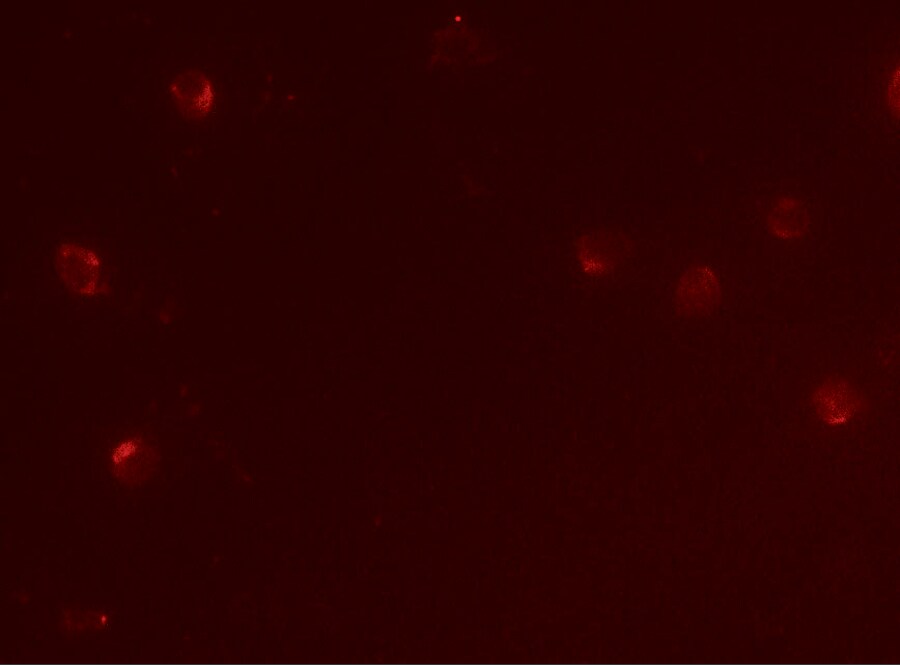
Immunocytochemistry/ Immunofluorescence: CD160 Antibody - BSA Free [NBP2-41234] -
Immunocytochemistry/ Immunofluorescence: CD160 Antibody - BSA Free [NBP2-41234] - Immunofluorescence of CD160 in Jurkat cells tissue with CD160 antibody at 5 ug/mL.Applications for CD160 Antibody - BSA Free
Application
Recommended Usage
Western Blot
1 - 2 ug/ml
Formulation, Preparation, and Storage
Purification
Peptide affinity purified
Formulation
PBS
Format
BSA Free
Preservative
0.02% Sodium Azide
Concentration
1 mg/ml
Shipping
The product is shipped with polar packs. Upon receipt, store it immediately at the temperature recommended below.
Stability & Storage
Store at 4C short term. Aliquot and store at -20C long term. Avoid freeze-thaw cycles.
Background: CD160
Identified ligands for CD160 include MHC class I proteins and herpes virus entry mediators (HVEM), each of which has a different effect on NK or T cells (1,3-5). CD160 binds to MHC class I proteins with weaker affinity, but the interaction causes NK cell cytotoxic function and cytokine production (1,3). CD160 engagement of MHC class I proteins and/or HVEM within NK cells promotes ERK1/2 and AKT activation and production of interferon gamma (IFNgamma) (5). Conversely, CD160 binding of HVEM in CD4+ T cells induces inhibitory signaling, signifying both a stimulatory and inhibitory role for CD160 as well as cell-specific context (4,5). Additionally, CD160 plays a role in diseases including certain types of cancer, such as thyroid cancer and colon cancer, viral infections, and autoimmune diseases (3,5). CD160 expression levels on CD8+ T cells have been shown to be elevated in chronic viral infections such as human immunodeficiency virus (HIV) and Epstein Barr virus (EBV) (3). In addition, when CD160 is co-expressed with the programmed cell death protein 1 (PD-1) receptor, T cell exhaustion occurs due to persistent stimulation, leading to inhibited immune response and ability to combat infection (3). CD160 may be a promising therapeutic target in cancer as murine studies have demonstrated that blocking the CD160-HVEM pathway causes a regression of neoplastic tumors in a thyroid cancer model (3-5).
References
1. Le Bouteiller P, Tabiasco J, Polgar B, et al. CD160: a unique activating NK cell receptor. Immunol Lett. 2011;138(2):93-96. https://doi.org/10.1016/j.imlet.2011.02.003
2. Uniprotkb (O95971)
3. Piotrowska M, Spodzieja M, Kuncewicz K, Rodziewicz-Motowidlo S, Orlikowska M. CD160 protein as a new therapeutic target in a battle against autoimmune, infectious and lifestyle diseases. Analysis of the structure, interactions and functions. Eur J Med Chem. 2021;224:113694. https://doi.org/10.1016/j.ejmech.2021.113694
4. Cai G, Freeman GJ. The CD160, BTLA, LIGHT/HVEM pathway: a bidirectional switch regulating T-cell activation. Immunol Rev. 2009;229(1):244-258. https://doi.org/10.1111/j.1600-065X.2009.00783.x
5. Sedy JR, Ramezani-Rad P. HVEM network signaling in cancer. Adv Cancer Res. 2019;142:145-186. https://doi.org/10.1016/bs.acr.2019.01.004
Alternate Names
BY55, CD160, NK1, NK28
Gene Symbol
CD160
Additional CD160 Products
Product Documents for CD160 Antibody - BSA Free
Certificate of Analysis
To download a Certificate of Analysis, please enter a lot or batch number in the search box below.
Product Specific Notices for CD160 Antibody - BSA Free
This product is for research use only and is not approved for use in humans or in clinical diagnosis. Primary Antibodies are guaranteed for 1 year from date of receipt.
Customer Reviews for CD160 Antibody - BSA Free
There are currently no reviews for this product. Be the first to review CD160 Antibody - BSA Free and earn rewards!
Have you used CD160 Antibody - BSA Free?
Submit a review and receive an Amazon gift card!
$25/€18/£15/$25CAN/¥2500 for a review with an image
$10/€7/£6/$10CAN/¥1110 for a review without an image
Submit a review
Protocols
Find general support by application which include: protocols, troubleshooting, illustrated assays, videos and webinars.
- Appropriate Fixation of IHC/ICC Samples
- Cellular Response to Hypoxia Protocols
- ClariTSA™ Fluorophore Kits
- Detection & Visualization of Antibody Binding
- ELISA Sample Preparation & Collection Guide
- ELISA Troubleshooting Guide
- How to Run an R&D Systems DuoSet ELISA
- How to Run an R&D Systems Quantikine ELISA
- How to Run an R&D Systems Quantikine™ QuicKit™ ELISA
- ICC Cell Smear Protocol for Suspension Cells
- ICC Immunocytochemistry Protocol Videos
- ICC for Adherent Cells
- Immunocytochemistry (ICC) Protocol
- Immunocytochemistry Troubleshooting
- Immunofluorescence of Organoids Embedded in Cultrex Basement Membrane Extract
- Immunohistochemistry (IHC) and Immunocytochemistry (ICC) Protocols
- Preparing Samples for IHC/ICC Experiments
- Preventing Non-Specific Staining (Non-Specific Binding)
- Primary Antibody Selection & Optimization
- Protocol for VisUCyte™ HRP Polymer Detection Reagent
- Protocol for the Fluorescent ICC Staining of Cell Smears - Graphic
- Protocol for the Fluorescent ICC Staining of Cultured Cells on Coverslips - Graphic
- Protocol for the Preparation and Fluorescent ICC Staining of Cells on Coverslips
- Protocol for the Preparation and Fluorescent ICC Staining of Non-adherent Cells
- Protocol for the Preparation and Fluorescent ICC Staining of Stem Cells on Coverslips
- Protocol for the Preparation of a Cell Smear for Non-adherent Cell ICC - Graphic
- Quantikine HS ELISA Kit Assay Principle, Alkaline Phosphatase
- Quantikine HS ELISA Kit Principle, Streptavidin-HRP Polymer
- R&D Systems Quality Control Western Blot Protocol
- Sandwich ELISA (Colorimetric) – Biotin/Streptavidin Detection Protocol
- Sandwich ELISA (Colorimetric) – Direct Detection Protocol
- TUNEL and Active Caspase-3 Detection by IHC/ICC Protocol
- The Importance of IHC/ICC Controls
- Troubleshooting Guide: ELISA
- Troubleshooting Guide: Western Blot Figures
- Western Blot Conditions
- Western Blot Protocol
- Western Blot Protocol for Cell Lysates
- Western Blot Troubleshooting
- Western Blot Troubleshooting Guide
- View all Protocols, Troubleshooting, Illustrated assays and Webinars
Loading...
Associated Pathways
