
CD27/TNFRSF7 Antibody (137910) [FITC]
Novus Biologicals | Catalog # FAB574F

Key Product Details
Species Reactivity
Mouse
Applications
Western Blot, Immunocytochemistry
Label
FITC (Excitation = 495 nm, Emission = 519 nm)
Antibody Source
Monoclonal Rat IgG2A Clone # 137910
Loading...
Product Specifications
Immunogen
Mouse myeloma cell line NS0-derived recombinant mouse CD27/TNFRSF7
Thr21-Arg182
Accession # P41272
Thr21-Arg182
Accession # P41272
Specificity
Detects mouse CD27 in direct ELISAs and Western blots. In Western blots, does not cross-react with recombinant human (rh) CD27, rhCD30, rhCD40, rhDR3, rhDR6, rhFas Ligand, rhTRAIL R3, rhTRAIL R4, rhLT beta R, rhNGF-R1, rh4-1BB, rhGITR, rhTNFR1, rhTNF RII, rhBAFF, rhTAJ, rhEDA, rhOPG, rhRELT, rhRANK, recombinant mouse (rm) CD30, rmCD40, rmGITR, rmHVEM, rmRANK, rmFas, rmTRAIL R2, rm4-1BB, rmLT beta R, rmOPG, rmNGFR, rmDR3, rmBAFF R, rmEDAR, rmOX-40, rmTWEAK R, rmTNF R1, recombinant rat Fas, or recombinant feline Fas.
Clonality
Monoclonal
Host
Rat
Isotype
IgG2A
Description
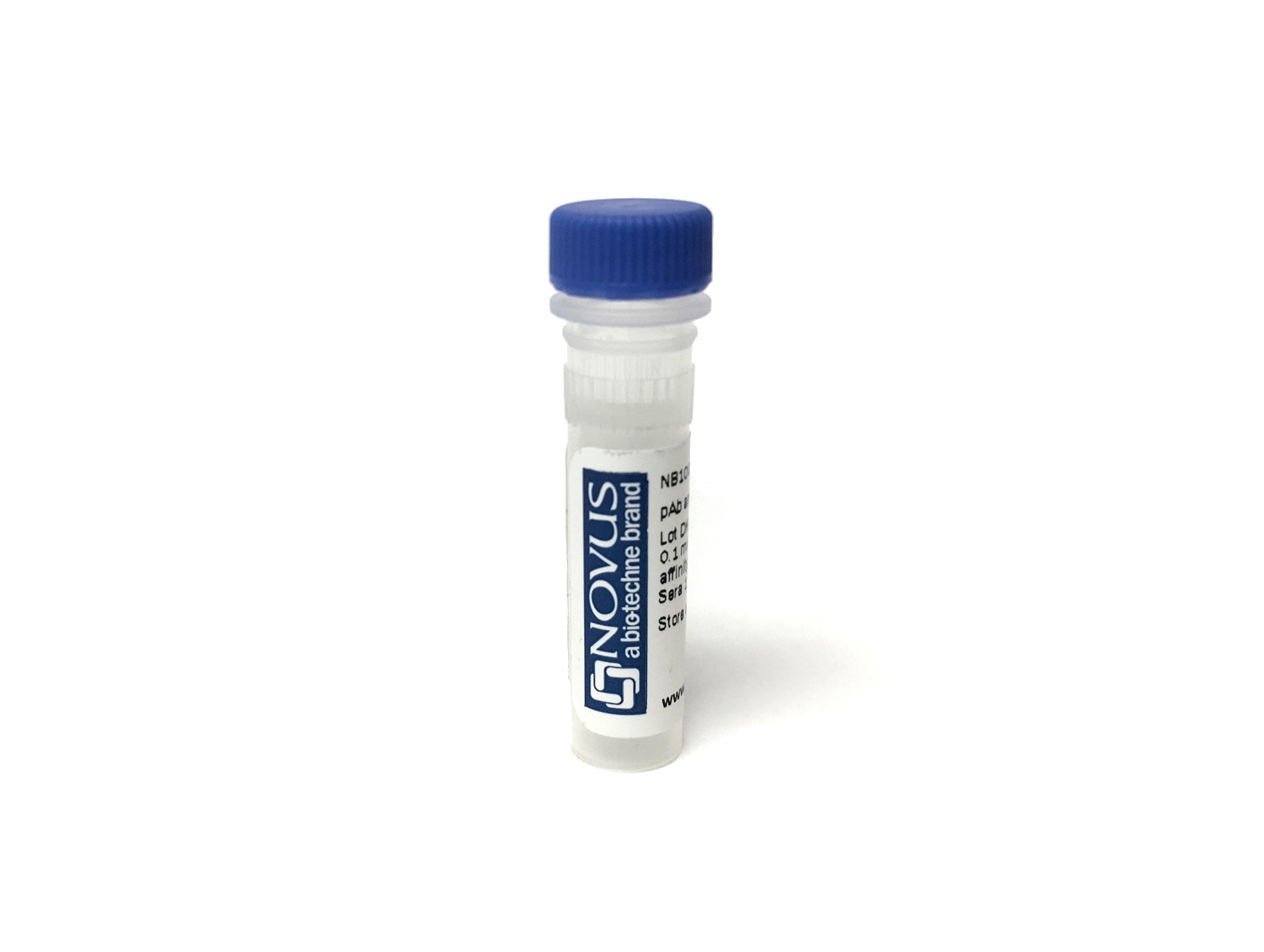
This conjugate is made on demand and is not held in inventory. Each order represents a unique lot. All conjugates are generated using validated conjugation protocols and meet strict degree of labeling (F/P) specifications; additional information is available upon request. The antibody concentration is provided on the individual product label.
For specialized conjugation needs, like large quantities, specific concentrations, and defined F/P ratios, bulk and custom antibody conjugation services are available.
For specialized conjugation needs, like large quantities, specific concentrations, and defined F/P ratios, bulk and custom antibody conjugation services are available.
Applications for CD27/TNFRSF7 Antibody (137910) [FITC]
Application
Recommended Usage
Immunocytochemistry
Optimal dilutions of this antibody should be experimentally determined.
Western Blot
Optimal dilutions of this antibody should be experimentally determined.
Application Notes
Recommended applications are based on validated applications from the unconjugated base product MAB574. This conjugated antibody is not kept in inventory and is made to order using validated conjugation protocols.
Formulation, Preparation, and Storage
Purification
Protein A or G purified from hybridoma culture supernatant
Formulation
PBS
Preservative
0.05% Sodium Azide
Concentration
Please see the vial label for concentration. If unlisted please contact technical services.
Shipping
The product is shipped with polar packs. Upon receipt, store it immediately at the temperature recommended below.
Stability & Storage
Store at 4C in the dark.
Background: CD27/TNFRSF7
Membrane-bound CD27 is expressed as a disulfide-linked homodimer (3). CD27 binds to the ligand CD70, a transmembrane glycoprotein that is transiently expressed on activated immune cells such as antigen presenting cells (APCs), dendritic cells (DCs), NK cells, B cells, and T cells (1,2,6,7). The receptor-ligand binding interaction leads to NFkappaB and c-Jun pathway activation which promotes immune stimulation and activation and survival of CD4+ T cells, CD8+ T cells, memory T cells, and NK cells (2,6,7). Both CD27 and CD70 are often abnormally expressed or dysregulated on malignant and cancer cells leading to immune evasion and tumor progression (7). CD27 has become a target of interest of immunotherapies for viral infections, autoimmune disease, and cancer (2). Varlilumab, an agonistic CD27 monoclonal antibody (mAB), has entered clinical trials for the treatment of hematological and solid tumor cancers (1,6). Additional clinical trials are in process that combine varlilumab with other immune checkpoint inhibitors like the programmed cell death protein-1 (PD-1) blocking mAb nivolumab (1,2). Initial results are promising, suggesting that targeting CD27, especially in combination with other therapeutics, may be a promising and effective immunotherapy for a variety of pathologies (1,2,6).
References
1. Starzer AM, Berghoff AS. New emerging targets in cancer immunotherapy: CD27 (TNFRSF7). ESMO Open. 2020;4(Suppl 3):e000629. https://doi.org/10.1136/esmoopen-2019-000629
2. Grant EJ, Nussing S, Sant S, Clemens EB, Kedzierska K. The role of CD27 in anti-viral T-cell immunity. Curr Opin Virol. 2017;22:77-88. https://doi.org/10.1016/j.coviro.2016.12.001
3. Buchan SL, Rogel A, Al-Shamkhani A. The immunobiology of CD27 and OX40 and their potential as targets for cancer immunotherapy. Blood. 2018;131(1):39-48. https://10.1182/blood-2017-07-741025
4. Uniprot (P26842)
5. Uniprot (P41272)
6. van de Ven K, Borst J. Targeting the T-cell co-stimulatory CD27/CD70 pathway in cancer immunotherapy: rationale and potential. Immunotherapy. 2015;7(6):655-667. https://doi.org/10.2217/imt.15.32
7. Flieswasser T, Van den Eynde A, Van Audenaerde J, et al. The CD70-CD27 axis in oncology: the new kids on the block. J Exp Clin Cancer Res. 2022;41(1):12. https://doi.org/10.1186/s13046-021-02215-y
Alternate Names
CD27, TNFRSF7
Gene Symbol
CD27
Additional CD27/TNFRSF7 Products
Product Documents for CD27/TNFRSF7 Antibody (137910) [FITC]
Certificate of Analysis
To download a Certificate of Analysis, please enter a lot or batch number in the search box below.
Product Specific Notices for CD27/TNFRSF7 Antibody (137910) [FITC]
This product is for research use only and is not approved for use in humans or in clinical diagnosis. Primary Antibodies are guaranteed for 1 year from date of receipt.
Related Research Areas
Customer Reviews for CD27/TNFRSF7 Antibody (137910) [FITC]
There are currently no reviews for this product. Be the first to review CD27/TNFRSF7 Antibody (137910) [FITC] and earn rewards!
Have you used CD27/TNFRSF7 Antibody (137910) [FITC]?
Submit a review and receive an Amazon gift card!
$25/€18/£15/$25CAN/¥2500 for a review with an image
$10/€7/£6/$10CAN/¥1110 for a review without an image
Submit a review
Protocols
Find general support by application which include: protocols, troubleshooting, illustrated assays, videos and webinars.
- Appropriate Fixation of IHC/ICC Samples
- Cellular Response to Hypoxia Protocols
- ClariTSA™ Fluorophore Kits
- Detection & Visualization of Antibody Binding
- ICC Cell Smear Protocol for Suspension Cells
- ICC Immunocytochemistry Protocol Videos
- ICC for Adherent Cells
- Immunocytochemistry (ICC) Protocol
- Immunocytochemistry Troubleshooting
- Immunofluorescence of Organoids Embedded in Cultrex Basement Membrane Extract
- Immunohistochemistry (IHC) and Immunocytochemistry (ICC) Protocols
- Preparing Samples for IHC/ICC Experiments
- Preventing Non-Specific Staining (Non-Specific Binding)
- Primary Antibody Selection & Optimization
- Protocol for VisUCyte™ HRP Polymer Detection Reagent
- Protocol for the Fluorescent ICC Staining of Cell Smears - Graphic
- Protocol for the Fluorescent ICC Staining of Cultured Cells on Coverslips - Graphic
- Protocol for the Preparation and Fluorescent ICC Staining of Cells on Coverslips
- Protocol for the Preparation and Fluorescent ICC Staining of Non-adherent Cells
- Protocol for the Preparation and Fluorescent ICC Staining of Stem Cells on Coverslips
- Protocol for the Preparation of a Cell Smear for Non-adherent Cell ICC - Graphic
- R&D Systems Quality Control Western Blot Protocol
- TUNEL and Active Caspase-3 Detection by IHC/ICC Protocol
- The Importance of IHC/ICC Controls
- Troubleshooting Guide: Western Blot Figures
- Western Blot Conditions
- Western Blot Protocol
- Western Blot Protocol for Cell Lysates
- Western Blot Troubleshooting
- Western Blot Troubleshooting Guide
- View all Protocols, Troubleshooting, Illustrated assays and Webinars
Loading...
Associated Pathways
