
CMP-Azido-Sialic Acid
R&D Systems | Catalog # ES102


Key Product Details
Key Benefits
Species
Conjugate
Product Summary for CMP-Azido-Sialic Acid

|
Formula |
C20H30N7O15P |
|
Molecular Weight |
639.46 Da |
|
Formulation |
1 mM provided in 20 mM Tris, pH 8.0 |
|
Stability & Storage |
Store the unopened product at < -20 °C. Good for 12 months from date of receipt. |
Incorporate or detect sialic acid without expensive specialized equipment!
Applications
- For in vitro enzymatic incorporation of azido-sugars into specific, targeted glycans.
- Detecting the presence or absence of sialated glycans.
- Labeling terminal sialoglycans on proteins and lipids.
Key Features and Benefits
- Can detect terminal sialoglycans without specialized, expensive equipment.
- Can be introduced to proteins and lipids via various sialyltransferases.
- Can be conjugated to desired reporter molecules, such as biotin, via click chemistry.
- Can be detected via Western blot, ELISA, and flow cytometry, depending on the type of reporter molecule.
- Has minimal side effects on target molecules.
- User-friendly.
For Details: Wu et al., (2015) Carbohydrate Res. 412:1-6
Related Reagents
Click Chemistry
Enzymes and Detection Reagents for CMP-Sialic-Acid, ES102
|
Sialyltransferases |
Sialation Link Specificity |
|---|---|
| ST3 beta-Gal alpha-2,3-Sialyltransferase 1/ST3GAL1 | Adds Sialic Acid to Galactose |
| ST3 beta-Gal alpha-2,3-Sialyltransferase 2/ST3GAL2 | Adds Sialic Acid to Galactose |
| ST3GAL5/GM3 Synthase | Adds Sialic Acid to Galactose |
| ST6 Gal Sialyltransferase 1/ST6GAL1 | Adds Sialic Acid to Galactose |
| ST6 Sialyltransferase 2/ST6GALNAC2 | Adds Sialic Acid to GalNAc |
| ST6GALNAC4 | Adds Sialic Acid to GalNAc |
| ST6 GalNAc alpha-2,6-sialyltransferaseV/ST6GALNAC5 | Adds Sialic Acid to GalNAc |
| ST6 Sialyltransferase 6/ST6GALNAC6 | Adds Sialic Acid to GalNAc |
| ST6 Gal Sialyltransferase 2/ST6GAL2 | Adds Sialic Acid to Galactose |
| ST6 Sialyltransferase 1/ST6GALNAC1 | Adds Sialic Acid to GalNAc |
| ST8 alpha-2,8-Sialyltransferase 8A/ST8SIA1 | Adds Sialic Acid to Sialic Acid |
| ST8 alpha-2,8-Sialyltransferase 8B/ST8SIA2 | Adds Sialic Acid to Sialic Acid |
| ST8 alpha-2,8-Sialyltransferase 4/ST8SIA4 | Adds Sialic Acid to Sialic Acid |
Schematic
|
Terminal sialic acid can be detected on O- or N-linked glycans. Sialic acid is removed using a Sialidase. The specificity of Sialyltransferases allows you to add Azido-Sialic Acid to open positions. Azido-Sialic Acid can be detected using Biotinylated Alkyne in a click chemistry reaction. |

Data Examples
|
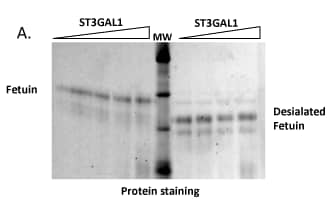
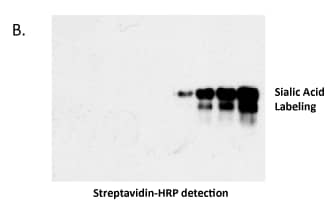
Labeling and detection of sialic acid on O-glycans on Bovine Fetuin. Fetuin (left side of the molecular marker; MW) and Desialylated Fetuin (right side of the molecular marker) were incubated with increasing amount of rhST3GAL1 (5, 25, 50, 250 ng) and 0.5 nmol CMP-Azido-Sialic Acid. Fetuin was treated with rcpNeuraminidase to prepare desialylated Fetuin. The reactions were then conjugated with Biotinylated Alkyne and separated by SDS-PAGE. The separated proteins were then blotted to a nitrocellulose membrane and detected with conventional Streptavidin-HRP chemiluminescence reagents. A. Total protein staining. B. Streptavidin-HRP detection of rhST3GAL1-mediated CMP-Azido-Sialic Acid incorporation. No incorporation of CMP-Azido-Sialic Acid is detected in fully sialted Fetuin. In contrast, strong labeling indicates CMP-Azido-Sialic Acid is incorporated into desialated Fetuin. Data adapted from Wu et al., (2015) Carbohydrate Res. 412:1-6. |
Formulation, Preparation, and Storage
Shipping
Storage
Product Documents for CMP-Azido-Sialic Acid
Certificate of Analysis
To download a Certificate of Analysis, please enter a lot or batch number in the search box below.
Note: Certificate of Analysis not available for kit components.
Product Specific Notices for CMP-Azido-Sialic Acid
For research use only
Related Research Areas
Citations for CMP-Azido-Sialic Acid
 Powered by Bioz
Customer Reviews for CMP-Azido-Sialic Acid
There are currently no reviews for this product. Be the first to review CMP-Azido-Sialic Acid and earn rewards!
Have you used CMP-Azido-Sialic Acid?
Submit a review and receive an Amazon gift card!
$25/€18/£15/$25CAN/¥2500 for a review with an image
$10/€7/£6/$10CAN/¥1110 for a review without an image
Submit a review
Protocols
View specific protocols for CMP-Azido-Sialic Acid (ES102):
Sample Protocol for Labeling and Detecting O-glycan on Fetuin with ST3GAL1
Protocols are guidelines. Parameters need to be optimized by end users.
Materials
- Assay Buffer: 25 mM HEPES, 150 mM NaCl, pH 7.5
- Fetuin (Sigma), 50 mg/mL stock in deionized water
- Recombinant Human ST3GAL1 (R&D Systems, Catalog # 6905-GT)
- Recombinant C. perfringens Neuraminidase (R&D Systems, Catalog # 5080-NM)
- CMP-Azido-Sialic Acid (R&D Systems, Catalog # ES102)
- Biotinylated Alkyne (R&D Systems, Catalog # ES100)
- MnCl2, 100 mM in deionized water
- CuCl2, 1 mM in deionized water
- Ascorbic Acid, 20 mM in deionized water
- SDS-PAGE and Western blot reagents or equivalent
- TBST buffer: 25 mM Tris, 137 mM NaCl, 0.1% Tween-20, pH 7.5
- Streptavidin-HRP (R&D Systems, Catalog # DY998)
Assay Procedure
1. Prepare Desialylated Fetuin by mixing Fetuin with rcpNeuraminidase at mass ratio of 100:1 in the Assay Buffer with the concentration of Fetuin at 1 mg/mL for 20 minutes at room temperature. The rcpNeuraminidase is then heat inactivated at 90°C for 5 minutes.
2. Prepare reaction mixture by combining 5 µg Desialylated Fetuin, 1 µg rhST3GAL1, 0.5 nmol CMP-Azido-Sialic Acid, in the Assay Buffer supplemented with 10 mM MnCl2 with the final volume of 25 µL.
3. Prepare negative controls according to step 2 but omit rhST3GAL1 or CMP-Azido-Sialic Acid.
4. Incubate reactions and controls at 37 °C for 30 minutes.
5. To each of the samples, add 5 µL of 1 mM CuCl2, 5 µL of 20 mM Ascorbic Acid, and 5 µL of 1 mM Biotinylated Alkyne. Mix with gentle tapping. Incubate all samples at room temperature for 1 hour.
6. Separate the reactions and controls by SDS-PAGE.
7. Blot the gel to a nitrocellulose membrane.
8. Block the blot with 10% fat-free milk for 5 minutes.
9. Thoroughly wash the membrane with TBST buffer by changing buffer three times for a total of 45 minutes.
10. Incubate the blot with 25 ng/mL Streptavidin-HRP in 30 mL TBST buffer for 30 minutes.
11. Thoroughly wash the membrane with TBST buffer by changing buffer three times for a total of 45 minutes.
12. Detect Detect with commercial ECL (Enhanced Chemiluminescence) reagents.
Final Assay Conditions Per Reaction
- CMP-Azido-Sialic Acid: 0.5 nmol
- rhST3GAL1: 1 µg
- Desialylated Fetuin: 5 µg
- Reaction volume: 25 µl
Click Chemistry Reaction Conditions Per Reaction
- CuCl2: 5 nmol
- Ascorbic Acid: 100 nmol
- Biotinylated Alkyne: 5 nmol
- Reaction volume: 40 µl