
COPS6 Antibody (OTI4E7)
Novus Biologicals | Catalog # NBP2-46333

Key Product Details
Species Reactivity
Human, Mouse, Rat
Applications
Immunohistochemistry, Immunohistochemistry-Paraffin, Western Blot, Immunocytochemistry/ Immunofluorescence
Label
Unconjugated
Antibody Source
Monoclonal Mouse IgG2A Clone # OTI4E7
Loading...
Product Specifications
Immunogen
Human recombinant protein fragment corresponding to amino acids 58-327 of human COPS6(NP_006824) produced in E.coli.
Reactivity Notes
Please note that this antibody is reactive to Mouse and derived from the same host, Mouse. Mouse-On-Mouse blocking reagent may be needed for IHC and ICC experiments to reduce high background signal. You can find these reagents under catalog numbers PK-2200-NB and MP-2400-NB. Please contact Technical Support if you have any questions.
Clonality
Monoclonal
Host
Mouse
Isotype
IgG2A
Theoretical MW
36 kDa.
Disclaimer note: The observed molecular weight of the protein may vary from the listed predicted molecular weight due to post translational modifications, post translation cleavages, relative charges, and other experimental factors.
Disclaimer note: The observed molecular weight of the protein may vary from the listed predicted molecular weight due to post translational modifications, post translation cleavages, relative charges, and other experimental factors.
Scientific Data Images for COPS6 Antibody (OTI4E7)
![Western Blot: COPS6 Antibody (OTI4E7) [NBP2-46333]](https://resources.rndsystems.com/images/products/COPS6-Antibody-OTI4E7-Western-Blot-NBP2-46333-img0004.jpg "Western Blot: COPS6 Antibody (OTI4E7) [NBP2-46333]")
Western Blot: COPS6 Antibody (OTI4E7) [NBP2-46333]
Western Blot: COPS6 Antibody (OTI4E7) [NBP2-46333] - Analysis of HEK293T cells were transfected with the pCMV6-ENTRY control (Left lane) or pCMV6-ENTRY COPS6.![Immunocytochemistry/ Immunofluorescence: COPS6 Antibody (OTI4E7) [NBP2-46333]](https://resources.rndsystems.com/images/products/COPS6-Antibody-OTI4E7-Immunofluorescence-NBP2-46333-img0001.jpg "Immunocytochemistry/ Immunofluorescence: COPS6 Antibody (OTI4E7) [NBP2-46333]")
Immunocytochemistry/ Immunofluorescence: COPS6 Antibody (OTI4E7) [NBP2-46333]
Immunocytochemistry/Immunofluorescence: COPS6 Antibody (OTI4E7) [NBP2-46333] - Analysis of COS7 cells transiently transfected by pCMV6-ENTRY COPS6.![Immunohistochemistry: COPS6 Antibody (OTI4E7) [NBP2-46333]](https://resources.rndsystems.com/images/products/COPS6-Antibody-OTI4E7-Immunohistochemistry-NBP2-46333-img0003.jpg "Immunohistochemistry: COPS6 Antibody (OTI4E7) [NBP2-46333]")
Immunohistochemistry: COPS6 Antibody (OTI4E7) [NBP2-46333]
Immunohistochemistry: COPS6 Antibody (OTI4E7) [NBP2-46333] - Analysis of Human Kidney tissue. (Heat-induced epitope retrieval by 10mM citric buffer, pH6.0, 120C for 3min)![Immunohistochemistry: COPS6 Antibody (OTI4E7) [NBP2-46333]](https://resources.rndsystems.com/images/products/COPS6-Antibody-OTI4E7-Immunohistochemistry-NBP2-46333-img0002.jpg "Immunohistochemistry: COPS6 Antibody (OTI4E7) [NBP2-46333]")
Immunohistochemistry: COPS6 Antibody (OTI4E7) [NBP2-46333]
Immunohistochemistry: COPS6 Antibody (OTI4E7) [NBP2-46333] - Analysis of Carcinoma of Human thyroid tissue. (Heat-induced epitope retrieval by 10mM citric buffer, pH6.0, 120C for 3min)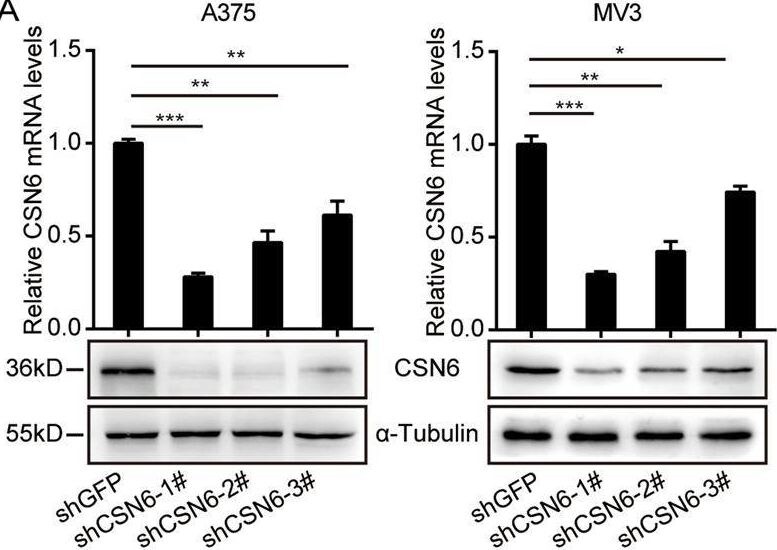
Western Blot: COPS6 Antibody (OTI4E7) [NBP2-46333] -
CSN6 is required for the proliferation, migration and invasion of melanoma cells and regulates cell cycle progression.A qRT-PCR assays and western blot analysis of CSN6 expression in CSN6-knockdown A375 and MV3 melanoma cells. B Growth curves of A375 and MV3 cells expressing shGFP, shCSN6#1, or shCSN6#2 (n = 4). C Representative fluorescence micrographs and quantification of BrdU staining to detect the amount of DNA synthesis in CSN6-knockdown A375 and MV3 melanoma cells. Scale bar = 100 μm. D Flow cytometry assays performed to quantify the cell population in each phase of the cell cycle. A375 and MV3 cells expressing shGFP, shCSN6#1, or shCSN6#2 were evaluated. E, F Migration and invasion assays performed with A375 and MV3 cells expressing shGFP, shCSN6#1, or shCSN6#2 (left), and calculations of the migratory or invasive cells (right). Migratory cells were stained with crystal violet and counted at 12 h. Invasive cells were stained and counted at 24 h. Scale bar = 50 μm. G Protein expression of several cell cycle regulatory proteins and metastasis-related proteins in A375 and MV3 cells expressing shGFP, shCSN6#1, or shCSN6#2. All data are shown as the mean +/- SD, and data were analyzed using two-tailed Student’s t-tests; *P < 0.05, **P < 0.01, and ***P < 0.001. All P-values are based on control versus treatment comparisons. Image collected and cropped by CiteAb from the following open publication (https://pubmed.ncbi.nlm.nih.gov/33483464), licensed under a CC-BY license. Not internally tested by Novus Biologicals.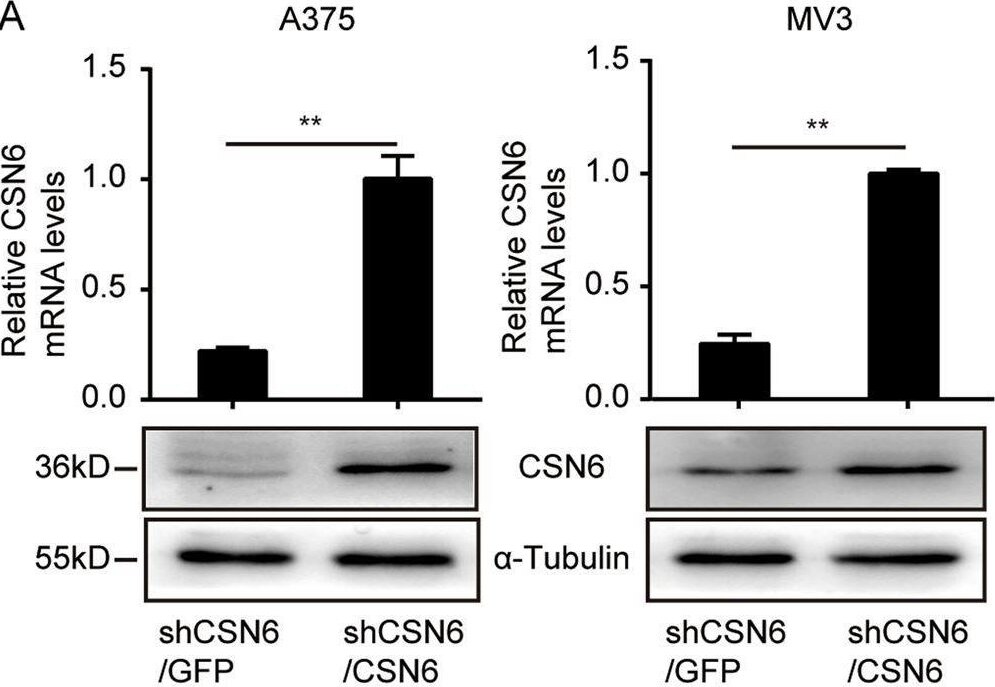
Western Blot: COPS6 Antibody (OTI4E7) [NBP2-46333] -
CSN6 recovery rescues the cell proliferation, migration, and invasion of CSN6-silenced melanoma cells.A qRT-PCR and western blot assays were used to confirm CSN6 expression in CSN6-rescued CSN6-knockdown A375 and MV3 melanoma cells. B CSN6 recovery rescued the proliferation of A375 and MV3 melanoma cells. Growth curves are shown for the CSN6-rescued CSN6-knockdown cells (n = 4). C Representative fluorescence micrographs and quantification of BrdU staining in CSN6-rescued CSN6-knockdown A375 and MV3 cells are shown. Scale bar = 100 μm. D, E Migration and invasion assays were performed with CSN6-rescued CSN6-knockdown A375 and MV3 cells (left), and the quantification of migratory or invasive cells (right). Migratory cells were stained with crystal violet and counted at 12 h. Invasive cells were stained and counted at 24 h. Scale bar = 50 μm. F Western blot assays were used to detect the protein expression levels of cell cycle regulatory proteins and metastasis-related proteins in CSN6-rescued CSN6-knockdown A375 and MV3 melanoma cells. All data are shown as the mean +/- SD, *P < 0.05 and **P < 0.01. All P-values are based on control versus treatment comparisons. Image collected and cropped by CiteAb from the following open publication (https://pubmed.ncbi.nlm.nih.gov/33483464), licensed under a CC-BY license. Not internally tested by Novus Biologicals.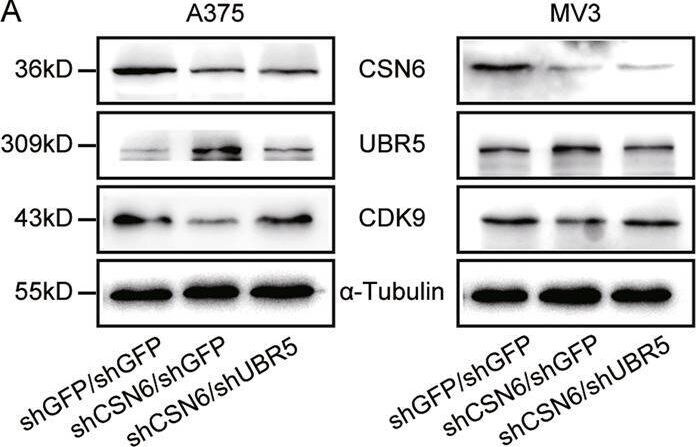
Western Blot: COPS6 Antibody (OTI4E7) [NBP2-46333] -
The effects induced by CSN6 silencing were abrogated by downregulation of UBR5 expression in CSN6-knockdown cells.A Total cellular extracts from CSN6-knockdown and UBR5-knockdown CSN6-knockdown A375 and MV3 cells were prepared and subjected to western blotting with the indicated antibody. B The migration and invasion of CSN6-knockdown and UBR5-knockdown CSN6-knockdown A375 and MV3 cells were quantified. C The growth curves of CSN6-knockdown and UBR5-knockdown CSN6-knockdown A375 and MV3 cells are shown (n = 4). D An in vitro colony formation assay was performed with CSN6-knockdown and UBR5-knockdown CSN6-knockdown A375 and MV3 cells. E, F Stably transfected CSN6-knockdown or UBR5-knockdown CSN6-knockdown A375 cells (1 × 10⁶ cells) or control cells were subcutaneously injected into right dorsal side of female nude mice (n = 6). Tumor volume was measured when the tumors reached a certain volume. Two weeks after injection, the mice were sacrificed, and the tumors were collected and weighed. One-way ANOVA. G Immunohistochemical analysis was conducted to detect CSN6, UBR5, CDK9 and Ki-67 expression, Scale bar = 100 μm. H The model of the CSN6-UBR5-CDK9 axis is shown. All data are shown as the mean +/- SD, *P < 0.05, **P < 0.01, and ***P < 0.001. All P-values are based on control versus treatment comparisons. Image collected and cropped by CiteAb from the following open publication (https://pubmed.ncbi.nlm.nih.gov/33483464), licensed under a CC-BY license. Not internally tested by Novus Biologicals.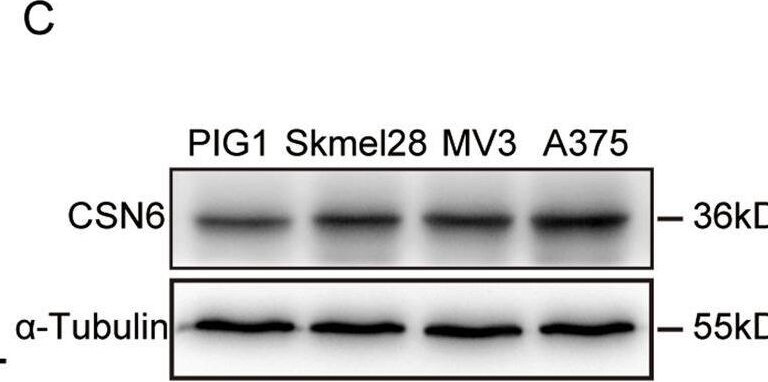
Western Blot: COPS6 Antibody (OTI4E7) [NBP2-46333] -
High CSN6 expression is associated with a poor melanoma patient prognosis.A Representative immunohistochemical staining assays showing CSN6 expression in human benign nevus tissue (left, n = 9) and melanoma tissue (right, n = 15). B Immunohistochemical analyses of CSN6 expression levels in 9 benign nevus tissue samples and 15 melanoma tissue samples, P < 0.001. C, D Western blot and qRT-PCR assays performed to detect CSN6 expression in the A375, MV3, and Skmel28 melanoma cell lines and the immortalized melanocyte cell line PIG1. E, F Kaplan–Meier analysis of the overall survival probability using data from the online R2 database. P-values calculated by the log-rank test are indicated. G Box plot analysis of CSN6 expression levels with the pathological stage of melanoma. Image collected and cropped by CiteAb from the following open publication (https://pubmed.ncbi.nlm.nih.gov/33483464), licensed under a CC-BY license. Not internally tested by Novus Biologicals.Applications for COPS6 Antibody (OTI4E7)
Application
Recommended Usage
Immunocytochemistry/ Immunofluorescence
1:100
Immunohistochemistry
1:150
Immunohistochemistry-Paraffin
1:150
Western Blot
1:2000
Formulation, Preparation, and Storage
Purification
Immunogen affinity purified
Formulation
PBS (pH 7.3), 1.0% BSA and 50% Glycerol
Preservative
0.02% Sodium Azide
Concentration
1 mg/ml
Shipping
The product is shipped with polar packs. Upon receipt, store it immediately at the temperature recommended below.
Stability & Storage
Store at -20C. Avoid freeze-thaw cycles.
Background: COPS6
Alternate Names
BMP2B, BMP2B1, BMP4, COP9 constitutive photomorphogenic homolog subunit 6 (Arabidopsis), COP9 signalosome complex subunit 6, CSN6COP9 subunit 6 (MOV34 homolog, 34 kD), H_NH0506M12.12, hVIP, JAB1-containing signalosome subunit 6, MOFC11, MOV34 homolog, MOV34 homolog, 34 kD, MOV34-34KD, SGN6, Signalosome subunit 6, Vpr-interacting protein
Gene Symbol
COPS6
Additional COPS6 Products
Product Documents for COPS6 Antibody (OTI4E7)
Certificate of Analysis
To download a Certificate of Analysis, please enter a lot or batch number in the search box below.
Product Specific Notices for COPS6 Antibody (OTI4E7)
This product is for research use only and is not approved for use in humans or in clinical diagnosis. Primary Antibodies are guaranteed for 1 year from date of receipt.
Citations for COPS6 Antibody (OTI4E7)
 Powered by Bioz
Customer Reviews for COPS6 Antibody (OTI4E7)
There are currently no reviews for this product. Be the first to review COPS6 Antibody (OTI4E7) and earn rewards!
Have you used COPS6 Antibody (OTI4E7)?
Submit a review and receive an Amazon gift card!
$25/€18/£15/$25CAN/¥2500 for a review with an image
$10/€7/£6/$10CAN/¥1110 for a review without an image
Submit a review
Protocols
Find general support by application which include: protocols, troubleshooting, illustrated assays, videos and webinars.
- Antigen Retrieval Protocol (PIER)
- Antigen Retrieval for Frozen Sections Protocol
- Appropriate Fixation of IHC/ICC Samples
- Cellular Response to Hypoxia Protocols
- Chromogenic IHC Staining of Formalin-Fixed Paraffin-Embedded (FFPE) Tissue Protocol
- Chromogenic Immunohistochemistry Staining of Frozen Tissue
- ClariTSA™ Fluorophore Kits
- Detection & Visualization of Antibody Binding
- Fluorescent IHC Staining of Frozen Tissue Protocol
- Graphic Protocol for Heat-induced Epitope Retrieval
- Graphic Protocol for the Preparation and Fluorescent IHC Staining of Frozen Tissue Sections
- Graphic Protocol for the Preparation and Fluorescent IHC Staining of Paraffin-embedded Tissue Sections
- Graphic Protocol for the Preparation of Gelatin-coated Slides for Histological Tissue Sections
- ICC Cell Smear Protocol for Suspension Cells
- ICC Immunocytochemistry Protocol Videos
- ICC for Adherent Cells
- IHC Sample Preparation (Frozen sections vs Paraffin)
- Immunocytochemistry (ICC) Protocol
- Immunocytochemistry Troubleshooting
- Immunofluorescence of Organoids Embedded in Cultrex Basement Membrane Extract
- Immunofluorescent IHC Staining of Formalin-Fixed Paraffin-Embedded (FFPE) Tissue Protocol
- Immunohistochemistry (IHC) and Immunocytochemistry (ICC) Protocols
- Immunohistochemistry Frozen Troubleshooting
- Immunohistochemistry Paraffin Troubleshooting
- Preparing Samples for IHC/ICC Experiments
- Preventing Non-Specific Staining (Non-Specific Binding)
- Primary Antibody Selection & Optimization
- Protocol for Heat-Induced Epitope Retrieval (HIER)
- Protocol for Making a 4% Formaldehyde Solution in PBS
- Protocol for VisUCyte™ HRP Polymer Detection Reagent
- Protocol for the Fluorescent ICC Staining of Cell Smears - Graphic
- Protocol for the Fluorescent ICC Staining of Cultured Cells on Coverslips - Graphic
- Protocol for the Preparation & Fixation of Cells on Coverslips
- Protocol for the Preparation and Chromogenic IHC Staining of Frozen Tissue Sections
- Protocol for the Preparation and Chromogenic IHC Staining of Frozen Tissue Sections - Graphic
- Protocol for the Preparation and Chromogenic IHC Staining of Paraffin-embedded Tissue Sections
- Protocol for the Preparation and Chromogenic IHC Staining of Paraffin-embedded Tissue Sections - Graphic
- Protocol for the Preparation and Fluorescent ICC Staining of Cells on Coverslips
- Protocol for the Preparation and Fluorescent ICC Staining of Non-adherent Cells
- Protocol for the Preparation and Fluorescent ICC Staining of Stem Cells on Coverslips
- Protocol for the Preparation and Fluorescent IHC Staining of Frozen Tissue Sections
- Protocol for the Preparation and Fluorescent IHC Staining of Paraffin-embedded Tissue Sections
- Protocol for the Preparation of Gelatin-coated Slides for Histological Tissue Sections
- Protocol for the Preparation of a Cell Smear for Non-adherent Cell ICC - Graphic
- R&D Systems Quality Control Western Blot Protocol
- TUNEL and Active Caspase-3 Detection by IHC/ICC Protocol
- The Importance of IHC/ICC Controls
- Troubleshooting Guide: Immunohistochemistry
- Troubleshooting Guide: Western Blot Figures
- Western Blot Conditions
- Western Blot Protocol
- Western Blot Protocol for Cell Lysates
- Western Blot Troubleshooting
- Western Blot Troubleshooting Guide
- View all Protocols, Troubleshooting, Illustrated assays and Webinars
Loading...