
DIO3 Antibody - BSA Free
Novus Biologicals | Catalog # NBP1-05767

![Western Blot: DIO3 AntibodyBSA Free [NBP1-05767]](https://resources.rndsystems.com/images/products/DIO3-Antibody-Western-Blot-NBP1-05767-img0002.jpg "Western Blot: DIO3 AntibodyBSA Free [NBP1-05767]")
Scientific images may be resized, cropped, or adjusted for brightness or contrast for presentation purposes. These updates are limited to presentation and do not affect the underlying scientific interpretation of the data. Where available, additional source data may be provided upon request.
Key Product Details
Species Reactivity
Validated:
Cited:
Applications
Validated:
Cited:
Label
Antibody Source
Format
Product Specifications
Immunogen
Reactivity Notes
Localization
Clonality
Host
Isotype
Theoretical MW
Disclaimer note: The observed molecular weight of the protein may vary from the listed predicted molecular weight due to post translational modifications, post translation cleavages, relative charges, and other experimental factors.
Scientific Data Images for DIO3 Antibody - BSA Free
Western Blot: DIO3 AntibodyBSA Free [NBP1-05767]
Western Blot: DIO3 Antibody [NBP1-05767] - Detection of Dio3 in rat placenta.![Flow Cytometry: DIO3 Antibody - BSA Free [NBP1-05767]](https://resources.rndsystems.com/images/products/DIO3-Antibody-Flow-Cytometry-NBP1-05767-img0005.jpg "Flow Cytometry: DIO3 Antibody - BSA Free [NBP1-05767]")
Flow Cytometry: DIO3 Antibody - BSA Free [NBP1-05767]
Flow Cytometry: DIO3 Antibody [NBP1-05767] - Analysis using the Biotin conjugate of NBP1-05767. Dio3 staining of mouse hepatic stellate cell cultured for 7 days. Image from verified customer review.![Western Blot: DIO3 AntibodyBSA Free [NBP1-05767]](https://resources.rndsystems.com/images/products/DIO3-Antibody-Western-Blot-NBP1-05767-img0003.jpg "Western Blot: DIO3 AntibodyBSA Free [NBP1-05767]")
Western Blot: DIO3 AntibodyBSA Free [NBP1-05767]
Western Blot: DIO3 Antibody [NBP1-05767] - Detection of Dio3 in rabbit brain whole cell homogenate. Photo courtesy of product review by verified customer.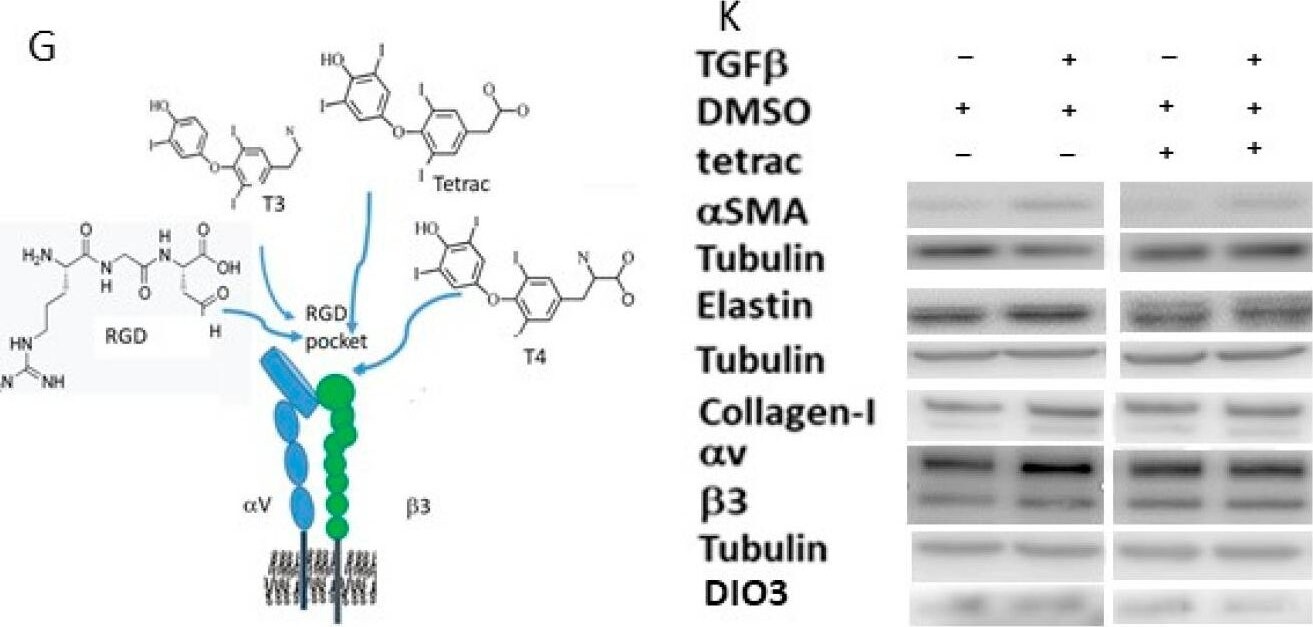
Western Blot: DIO3 Antibody - BSA Free [NBP1-05767] -
The effect of fibrotic-ECM and tetrac on DF cell proliferation and death and on the levels of MF biomarkers, alpha v beta 3, miRNA-2,1 and D3: DF (100,000 cells/well) were cultured on normal (−TGF beta (TGFb in the graphs)) or fibrotic-ECM (+TGF beta ) with/without 0.5 μM tetrac or its solvent (DMSO-KOH propylene glycol) for 48 h. Then, cells were harvested, and the following was undertaken: (1) the cells were counted using a counter and trypan-blue; (2) the proteins were extracted from the cells, and protein levels were measured by Western blot; and (3) the RNA was extracted from the cells, and the level of miRNA-21 was evaluated using qPCR. (A,H) shows the average number of total cells, live cells, viability, and cyclin-D1 at the end of the experiment (mean + SD). (B–F,I,J) show collagen-I (B), elastin (C), alpha SMA (D), alpha v (E), beta 3 (F), miRNA-21 (I), and D3 (J) levels, in cells cultured on ECMs with/without tetrac. (G) shows a schematic demonstration of the alpha v beta 3 binding site of RGD, T3, T4 and tetrac. (K) shows representative Western blot images of protein levels in the different treatments. The blots contain skipping lanes. * The results are significantly different (p ≤ 0.05, n = 4–6). Image collected and cropped by CiteAb from the following open publication (https://pubmed.ncbi.nlm.nih.gov/37240272), licensed under a CC-BY license. Not internally tested by Novus Biologicals.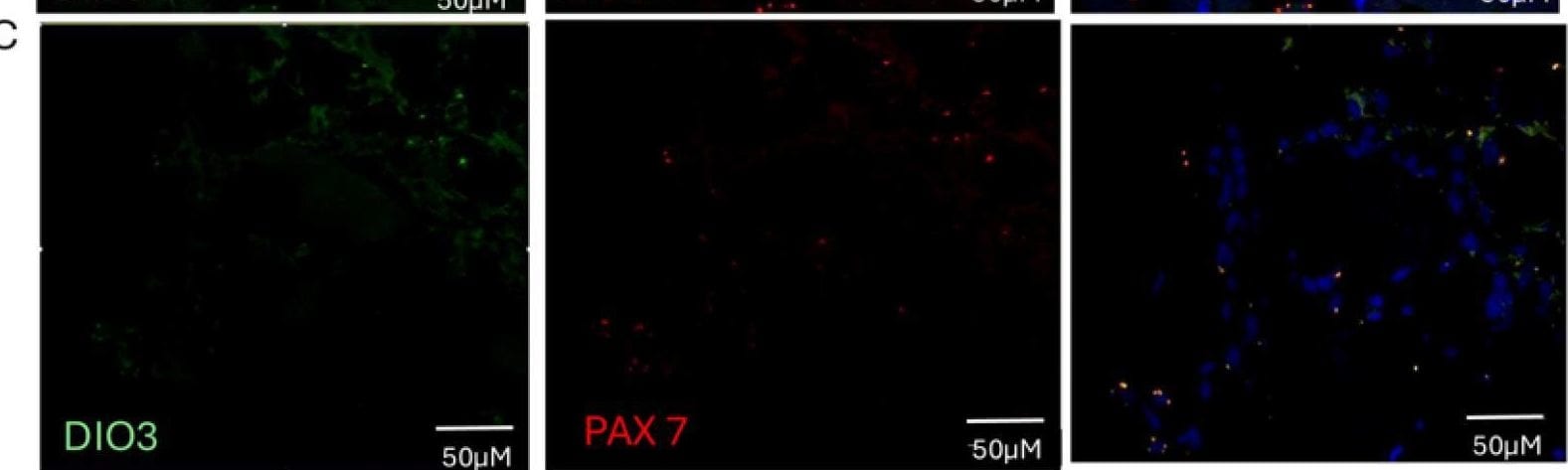
Immunocytochemistry/ Immunofluorescence: DIO3 Antibody - BSA Free [NBP1-05767] -
Type 3 deiodinase expression and colocalization on muscle. (A) DIO3 expression is augmented in the muscle of the critically ill, specifically in those with NTIS. (B) panel. RNAscope showing the colocalization of DIO3 and MYOD+, augmented in patients with T3 levels < 35 ng/dL. (C) RNAscope showing that DIO3 and PAX7+ do not colocalize in patients with T3 levels < 35 ng/dL. (D) RNAscope of DIO3 and DIO2, also shows that these genes do not colocalize in patients with T3 levels < 35 ng/dL. DAPI (blue), DIO3 (green), MYOD, PAX7, DIO2. (red) * p = 0.001, ** p < 0.0001. ns: Statistically not significant. Image collected and cropped by CiteAb from the following open publication (https://pubmed.ncbi.nlm.nih.gov/40141055), licensed under a CC-BY license. Not internally tested by Novus Biologicals.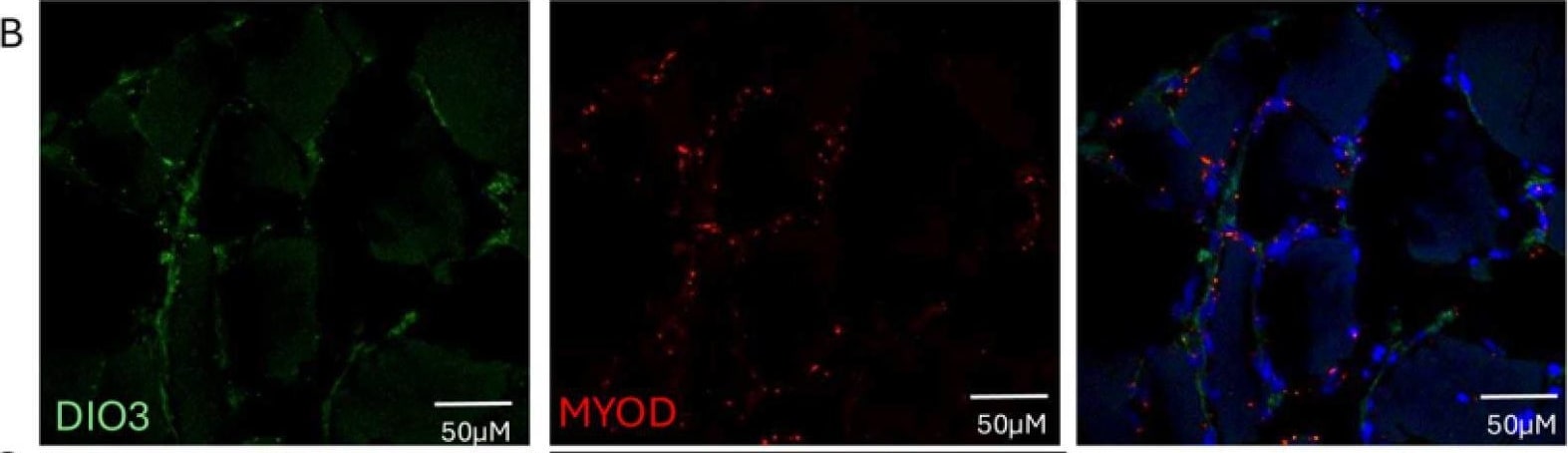
Immunocytochemistry/ Immunofluorescence: DIO3 Antibody - BSA Free [NBP1-05767] -
Type 3 deiodinase expression and colocalization on muscle. (A) DIO3 expression is augmented in the muscle of the critically ill, specifically in those with NTIS. (B) panel. RNAscope showing the colocalization of DIO3 and MYOD+, augmented in patients with T3 levels < 35 ng/dL. (C) RNAscope showing that DIO3 and PAX7+ do not colocalize in patients with T3 levels < 35 ng/dL. (D) RNAscope of DIO3 and DIO2, also shows that these genes do not colocalize in patients with T3 levels < 35 ng/dL. DAPI (blue), DIO3 (green), MYOD, PAX7, DIO2. (red) * p = 0.001, ** p < 0.0001. ns: Statistically not significant. Image collected and cropped by CiteAb from the following open publication (https://pubmed.ncbi.nlm.nih.gov/40141055), licensed under a CC-BY license. Not internally tested by Novus Biologicals.Applications for DIO3 Antibody - BSA Free
Flow Cytometry
Immunocytochemistry/ Immunofluorescence
Immunohistochemistry
Immunohistochemistry-Frozen
Immunohistochemistry-Paraffin
Western Blot
Reviewed Applications
Read 2 reviews rated 3.5 using NBP1-05767 in the following applications:
Flow Cytometry Panel Builder
Bio-Techne Knows Flow Cytometry
Save time and reduce costly mistakes by quickly finding compatible reagents using the Panel Builder Tool.
Advanced Features
- Spectra Viewer - Custom analysis of spectra from multiple fluorochromes
- Spillover Popups - Visualize the spectra of individual fluorochromes
- Antigen Density Selector - Match fluorochrome brightness with antigen density

Formulation, Preparation, and Storage
Purification
Formulation
Format
Preservative
Concentration
Shipping
Stability & Storage
Background: DIO3
Alternate Names
Gene Symbol
Additional DIO3 Products
Product Documents for DIO3 Antibody - BSA Free
Certificate of Analysis
To download a Certificate of Analysis, please enter a lot or batch number in the search box below.
Product Specific Notices for DIO3 Antibody - BSA Free
This product is for research use only and is not approved for use in humans or in clinical diagnosis. Primary Antibodies are guaranteed for 1 year from date of receipt.
Citations for DIO3 Antibody - BSA Free
 Powered by Bioz
Customer Reviews for DIO3 Antibody - BSA Free (2)
Have you used DIO3 Antibody - BSA Free?
Submit a review and receive an Amazon gift card!
$25/€18/£15/$25CAN/¥2500 for a review with an image
$10/€7/£6/$10CAN/¥1110 for a review without an image
Submit a review
Customer Images

-
Application: Western BlotSample Tested: brain whole cell homogenateSpecies: OtherVerified Customer | Posted 01/28/2013

-
Application: Western BlotSample Tested: HEK293 cells transfected with human D3 expression vectorSpecies: HumanVerified Customer | Posted 01/05/2010
There are no reviews that match your criteria.
Protocols
View specific protocols for DIO3 Antibody - BSA Free (NBP1-05767):
Antigen Unmasking:
Bring slides to a boil in 10 mM sodium citrate buffer (pH 6.0) then maintain at a sub-boiling temperature for 10 minutes. Cool slides on bench-top for 30 minutes (keep slides in the sodium citrate buffer at all times).
Staining:
1. Wash sections in deionized water three times for 5 minutes each.
2. Wash sections in PBS for 5 minutes.
3. Block each section with 100-400 ul blocking solution (1% BSA in PBS) for 1 hour at room temperature.
4. Remove blocking solution and add 100-400 ul diluted primary antibody. Incubate overnight at 4 C.
5. Remove antibody solution and wash sections in wash buffer three times for 5 minutes each.
6. Add 100-400 ul HRP polymer conjugated secondary antibody. Incubate 30 minutes at room temperature.
7. Wash sections three times in wash buffer for 5 minutes each.
8. Add 100-400 ul DAB substrate to each section and monitor staining closely.
9. As soon as the sections develop, immerse slides in deionized water.
10. Counterstain sections in hematoxylin.
11. Wash sections in deionized water two times for 5 minutes each.
12. Dehydrate sections.
13. Mount coverslips.
Find general support by application which include: protocols, troubleshooting, illustrated assays, videos and webinars.
- 7-Amino Actinomycin D (7-AAD) Cell Viability Flow Cytometry Protocol
- Antigen Retrieval Protocol (PIER)
- Antigen Retrieval for Frozen Sections Protocol
- Appropriate Fixation of IHC/ICC Samples
- Cellular Response to Hypoxia Protocols
- Chromogenic IHC Staining of Formalin-Fixed Paraffin-Embedded (FFPE) Tissue Protocol
- Chromogenic Immunohistochemistry Staining of Frozen Tissue
- ClariTSA™ Fluorophore Kits
- Detection & Visualization of Antibody Binding
- Extracellular Membrane Flow Cytometry Protocol
- Flow Cytometry Protocol for Cell Surface Markers
- Flow Cytometry Protocol for Staining Membrane Associated Proteins
- Flow Cytometry Staining Protocols
- Flow Cytometry Troubleshooting Guide
- Fluorescent IHC Staining of Frozen Tissue Protocol
- Graphic Protocol for Heat-induced Epitope Retrieval
- Graphic Protocol for the Preparation and Fluorescent IHC Staining of Frozen Tissue Sections
- Graphic Protocol for the Preparation and Fluorescent IHC Staining of Paraffin-embedded Tissue Sections
- Graphic Protocol for the Preparation of Gelatin-coated Slides for Histological Tissue Sections
- ICC Cell Smear Protocol for Suspension Cells
- ICC Immunocytochemistry Protocol Videos
- ICC for Adherent Cells
- IHC Sample Preparation (Frozen sections vs Paraffin)
- Immunocytochemistry (ICC) Protocol
- Immunocytochemistry Troubleshooting
- Immunofluorescence of Organoids Embedded in Cultrex Basement Membrane Extract
- Immunofluorescent IHC Staining of Formalin-Fixed Paraffin-Embedded (FFPE) Tissue Protocol
- Immunohistochemistry (IHC) and Immunocytochemistry (ICC) Protocols
- Immunohistochemistry Frozen Troubleshooting
- Immunohistochemistry Paraffin Troubleshooting
- Intracellular Flow Cytometry Protocol Using Alcohol (Methanol)
- Intracellular Flow Cytometry Protocol Using Detergents
- Intracellular Nuclear Staining Flow Cytometry Protocol Using Detergents
- Intracellular Staining Flow Cytometry Protocol Using Alcohol Permeabilization
- Intracellular Staining Flow Cytometry Protocol Using Detergents to Permeabilize Cells
- Preparing Samples for IHC/ICC Experiments
- Preventing Non-Specific Staining (Non-Specific Binding)
- Primary Antibody Selection & Optimization
- Propidium Iodide Cell Viability Flow Cytometry Protocol
- Protocol for Heat-Induced Epitope Retrieval (HIER)
- Protocol for Liperfluo
- Protocol for Making a 4% Formaldehyde Solution in PBS
- Protocol for VisUCyte™ HRP Polymer Detection Reagent
- Protocol for the Characterization of Human Th22 Cells
- Protocol for the Characterization of Human Th9 Cells
- Protocol for the Fluorescent ICC Staining of Cell Smears - Graphic
- Protocol for the Fluorescent ICC Staining of Cultured Cells on Coverslips - Graphic
- Protocol for the Preparation & Fixation of Cells on Coverslips
- Protocol for the Preparation and Chromogenic IHC Staining of Frozen Tissue Sections
- Protocol for the Preparation and Chromogenic IHC Staining of Frozen Tissue Sections - Graphic
- Protocol for the Preparation and Chromogenic IHC Staining of Paraffin-embedded Tissue Sections
- Protocol for the Preparation and Chromogenic IHC Staining of Paraffin-embedded Tissue Sections - Graphic
- Protocol for the Preparation and Fluorescent ICC Staining of Cells on Coverslips
- Protocol for the Preparation and Fluorescent ICC Staining of Non-adherent Cells
- Protocol for the Preparation and Fluorescent ICC Staining of Stem Cells on Coverslips
- Protocol for the Preparation and Fluorescent IHC Staining of Frozen Tissue Sections
- Protocol for the Preparation and Fluorescent IHC Staining of Paraffin-embedded Tissue Sections
- Protocol for the Preparation of Gelatin-coated Slides for Histological Tissue Sections
- Protocol for the Preparation of a Cell Smear for Non-adherent Cell ICC - Graphic
- Protocol: Annexin V and PI Staining by Flow Cytometry
- Protocol: Annexin V and PI Staining for Apoptosis by Flow Cytometry
- R&D Systems Quality Control Western Blot Protocol
- TUNEL and Active Caspase-3 Detection by IHC/ICC Protocol
- The Importance of IHC/ICC Controls
- Troubleshooting Guide: Fluorokine Flow Cytometry Kits
- Troubleshooting Guide: Immunohistochemistry
- Troubleshooting Guide: Western Blot Figures
- Western Blot Conditions
- Western Blot Protocol
- Western Blot Protocol for Cell Lysates
- Western Blot Troubleshooting
- Western Blot Troubleshooting Guide
- View all Protocols, Troubleshooting, Illustrated assays and Webinars
FAQs for DIO3 Antibody - BSA Free
-
Q: I am looking for a Dio3 peptide that I can inject in vivo to produce a biological effect. Can you provide information or confirm whether the Dio3 peptide you have would be effective as a biological agent in vivo?
A: I have pulled up information on the Dio3 peptides and recombinant proteins that we have available. Unfortunately I would not expect any of them to be biologically active and capable of producing a response when injected in vivo. The two peptides we carry are simply intended to be used for negative control competition assays to block signal of the primary and determine what is specific and non-specific as far as signal is concerned. The other two recombinant proteins are ones we distribute for a Taiwanese company called Abnova and they should not be biologically active based on the cell free wheat germ system employed to synthesize them. We will typically list our active proteins with an indication of such on our datasheet if it has been tested and usually the application of functional listed.
-
Q: We have used one of your antibodies against Dio3 (cat# NBP1-05767) in the past and, despite it being directed against rodent D3 peptide sequence, it also appears to stains human D3 specifically in our hands. Can you please let us know the rodent D3 peptide sequence that was used to create this antibody? Alternatively, can you let us know if this rodent D3 peptide sequence also matches the human D3 peptide sequence? If there is a high degree of sequence homology, we wish to publish our findings and include a description that your antibody works in human tissues (IHC).We also noticed a new D3 aB on your website (cat# NBP1-19747) that is said to recognize human D3. Can you also let me know the sequence of the peptide used to generate it? We are one of the only labs in the world that study D3. If you can send us some samples of these antibodies, we can likely help you validate them experimentally for Western, IHC, etc.
A: The immunogen shares 93% homology to human. It is expected to cross-react with human cells. Furthermore, full-length DIO3 in human and mouse share greater than 95% similarity over the entire protein. It will be very difficult to find an antibody that works on one species but not the other unless the immunogen falls within amino acids 48-55, which is the only region where there is significant difference between the two species. It is highly doubtful you will find a commercial antibody that uses this immunogen to generate their antibody as most companies will want to increase the amount of species recognized by an antibody, not decrease it. For NBP1-19747, like all of our immunogens, the exact sequence is considered proprietary, but as you can see on our datasheet, the immunogen surrounds amino acid 66, which does not fall within the range where mouse and human are dissimilar.
-
Q: I am looking for a Dio3 peptide that I can inject in vivo to produce a biological effect. Can you provide information or confirm whether the Dio3 peptide you have would be effective as a biological agent in vivo?
A: I have pulled up information on the Dio3 peptides and recombinant proteins that we have available. Unfortunately I would not expect any of them to be biologically active and capable of producing a response when injected in vivo. The two peptides we carry are simply intended to be used for negative control competition assays to block signal of the primary and determine what is specific and non-specific as far as signal is concerned. The other two recombinant proteins are ones we distribute for a Taiwanese company called Abnova and they should not be biologically active based on the cell free wheat germ system employed to synthesize them. We will typically list our active proteins with an indication of such on our datasheet if it has been tested and usually the application of functional listed.
-
Q: We have used one of your antibodies against Dio3 (cat# NBP1-05767) in the past and, despite it being directed against rodent D3 peptide sequence, it also appears to stains human D3 specifically in our hands. Can you please let us know the rodent D3 peptide sequence that was used to create this antibody? Alternatively, can you let us know if this rodent D3 peptide sequence also matches the human D3 peptide sequence? If there is a high degree of sequence homology, we wish to publish our findings and include a description that your antibody works in human tissues (IHC).We also noticed a new D3 aB on your website (cat# NBP1-19747) that is said to recognize human D3. Can you also let me know the sequence of the peptide used to generate it? We are one of the only labs in the world that study D3. If you can send us some samples of these antibodies, we can likely help you validate them experimentally for Western, IHC, etc.
A: The immunogen shares 93% homology to human. It is expected to cross-react with human cells. Furthermore, full-length DIO3 in human and mouse share greater than 95% similarity over the entire protein. It will be very difficult to find an antibody that works on one species but not the other unless the immunogen falls within amino acids 48-55, which is the only region where there is significant difference between the two species. It is highly doubtful you will find a commercial antibody that uses this immunogen to generate their antibody as most companies will want to increase the amount of species recognized by an antibody, not decrease it. For NBP1-19747, like all of our immunogens, the exact sequence is considered proprietary, but as you can see on our datasheet, the immunogen surrounds amino acid 66, which does not fall within the range where mouse and human are dissimilar.