
F. keratolyticus Endo-beta-Galactosidase Protein, CF
R&D Systems | Catalog # 8620-GH


Loading...
Key Product Details
- R&D Systems E. coli-derived F. keratolyticus Endo-beta-Galactosidase Protein (8620-GH)
- Quality control testing to verify active proteins with lot specific assays by in-house scientists
- All R&D Systems proteins are covered with a 100% guarantee
Source
E. coli
Applications
Enzyme Activity
Loading...
Learn more about Fluorescent Glycan Labeling and Detection
Product Specifications
Source
E. coli-derived f. keratoyticus Endo-beta-Galactosidase protein
| msyB (Thr2-Arg124) Accession # P25738 |
GSENLYFQGHMHHHHHH | F. keratolyticus Endo-beta -Galactosidase (Asp25-Leu422) Accession # Q9ZG90 |
| N-terminus | C-terminus |
Purity
>95%, by SDS-PAGE visualized with Silver Staining and quantitative densitometry by Coomassie® Blue Staining.
Endotoxin Level
<1.0 EU per 1 μg of the protein by the LAL method.
N-terminal Sequence Analysis
Thr2 (msyB)
Predicted Molecular Mass
59 kDa
SDS-PAGE
66 kDa, reducing conditions
Activity
Measured by its ability to cleave keratan sulfate.
50% cleavage of keratan sulfate (0.5 μg) is achieved using <5 ng rF.k. Endo-beta -galactosidase, as measured under the described conditions.
50% cleavage of keratan sulfate (0.5 μg) is achieved using <5 ng rF.k. Endo-beta -galactosidase, as measured under the described conditions.
Reviewed Applications
Read 1 review rated 5 using 8620-GH in the following applications:
Formulation, Preparation, and Storage
8620-GH
| Formulation | Supplied as a 0.2 μm filtered solution in Tris and NaCl. |
| Shipping | The product is shipped with polar packs. Upon receipt, store it immediately at the temperature recommended below. |
| Stability & Storage | Use a manual defrost freezer and avoid repeated freeze-thaw cycles.
|
Background: Endo-beta-Galactosidase
References
- Leng, L. et al. (1998) Gene 222:187.
- Amano. J. et al. (1991) J. Biol. Chem. 266:11461.
- Maria Vistnes et al. (2014) PLoS ONE 9:e89621
- Xiaoke Yin et al. (2013) Molecular & Cellular Proteomics 12:956.
Additional Endo-beta-Galactosidase Products
Product Documents for F. keratolyticus Endo-beta-Galactosidase Protein, CF
Certificate of Analysis
To download a Certificate of Analysis, please enter a lot or batch number in the search box below.
Note: Certificate of Analysis not available for kit components.
Product Specific Notices for F. keratolyticus Endo-beta-Galactosidase Protein, CF
For research use only
Related Research Areas
Citations for F. keratolyticus Endo-beta-Galactosidase Protein, CF
 Powered by Bioz
Customer Reviews for F. keratolyticus Endo-beta-Galactosidase Protein, CF (1)
5 out of 5
1 Customer Rating
Have you used F. keratolyticus Endo-beta-Galactosidase Protein, CF?
Submit a review and receive an Amazon gift card!
$25/€18/£15/$25CAN/¥2500 for a review with an image
$10/€7/£6/$10CAN/¥1110 for a review without an image
Submit a review
Customer Images
Showing
1
-
1 of
1 review
Showing All
Filter By:
-
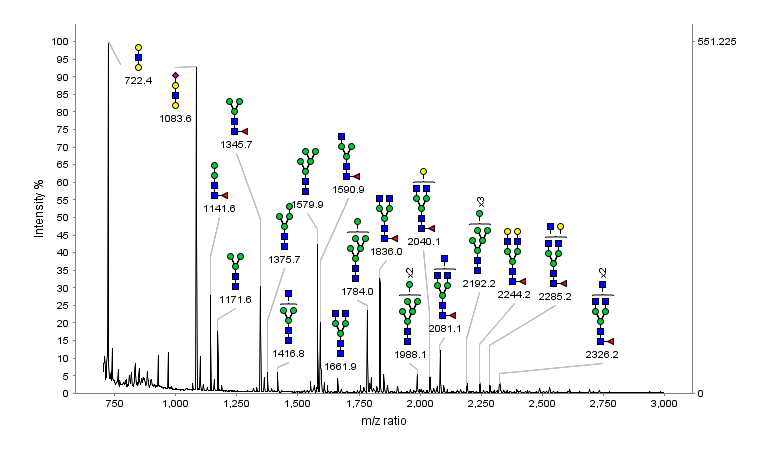
Application: Mass spectrometry analysis of N-glycan structuresVerified Customer | Posted 01/15/2020

There are no reviews that match your criteria.
Protocols
View specific protocols for F. keratolyticus Endo-beta-Galactosidase Protein, CF (8620-GH):
Materials
- Labeling Buffer: 25 mM MES, 0.5% (v/v) Triton® X-100, 2.5 mM MgCl2, 2.5 mM MnCl2, 1.25 mM CaCl2, 0.75 mg/mL BSA, pH 7.0
- Assay Buffer: 0.1 M MES, pH 6.0
- Gel Running Buffer: 40 mM Tris, 1 mM EDTA, adjust to pH 8.0 with acetic acid
- Recombinant F. keratoyticus Endo-beta -Galactosidase (rF.k. Endo-beta -galactosidase) (Catalog # 8620-GH)
- Goat Keratan Sulfate Proteoglycans (Catalog # 8618-KS)
- Recombinant Human Carbohydrate Sulfotransferase 1/CHST1 (rhCHST1) (Catalog # 5316-ST)
- 8% SDS-PAGE (approximately 15 cm x 20 cm, 20 lanes per gel)
- PAP35S (prepared in-house using the PAPS Synthesis Kit (Catalog # EA005), ~1 μM = ~2 x 10⁶ cpm/μL)
- Gel loading buffer: 0.15 M Tris, 20.8 mM SDS, 1.15 M Glycine, 174 µM Bromophenol Blue, 30% Glycerol
- Blotting paper (Fisher Scientific, Catalog # 05-714-4)
- Gel dryer
- Glogos® II autorad markers (Stratagene, Catalog # 420202) or equivalent
- Blue sensitive medical X-ray film
- X-ray film cassette
- Film developer (Konica SRX-101A Medical Film Processor) or equivalent
- Liquid scintillation counter (Beckman Coulter, Model # LS5000TD) or equivalent
- Liquid scintillation fluid (Beckman Coulter, Catalog # 141349) or equivalent
- Create Radiolabeled Keratan Sulfate Mixture containing 0.1 mg/mL Keratan Sulfate, 12 μg/mL rhCHST- 1, and 0.025 μM PAP35S in Labeling Buffer.
- Incubate Keratan Sulfate Mixture at 37 °C for 1.5 hours.
- Dilute incubated Keratan Sulfate Mixture 3 fold in Assay Buffer.
- Dilute rF.k. endo-beta -galactosidase to 2.667, 0.667, 0.2667, 0.133, 0.0667, 0.02, 0.00667, and 0.00133 µg/mL in Assay Buffer.
- Combine 15 µL of rF.k. endo-beta -galactosidase at each dilution with 15 µL diluted Keratan Sulfate Mixture. Include a control containing 15 µL Assay Buffer and 15 µL Keratan Sulfate Mixture.
- Incubate all reactions at 37 °C for 20 minutes.
- Add 15 µL gel loading buffer to each reaction. Mix.
- Load 30 µL of each reaction per lane on a gel. Leave empty lanes between samples.
- Run at 200 V for 30 minutes.
- Transfer gel onto blotting paper and dry with gel dryer for 1 hour or until fully dry.
- Affix two autorad markers to the blotting paper next to the dried gel.
- In a darkroom expose dried gel to X-ray film by enclosing overnight in a cassette. Develop the following day.
- Using the dried gel, begin marking regions to be cut out for scintillation counting.
- Mark a horizontal line across the top of the entire gel just under the bottom of the wells.
- Using the developed film as an overlay, mark a second line just below the lower edge of the labeled Keratan Sulfate for each well.
- Draw a third line just below where the labeled product migrated (ignore any free sulfate, appearing equivalent in all lanes, and migrating the furthest). For the control, identify the empty region where the product would appear.
- The area between the first two lines is considered to contain the labeled starting material. The area between the second two lines is considered to contain the compact cleavage product resulting from the reaction.
- Mark vertical lines distinguishing one lane (reaction condition) from another.
- Cut each region (two per lane) and place each into a separate liquid scintillation vial. Add 5 mL liquid scintillation fluid to each vial and count the vials for 35S.
- Determine the amount of rF.k. Endo-beta -galactosidase required for 50% cleavage by plotting % cleavage vs. ng of
rF.k. Endo-beta -galactosidase with 4-PL fitting.
Per Reaction:
- Keratan Sulfate: 0.5 μg
- rF.k. Endo-beta -galactosidase: 40, 10, 4, 2, 1, 0.3, 0.1 and 0.02 ng
Loading...