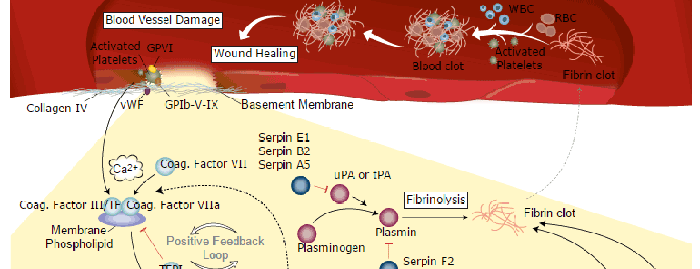
GPV (platelet glycoprotein V; designated CD42d) is an 83 kDa type I transmembrane (TM) glycoprotein of the leucine-rich repeat (LRR) family. It is expressed exclusively within the platelet / megakaryocyte lineage, where it noncovalently interacts with other platelet TM LRR proteins, GPIb alpha/beta and GPIX, at a ratio of one GPV to two of each other subunit. The GPI-V-IX complex tethers platelets to von Willebrand factor on the surface of injured endothelial cells. Absence of the complex results in Bernard-Soulier syndrome, a rare bleeding disorder. The human GPV cDNA encodes a 560 amino acid (aa) protein with a 16 aa signal sequence, a 507 aa extracellular domain (ECD) containing 15 LRR, a 21 aa TM sequence, and a short (16 aa) cytoplasmic tail that binds calmodulin in resting, but not activated platelets. The human GPV ECD shares 70%, 71% and 81% aa identity with mouse, rat and equine GPV, respectively. GPV can form soluble fragments of 80 kDa by ADAM10 or ADAM17 cleavage after P507, or 69 kDa by thrombin cleavage after R476. High circulating soluble GPV may be an indicator of platelet activation, but may also be caused by high doses of aspirin. The function of GPV is not entirely clear. Deletion of GPV in mice does not produce any obvious change to surface expression or function of GPIb and GPIX, but surface expression of GPV requires GPIb. Deletion studies also indicate that GPV may play a minor role in collagen adhesion, and may modify platelet aggregation in response to thrombin.
Glycoprotein V/CD42d Antibody [Dylight 405]
Novus Biologicals | Catalog # AF6990E

Key Product Details
Species Reactivity
Mouse
Applications
Western Blot, Immunocytochemistry
Label
DyLight 405 (Excitation = 400 nm, Emission = 420 nm)
Antibody Source
Polyclonal Sheep IgG
Loading...
Product Specifications
Immunogen
Mouse myeloma cell line NS0-derived recombinant mouse Glycoprotein V/CD42d
Gln17-Gly522
Accession # NP_032174
Gln17-Gly522
Accession # NP_032174
Specificity
Detects mouse Glycoprotein V/CD42d in direct ELISAs and Western blots.
Clonality
Polyclonal
Host
Sheep
Isotype
IgG
Description
This conjugate is made on demand and is not held in inventory. Each order represents a unique lot. All conjugates are generated using validated conjugation protocols and meet strict degree of labeling (F/P) specifications; additional information is available upon request. The antibody concentration is provided on the individual product label.
For specialized conjugation needs, like large quantities, specific concentrations, and defined F/P ratios, bulk and custom antibody conjugation services are available.
For specialized conjugation needs, like large quantities, specific concentrations, and defined F/P ratios, bulk and custom antibody conjugation services are available.
Applications for Glycoprotein V/CD42d Antibody [Dylight 405]
Application
Recommended Usage
Immunocytochemistry
Optimal dilutions of this antibody should be experimentally determined.
Western Blot
Optimal dilutions of this antibody should be experimentally determined.
Application Notes
Recommended applications are based on validated applications from the unconjugated base product AF6990. This conjugated antibody is not kept in inventory and is made to order using validated conjugation protocols.
Formulation, Preparation, and Storage
Purification
Antigen Affinity-purified
Formulation
50mM Sodium Borate
Preservative
0.05% Sodium Azide
Concentration
Please see the vial label for concentration. If unlisted please contact technical services.
Shipping
The product is shipped with polar packs. Upon receipt, store it immediately at the temperature recommended below.
Stability & Storage
Store at 4C in the dark.
Background: Glycoprotein V/CD42d
Alternate Names
CD42d, GP5, GPV
Gene Symbol
GP5
Additional Glycoprotein V/CD42d Products
Product Documents for Glycoprotein V/CD42d Antibody [Dylight 405]
Certificate of Analysis
To download a Certificate of Analysis, please enter a lot or batch number in the search box below.
Product Specific Notices for Glycoprotein V/CD42d Antibody [Dylight 405]
DyLight (R) is a trademark of Thermo Fisher Scientific Inc. and its subsidiaries.
This product is for research use only and is not approved for use in humans or in clinical diagnosis. Primary Antibodies are guaranteed for 1 year from date of receipt.
Related Research Areas
Customer Reviews for Glycoprotein V/CD42d Antibody [Dylight 405]
There are currently no reviews for this product. Be the first to review Glycoprotein V/CD42d Antibody [Dylight 405] and earn rewards!
Have you used Glycoprotein V/CD42d Antibody [Dylight 405]?
Submit a review and receive an Amazon gift card!
$25/€18/£15/$25CAN/¥2500 for a review with an image
$10/€7/£6/$10CAN/¥1110 for a review without an image
Submit a review
Protocols
Find general support by application which include: protocols, troubleshooting, illustrated assays, videos and webinars.
- Appropriate Fixation of IHC/ICC Samples
- Cellular Response to Hypoxia Protocols
- ClariTSA™ Fluorophore Kits
- Detection & Visualization of Antibody Binding
- ICC Cell Smear Protocol for Suspension Cells
- ICC Immunocytochemistry Protocol Videos
- ICC for Adherent Cells
- Immunocytochemistry (ICC) Protocol
- Immunocytochemistry Troubleshooting
- Immunofluorescence of Organoids Embedded in Cultrex Basement Membrane Extract
- Immunohistochemistry (IHC) and Immunocytochemistry (ICC) Protocols
- Preparing Samples for IHC/ICC Experiments
- Preventing Non-Specific Staining (Non-Specific Binding)
- Primary Antibody Selection & Optimization
- Protocol for VisUCyte™ HRP Polymer Detection Reagent
- Protocol for the Fluorescent ICC Staining of Cell Smears - Graphic
- Protocol for the Fluorescent ICC Staining of Cultured Cells on Coverslips - Graphic
- Protocol for the Preparation and Fluorescent ICC Staining of Cells on Coverslips
- Protocol for the Preparation and Fluorescent ICC Staining of Non-adherent Cells
- Protocol for the Preparation and Fluorescent ICC Staining of Stem Cells on Coverslips
- Protocol for the Preparation of a Cell Smear for Non-adherent Cell ICC - Graphic
- R&D Systems Quality Control Western Blot Protocol
- TUNEL and Active Caspase-3 Detection by IHC/ICC Protocol
- The Importance of IHC/ICC Controls
- Troubleshooting Guide: Western Blot Figures
- Western Blot Conditions
- Western Blot Protocol
- Western Blot Protocol for Cell Lysates
- Western Blot Troubleshooting
- Western Blot Troubleshooting Guide
- View all Protocols, Troubleshooting, Illustrated assays and Webinars
Loading...
Associated Pathways