
gp96/HSP90B1/GRP94 Antibody (SPM249)
Novus Biologicals | Catalog # NBP2-44690

![Immunohistochemistry-Paraffin: gp96/HSP90B1/GRP94 Antibody (SPM249) [NBP2-44690]](https://resources.rndsystems.com/images/products/gp96-HSP90B1-GRP94-Antibody-SPM249-Immunohistochemistry-Paraffin-NBP2-44690-img0001.jpg "Immunohistochemistry-Paraffin: gp96/HSP90B1/GRP94 Antibody (SPM249) [NBP2-44690]")
Scientific images may be resized, cropped, or adjusted for brightness or contrast for presentation purposes. These updates are limited to presentation and do not affect the underlying scientific interpretation of the data. Where available, additional source data may be provided upon request.
Key Product Details
Species Reactivity
Validated:
Cited:
Applications
Validated:
Cited:
Label
Antibody Source
Product Specifications
Immunogen
Localization
Marker
Specificity
Clonality
Host
Isotype
Theoretical MW
Disclaimer note: The observed molecular weight of the protein may vary from the listed predicted molecular weight due to post translational modifications, post translation cleavages, relative charges, and other experimental factors.
Description
Antibody with azide - store at 2 to 8C.
Scientific Data Images for gp96/HSP90B1/GRP94 Antibody (SPM249)
Immunohistochemistry-Paraffin: gp96/HSP90B1/GRP94 Antibody (SPM249) [NBP2-44690]
Immunohistochemistry-Paraffin: gp96/HSP90B1/GRP94 Antibody (SPM249) [NBP2-44690] - Human Breast Carcinoma stained with GRP94 Monoclonal Antibody (SPM249).![Flow Cytometry: gp96/HSP90B1/GRP94 Antibody (SPM249) [NBP2-44690]](https://resources.rndsystems.com/images/products/gp96-HSP90B1-GRP94-Antibody-SPM249-Flow-Cytometry-NBP2-44690-img0002.jpg "Flow Cytometry: gp96/HSP90B1/GRP94 Antibody (SPM249) [NBP2-44690]")
Flow Cytometry: gp96/HSP90B1/GRP94 Antibody (SPM249) [NBP2-44690]
Flow Cytometry: gp96/HSP90B1/GRP94 Antibody (SPM249) [NBP2-44690] - Flow Cytometric Analysis of PFA-fixed HePG2 cells using gp96/HSP90B1/GRP94 Antibody (SPM249).followed by Goat anti-Rat- IgG-CF488 (Blue); Isotype Control (Red).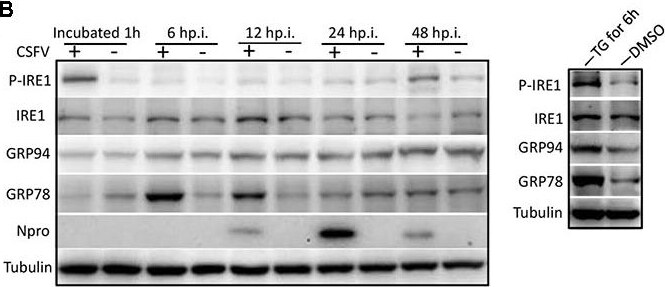
Western Blot: gp96/HSP90B1/GRP94 Antibody (SPM249) [NBP2-44690] -
Western Blot: gp96/HSP90B1/GRP94 Antibody (SPM249) [NBP2-44690] - Classical swine fever virus (CSFV) infection induces the activation of UPR. (A) RNA extracted from CSFV-infected cells was quantified for the expression of UPR genes Xbp1(s), GRP78, GRP94, EDEM-1, ATF4, ATF6, CHOP, Calreticulin, Calnexin, & ERp57 using q-PCR. Mock-infected PK-15 & Thapsigargin (TG)-treated PK-15 were used as negative & positive controls, respectively, & the fold induction was calculated compared to mock cells at the same time point. Error bars represent the mean ± SD of 3 independent experiments; one-way ANOVA test; ∗P < 0.05; ∗∗P < 0.01; ∗∗∗P < 0.001. (B,D,E) Immunoblotting analysis of components of UPR signaling pathways during a time course of CSFV infection. Mock or CSFV-infected PK-15 cells lysates were collected at the indicated time points. Lysates were analyzed for the activation of the IRE1 (B), PERK (D) & ATF6 (E) pathway by immunoblotting analysis. Tubulin was used as a loading control, & infection was confirmed by detecting the viral protein Npro. Results of a representative experiment of 2 independent experiments are shown. (C) RNA was collected as described above, & the splicing levels of XBP1 were analyzed with semi-quantitative PCR as described in materials & methods. The length of Xbp1(u) is 474 bp & Xbp1(s) is 448 bp. (F) The relative expression ratios of the targeted proteins/genes were analyzed by densitometric scanning. Error bars represent the mean ± SD of 2 independent experiments; one-way ANOVA test; ∗P < 0.05; ∗∗P < 0.01; ∗∗∗P < 0.001. Image collected & cropped by CiteAb from the following publication (http://journal.frontiersin.org/article/10.3389/fmicb.2017.02129/full), licensed under a CC-BY license. Not internally tested by Novus Biologicals.![gp96/HSP90B1/GRP94 Antibody (SPM249) Immunocytochemistry/ Immunofluorescence: gp96/HSP90B1/GRP94 Antibody (SPM249) [NBP2-44690] -](https://resources.rndsystems.com/images/products/nbp2-44690_rat-monoclonal-gp96-hsp90b1-grp94-antibody-spm249-29520251637292.jpg "Immunocytochemistry/ Immunofluorescence: gp96/HSP90B1/GRP94 Antibody (SPM249) [NBP2-44690] -")
Immunocytochemistry/ Immunofluorescence: gp96/HSP90B1/GRP94 Antibody (SPM249) [NBP2-44690] -
Immunofluorescence Analysis of HePG2 cells labeling GRP94 with gp96/HSP90B1/GRP94 Antibody (SPM249) followed by Goat anti-Mouse IgG-CF488 (Green). The nuclear counterstain is Reddot.(Red).Applications for gp96/HSP90B1/GRP94 Antibody (SPM249)
Flow Cytometry
Immunocytochemistry/ Immunofluorescence
Immunohistochemistry-Paraffin
Western Blot
Optimal dilution for a specific application should be determined.
Flow Cytometry Panel Builder
Bio-Techne Knows Flow Cytometry
Save time and reduce costly mistakes by quickly finding compatible reagents using the Panel Builder Tool.
Advanced Features
- Spectra Viewer - Custom analysis of spectra from multiple fluorochromes
- Spillover Popups - Visualize the spectra of individual fluorochromes
- Antigen Density Selector - Match fluorochrome brightness with antigen density

Formulation, Preparation, and Storage
Purification
Formulation
Preservative
Concentration
Shipping
Stability & Storage
Background: gp96/HSP90B1
Long Name
Alternate Names
Gene Symbol
UniProt
Additional gp96/HSP90B1 Products
Product Documents for gp96/HSP90B1/GRP94 Antibody (SPM249)
Certificate of Analysis
To download a Certificate of Analysis, please enter a lot or batch number in the search box below.
Product Specific Notices for gp96/HSP90B1/GRP94 Antibody (SPM249)
This product is for research use only and is not approved for use in humans or in clinical diagnosis. Primary Antibodies are guaranteed for 1 year from date of receipt.
Related Research Areas
Citations for gp96/HSP90B1/GRP94 Antibody (SPM249)
 Powered by Bioz
Customer Reviews for gp96/HSP90B1/GRP94 Antibody (SPM249)
There are currently no reviews for this product. Be the first to review gp96/HSP90B1/GRP94 Antibody (SPM249) and earn rewards!
Have you used gp96/HSP90B1/GRP94 Antibody (SPM249)?
Submit a review and receive an Amazon gift card!
$25/€18/£15/$25CAN/¥2500 for a review with an image
$10/€7/£6/$10CAN/¥1110 for a review without an image
Submit a review
Protocols
Find general support by application which include: protocols, troubleshooting, illustrated assays, videos and webinars.
- 7-Amino Actinomycin D (7-AAD) Cell Viability Flow Cytometry Protocol
- Antigen Retrieval Protocol (PIER)
- Antigen Retrieval for Frozen Sections Protocol
- Appropriate Fixation of IHC/ICC Samples
- Cellular Response to Hypoxia Protocols
- Chromogenic IHC Staining of Formalin-Fixed Paraffin-Embedded (FFPE) Tissue Protocol
- Chromogenic Immunohistochemistry Staining of Frozen Tissue
- ClariTSA™ Fluorophore Kits
- Detection & Visualization of Antibody Binding
- Extracellular Membrane Flow Cytometry Protocol
- Flow Cytometry Protocol for Cell Surface Markers
- Flow Cytometry Protocol for Staining Membrane Associated Proteins
- Flow Cytometry Staining Protocols
- Flow Cytometry Troubleshooting Guide
- Fluorescent IHC Staining of Frozen Tissue Protocol
- Graphic Protocol for Heat-induced Epitope Retrieval
- Graphic Protocol for the Preparation and Fluorescent IHC Staining of Frozen Tissue Sections
- Graphic Protocol for the Preparation and Fluorescent IHC Staining of Paraffin-embedded Tissue Sections
- Graphic Protocol for the Preparation of Gelatin-coated Slides for Histological Tissue Sections
- ICC Cell Smear Protocol for Suspension Cells
- ICC Immunocytochemistry Protocol Videos
- ICC for Adherent Cells
- IHC Sample Preparation (Frozen sections vs Paraffin)
- Immunocytochemistry (ICC) Protocol
- Immunocytochemistry Troubleshooting
- Immunofluorescence of Organoids Embedded in Cultrex Basement Membrane Extract
- Immunofluorescent IHC Staining of Formalin-Fixed Paraffin-Embedded (FFPE) Tissue Protocol
- Immunohistochemistry (IHC) and Immunocytochemistry (ICC) Protocols
- Immunohistochemistry Frozen Troubleshooting
- Immunohistochemistry Paraffin Troubleshooting
- Intracellular Flow Cytometry Protocol Using Alcohol (Methanol)
- Intracellular Flow Cytometry Protocol Using Detergents
- Intracellular Nuclear Staining Flow Cytometry Protocol Using Detergents
- Intracellular Staining Flow Cytometry Protocol Using Alcohol Permeabilization
- Intracellular Staining Flow Cytometry Protocol Using Detergents to Permeabilize Cells
- Preparing Samples for IHC/ICC Experiments
- Preventing Non-Specific Staining (Non-Specific Binding)
- Primary Antibody Selection & Optimization
- Propidium Iodide Cell Viability Flow Cytometry Protocol
- Protocol for Heat-Induced Epitope Retrieval (HIER)
- Protocol for Liperfluo
- Protocol for Making a 4% Formaldehyde Solution in PBS
- Protocol for VisUCyte™ HRP Polymer Detection Reagent
- Protocol for the Characterization of Human Th22 Cells
- Protocol for the Characterization of Human Th9 Cells
- Protocol for the Fluorescent ICC Staining of Cell Smears - Graphic
- Protocol for the Fluorescent ICC Staining of Cultured Cells on Coverslips - Graphic
- Protocol for the Preparation & Fixation of Cells on Coverslips
- Protocol for the Preparation and Chromogenic IHC Staining of Frozen Tissue Sections
- Protocol for the Preparation and Chromogenic IHC Staining of Frozen Tissue Sections - Graphic
- Protocol for the Preparation and Chromogenic IHC Staining of Paraffin-embedded Tissue Sections
- Protocol for the Preparation and Chromogenic IHC Staining of Paraffin-embedded Tissue Sections - Graphic
- Protocol for the Preparation and Fluorescent ICC Staining of Cells on Coverslips
- Protocol for the Preparation and Fluorescent ICC Staining of Non-adherent Cells
- Protocol for the Preparation and Fluorescent ICC Staining of Stem Cells on Coverslips
- Protocol for the Preparation and Fluorescent IHC Staining of Frozen Tissue Sections
- Protocol for the Preparation and Fluorescent IHC Staining of Paraffin-embedded Tissue Sections
- Protocol for the Preparation of Gelatin-coated Slides for Histological Tissue Sections
- Protocol for the Preparation of a Cell Smear for Non-adherent Cell ICC - Graphic
- Protocol: Annexin V and PI Staining by Flow Cytometry
- Protocol: Annexin V and PI Staining for Apoptosis by Flow Cytometry
- R&D Systems Quality Control Western Blot Protocol
- TUNEL and Active Caspase-3 Detection by IHC/ICC Protocol
- The Importance of IHC/ICC Controls
- Troubleshooting Guide: Fluorokine Flow Cytometry Kits
- Troubleshooting Guide: Immunohistochemistry
- Troubleshooting Guide: Western Blot Figures
- Western Blot Conditions
- Western Blot Protocol
- Western Blot Protocol for Cell Lysates
- Western Blot Troubleshooting
- Western Blot Troubleshooting Guide
- View all Protocols, Troubleshooting, Illustrated assays and Webinars