
Histone H3.1 Antibody
Novus Biologicals | Catalog # NBP2-75524

![Immunocytochemistry/ Immunofluorescence: Histone H3.1 Antibody [NBP2-75524]](https://resources.rndsystems.com/images/products/Histone-H3.1-Antibody-Immunocytochemistry-Immunofluorescence-NBP2-75524-img0003.jpg "Immunocytochemistry/ Immunofluorescence: Histone H3.1 Antibody [NBP2-75524]")
Loading...
Key Product Details
Species Reactivity
Validated:
Human, Mouse
Cited:
Human, Mouse
Applications
Validated:
Immunohistochemistry, Immunohistochemistry-Paraffin, Western Blot, Immunocytochemistry/ Immunofluorescence
Cited:
Western Blot, Immunoprecipitation
Label
Unconjugated
Antibody Source
Polyclonal Rabbit IgG
Loading...
Product Specifications
Immunogen
Synthetic peptide within Human Histone H3.1 aa 1-50 / 136. (SwissProt: P68431 Human; SwissProt: P68433 Mouse)
Localization
Nucleus.
Clonality
Polyclonal
Host
Rabbit
Isotype
IgG
Theoretical MW
15.4 kDa.
Disclaimer note: The observed molecular weight of the protein may vary from the listed predicted molecular weight due to post translational modifications, post translation cleavages, relative charges, and other experimental factors.
Disclaimer note: The observed molecular weight of the protein may vary from the listed predicted molecular weight due to post translational modifications, post translation cleavages, relative charges, and other experimental factors.
Scientific Data Images for Histone H3.1 Antibody
Immunocytochemistry/ Immunofluorescence: Histone H3.1 Antibody [NBP2-75524]
Immunocytochemistry/Immunofluorescence: Histone H3.1 Antibody [NBP2-75524] - Staining Histone H3.1 in MCF-7 cells (green). The nuclear counter stain is DAPI (blue). Cells were fixed in paraformaldehyde, permeabilised with 0.25% Triton X100/PBS.![Immunohistochemistry-Paraffin: Histone H3.1 Antibody [NBP2-75524]](https://resources.rndsystems.com/images/products/Histone-H3.1-Antibody-Immunohistochemistry-Paraffin-NBP2-75524-img0004.jpg "Immunohistochemistry-Paraffin: Histone H3.1 Antibody [NBP2-75524]")
Immunohistochemistry-Paraffin: Histone H3.1 Antibody [NBP2-75524]
Immunohistochemistry-Paraffin: Histone H3.1 Antibody [NBP2-75524] - Analysis of paraffin-embedded human liver tissue using anti-Histone H3.1 antibody. Counter stained with hematoxylin.![Immunocytochemistry/ Immunofluorescence: Histone H3.1 Antibody [NBP2-75524]](https://resources.rndsystems.com/images/products/Histone-H3.1-Antibody-Immunocytochemistry-Immunofluorescence-NBP2-75524-img0001.jpg "Immunocytochemistry/ Immunofluorescence: Histone H3.1 Antibody [NBP2-75524]")
Immunocytochemistry/ Immunofluorescence: Histone H3.1 Antibody [NBP2-75524]
Immunocytochemistry/Immunofluorescence: Histone H3.1 Antibody [NBP2-75524] - Staining Histone H3.1 in Hela cells (green). The nuclear counter stain is DAPI (blue). Cells were fixed in paraformaldehyde, permeabilised with 0.25% Triton X100/PBS.![Immunocytochemistry/ Immunofluorescence: Histone H3.1 Antibody [NBP2-75524]](https://resources.rndsystems.com/images/products/Histone-H3.1-Antibody-Immunocytochemistry-Immunofluorescence-NBP2-75524-img0002.jpg "Immunocytochemistry/ Immunofluorescence: Histone H3.1 Antibody [NBP2-75524]")
Immunocytochemistry/ Immunofluorescence: Histone H3.1 Antibody [NBP2-75524]
Immunocytochemistry/Immunofluorescence: Histone H3.1 Antibody [NBP2-75524] - Staining Histone H3.1 in PC-3M cells (green). The nuclear counter stain is DAPI (blue). Cells were fixed in paraformaldehyde, permeabilised with 0.25% Triton X100/PBS.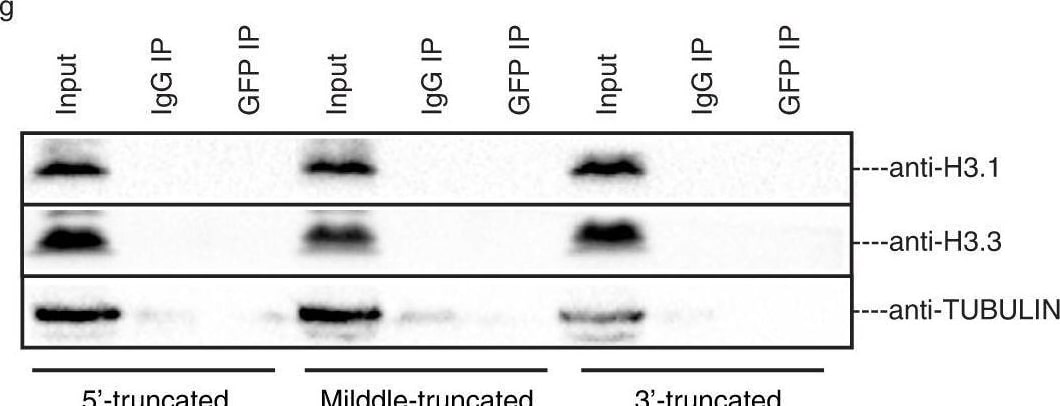
Western Blot: Histone H3.1 Antibody [NBP2-75524] -
Abnormal H3K9me3 is incidental to incorrect H3.1/3.2 incorporation introduced by major satellite RNA.a Immunostaining for H3.1/3.2 and H3.3 in representative pronucleus of Ctrl and MajSat_OE zygotes. Scale bars, 20 um. Representative images from 3 biological replicates, with each replicate containing at least 10 zygotes. b Scatterplot showing H3.1/3.2 and H3.3 fluorescence intensity mean values in pronucleus of Ctrl and MajSat_OE zygotes. The statistical data are expressed as mean +/- SEM, *p < 0.05 and ns means not significant (H3.1/3.2: male p = 0.0438, female p = 0.6590, H3.3: male p = 0.0380, female p = 0.5885) by two-sided Student’s t test for each comparison. Each treatment contains 3 biological replicates, with each replicate containing at least 5 zygotes. c Immunostaining for H3K14ac in representative pronucleus of Ctrl and Lsm1_KD zygote. Scale bars, 20 um. Representative images from 3 biological replicates, with each replicate containing at least 10 zygotes. d Immunostaining for H3K14ac in representative pronucleus of Ctrl and MajSat_OE zygote. Scale bars, 20 um. Representative images from 3 biological replicates, with each replicate containing at least 10 zygotes. e Scheme for the RNA pulldown to determine the interaction between MajSat RNA and H3.1/H3.3. f, g Pulldown of H3.1, H3.3 using intact and truncated MajSat RNA. Representative images from 3 biological replicates. Image collected and cropped by CiteAb from the following open publication (https://pubmed.ncbi.nlm.nih.gov/36810573), licensed under a CC-BY license. Not internally tested by Novus Biologicals.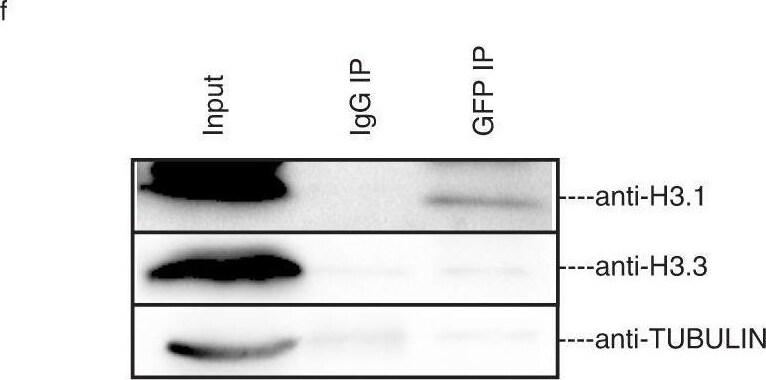
Western Blot: Histone H3.1 Antibody [NBP2-75524] -
Abnormal H3K9me3 is incidental to incorrect H3.1/3.2 incorporation introduced by major satellite RNA.a Immunostaining for H3.1/3.2 and H3.3 in representative pronucleus of Ctrl and MajSat_OE zygotes. Scale bars, 20 um. Representative images from 3 biological replicates, with each replicate containing at least 10 zygotes. b Scatterplot showing H3.1/3.2 and H3.3 fluorescence intensity mean values in pronucleus of Ctrl and MajSat_OE zygotes. The statistical data are expressed as mean +/- SEM, *p < 0.05 and ns means not significant (H3.1/3.2: male p = 0.0438, female p = 0.6590, H3.3: male p = 0.0380, female p = 0.5885) by two-sided Student’s t test for each comparison. Each treatment contains 3 biological replicates, with each replicate containing at least 5 zygotes. c Immunostaining for H3K14ac in representative pronucleus of Ctrl and Lsm1_KD zygote. Scale bars, 20 um. Representative images from 3 biological replicates, with each replicate containing at least 10 zygotes. d Immunostaining for H3K14ac in representative pronucleus of Ctrl and MajSat_OE zygote. Scale bars, 20 um. Representative images from 3 biological replicates, with each replicate containing at least 10 zygotes. e Scheme for the RNA pulldown to determine the interaction between MajSat RNA and H3.1/H3.3. f, g Pulldown of H3.1, H3.3 using intact and truncated MajSat RNA. Representative images from 3 biological replicates. Image collected and cropped by CiteAb from the following open publication (https://pubmed.ncbi.nlm.nih.gov/36810573), licensed under a CC-BY license. Not internally tested by Novus Biologicals.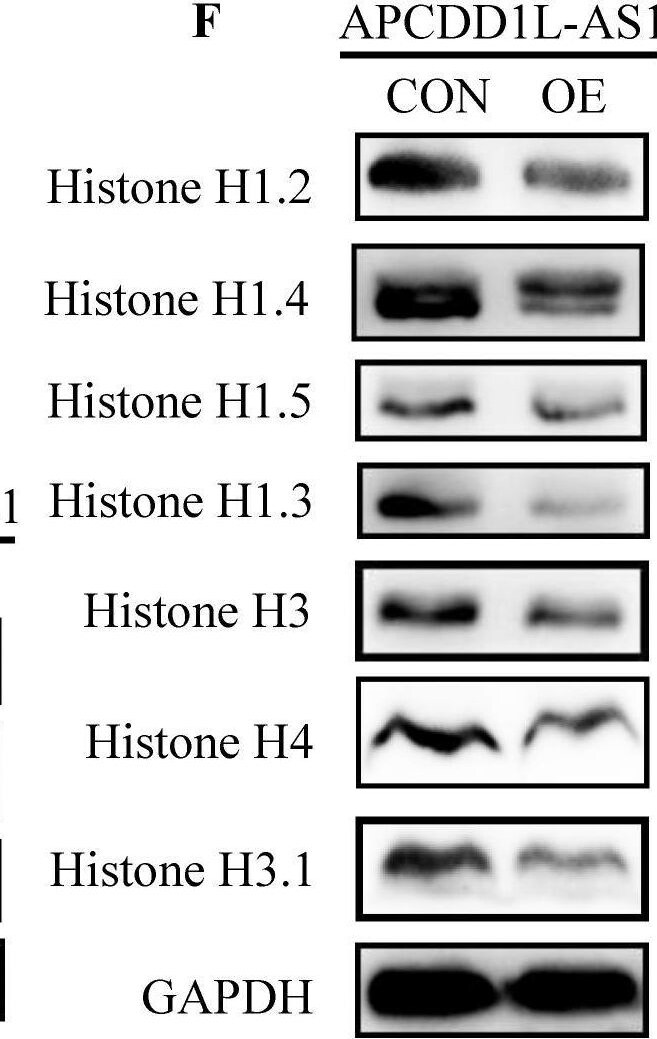
Western Blot: Histone H3.1 Antibody [NBP2-75524] -
APCDD1L-AS1 overexpression induced histones expression disorders. A The overexpression efficiency of APCDD1L-AS1 in OSRC2 cells. B The TMT results showed that 39 proteins were downregulated and 66 proteins were upregulated in APCDD1L-AS1 overexpressed OSRC2 cells compared with its control cells. C Biological Process GO term enrichment analysis results of the complete 105 statistically significant proteins. D The TMT results of Histone H3.1, Histone H4, Histone H3, Histone H1.3, Histone H1.5, Histone H1.4 and Histone H1.2. E The protein expression of Histone H3.1, Histone H4, Histone H3, Histone H1.3, Histone H1.5, Histone H1.4 and Histone H1.2 in the same cell protein samples. F The protein expression of Histone H3.1, Histone H4, Histone H3, Histone H1.3, Histone H1.5, Histone H1.4 and Histone H1.2 in the in mice tumors. Image collected and cropped by CiteAb from the following open publication (https://pubmed.ncbi.nlm.nih.gov/35414787), licensed under a CC-BY license. Not internally tested by Novus Biologicals.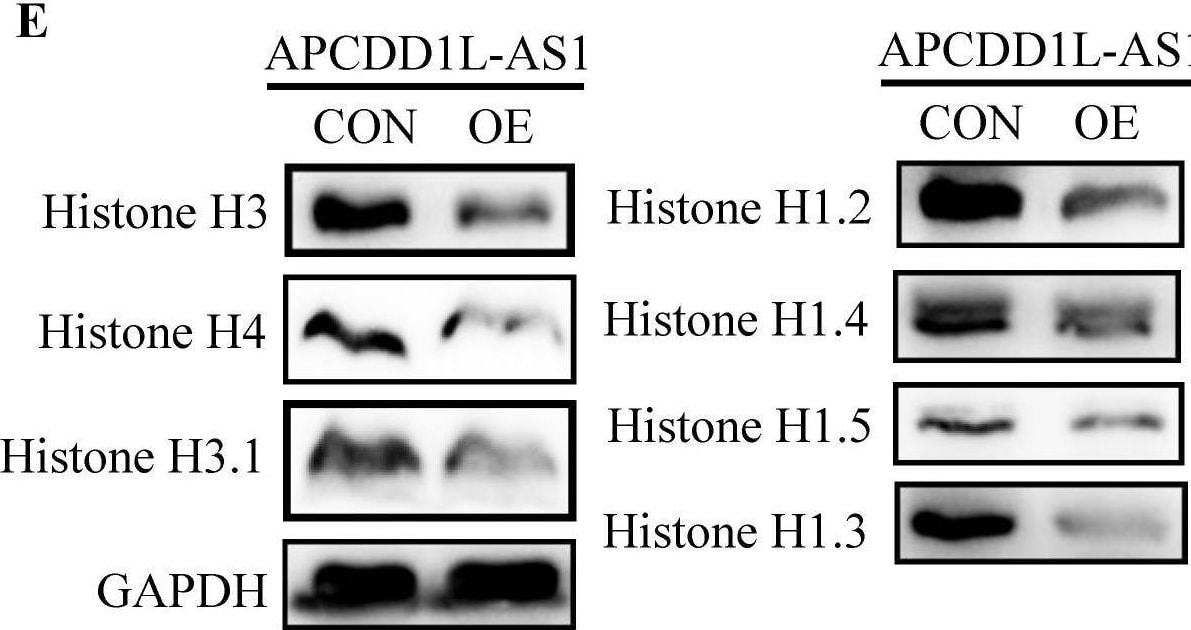
Western Blot: Histone H3.1 Antibody [NBP2-75524] -
APCDD1L-AS1 overexpression induced histones expression disorders. A The overexpression efficiency of APCDD1L-AS1 in OSRC2 cells. B The TMT results showed that 39 proteins were downregulated and 66 proteins were upregulated in APCDD1L-AS1 overexpressed OSRC2 cells compared with its control cells. C Biological Process GO term enrichment analysis results of the complete 105 statistically significant proteins. D The TMT results of Histone H3.1, Histone H4, Histone H3, Histone H1.3, Histone H1.5, Histone H1.4 and Histone H1.2. E The protein expression of Histone H3.1, Histone H4, Histone H3, Histone H1.3, Histone H1.5, Histone H1.4 and Histone H1.2 in the same cell protein samples. F The protein expression of Histone H3.1, Histone H4, Histone H3, Histone H1.3, Histone H1.5, Histone H1.4 and Histone H1.2 in the in mice tumors. Image collected and cropped by CiteAb from the following open publication (https://pubmed.ncbi.nlm.nih.gov/35414787), licensed under a CC-BY license. Not internally tested by Novus Biologicals.![Histone H3.1 Antibody Western Blot: Histone H3.1 Antibody [NBP2-75524]](https://resources.rndsystems.com/images/products/nbp2-75524_-western-blot-639204586675750410.jpg "Western Blot: Histone H3.1 Antibody [NBP2-75524]")
Western Blot: Histone H3.1 Antibody [NBP2-75524]
Western blot analysis of Histone H3.1 on F9 cell lysate using NBP2-75524 at 1/1,000 dilution.Applications for Histone H3.1 Antibody
Application
Recommended Usage
Immunocytochemistry/ Immunofluorescence
1:50-1:200
Immunohistochemistry-Paraffin
1:50-1:200
Western Blot
1:500-1:1000
Formulation, Preparation, and Storage
Purification
Immunogen affinity purified
Formulation
PBS (pH7.4), 0.2% BSA, 50% Glycerol
Preservative
0.05% Sodium Azide
Concentration
1 mg/ml
Shipping
The product is shipped with polar packs. Upon receipt, store it immediately at the temperature recommended below.
Stability & Storage
Store at 4C short term. Aliquot and store at -20C long term. Avoid freeze-thaw cycles.
Background: Histone H3.1
Long Name
Histone Cluster 1 H3 Family Member A
Alternate Names
HIST1H3A
Gene Symbol
H3C6
Additional Histone H3.1 Products
Product Documents for Histone H3.1 Antibody
Certificate of Analysis
To download a Certificate of Analysis, please enter a lot or batch number in the search box below.
Product Specific Notices for Histone H3.1 Antibody
This product is for research use only and is not approved for use in humans or in clinical diagnosis. Primary Antibodies are guaranteed for 1 year from date of receipt.
Related Research Areas
Citations for Histone H3.1 Antibody
 Powered by Bioz
Customer Reviews for Histone H3.1 Antibody
There are currently no reviews for this product. Be the first to review Histone H3.1 Antibody and earn rewards!
Have you used Histone H3.1 Antibody?
Submit a review and receive an Amazon gift card!
$25/€18/£15/$25CAN/¥2500 for a review with an image
$10/€7/£6/$10CAN/¥1110 for a review without an image
Submit a review
Protocols
Find general support by application which include: protocols, troubleshooting, illustrated assays, videos and webinars.
- Antigen Retrieval Protocol (PIER)
- Antigen Retrieval for Frozen Sections Protocol
- Appropriate Fixation of IHC/ICC Samples
- Cellular Response to Hypoxia Protocols
- Chromogenic IHC Staining of Formalin-Fixed Paraffin-Embedded (FFPE) Tissue Protocol
- Chromogenic Immunohistochemistry Staining of Frozen Tissue
- ClariTSA™ Fluorophore Kits
- Detection & Visualization of Antibody Binding
- Fluorescent IHC Staining of Frozen Tissue Protocol
- Graphic Protocol for Heat-induced Epitope Retrieval
- Graphic Protocol for the Preparation and Fluorescent IHC Staining of Frozen Tissue Sections
- Graphic Protocol for the Preparation and Fluorescent IHC Staining of Paraffin-embedded Tissue Sections
- Graphic Protocol for the Preparation of Gelatin-coated Slides for Histological Tissue Sections
- ICC Cell Smear Protocol for Suspension Cells
- ICC Immunocytochemistry Protocol Videos
- ICC for Adherent Cells
- IHC Sample Preparation (Frozen sections vs Paraffin)
- Immunocytochemistry (ICC) Protocol
- Immunocytochemistry Troubleshooting
- Immunofluorescence of Organoids Embedded in Cultrex Basement Membrane Extract
- Immunofluorescent IHC Staining of Formalin-Fixed Paraffin-Embedded (FFPE) Tissue Protocol
- Immunohistochemistry (IHC) and Immunocytochemistry (ICC) Protocols
- Immunohistochemistry Frozen Troubleshooting
- Immunohistochemistry Paraffin Troubleshooting
- Preparing Samples for IHC/ICC Experiments
- Preventing Non-Specific Staining (Non-Specific Binding)
- Primary Antibody Selection & Optimization
- Protocol for Heat-Induced Epitope Retrieval (HIER)
- Protocol for Making a 4% Formaldehyde Solution in PBS
- Protocol for VisUCyte™ HRP Polymer Detection Reagent
- Protocol for the Fluorescent ICC Staining of Cell Smears - Graphic
- Protocol for the Fluorescent ICC Staining of Cultured Cells on Coverslips - Graphic
- Protocol for the Preparation & Fixation of Cells on Coverslips
- Protocol for the Preparation and Chromogenic IHC Staining of Frozen Tissue Sections
- Protocol for the Preparation and Chromogenic IHC Staining of Frozen Tissue Sections - Graphic
- Protocol for the Preparation and Chromogenic IHC Staining of Paraffin-embedded Tissue Sections
- Protocol for the Preparation and Chromogenic IHC Staining of Paraffin-embedded Tissue Sections - Graphic
- Protocol for the Preparation and Fluorescent ICC Staining of Cells on Coverslips
- Protocol for the Preparation and Fluorescent ICC Staining of Non-adherent Cells
- Protocol for the Preparation and Fluorescent ICC Staining of Stem Cells on Coverslips
- Protocol for the Preparation and Fluorescent IHC Staining of Frozen Tissue Sections
- Protocol for the Preparation and Fluorescent IHC Staining of Paraffin-embedded Tissue Sections
- Protocol for the Preparation of Gelatin-coated Slides for Histological Tissue Sections
- Protocol for the Preparation of a Cell Smear for Non-adherent Cell ICC - Graphic
- R&D Systems Quality Control Western Blot Protocol
- TUNEL and Active Caspase-3 Detection by IHC/ICC Protocol
- The Importance of IHC/ICC Controls
- Troubleshooting Guide: Immunohistochemistry
- Troubleshooting Guide: Western Blot Figures
- Western Blot Conditions
- Western Blot Protocol
- Western Blot Protocol for Cell Lysates
- Western Blot Troubleshooting
- Western Blot Troubleshooting Guide
- View all Protocols, Troubleshooting, Illustrated assays and Webinars
Loading...