
Axl (Ufo, Ark), Dtk (Sky, Tyro3, Rse, Brt), and Mer (human and mouse homologues of chicken c-Eyk) constitute a subfamily of the receptor tyrosine kinases (1,2). The extracellular domains of these proteins contain two Ig-like motifs and two fibronectin type III motifs. This characteristic topology is also found in neural cell adhesion molecules and in receptor tyrosine phosphatases. The human Axl cDNA encodes an 887 amino acid (aa) precursor that includes an 18 aa signal sequence, a 426 aa extracellular domain, a 21 aa transmembrane segment, and a 422 aa cytoplasmic domain. The extracellular domains of human and mouse Axl share 81% aa sequence identity. A short alternately spliced form of human Axl is distinguished by a 9 aa deletion in the extracellular juxtamembrane region. These receptors bind the vitamin K-dependent protein growth arrest specific gene 6 (Gas6) which is structurally related to the anticoagulation factor protein S. Binding of Gas6 induces receptor autophosphorylation and downstream signaling pathways that can lead to cell proliferation, migration, or the prevention of apoptosis (3). This family of tyrosine kinase receptors is involved in hematopoiesis, embryonic development, tumorigenesis, and regulation of testicular functions.
Human Axl Antibody (108724) [APC]
R&D Systems | Catalog # FAB154A

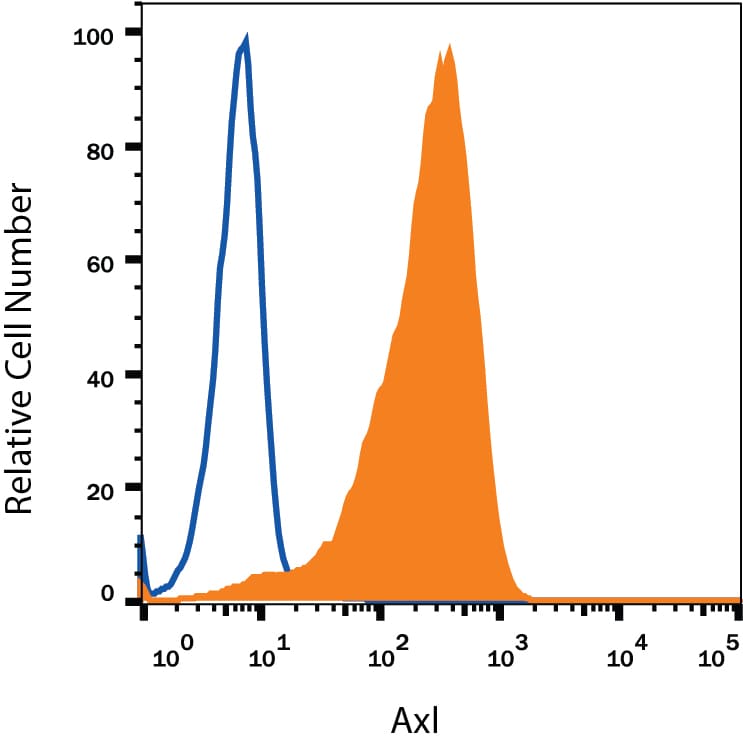
Scientific images may be resized, cropped, or adjusted for brightness or contrast for presentation purposes. These updates are limited to presentation and do not affect the underlying scientific interpretation of the data. Where available, additional source data may be provided upon request.
Key Product Details
Validated by
Species Reactivity
Validated:
Cited:
Applications
Validated:
Cited:
Label
Antibody Source
Product Specifications
Immunogen
Met1-Pro440
Accession # AAA61243
Specificity
Clonality
Host
Isotype
Scientific Data Images for Human Axl Antibody (108724) [APC]
Detection of Axl in HeLa Human Cell Line by Flow Cytometry.
HeLa human cervical epithelial carcinoma cell line was stained with Mouse Anti-Human Axl APC-conjugated Monoclonal Antibody (Catalog # FAB154A, filled histogram) or isotype control antibody (Catalog # IC002A, open histogram). View our protocol for Staining Membrane-associated Proteins.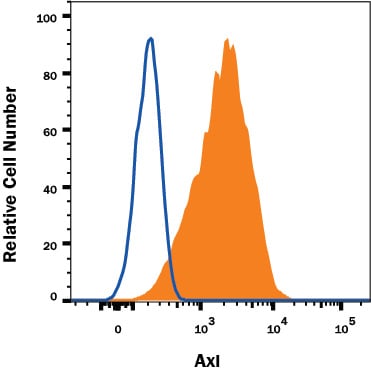
Detection of Axl in A431 Human Cell Line by Flow Cytometry.
A431 human epithelial carcinoma cell line was stained with APC-conjugated Mouse Anti-Human Axl Monoclonal Antibody (Catalog # FAB154A, filled histogram) or isotype control antibody (Catalog # IC002A, open histogram). View our protocol for Staining Membrane-associated Proteins.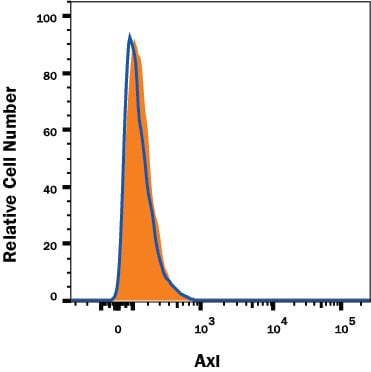
Axl Specificity is Shown by Flow Cytometry in Knockout Cell Line.
Axl knockout A431 human epithelial carcinoma cell line was stained with APC-conjugated Mouse Anti-Human Axl Monoclonal Antibody (Catalog # FAB154A, filled histogram) or isotype control antibody (Catalog # IC002A, open histogram). No staining in the Axl knockout A431 cell line was observed. View our protocol for Staining Membrane-associated Proteins.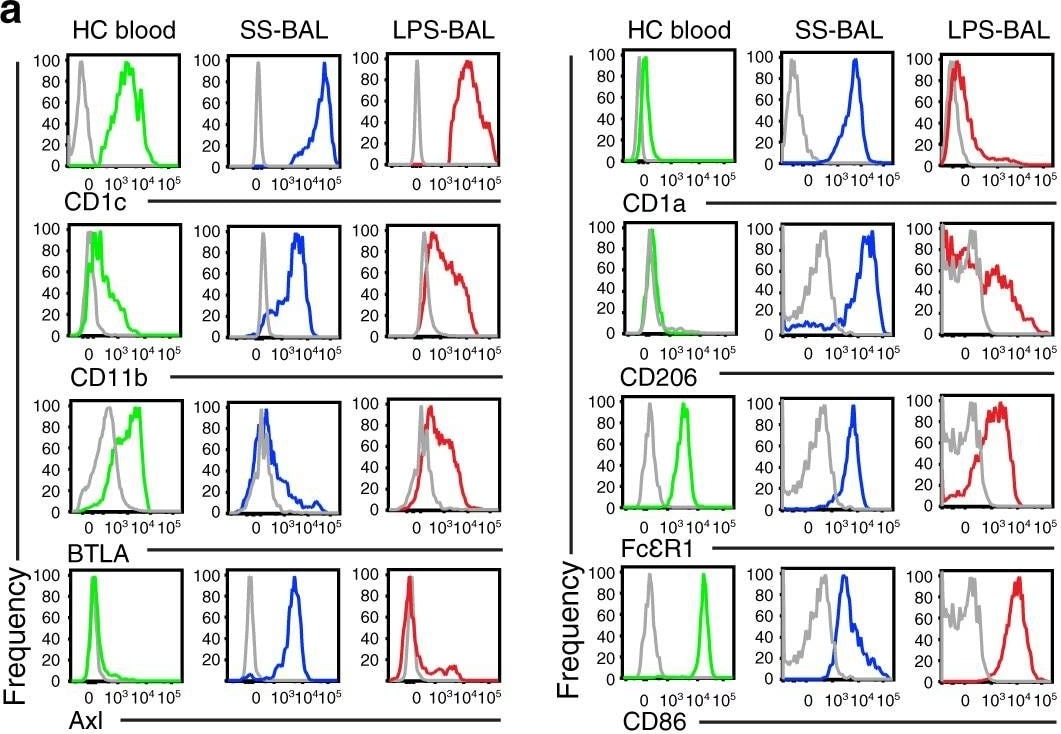
Detection of Human Axl by Flow Cytometry
CD1c+ DCs in LPS-BAL are likely to be tissue-recruited blood CD1c+ DCs. a Expression of surface antigens by flow cytometry on DC2/3 from HC blood (green), SS-BAL (blue) and LPS-BAL (red) relative to isotype control (gray). Antigens predicted to discriminate between blood and tissue CD1c+ DCs were tested. Representative plots from more than three experiments are shown. b Dendrogram showing hierarchical clustering of monocyte/macrophage and DC gene expression by indicated subsets isolated from HC blood and SS/LPS BAL. In vitro monocyte-derived DCs were also included. Clustering used Pearson correlation metric. Monocyte/macrophage and DC identifying genes were taken from McGovern et al.28. The 25 genes available on the NanoString Immunology v2 panel were used. c Proliferation of allogeneic peripheral blood T cells measured by CSFE dilution during 7-day co-culture with or without MP subsets isolated from LPS BAL. Flow cytometry plots are gated on CD3+ T cells from a representative experiment. Summary graph shows 2–3 replicates per subset. Bars show mean ± SEM. Means were compared by one-way ANOVA with Dunnett’s multiple comparison test of DC2/3 against other subsets. *p < 0.05. d Analysis of differentially expressed genes (DEGs) by DC2/3 from SS/LPS-BAL and HC blood. Comparisons were made by unpaired t-test with p < 0.05 and >3-fold difference in mean expression. Venn diagram shows DEGs in DC2/3 from SS-BAL, LPS-BAL, and HC blood. Circles represent DEGs between SS BAL and blood (cyan; 154 genes, 33%) and between LPS-BAL and blood (yellow; 124 genes, 39%). The overlapping circles represents DEGs shared between comparisons (100 genes, 21%). The top 10 upregulated genes (standard type) and top 5 downregulated genes (italic type) in BAL relative to blood are listed. Heatmap shows DEGs common to DC2/3 in both SS-BAL and LPS-BAL relative to HC blood. Genes with >10-fold difference in mean expression are shown. Genes discussed in the text are colored burgundy. e Heatmap showin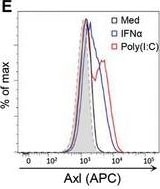
Detection of Human Axl by Flow Cytometry
Inflammatory stimuli associated with viral infections upregulate Axl and promote Gas6 binding to macrophages. (A–E) MDMs were stimulated for 24 h with dexamethasone (Dex), LPS, IFN‐ gamma, poly(I:C) or IFN‐ alpha. (A) MerTK and (C) Axl protein expression determined by ELISA of total cell lysates (mean+SEM, n = 4). (B) MerTK and (D) Axl protein expression analyzed by western blotting; actin was used as loading control. A representative of two to three independent experiments is shown. (E) Flow cytometric analysis of Axl expression on MDMs stimulated with poly(I:C) or IFN‐ alpha for 24 h. Representative histograms of two independent experiments are shown; dotted line/shaded: FMO control. (F) Axl and MerTK relative mRNA and (G) protein expression in MDMs differentiated by 6‐day culture in M‐CSF or GM‐CSF determined by qPCR (mean+SEM, n = 6) and by ELISA of total cell lysates (mean+SEM, n = 3), respectively. (H) Axl, MerTK and Tyro3 relative mRNA expression in MDMs stimulated as in (A–C) analyzed by qPCR (mean+SEM, n = 2–3). (I and J) Flow cytometric analysis of Gas6 binding to MDMs stimulated with poly(I:C) for 24 h. (I) Representative of four independent experiments is shown; dotted line/shaded: isotype control. (J) Ratio of Gas6 to isotype control geometric mean fluorescence intensity (MFI)+SEM in unstimulated and poly(I:C)‐stimulated MDMs (n = 4). *p < 0.01, paired t‐test. ELISA and qPCR samples were assayed in duplicate. Image collected and cropped by CiteAb from the following publication (https://pubmed.ncbi.nlm.nih.gov/29400409), licensed under a CC-BY license. Not internally tested by R&D Systems.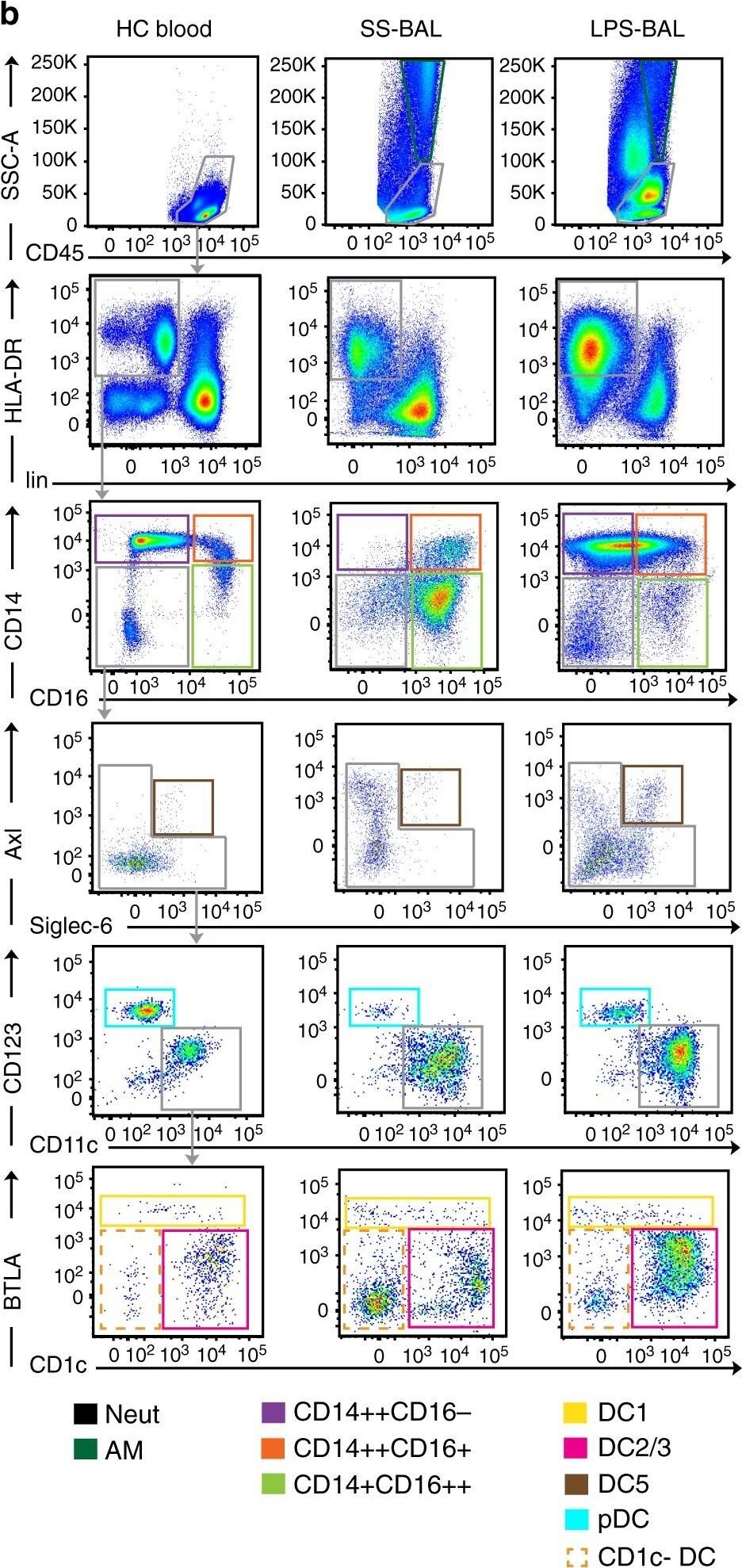
Detection of Human Axl by Flow Cytometry
Neutrophils and mononuclear phagocytes are expanded in the alveolar airspace following LPS inhalation. a Schematic overview of study design. Solid arrows denote LPS inhalation (red) or saline inhalation control (blue). Black arrows denote blood sampling. Dashed arrows denote BAL. b Flow cytometry of leukocyte preparations from SS-BAL, LPS-BAL, and HC blood. The CD45 versus SSC plot was used to define CD45+SSChi AM, CD45loSSCmid neutrophils and CD45+SSClo mononuclear cells (see also Supplementary Fig. 1). Monocyte/macrophages and DCs were negative for lineage markers CD3, CD19, CD20, and CD56 and expressed HLA-DR. Monocyte/macrophages were divided into CD14++CD16−, CD14++CD16+, and CD14-CD16++ populations analogous to blood classical, intermediate and non-classical monocytes. DCs within the CD14-CD16− gate were divided into subsets: Axl+Siglec6+ DC5s, CD11cloCD123+ pDCs, CD1c+BTLAlo-mid DC2/3s, and BTLAhi DC1s. Plots are representative of n = 9 SS BAL and n = 10 LPS BAL. c Concentrations of neutrophil, monocyte/macrophage and DC subsets in SS-BAL and LPS BAL. Bars represent mean and lines SEM. p-values from unpaired t-tests of SS versus LPS are shown: “ns” p > 0.05, *p < 0.05, **p < 0.01, ***p < 0.001, ****p < 0.0001. d Monocyte/macrophage and DC frequency in HC blood, SS-BAL and LPS-BAL as a proportion of SSClo MHC class II-expressing cells (not-including CD1c- DCs). e Concentration of selected leukocyte populations in peripheral blood at 2-h intervals following inhalation of saline (blue line) or LPS (red line). Data points show mean ± SEM for 3–5 participants. p-values from one-way ANOVA are shown. p-value representation is described in c Image collected and cropped by CiteAb from the following publication (https://pubmed.ncbi.nlm.nih.gov/31040289), licensed under a CC-BY license. Not internally tested by R&D Systems.Applications for Human Axl Antibody (108724) [APC]
Flow Cytometry
Sample: HeLa human cervical epithelial carcinoma cell line, and A431 human epithelial carcinoma cell line
Knockout Validated
Reviewed Applications
Read 3 reviews rated 4.3 using FAB154A in the following applications:
Spectra Viewer
Plan Your Experiments
Use our spectra viewer to interactively plan your experiments, assessing multiplexing options. View the excitation and emission spectra for our fluorescent dye range and other commonly used dyes.
Spectra Viewer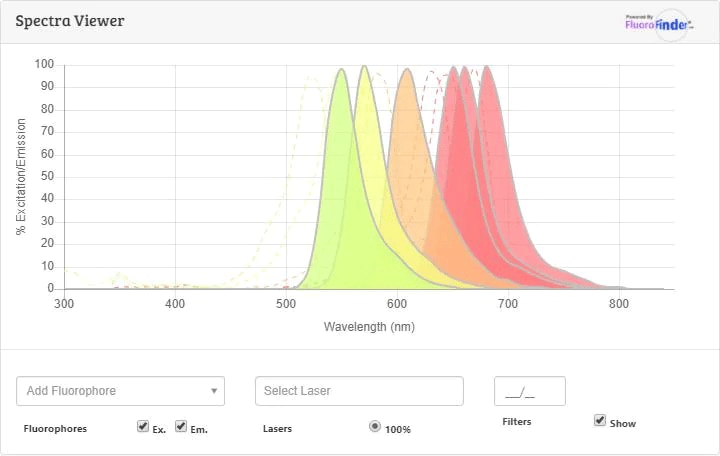
Flow Cytometry Panel Builder
Bio-Techne Knows Flow Cytometry
Save time and reduce costly mistakes by quickly finding compatible reagents using the Panel Builder Tool.
Advanced Features
- Spectra Viewer - Custom analysis of spectra from multiple fluorochromes
- Spillover Popups - Visualize the spectra of individual fluorochromes
- Antigen Density Selector - Match fluorochrome brightness with antigen density

Formulation, Preparation, and Storage
Purification
Formulation
Shipping
Stability & Storage
- 12 months from date of receipt, 2 to 8 °C as supplied.
Background: Axl
References
- Yanagita, M. (2004) Curr. Opin. Nephrol. Hypertens. 13:465.
- Nagata, K. et al. (1996) J. Biol. Chem. 22:30022.
- Holland, S. et al. (2005) Canc. Res. 65:9294.
Long Name
Alternate Names
Gene Symbol
UniProt
Additional Axl Products
Product Documents for Human Axl Antibody (108724) [APC]
Certificate of Analysis
To download a Certificate of Analysis, please enter a lot or batch number in the search box below.
Note: Certificate of Analysis not available for kit components.
Product Specific Notices for Human Axl Antibody (108724) [APC]
For research use only
Related Research Areas
Citations for Human Axl Antibody (108724) [APC]
 Powered by Bioz
Customer Reviews for Human Axl Antibody (108724) [APC] (3)
Have you used Human Axl Antibody (108724) [APC]?
Submit a review and receive an Amazon gift card!
$25/€18/£15/$25CAN/¥2500 for a review with an image
$10/€7/£6/$10CAN/¥1110 for a review without an image
Submit a review
Customer Images
![Human Axl Antibody (108724) [APC] FAB154A](https://resources.rndsystems.com/images/reviews/review_fab154a_26946_0.jpg)
![Human Axl Antibody (108724) [APC] FAB154A](https://resources.rndsystems.com/images/reviews/review_fab154a_4621.jpg)
![Human Axl Antibody (108724) [APC] FAB154A](https://resources.rndsystems.com/images/reviews/review_fab154a_3136.png)
-
Application: Flow CytometrySample Tested: Blood mononuclear cells (PBMCs)Species: HumanVerified Customer | Posted 06/03/2018the gating was based on FMO control. In my hand, Axl antibody with APC works better than PE.
![Human Axl Antibody (108724) [APC] FAB154A](data:image/png;base64,R0lGODlhAQABAAD/ACwAAAAAAQABAAACADs=)
-
Application: Flow CytometrySample Tested: ASTROCYTESpecies: HumanVerified Customer | Posted 09/10/2016
-
Application: Flow CytometrySample Tested: Human AML cellsSpecies: HumanVerified Customer | Posted 07/13/2016
There are no reviews that match your criteria.
Protocols
Find general support by application which include: protocols, troubleshooting, illustrated assays, videos and webinars.
- 7-Amino Actinomycin D (7-AAD) Cell Viability Flow Cytometry Protocol
- Extracellular Membrane Flow Cytometry Protocol
- Flow Cytometry Protocol for Cell Surface Markers
- Flow Cytometry Protocol for Staining Membrane Associated Proteins
- Flow Cytometry Staining Protocols
- Flow Cytometry Troubleshooting Guide
- Intracellular Flow Cytometry Protocol Using Alcohol (Methanol)
- Intracellular Flow Cytometry Protocol Using Detergents
- Intracellular Nuclear Staining Flow Cytometry Protocol Using Detergents
- Intracellular Staining Flow Cytometry Protocol Using Alcohol Permeabilization
- Intracellular Staining Flow Cytometry Protocol Using Detergents to Permeabilize Cells
- Propidium Iodide Cell Viability Flow Cytometry Protocol
- Protocol for Liperfluo
- Protocol for the Characterization of Human Th22 Cells
- Protocol for the Characterization of Human Th9 Cells
- Protocol: Annexin V and PI Staining by Flow Cytometry
- Protocol: Annexin V and PI Staining for Apoptosis by Flow Cytometry
- Troubleshooting Guide: Fluorokine Flow Cytometry Kits
- View all Protocols, Troubleshooting, Illustrated assays and Webinars