
BCMA, B cell maturation, is a member of the TNF receptor superfamily. It has been designated TNFRSF17. BCMA is a type III membrane protein containing one extracellular cysteine rich domain. Within the TNFRSF, it shares the highest homology with TACI. BCMA and TACI have both been shown to bind to APRIL and BAFF, members of the TNF ligand superfamily. BCMA expression has been found in immune organs and mature B cell lines. Although some expression has been observed at the cell surface, BCMA appears to be localized to the Golgi compartment. The binding of BCMA to APRIL or BAFF has been shown to stimulate IgM production in peripheral blood B cells and increase the survival of cultured B cells. This data suggests that BCMA may play an important role in B cell development, function and regulation. Human BCMA is a 184 amino acid (aa) protein consisting of a 54 aa extracellular domain, a 23 aa transmembrane domain, and a 107 aa intracellular domain. Mouse and human BCMA share 62% amino acid identity.

Scientific images may be resized, cropped, or adjusted for brightness or contrast for presentation purposes. These updates are limited to presentation and do not affect the underlying scientific interpretation of the data. Where available, additional source data may be provided upon request.
Key Product Details
Species Reactivity
Validated:
Cited:
Applications
Validated:
Cited:
Label
Antibody Source
Product Specifications
Immunogen
Met1-Ala54
Accession # Q6PE46
Specificity
Clonality
Host
Isotype
Endotoxin Level
Scientific Data Images for Human BCMA/TNFRSF17 Antibody
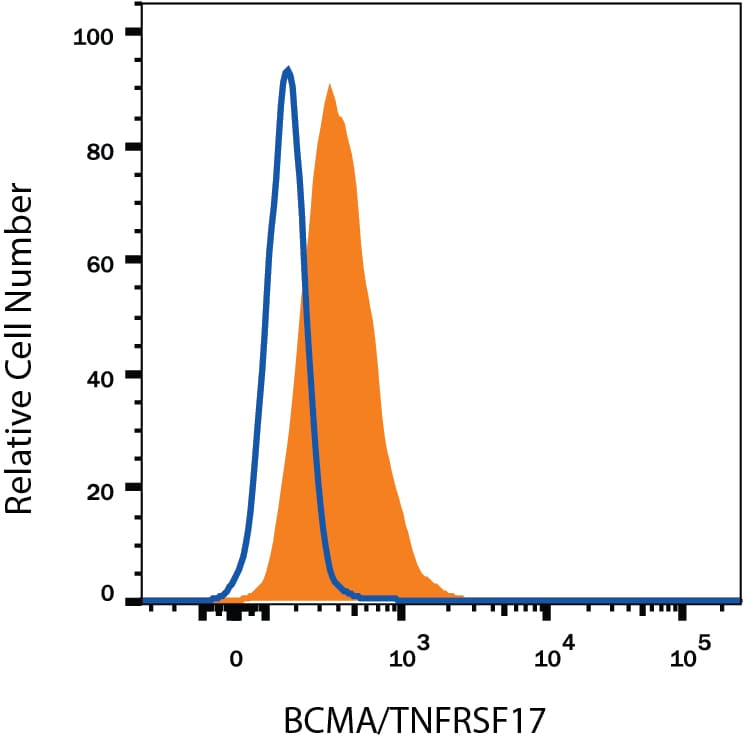
Detection of BCMA/TNFRSF17 in U266 Human Cell Line by Flow Cytometry.
U266 human myeloma cell line was stained with Goat Anti-Human BCMA/TNFRSF17 Antigen Affinity-purified Polyclonal Antibody (Catalog # AF193, filled histogram) or isotype control antibody (Catalog # AB-108-C, open histogram), followed by Phycoerythrin-conjugated Anti-Goat IgG Secondary Antibody (Catalog # F0107).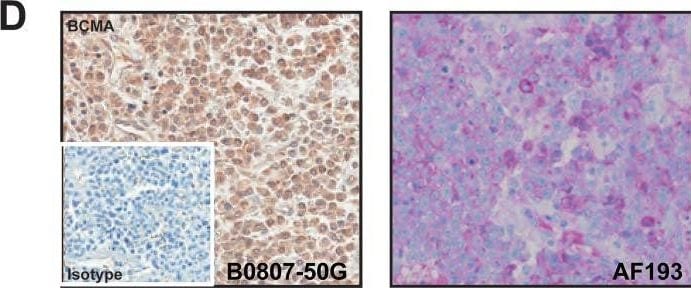
Detection of BCMA/TNFRSF17 by Immunohistochemistry
BCMA expression on MM patient samples(A) An example of flow cytometry analysis of a bone marrow (BM) sample from an MM patient is shown. Plasma cells (PC; both malignant and non-malignant) were identified by gating bone marrow on live single cells followed by using CD38 and CD45 staining as shown. Malignant PCs were evaluated for BCMA expression with fluorescence minus one, FMO, used as control. (B) Ten consecutive MM patients were analyzed for BCMA expression as in Figure 1A. BCMA median expression was 86% (red line). (C) BCMA expression (dark histogram) on 3 established multiple myeloma cell lines assessed by flow cytometer. The lighter histogram shows staining of a matched isotype control. (D) Representative immunohistochemical staining of a bone marrow biopsy specimen stained for BCMA using two commercially available antibodies, B0807-50G (brown staining, primary antibody concentration of 0.6 μg/ml, US Biological) and AF193 (magenta staining, primary antibody concentration of 2.0 μgml, R&D Systems). Image collected and cropped by CiteAb from the following open publication (https://pubmed.ncbi.nlm.nih.gov/29899820), licensed under a CC-BY license. Not internally tested by R&D Systems.
Human BCMA / TNFRSF17 ELISA Standard Curve
Recombinant Human BCMA/TNFRSF17 Fc Chimera (Catalog # 193-BC) was serially diluted and captured by Goat Anti-Human BCMA/TNFRSF17 Antigen Affinity-purified Polyclonal Antibody (Catalog # AF193) coated on a Clear Polystyrene Microplate (Catalog # DY990). Goat Anti-Human BCMA/TNFRSF17 Antigen Affinity-purified Polyclonal Antibody (Catalog # AF193) was biotinylated and incubated with the protein captured on the plate. Detection of the standard curve was achieved by incubating Streptavidin-HRP (Catalog # DY998)
Human BCMA / TNFRSF17 ELISA Standard Curve
Recombinant Human BCMA/TNFRSF17 Fc Chimera (Catalog # 193-BC) was serially diluted and captured by Goat Anti-Human BCMA/TNFRSF17 Antigen Affinity-purified Polyclonal Antibody (Catalog # AF193) coated on a Clear Polystyrene Microplate (Catalog # DY990). Goat Anti-Human BCMA/TNFRSF17 Antigen Affinity-purified Polyclonal Antibody (Catalog # AF193) was biotinylated and incubated with the protein captured on the plate. Detection of the standard curve was achieved by incubating Streptavidin-HRP (Catalog # DY998)Applications for Human BCMA/TNFRSF17 Antibody
Blockade of Receptor-ligand Interaction
CyTOF-ready
ELISA
This antibody functions as an ELISA detection antibody when paired with Mouse Anti-Human BCMA/TNFRSF17 Monoclonal Antibody(Catalog # MAB1932).
This product is intended for assay development on various assay platforms requiring antibody pairs. We recommend the Human BCMA/TNFRSF17 DuoSet ELISA Kit (Catalog # DY193) for convenient development of a sandwich ELISA.
Flow Cytometry
Sample: U266 human myeloma cell line
Western Blot
Sample: Recombinant Human BCMA/TNFRSF17 Fc Chimera (Catalog # 193-BC)
Human BCMA/TNFRSF17 Sandwich Immunoassay
Reviewed Applications
Read 1 review rated 5 using AF193 in the following applications:
Flow Cytometry Panel Builder
Bio-Techne Knows Flow Cytometry
Save time and reduce costly mistakes by quickly finding compatible reagents using the Panel Builder Tool.
Advanced Features
- Spectra Viewer - Custom analysis of spectra from multiple fluorochromes
- Spillover Popups - Visualize the spectra of individual fluorochromes
- Antigen Density Selector - Match fluorochrome brightness with antigen density

Formulation, Preparation, and Storage
Purification
Reconstitution
Reconstitute at 0.2 mg/mL in sterile PBS. For liquid material, refer to CoA for concentration.
Formulation
Shipping
Stability & Storage
- 12 months from date of receipt, -20 to -70 °C as supplied.
- 1 month, 2 to 8 °C under sterile conditions after reconstitution.
- 6 months, -20 to -70 °C under sterile conditions after reconstitution.
Calculators
Background: BCMA/TNFRSF17
References
- Madry, C. et al. (1998) Int. Immunol. 10:1693.
- Gras, M. et al. (1995) Int. Immunol. 7:1093.
- Kwon, B. et al. (1999) Curr. Opin. Immunol. 11:340.
- Marsters, S. et al. (2000) Curr. Biol. 10:785.
- Thompson, J. et al. (2000) J. Exp. Med. 192:129.
Long Name
Alternate Names
Gene Symbol
UniProt
Additional BCMA/TNFRSF17 Products
Product Documents for Human BCMA/TNFRSF17 Antibody
Certificate of Analysis
To download a Certificate of Analysis, please enter a lot or batch number in the search box below.
Note: Certificate of Analysis not available for kit components.
Product Specific Notices for Human BCMA/TNFRSF17 Antibody
For research use only
Citations for Human BCMA/TNFRSF17 Antibody
 Powered by Bioz
Customer Reviews for Human BCMA/TNFRSF17 Antibody (1)
Have you used Human BCMA/TNFRSF17 Antibody?
Submit a review and receive an Amazon gift card!
$25/€18/£15/$25CAN/¥2500 for a review with an image
$10/€7/£6/$10CAN/¥1110 for a review without an image
Submit a review
-
Application: ELISASample Tested: See PMIC 22804669Species: HumanVerified Customer | Posted 01/05/2015
There are no reviews that match your criteria.
Protocols
Find general support by application which include: protocols, troubleshooting, illustrated assays, videos and webinars.
- 7-Amino Actinomycin D (7-AAD) Cell Viability Flow Cytometry Protocol
- Cellular Response to Hypoxia Protocols
- ELISA Sample Preparation & Collection Guide
- ELISA Troubleshooting Guide
- Extracellular Membrane Flow Cytometry Protocol
- Flow Cytometry Protocol for Cell Surface Markers
- Flow Cytometry Protocol for Staining Membrane Associated Proteins
- Flow Cytometry Staining Protocols
- Flow Cytometry Troubleshooting Guide
- How to Run an R&D Systems DuoSet ELISA
- How to Run an R&D Systems Quantikine ELISA
- How to Run an R&D Systems Quantikine™ QuicKit™ ELISA
- Intracellular Flow Cytometry Protocol Using Alcohol (Methanol)
- Intracellular Flow Cytometry Protocol Using Detergents
- Intracellular Nuclear Staining Flow Cytometry Protocol Using Detergents
- Intracellular Staining Flow Cytometry Protocol Using Alcohol Permeabilization
- Intracellular Staining Flow Cytometry Protocol Using Detergents to Permeabilize Cells
- Propidium Iodide Cell Viability Flow Cytometry Protocol
- Protocol for Liperfluo
- Protocol for the Characterization of Human Th22 Cells
- Protocol for the Characterization of Human Th9 Cells
- Protocol: Annexin V and PI Staining by Flow Cytometry
- Protocol: Annexin V and PI Staining for Apoptosis by Flow Cytometry
- Quantikine HS ELISA Kit Assay Principle, Alkaline Phosphatase
- Quantikine HS ELISA Kit Principle, Streptavidin-HRP Polymer
- R&D Systems Quality Control Western Blot Protocol
- Sandwich ELISA (Colorimetric) – Biotin/Streptavidin Detection Protocol
- Sandwich ELISA (Colorimetric) – Direct Detection Protocol
- Troubleshooting Guide: ELISA
- Troubleshooting Guide: Fluorokine Flow Cytometry Kits
- Troubleshooting Guide: Western Blot Figures
- Western Blot Conditions
- Western Blot Protocol
- Western Blot Protocol for Cell Lysates
- Western Blot Troubleshooting
- Western Blot Troubleshooting Guide
- View all Protocols, Troubleshooting, Illustrated assays and Webinars
Associated Pathways
