
CD99 antigen-like 2 (CD99-L2) is a 45 kDa type I transmembrane glycoprotein in the CD99 family of molecules (1‑3). The major form of human CD99-L2 cDNA encodes a 262 amino acid (aa) precursor with a 25 aa predicted signal sequence, a 160 aa extracellular domain (ECD), a 21 aa transmembrane (TM) segment, and a 56 aa cytoplasmic region (4). This form is called the long form, or isoform E3’-E4’-E3-E4. Other isoforms include the muscle E3-E4, missing aa 45‑93, and E4, a short form missing aa 45‑116 (1, 4). E3-E4 and E3’-E3-E4 forms are the major isoforms in mouse and rat, respectively (1). Human forms that diverge at Pro 45 (145 aa precursor) or Met 180 (173 aa precursor) have been sequenced, and would be predicted to lack a TM segment (4, 5). None of the forms contain predicted N-linked glycosylation sites within the ECD, but O-linked glycosylation is likely (1, 2). The ECD of the human CD99-L2 isoform E3-E4 shares 85%, 75% and 70% aa identity with the corresponding forms of mouse, rat, and bovine CD99-L2, respectively. The human CD99 and CD99-L2 ECDs share only about 35% aa identity, but both contain three conserved acidic motifs and are thought to originate from the same ancestral gene (1, 2). The nearly ubiquitous expression of CD99-L2 is similar to that of CD99. Human CD99-L2 cDNA is detected in most organs, but not in thymus (1). In the mouse, protein is detectable in lung, thymocytes, mouse leukocytes and vascular endothelial cells (1, 3, 6). The endothelial cell CD99-L2 is reported to mediate cell aggregation and neutrophil or monocyte, but not lymphocyte, extravasation to inflamed tissue in vivo (3, 6).
Human CD99-L2 Antibody
R&D Systems | Catalog # AF5185

Scientific images may be resized, cropped, or adjusted for brightness or contrast for presentation purposes. These updates are limited to presentation and do not affect the underlying scientific interpretation of the data. Where available, additional source data may be provided upon request.
Key Product Details
Species Reactivity
Validated:
Cited:
Applications
Validated:
Cited:
Label
Antibody Source
Product Specifications
Immunogen
Val20-Ala188
Accession # Q8TCZ2
Specificity
Clonality
Host
Isotype
Scientific Data Images for Human CD99-L2 Antibody
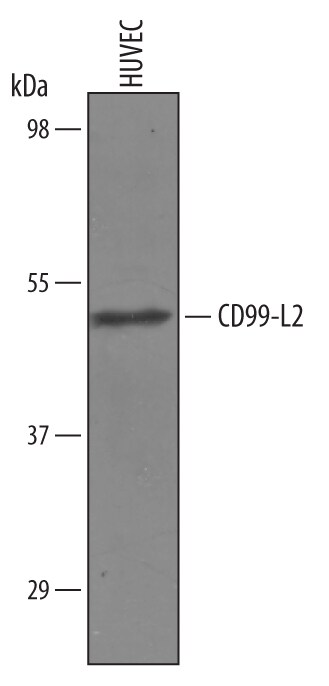
Detection of Human CD99‑L2 by Western Blot.
Western blot shows lysates of HUVEC human umbilical vein endothelial cells. PVDF Membrane was probed with 1 µg/mL of Sheep Anti-Human CD99-L2 Antigen Affinity-purified Polyclonal Antibody (Catalog # AF5185) followed by HRP-conjugated Anti-Sheep IgG Secondary Antibody (HAF016). A specific band was detected for CD99-L2 at approximately 50 kDa (as indicated). This experiment was conducted under reducing conditions and using Immunoblot Buffer Group 1.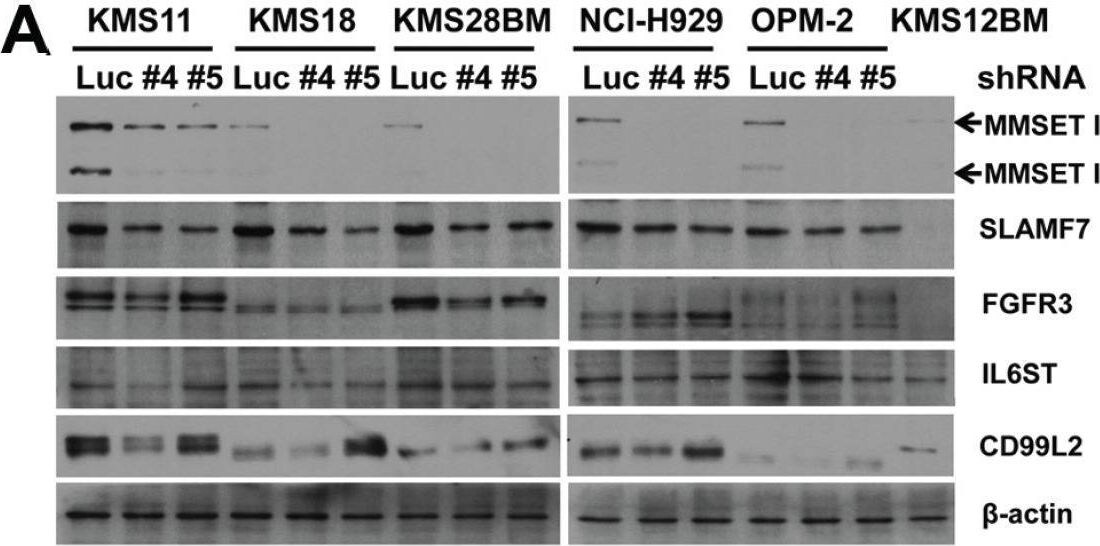
Detection of CD99-L2 by Western Blot
Validation of LC-MS/MS measurements with selected proteinsT(4;14) MM cell lines were treated with MMSET shRNAs for 3 days. (A) Whole cell lysates were prepared from infected cells and protein levels were analyzed by Western-blot. b-actin was used as an internal control. KMS12BM is a non-t(4;14) MM cell line, others are t(4;14) MM cell lines. (B) Determination of SLAMF7 expression in MM cell lines by indirect flow cytometric analysis. Ab control, isotype mouse IgG. ShLuc, control shRNA; Sh#4 and Sh#5, MMSET shRNAs. KMS11, KMS18, KMS28BM, NCI-H929 and OPM-2 are t(4;14) positive, other cell lines are t(4;14) negative. Results indicated SLAMF7 was universally over-expressed in t(4;14) MM cell lines and down-regulated by MMSET knockdown treatments. (C) Determination of SLAMF7 expression in primary MM cells by direct flow cytometric analysis. Ab control, mouse IgG2b-FITC. Patient samples N089, N104 and N140 are t(4;14) positive, and patient samples N048, N051 and N084 are t(4;14) negative. Image collected and cropped by CiteAb from the following open publication (https://pubmed.ncbi.nlm.nih.gov/23900284), licensed under a CC-BY license. Not internally tested by R&D Systems.Applications for Human CD99-L2 Antibody
Western Blot
Sample: HUVEC human umbilical vein endothelial cells
Formulation, Preparation, and Storage
Purification
Reconstitution
Reconstitute at 0.2 mg/mL in sterile PBS. For liquid material, refer to CoA for concentration.
Formulation
Shipping
Stability & Storage
- 12 months from date of receipt, -20 to -70 °C as supplied.
- 1 month, 2 to 8 °C under sterile conditions after reconstitution.
- 6 months, -20 to -70 °C under sterile conditions after reconstitution.
Calculators
Background: CD99-L2
References
- Suh, Y.H. et al. (2003) Gene 307:63.
- Park, S.H. et al. (2005) Gene 353:177.
- Schenkel, A.R. et al. (2007) Cell Commun. Adhes. 14:227.
- Swissprot Accession # Q8TCZ2.
- Entrez Accession # EAW99391.
- Bixel, G. et al. (2007) Blood 109:5327.
Long Name
Alternate Names
Gene Symbol
UniProt
Additional CD99-L2 Products
Product Documents for Human CD99-L2 Antibody
Certificate of Analysis
To download a Certificate of Analysis, please enter a lot or batch number in the search box below.
Note: Certificate of Analysis not available for kit components.
Product Specific Notices for Human CD99-L2 Antibody
For research use only
Related Research Areas
Citations for Human CD99-L2 Antibody
 Powered by Bioz
Customer Reviews for Human CD99-L2 Antibody
There are currently no reviews for this product. Be the first to review Human CD99-L2 Antibody and earn rewards!
Have you used Human CD99-L2 Antibody?
Submit a review and receive an Amazon gift card!
$25/€18/£15/$25CAN/¥2500 for a review with an image
$10/€7/£6/$10CAN/¥1110 for a review without an image
Submit a review
Protocols
Find general support by application which include: protocols, troubleshooting, illustrated assays, videos and webinars.
- Cellular Response to Hypoxia Protocols
- R&D Systems Quality Control Western Blot Protocol
- Troubleshooting Guide: Western Blot Figures
- Western Blot Conditions
- Western Blot Protocol
- Western Blot Protocol for Cell Lysates
- Western Blot Troubleshooting
- Western Blot Troubleshooting Guide
- View all Protocols, Troubleshooting, Illustrated assays and Webinars