![Human Frizzled-5 Antibody [Alexa Fluor® 700]](https://resources.rndsystems.com/images/icons/RnD-Default-Product-Image_Antibodies-Icon.svg "Human Frizzled-5 Antibody [Alexa Fluor® 700]")
Wnt signaling is involved in variety of developmental processes including cell fate determination, cell polarity, tissue patterning and control of cell proliferation. Members of the Frizzled family of proteins serve as receptors for the Wnt signaling pathway. The founding member of this family was identified in Drosophila based on its role in tissue polarity in the adult cuticle and named for the disorganized appearance of bristle hairs on the mutant. The predicted structure of Frizzled proteins is similar among all family members, containing a divergent N-terminal signal peptide, a highly conserved extracellular cysteine-rich domain, a variable-length linker region, a seven-pass transmembrane domain, and a variable-length C-terminal tail. One of the most conserved regions of the Frizzled (Frz) proteins is the extracellular cysteine-rich domain (CRD) which spans approximately 120 amino acid (aa) and contains 10 invariant cysteines (1). Human Frz-5 shows 95% aa identity to mouse Frz-5 in the CRD region. In the mouse, Frz-5 is expressed in adult tissues (heart and kidney), as well as embryonic tissues (telencephalon, eye, and lung bud) (2, 3). Null mutations in Frz-5 reveal that it plays a role in the formation and maintenance of the extra-embryonic vasculature (3). Functional interactions with Frz-5 have been reported for Wnt-5a, Wnt-10b, Wnt-2b, and Wnt-7a, implicating these Wnts as ligands for the Frz-5 receptor (3-5).
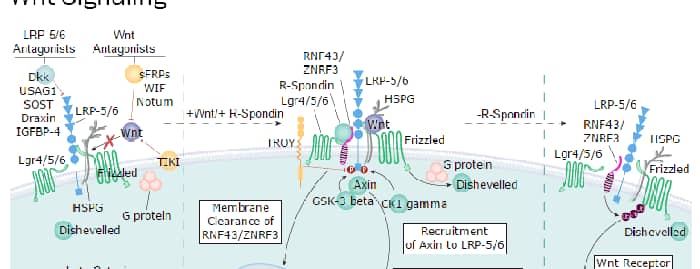
Two distinct Wnt signal transduction pathways have been characterized. One is the canonical Wnt/ beta -catenin pathway that is involved in diverse biological mechanisms such as dorsal/ventral development in Xenopus embryos and mammalian tumor formation. Frz-5 is implicated in this pathway based on its ability to induce beta -catenin target genes in the presence of ligand (5). However, Frz-5 is also implicated in beta -catenin independent pathways (4, 6).