
Human Hexosaminidase A/HEXA Antibody (714712)
R&D Systems | Catalog # MAB62371

Scientific images may be resized, cropped, or adjusted for brightness or contrast for presentation purposes. These updates are limited to presentation and do not affect the underlying scientific interpretation of the data. Where available, additional source data may be provided upon request.
Key Product Details
Species Reactivity
Applications
Label
Antibody Source
Product Specifications
Immunogen
Met1-Thr529
Accession # P06865
Specificity
Clonality
Host
Isotype
Endotoxin Level
Scientific Data Images for Human Hexosaminidase A/HEXA Antibody (714712)
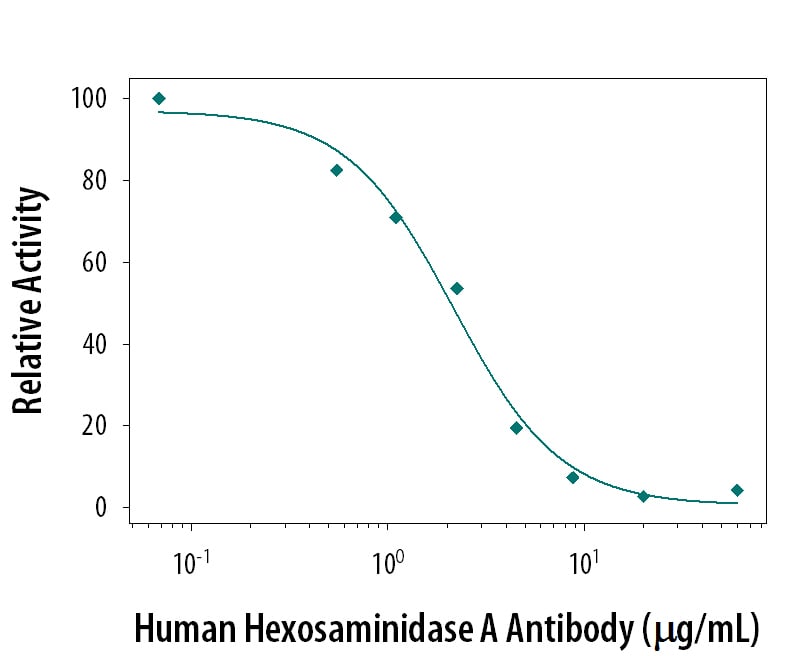
Neutralization of Human Hexosaminidase A Activity by Human Hexosaminidase A Antibody.
The cleavage of 4-Methylumbelliferyl-N-Acetyl-beta -D-glucosaminide (400 µM) by Human Hexosaminidase A (2.0 µg/mL, 6237-GH) is measured after it has been preincubated with increasing concentrations of Mouse Anti-Human Hexosaminidase A Monoclonal Antibody (Catalog # MAB62371). The ND50 is typically 3.0 µg/mL.Applications for Human Hexosaminidase A/HEXA Antibody (714712)
Neutralization
Formulation, Preparation, and Storage
Purification
Reconstitution
Sterile PBS to a final concentration of 0.5 mg/mL. For liquid material, refer to CoA for concentration.
Formulation
Shipping
Stability & Storage
- 12 months from date of receipt, -20 to -70 °C as supplied.
- 1 month, 2 to 8 °C under sterile conditions after reconstitution.
- 6 months, -20 to -70 °C under sterile conditions after reconstitution.
Calculators
Background: Hexosaminidase A/HEXA
References
- Gilbert, F. et al. (1975) Proc. Natl. Acad. Sci. USA 72:263.
- Myerowitz, R. et al. (1985) Proc. Natl. Acad. Sci. USA 82:7830.
- Korneluk, R.G. et al. (1986) J. Biol. Chem. 261:8407.
- Mark, B.L. et al. (2003) J. Mol. Biol. 327:1093.
- Mahuran, D.J. et al. (1988) J. Biol. Chem. 263:4612.
- Hepbildikler, S.T. et al. (2002) J. Biol. Chem. 277:2562.
- Mahuran, D.J. (1991) Biochim. Biophys. Acta 1096:87.
- Mencarelli, S. et al. (2005) FEBS Lett. 579:5501.
- Neufeld, E.F. (1989) J. Biol. Chem. 264:10927.
- Ohno, K. et al. (2008) Mol. Genet. Metab. 94:462.
Alternate Names
Entrez Gene IDs
Gene Symbol
UniProt
Additional Hexosaminidase A/HEXA Products
Product Documents for Human Hexosaminidase A/HEXA Antibody (714712)
Certificate of Analysis
To download a Certificate of Analysis, please enter a lot or batch number in the search box below.
Note: Certificate of Analysis not available for kit components.
Product Specific Notices for Human Hexosaminidase A/HEXA Antibody (714712)
For research use only
Related Research Areas
Customer Reviews for Human Hexosaminidase A/HEXA Antibody (714712)
There are currently no reviews for this product. Be the first to review Human Hexosaminidase A/HEXA Antibody (714712) and earn rewards!
Have you used Human Hexosaminidase A/HEXA Antibody (714712)?
Submit a review and receive an Amazon gift card!
$25/€18/£15/$25CAN/¥2500 for a review with an image
$10/€7/£6/$10CAN/¥1110 for a review without an image
Submit a review