
IGFBP-rp1, also known as Mac25/Angiomodulin (AGM), tumor-derived adhesion factor (TAF) and prostacyclin-stimulating factor (PSF), is a secreted protein that contains three protein domain modules. Human IGFBP-rp1 cDNA encodes 282 amino acid (aa) residue precursor protein with a putative 26 aa signal peptide. Mature IGFBP-rp1 is a glycosylated protein with an N-terminal IGFBP domain, followed by a Kazal-type serine proteinase inhibitor domain and a C-terminal immunoglobulin-like C2-type domain. The similarity of IGFBP-rp1 with the IGFBPs is confined to the N-terminal IGFBP domain, which contains all 12 of the conserved cysteine residues found in IGFBP-1 through 5. Human and mouse IGFBP-rp1 are highly homologous. Discounting a segment of 43 aa near the N-terminus that is missing in the mouse homologue, human and mouse IGFBP-rp1 share 94% aa sequence identity. IGFBP-rp1 is expressed in many normal tissues and in cancer cells. It is abundantly expressed in high endothelial venules (HEVs) of blood vessels in the secondary lymphoid tissues. The expression of IGFBP-rp1 is upregulated in senescing epithelial cells and by retinoic acid. IGFBP-rp1 binds IGF and insulin with very low affinity and has been shown to enhance the mitogenic actions of IGF and insulin. IGFBP-rp1 also has IGF/insulin-independent activities. It interacts with heparan sulfate proteoglycans, type IV collagen, and specific chemokines. IGFBP‑rp1 supports weak cell adhesion, promotes cell spreading on type IV collagen, and stimulates the production of the potent vasodilator PGI2. It modulates tumor cell growth and has also been implicated in angiogenesis. IGFBP-rp1 is proteolytically cleaved between lysine 97 and alanine 98. Cleaved IGFBP-rp1 has enhanced cell attachment activity but can no longer bind IGF/insulin (1-3).
Human IGFBP-rp1/IGFBP-7 Antibody
R&D Systems | Catalog # AF1334

Scientific images may be resized, cropped, or adjusted for brightness or contrast for presentation purposes. These updates are limited to presentation and do not affect the underlying scientific interpretation of the data. Where available, additional source data may be provided upon request.
Key Product Details
Species Reactivity
Validated:
Cited:
Applications
Validated:
Cited:
Label
Antibody Source
Product Specifications
Immunogen
Arg98-Arg277
Accession # AAA16187
Specificity
Clonality
Host
Isotype
Scientific Data Images for Human IGFBP-rp1/IGFBP-7 Antibody
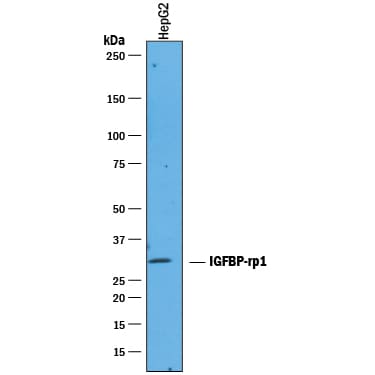
Detection of Human IGFBP‑rp1/IGFBP‑7 by Western Blot.
Western blot shows lysates of HepG2 human hepatocellular carcinoma cell line. PVDF membrane was probed with 1 µg/mL of Goat Anti-Human IGFBP-rp1/IGFBP-7 Antigen Affinity-purified Polyclonal Antibody (Catalog # AF1334) followed by HRP-conjugated Anti-Goat IgG Secondary Antibody (Catalog # HAF019). A specific band was detected for IGFBP-rp1/IGFBP-7 at approximately 30 kDa (as indicated). This experiment was conducted under reducing conditions and using Immunoblot Buffer Group 1.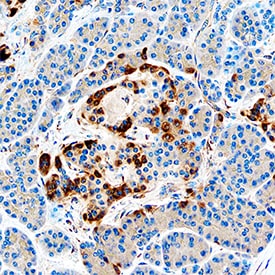
IGFBP‑rp1/IGFBP‑7 in Human Pancreas.
IGFBP-rp1/IGFBP-7 was detected in immersion fixed paraffin-embedded sections of human pancreas using Goat Anti-Human IGFBP-rp1/IGFBP-7 Antigen Affinity-purified Polyclonal Antibody (Catalog # AF1334) at 0.3 µg/mL overnight at 4 °C. Tissue was stained using the Anti-Goat HRP-DAB Cell & Tissue Staining Kit (brown; Catalog # CTS008) and counterstained with hematoxylin (blue). Specific staining was localized to islets. View our protocol for Chromogenic IHC Staining of Paraffin-embedded Tissue Sections.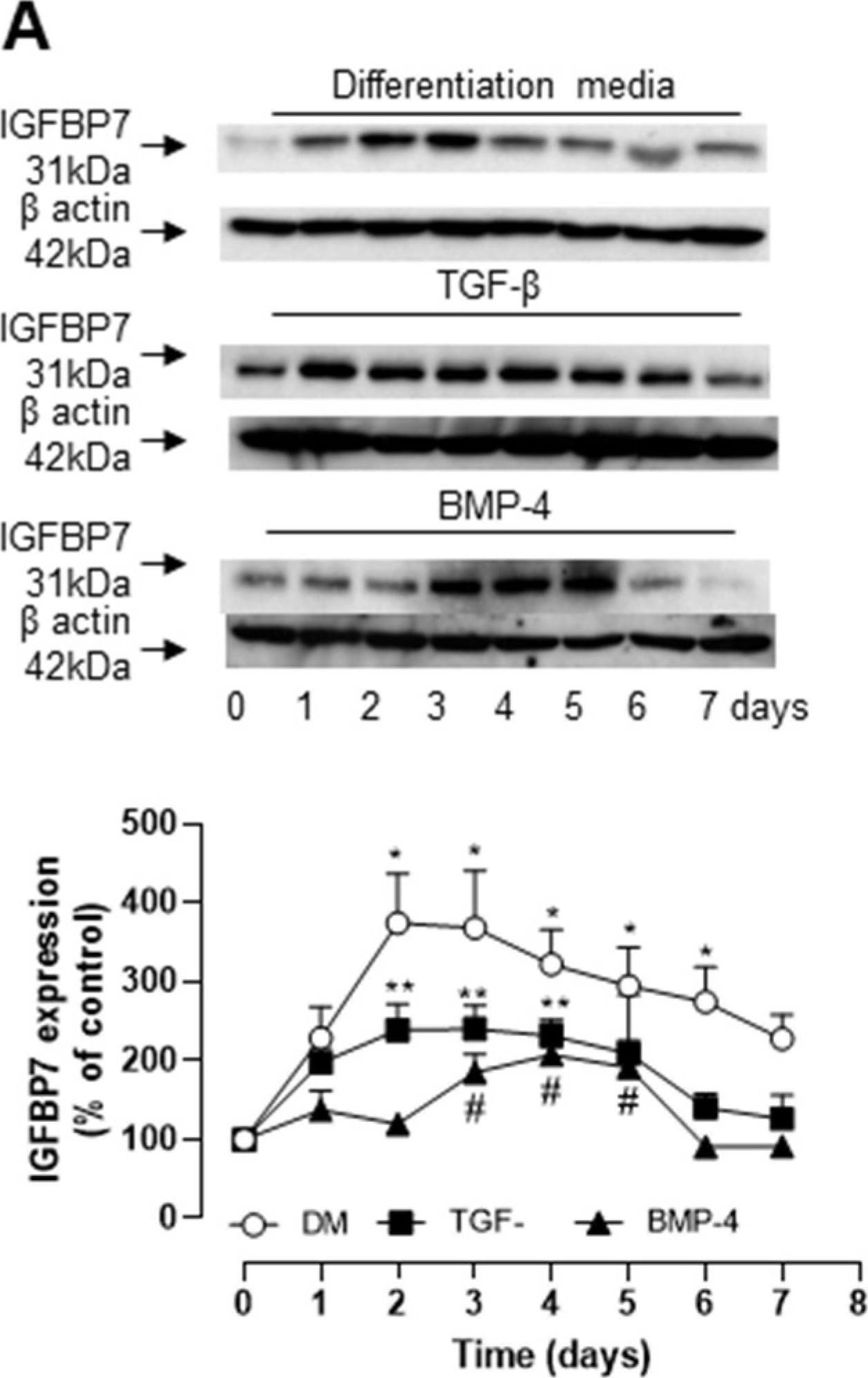
Detection of IGFBP-rp1/IGFBP-7 by Western Blot
IGFBP7 expression is increased in human ASCs going through differentiation with TGF-beta and BMP-4. (A) Top is representative immunoblot for IGFBP7 expression. Corresponding line graph demonstrating the time-course (0 to 7 days) effect of TGF-beta and BMP-4 on IGFBP7 expression. TGF-beta and BMP-4 synergistically induce the expression of IGFBP7 on hASC. hASCs were stimulated with TGF-beta, BMP-4 or combination of TGF-beta and BMP-4 (DM) for up to 7 days and IGFBP7 expression was evaluated by Western blot. Top are representative immunoblots for IGFBP7 expression. Corresponding bar graph demonstrating the time-course (0 to 7 days) effect of TGF-beta, BMP-4 or DM on IGFBP7 expression. (B) Fluorescence microscopy was also used to detect TGF-beta, BMP-4 or DM-induced IGFBP7 expression on day 0, 4 and 7. Scale bar 100µm. Results are mean ± SEM of 5 experiments. * p < 0.05 vs. day 0 of stimulation with DM; ** p < 0.05 vs. day 0 of stimulation with TGF-beta ; # p < 0.05 vs. day 0 of stimulation with BMP-4. Image collected and cropped by CiteAb from the following open publication (https://pubmed.ncbi.nlm.nih.gov/34356861), licensed under a CC-BY license. Not internally tested by R&D Systems.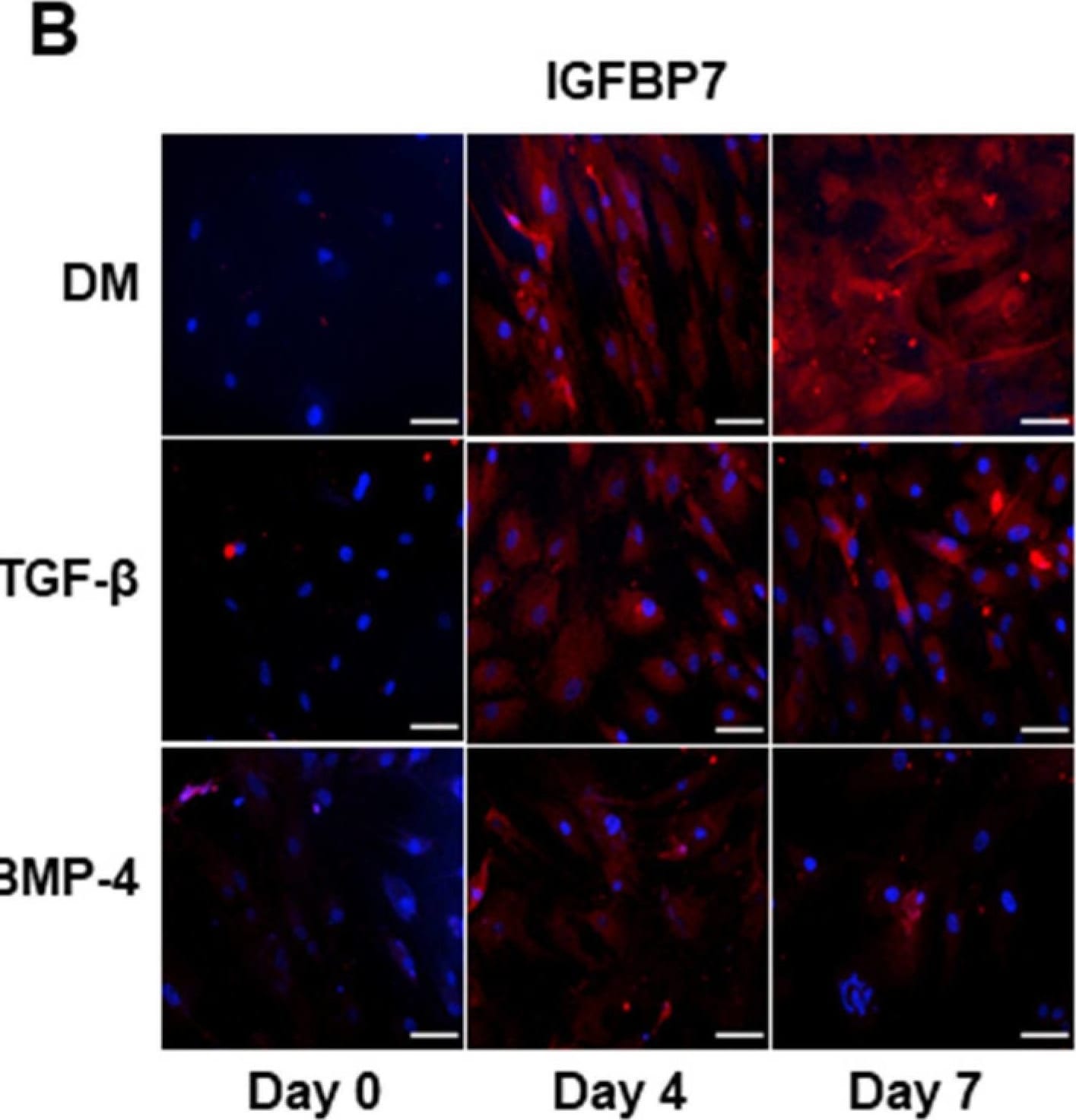
Detection of IGFBP-rp1/IGFBP-7 by Immunocytochemistry/ Immunofluorescence
IGFBP7 expression is increased in human ASCs going through differentiation with TGF-beta and BMP-4. (A) Top is representative immunoblot for IGFBP7 expression. Corresponding line graph demonstrating the time-course (0 to 7 days) effect of TGF-beta and BMP-4 on IGFBP7 expression. TGF-beta and BMP-4 synergistically induce the expression of IGFBP7 on hASC. hASCs were stimulated with TGF-beta, BMP-4 or combination of TGF-beta and BMP-4 (DM) for up to 7 days and IGFBP7 expression was evaluated by Western blot. Top are representative immunoblots for IGFBP7 expression. Corresponding bar graph demonstrating the time-course (0 to 7 days) effect of TGF-beta, BMP-4 or DM on IGFBP7 expression. (B) Fluorescence microscopy was also used to detect TGF-beta, BMP-4 or DM-induced IGFBP7 expression on day 0, 4 and 7. Scale bar 100µm. Results are mean ± SEM of 5 experiments. * p < 0.05 vs. day 0 of stimulation with DM; ** p < 0.05 vs. day 0 of stimulation with TGF-beta ; # p < 0.05 vs. day 0 of stimulation with BMP-4. Image collected and cropped by CiteAb from the following open publication (https://pubmed.ncbi.nlm.nih.gov/34356861), licensed under a CC-BY license. Not internally tested by R&D Systems.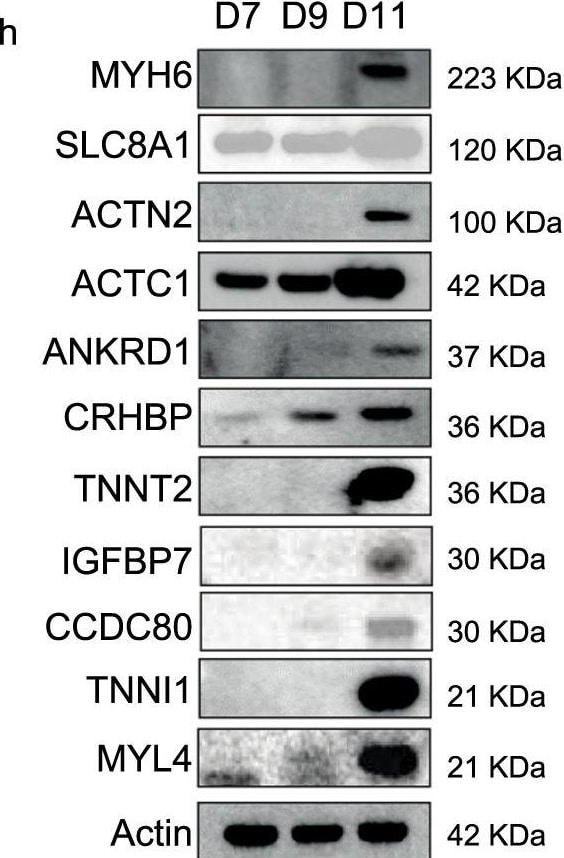
Detection of IGFBP-rp1/IGFBP-7 by Western Blot
Committed Cardiac Progenitors and their Signature Genes.a Schematic showing the laminin (LN) protocol that uses LN-521 + 221 as a defined extracellular matrix together with small molecule inhibitors for the differentiation of pluripotent stem cells to day 11 committed cardiac progenitors (CCPs). b Heat map of three biological replicates from bulk RNA-seq data demonstrating the canonical progenitor gene expression on days 9 and 11. Supplementary Table 1 shows the actual transcripts per million (TPM) for each gene. c Time course analysis of scRNAseq data from days 0 to 11 for known canonical gene expression: PDGFRA, GATA4, KDR, NKX2–5, ISL1, and MESP1. d Immunoblotting of canonical progenitor genes from differentiation days 7, 9, and 11. Supplementary Fig. 1 shows the quantification of each blot from five biological replicates. e Heat map of the bulk RNA-seq data using CCP signature genes at differentiation days 9 and 11. Supplementary Table 1 shows the actual TPM for each gene. f Single-cell RNA-seq data (two biological replicates) of the CCP signature gene expression in tSNE plots from days 0, 4, 7, 9, and 11. The tSNE plot at the top left shows the overall distribution of each day using different colors. g Time course analysis of scRNAseq data from days 0 to 11 for day 11 CCP gene signature markers. h Immunoblotting of CCP signature genes from differentiation days 7, 9, and 11 (5 biological replicates). Supplementary Fig. 1 shows the quantification of each blot. Comparisons between groups were performed using two-way ANOVA with Tukey post hoc analysis. Image collected and cropped by CiteAb from the following open publication (https://pubmed.ncbi.nlm.nih.gov/37236990), licensed under a CC-BY license. Not internally tested by R&D Systems.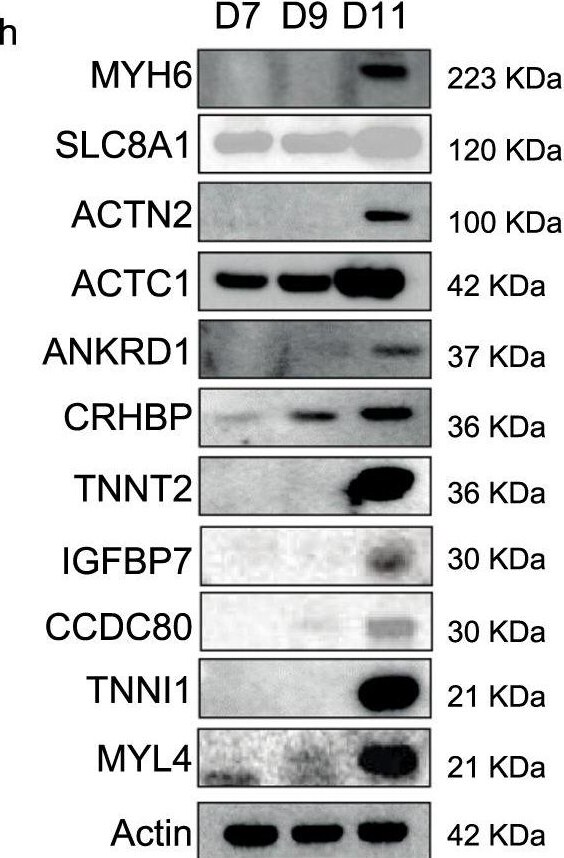
Detection of IGFBP-rp1/IGFBP-7 by Western Blot
Committed Cardiac Progenitors and their Signature Genes.a Schematic showing the laminin (LN) protocol that uses LN-521 + 221 as a defined extracellular matrix together with small molecule inhibitors for the differentiation of pluripotent stem cells to day 11 committed cardiac progenitors (CCPs). b Heat map of three biological replicates from bulk RNA-seq data demonstrating the canonical progenitor gene expression on days 9 and 11. Supplementary Table 1 shows the actual transcripts per million (TPM) for each gene. c Time course analysis of scRNAseq data from days 0 to 11 for known canonical gene expression: PDGFRA, GATA4, KDR, NKX2–5, ISL1, and MESP1. d Immunoblotting of canonical progenitor genes from differentiation days 7, 9, and 11. Supplementary Fig. 1 shows the quantification of each blot from five biological replicates. e Heat map of the bulk RNA-seq data using CCP signature genes at differentiation days 9 and 11. Supplementary Table 1 shows the actual TPM for each gene. f Single-cell RNA-seq data (two biological replicates) of the CCP signature gene expression in tSNE plots from days 0, 4, 7, 9, and 11. The tSNE plot at the top left shows the overall distribution of each day using different colors. g Time course analysis of scRNAseq data from days 0 to 11 for day 11 CCP gene signature markers. h Immunoblotting of CCP signature genes from differentiation days 7, 9, and 11 (5 biological replicates). Supplementary Fig. 1 shows the quantification of each blot. Comparisons between groups were performed using two-way ANOVA with Tukey post hoc analysis. Image collected and cropped by CiteAb from the following open publication (https://pubmed.ncbi.nlm.nih.gov/37236990), licensed under a CC-BY license. Not internally tested by R&D Systems.Applications for Human IGFBP-rp1/IGFBP-7 Antibody
Immunohistochemistry
Sample: Immersion fixed paraffin-embedded sections of human small intestine and human pancreas
Western Blot
Sample: HepG2 human hepatocellular carcinoma cell line
Formulation, Preparation, and Storage
Purification
Reconstitution
Reconstitute at 0.2 mg/mL in sterile PBS. For liquid material, refer to CoA for concentration.
Formulation
Shipping
Stability & Storage
- 12 months from date of receipt, -20 to -70 °C as supplied.
- 1 month, 2 to 8 °C under sterile conditions after reconstitution.
- 6 months, -20 to -70 °C under sterile conditions after reconstitution.
Calculators
Background: IGFBP-rp1/IGFBP-7
References
- Hwa, V. et al. (1999) Endocrinology Rev. 20:761.
- Nagakubo, D. et al. (2003) J. Immunol. 171:553.
- Ahmed, S. et al. (2003) Biochem. Biophys. Res. Commun. 310:612.
Long Name
Alternate Names
Gene Symbol
UniProt
Additional IGFBP-rp1/IGFBP-7 Products
Product Documents for Human IGFBP-rp1/IGFBP-7 Antibody
Certificate of Analysis
To download a Certificate of Analysis, please enter a lot or batch number in the search box below.
Note: Certificate of Analysis not available for kit components.
Product Specific Notices for Human IGFBP-rp1/IGFBP-7 Antibody
For research use only
Related Research Areas
Citations for Human IGFBP-rp1/IGFBP-7 Antibody
 Powered by Bioz
Customer Reviews for Human IGFBP-rp1/IGFBP-7 Antibody
There are currently no reviews for this product. Be the first to review Human IGFBP-rp1/IGFBP-7 Antibody and earn rewards!
Have you used Human IGFBP-rp1/IGFBP-7 Antibody?
Submit a review and receive an Amazon gift card!
$25/€18/£15/$25CAN/¥2500 for a review with an image
$10/€7/£6/$10CAN/¥1110 for a review without an image
Submit a review
Protocols
Find general support by application which include: protocols, troubleshooting, illustrated assays, videos and webinars.
- Antigen Retrieval Protocol (PIER)
- Antigen Retrieval for Frozen Sections Protocol
- Appropriate Fixation of IHC/ICC Samples
- Cellular Response to Hypoxia Protocols
- Chromogenic IHC Staining of Formalin-Fixed Paraffin-Embedded (FFPE) Tissue Protocol
- Chromogenic Immunohistochemistry Staining of Frozen Tissue
- ClariTSA™ Fluorophore Kits
- Detection & Visualization of Antibody Binding
- Fluorescent IHC Staining of Frozen Tissue Protocol
- Graphic Protocol for Heat-induced Epitope Retrieval
- Graphic Protocol for the Preparation and Fluorescent IHC Staining of Frozen Tissue Sections
- Graphic Protocol for the Preparation and Fluorescent IHC Staining of Paraffin-embedded Tissue Sections
- Graphic Protocol for the Preparation of Gelatin-coated Slides for Histological Tissue Sections
- IHC Sample Preparation (Frozen sections vs Paraffin)
- Immunofluorescent IHC Staining of Formalin-Fixed Paraffin-Embedded (FFPE) Tissue Protocol
- Immunohistochemistry (IHC) and Immunocytochemistry (ICC) Protocols
- Immunohistochemistry Frozen Troubleshooting
- Immunohistochemistry Paraffin Troubleshooting
- Preparing Samples for IHC/ICC Experiments
- Preventing Non-Specific Staining (Non-Specific Binding)
- Primary Antibody Selection & Optimization
- Protocol for Heat-Induced Epitope Retrieval (HIER)
- Protocol for Making a 4% Formaldehyde Solution in PBS
- Protocol for VisUCyte™ HRP Polymer Detection Reagent
- Protocol for the Preparation & Fixation of Cells on Coverslips
- Protocol for the Preparation and Chromogenic IHC Staining of Frozen Tissue Sections
- Protocol for the Preparation and Chromogenic IHC Staining of Frozen Tissue Sections - Graphic
- Protocol for the Preparation and Chromogenic IHC Staining of Paraffin-embedded Tissue Sections
- Protocol for the Preparation and Chromogenic IHC Staining of Paraffin-embedded Tissue Sections - Graphic
- Protocol for the Preparation and Fluorescent IHC Staining of Frozen Tissue Sections
- Protocol for the Preparation and Fluorescent IHC Staining of Paraffin-embedded Tissue Sections
- Protocol for the Preparation of Gelatin-coated Slides for Histological Tissue Sections
- R&D Systems Quality Control Western Blot Protocol
- TUNEL and Active Caspase-3 Detection by IHC/ICC Protocol
- The Importance of IHC/ICC Controls
- Troubleshooting Guide: Immunohistochemistry
- Troubleshooting Guide: Western Blot Figures
- Western Blot Conditions
- Western Blot Protocol
- Western Blot Protocol for Cell Lysates
- Western Blot Troubleshooting
- Western Blot Troubleshooting Guide
- View all Protocols, Troubleshooting, Illustrated assays and Webinars