
Two type I membrane proteins belonging to the hemopoietin receptor family have been cloned and shown to bind IL-13 with high affinity. The lower affinity IL-13 binding protein is now referred to as IL-13 R alpha 1 and is also known as CD213a. IL-13 R alpha 1 combines with IL-4 R alpha to form a high affinity receptor complex capable of transducing an IL-13-dependent proliferative signal. The higher affinity IL-13 binding protein, now referred to as IL-13 R alpha 2, does not induce a signal and acts as a decoy receptor.
Human IL-13 R alpha 2 Antibody (83834)
R&D Systems | Catalog # MAB614


Scientific images may be resized, cropped, or adjusted for brightness or contrast for presentation purposes. These updates are limited to presentation and do not affect the underlying scientific interpretation of the data. Where available, additional source data may be provided upon request.
Key Product Details
Species Reactivity
Validated:
Human
Cited:
Human
Applications
Validated:
Western Blot
Cited:
Western Blot, Flow Cytometry, ELISA Development
Label
Unconjugated
Antibody Source
Monoclonal Mouse IgG1 Clone # 83834
Loading...
Product Specifications
Immunogen
Mouse myeloma cell line NS0-derived recombinant human IL‑13 R alpha 2
Cys22-Leu342
Accession # Q14627
Cys22-Leu342
Accession # Q14627
Specificity
Detects human IL-13 R alpha 2 in direct ELISAs and Western blots. In Western blots, this antibody shows approximately 5% cross‑reactivity with recombinant human (rh) IL‑4 R and rhIL‑9 R and no cross-reactivity with rhIL‑5 R alpha, rhIL‑5 R beta, rhIL‑13 R alpha 1, or recombinant mouse IL‑13 R alpha 2.
Clonality
Monoclonal
Host
Mouse
Isotype
IgG1
Scientific Data Images for Human IL-13 R alpha 2 Antibody (83834)
Detection of Human IL‑13 R alpha 2 by Western Blot.
Western blot shows lysates of human placenta tissue and human testis tissue. PVDF membrane was probed with 5 µg/mL of Mouse Anti-Human IL-13 Ra2 Monoclonal Antibody (Catalog # MAB614) followed by HRP-conjugated Anti-Mouse IgG Secondary Antibody (Catalog # HAF018). A specific band was detected for IL-13 Ra2 at approximately 50-55 kDa (as indicated). This experiment was conducted under reducing conditions and using Immunoblot Buffer Group 1.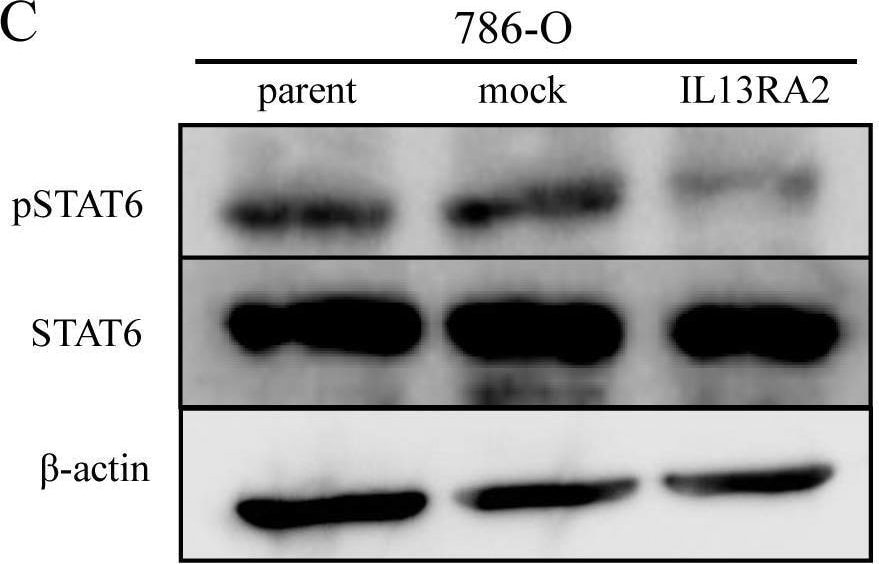
Detection of IL-13 R alpha 2 by Western Blot
Evaluation of apoptosis and microvessel density after sunitinib treatment in xenograft model derived from cell lines.MVD was decreased by sunitinib treatment of each xenograft tumor derived from (A) 786-O or (B) Caki-1 subclones regardless of IL13RA2 expression level. MVD was determined from CD31 staining using Image J software. Statistical analysis was performed using the Students’ t-test (*P < 0.01). Immunoblot analysis of (C) 786-O subclones and (D) Caki-1 subclones. IL13RA2 expression was negatively correlated with the phosphorylation of STAT6. Whole cell extracts were immunoblotted using the indicated antibodies. ssDNA staining of xenograft tumors derived from (E) 786-O subclones and (B) Caki-1 subclones treated with sunitinib or vehicle only. Apoptosis was assessed by calculating the ssDNA positivity rate. Statistical analysis was performed using the Students’ t-test (*P < 0.05, **P < 0.01). Image collected and cropped by CiteAb from the following open publication (https://pubmed.ncbi.nlm.nih.gov/26114873), licensed under a CC-BY license. Not internally tested by R&D Systems.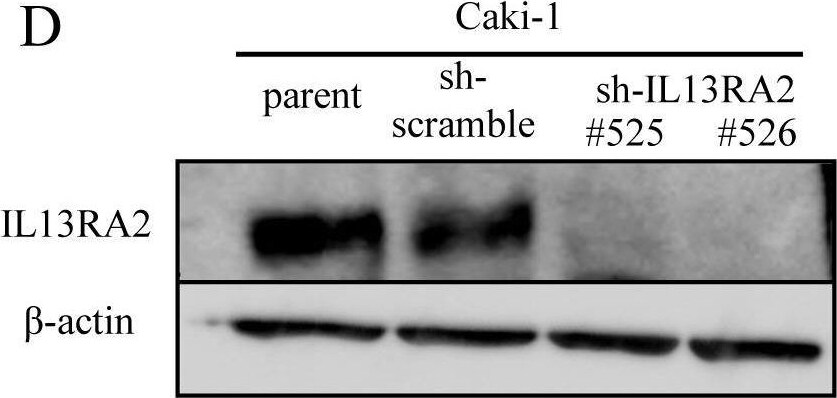
Detection of IL-13 R alpha 2 by Western Blot
Overexpression of IL13RA2 leads to acquired resistance to sunitinib and shRNA-mediated IL13RA2 knockdown induces sensitivity to sunitinib.(A) Immunoblot analysis of 786-O subclones infected with retrovirus encoding mock or WT IL13RA2. Whole cell extracts were immunoblotted using the indicated antibodies. Sequential changes in subcutaneous xenograft tumors from 786-O subclones infected with (B) mock or (C) WT IL13RA2 treated with sunitinib and vehicle (control). Each time point represents the mean ± SE of tumor volume in each group. The difference in tumor size between the treatment group and control was statistically significant in 786-O-mock cells but not statistically significant in 786-O-IL13RA2 cells (*P < 0.05, n.s.: not significant; two-way repeated ANOVA). The horizontal arrow bars indicate the periods of sunitinib administration. (D) Immunoblot analysis of Caki-1 subclones infected with lentivirus encoding scrambled or IL13RA2 shRNA. Whole cell extracts were immunoblotted using the indicated antibodies. Sequential changes of subcutaneous xenograft tumors from a Caki-1 subclone infected with (E) scrambled or (F) IL13RA2 shRNA treated with sunitinib and vehicle (control). Each time point represents the mean ± SE of tumor volume in each group. Day 0 is the first day of sunitinib administration 4 weeks after transplantation. The difference in tumor size between the treatment group and control was not significant in Caki-1-sh-scrambled cells but statistically significant in Caki-1-sh-IL13RA2 cells (n.s.: not significant, *P < 0.05; two-way repeated ANOVA). The arrow bars indicate the period of sunitinib administration. Image collected and cropped by CiteAb from the following open publication (https://pubmed.ncbi.nlm.nih.gov/26114873), licensed under a CC-BY license. Not internally tested by R&D Systems.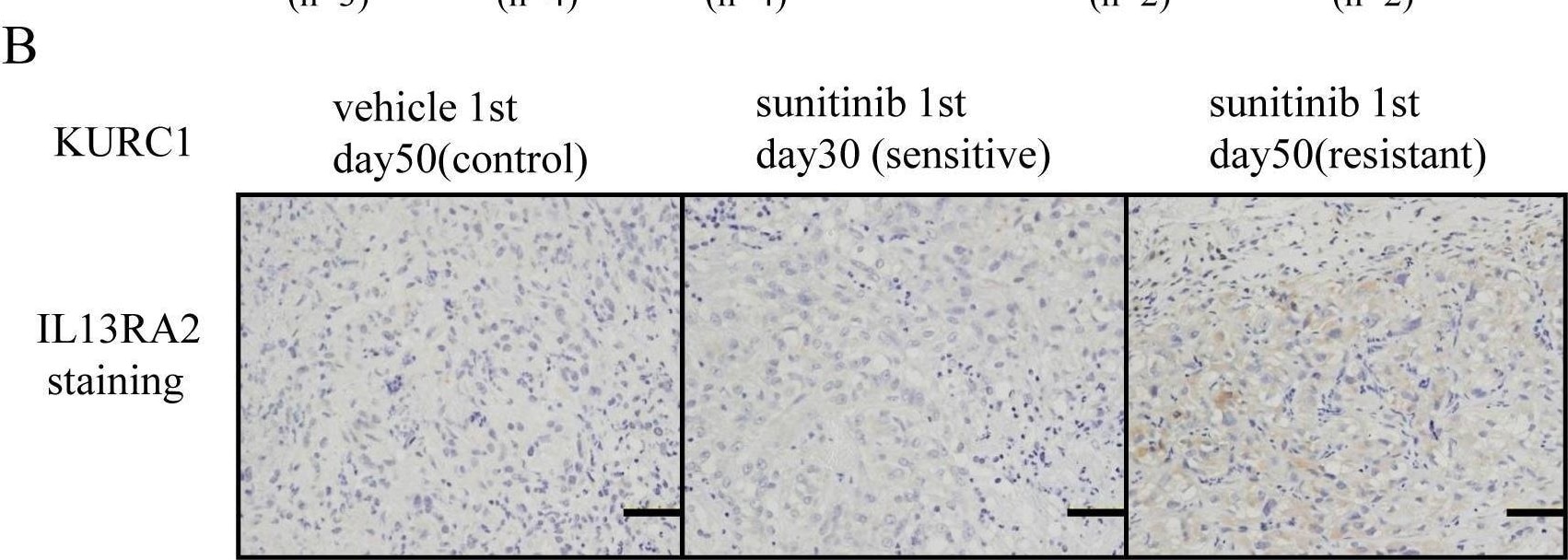
Detection of IL-13 R alpha 2 by Immunohistochemistry
Evaluation of IL13RA2 mRNA and protein expression.(A) Evaluation of IL13RA2 mRNA expression in KURC1 and KURC2 xenograft tumors treated with sunitinib or vehicle by qPCR. All samples were prepared in triplicate and data are presented as the mean ± SE from indicated number of samples. Columns, mean; bar, SE. The difference in the mRNA expression levels between the sunitinib-treated group and control or sensitive group in KURC1 was statistically significant (*P < 0.01; Students’ t-test). There was no significant difference in KURC2 groups. (B) Immunohistochemical staining of IL13RA2 in KURC1 xenograft tumors. Scale bar, 50 μm. (C) IL13RA2 expression in human ccRCC tumors with the response to sunitinib treatment evaluated by immunohistochemistry. ccRCC tumor samples were collected from patients prior to sunitinib treatment. Left: representative pictures of immunohistochemistry sections of tumors showing none, weak, or strong staining for IL13RA2. Right: ratio of IL13RA2 expression pattern and correlation of the response to sunitinib treatment. Scale bar, 100 μm. Image collected and cropped by CiteAb from the following open publication (https://pubmed.ncbi.nlm.nih.gov/26114873), licensed under a CC-BY license. Not internally tested by R&D Systems.Applications for Human IL-13 R alpha 2 Antibody (83834)
Application
Recommended Usage
Western Blot
5 µg/mL
Sample: Human placenta tissue and human testis tissue
Sample: Human placenta tissue and human testis tissue
Formulation, Preparation, and Storage
Purification
Protein A or G purified from hybridoma culture supernatant
Reconstitution
Reconstitute at 0.5 mg/mL in sterile PBS. For liquid material, refer to CoA for concentration.
Loading...
Formulation
Lyophilized from a 0.2 μm filtered solution in PBS with Trehalose. *Small pack size (SP) is supplied either lyophilized or as a 0.2 µm filtered solution in PBS.
Shipping
Lyophilized product is shipped at ambient temperature. Liquid small pack size (-SP) is shipped with polar packs. Upon receipt, store immediately at the temperature recommended below.
Stability & Storage
Use a manual defrost freezer and avoid repeated freeze-thaw cycles.
- 12 months from date of receipt, -20 to -70 °C as supplied.
- 1 month, 2 to 8 °C under sterile conditions after reconstitution.
- 6 months, -20 to -70 °C under sterile conditions after reconstitution.
Calculators
Background: IL-13 R alpha 2
Long Name
Interleukin 13 Receptor alpha 2
Alternate Names
CD213a2, IL-13Ra2, IL13R alpha 2, IL13RA2
Gene Symbol
IL13RA2
UniProt
Additional IL-13 R alpha 2 Products
Product Documents for Human IL-13 R alpha 2 Antibody (83834)
Certificate of Analysis
To download a Certificate of Analysis, please enter a lot or batch number in the search box below.
Note: Certificate of Analysis not available for kit components.
Product Specific Notices for Human IL-13 R alpha 2 Antibody (83834)
For research use only
Citations for Human IL-13 R alpha 2 Antibody (83834)
 Powered by Bioz
Customer Reviews for Human IL-13 R alpha 2 Antibody (83834)
There are currently no reviews for this product. Be the first to review Human IL-13 R alpha 2 Antibody (83834) and earn rewards!
Have you used Human IL-13 R alpha 2 Antibody (83834)?
Submit a review and receive an Amazon gift card!
$25/€18/£15/$25CAN/¥2500 for a review with an image
$10/€7/£6/$10CAN/¥1110 for a review without an image
Submit a review
Protocols
Find general support by application which include: protocols, troubleshooting, illustrated assays, videos and webinars.
- Cellular Response to Hypoxia Protocols
- R&D Systems Quality Control Western Blot Protocol
- Troubleshooting Guide: Western Blot Figures
- Western Blot Conditions
- Western Blot Protocol
- Western Blot Protocol for Cell Lysates
- Western Blot Troubleshooting
- Western Blot Troubleshooting Guide
- View all Protocols, Troubleshooting, Illustrated assays and Webinars
Loading...