
DOK7 (Downstream of kinase 7) is a 55 kDa member of the DOK family of cytoplasmic adaptor proteins. It links the acetylcholine receptor and the receptor tyrosine kinase MuSK in skeletal and cardiac muscle. Mutations can cause familial myasthenic syndromes. The 504 amino acid (aa) human DOK7 contains pleckstrin homology (aa 7‑109) and phosphotyrosine-binding (PTK, aa 125‑236) and SH2 domains and a C‑terminal nuclear export signal. Splicing isoforms of 255, 608, and 366 aa diverge at aa 175 or 500, or have 40 divergent aa replacing aa 1‑178, respectively. Within aa 179‑299, human DOK7 shares 92% and 93% aa identity with mouse and rat DOK7, respectively.

Scientific images may be resized, cropped, or adjusted for brightness or contrast for presentation purposes. These updates are limited to presentation and do not affect the underlying scientific interpretation of the data. Where available, additional source data may be provided upon request.
Key Product Details
Validated by
Biological Validation
Species Reactivity
Validated:
Human, Mouse, Rat
Cited:
Mouse
Applications
Validated:
Western Blot, Simple Western
Cited:
Western Blot, Immunoprecipitation
Label
Unconjugated
Antibody Source
Polyclonal Goat IgG
Loading...
Product Specifications
Immunogen
E. coli-derived recombinant human DOK7
Ala179-Pro299
Accession # Q18PE1
Ala179-Pro299
Accession # Q18PE1
Specificity
Detects human, mouse, and rat DOK7 in Western blots.
Clonality
Polyclonal
Host
Goat
Isotype
IgG
Scientific Data Images for DOK7 Antibody
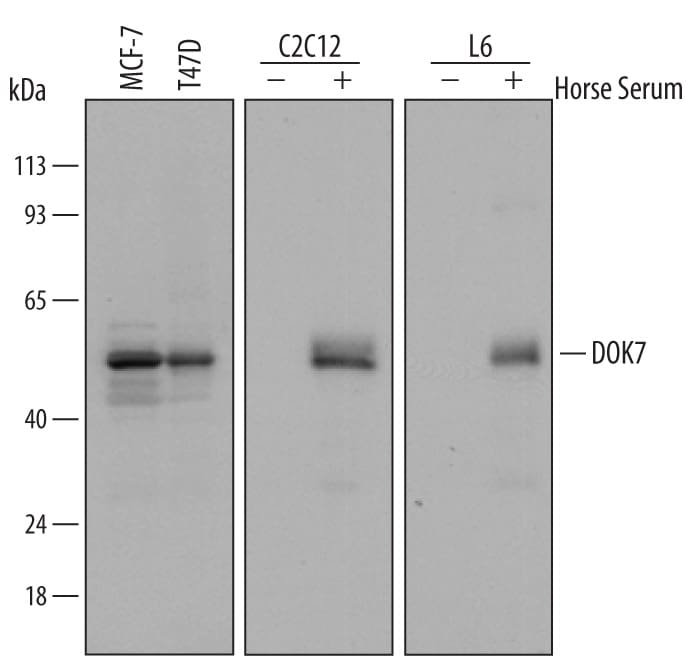
Detection of Human, Mouse, and Rat DOK7 by Western Blot.
Western blot shows lysates of untreated MCF-7 human breast cancer cell line and T47D human breast cancer cell line and C2C12 mouse myoblast cell line and L6 rat myoblast cell line untreated (-) or treated (+) with 2% horse serum for 6 days. PVDF Membrane was probed with 0.5 µg/mL of Goat Anti-Human/Mouse/Rat DOK7 Antigen Affinity-purified Polyclonal Antibody (Catalog # AF6398) followed by HRP-conjugated Anti-Goat IgG Secondary Antibody (Catalog # HAF109). A specific band was detected for DOK7 at approximately 55 kDa (as indicated). This experiment was conducted under reducing conditions and using Immunoblot Buffer Group 2.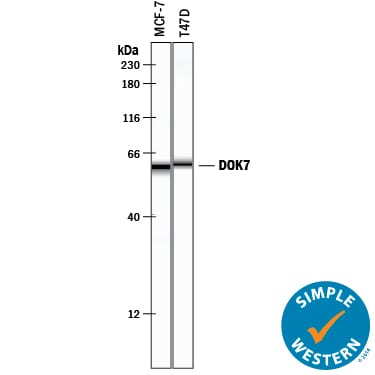
Detection of Human DOK7 by Simple WesternTM.
Simple Western lane view shows lysates of MCF-7 human breast cancer cell line and T47D human breast cancer cell line, loaded at 0.2 mg/mL. A specific band was detected for DOK7 at approximately 60 & 62 kDa (as indicated) using 5 µg/mL of Goat Anti-Human/Mouse/Rat DOK7 Antigen Affinity-purified Polyclonal Antibody (Catalog # AF6398) followed by 1:50 dilution of HRP-conjugated Anti-Goat IgG Secondary Antibody (Catalog # HAF109). This experiment was conducted under reducing conditions and using the 12-230 kDa separation system.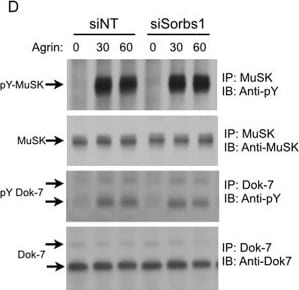
Detection of Mouse DOK7 by Western Blot
Sorbs1 is enriched at AChR aggregates, and Sorbs1 RNAi blocks AChR clustering in vitro. (A) Treatment of myotubes with siRNA directed against Sorbs1 blocks AChR clustering in C2C12 cells. Montages containing sixteen fields at a magnification of 10× were analyzed with ImageJ software (NIH). (B) Sorbs1 siRNA significantly reduces Sorbs1 protein expression in myotubes. (C) Sorbs1 protein is highly enriched at sites where AChRs aggregate. (D) Agrin stimulates tyrosine phosphorylation of MuSK and Dok-7 at similar levels in myotubes treated with Sorbs1 siRNA. Image collected and cropped by CiteAb from the following publication (https://pubmed.ncbi.nlm.nih.gov/26527617), licensed under a CC-BY license. Not internally tested by R&D Systems.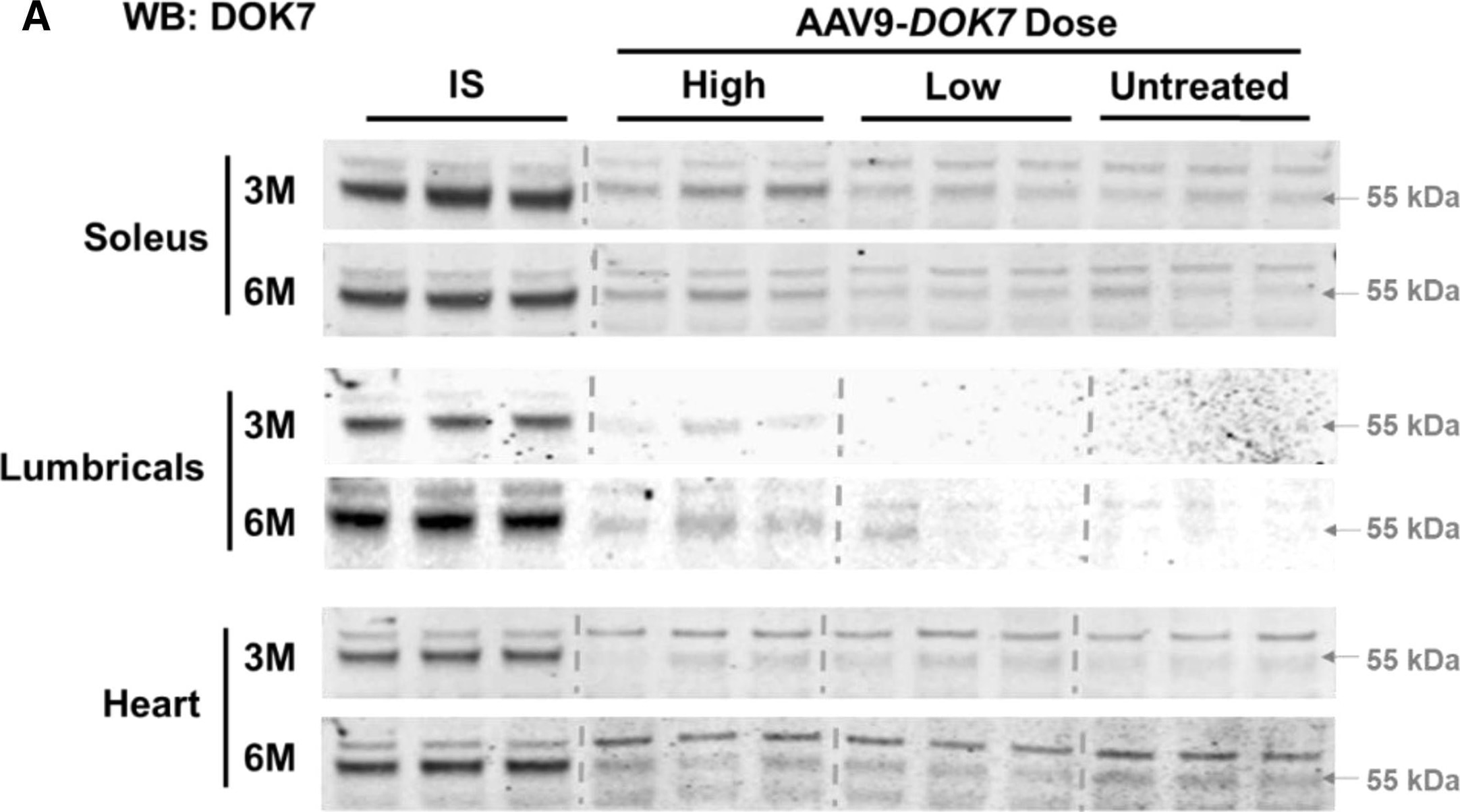
Detection of DOK7 by Western Blot
hDOK7 overexpression stimulates long-term elevation of DOK7 protein expression in mouse hindlimb muscles but not the heart(A) Western blots of tissue lysates probed with anti-DOK7 antibody shown at 55 kDa (middle band). Tissue from three mice each untreated or injected with high- or low-dose AAV9-tMCK-DOK7 was run alongside internal standards (ISs) produced in triplicate, enabling cross-gel comparison. Tissues were taken from mice at 3 months (M) and 6 months of age.(B–D) Bar charts comparing the effect of dose on tissue-specific DOK7 expression. Western blot data were quantified and normalized to the average value of three internal standards. DOK7 expression was significantly increased at 3 and 6 months following high-dose treatment in the hindlimb soleus muscle (B) and lumbricals (C) but not in heart tissue (D), when compared to untreated controls. Specifically, there was a 3.8-fold increase in DOK7 expression in the soleus 3 months following treatment and a 1.9-fold increase at 6 months (B; p < 0.0001 and p = 0.019), while in the lumbricals, there was a 4.7-fold increase in DOK7 expression at 3 months and a 4.6-fold increase at 6 months (C; p = 0.0009 and p = 0.0031) (one-way ANOVAs with Šídák’s multiple comparisons, means of n = 3 per group [with SEM], and each data point represents one animal). ∗p < 0.05, ∗∗p < 0.01, ∗∗∗p < 0.001, ∗∗∗∗p < 0.0001. Image collected and cropped by CiteAb from the following open publication (https://pubmed.ncbi.nlm.nih.gov/37637210), licensed under a CC-BY license. Not internally tested by R&D Systems.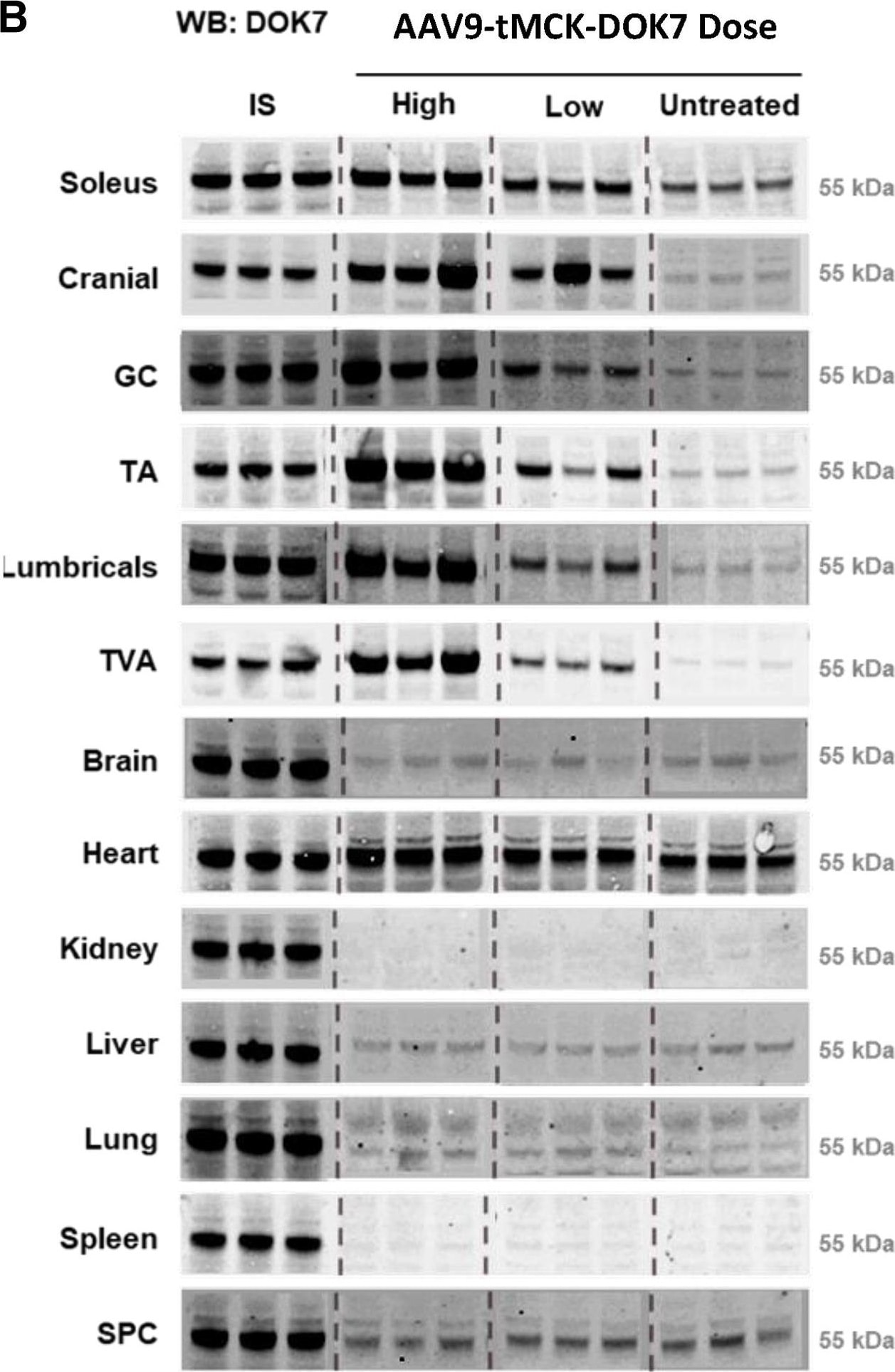
Detection of DOK7 by Western Blot
AAV9-tMCK-DOK7 increases DOK7 expression in skeletal muscle(A) Schematic of the AAV9-tMCK-DOK7 plasmid showing the skeletal muscle targeting tMCK promoter & DOK7 transgene.(B–D) DOK7 expression across a range of muscles & organs from 1-month-old mice treated with high dose (5e11 vg), low dose (1.25e11 vg), or untreated with AAV9-tMCK-DOK7. “IS” denotes internal standards run in triplicate used to allow comparison between blots. (B) Western blots where the molecular weight of DOK7 is indicated. Dotted lines illustrate where blot sections have been cropped together. (C) Bar graph of endogenous expression in skeletal muscle & tissue shown by quantified WBs. Values are normalized to the average of three DOK7 internal standards (ISs). Each dot represents a single mouse, & bars represent the mean (with SEM) (n = 3 per bar). (D) DOK7 expression in response to high-dose or low-dose treatments were compared by one-way ANOVA with Holm-Šídák’s multiple comparisons. Each bar represents an average of three animals (with SEM), normalized to internal standard (IS) & then normalized to endogenous protein levels for that tissue. Expression increased by 40x over endogenous levels in the GC (p = 0.0114), & the TA (p = 0.0242), hindlimb lumbricals (p = 0.0074), & TVA (p = 0.013) each showed a marked rise in DOK7. The soleus, which exhibited the highest endogenous levels of DOK7 in skeletal muscle, still expressed ∼4x as much DOK7 following high-dose treatment (p = 0.0032). There was also a small but significant increase in DOK7 expression in the heart following high-dose AAV9-tMCK-DOK7 treatment (p = 0.0018, n = 3 in all groups, one-way ANOVAs with Holm-Šídák’s comparisons). SPC, spinal cord; TVA, transverse abdominis; TA, tibialis anterior; GC, gastrocnemius; ∗p < 0.05, ∗∗p < 0.01. Image collected & cropped by CiteAb from the following open publication (https://pubmed.ncbi.nlm.nih.gov/37637210), licensed under a CC-BY license. Not internally tested by R&D Systems.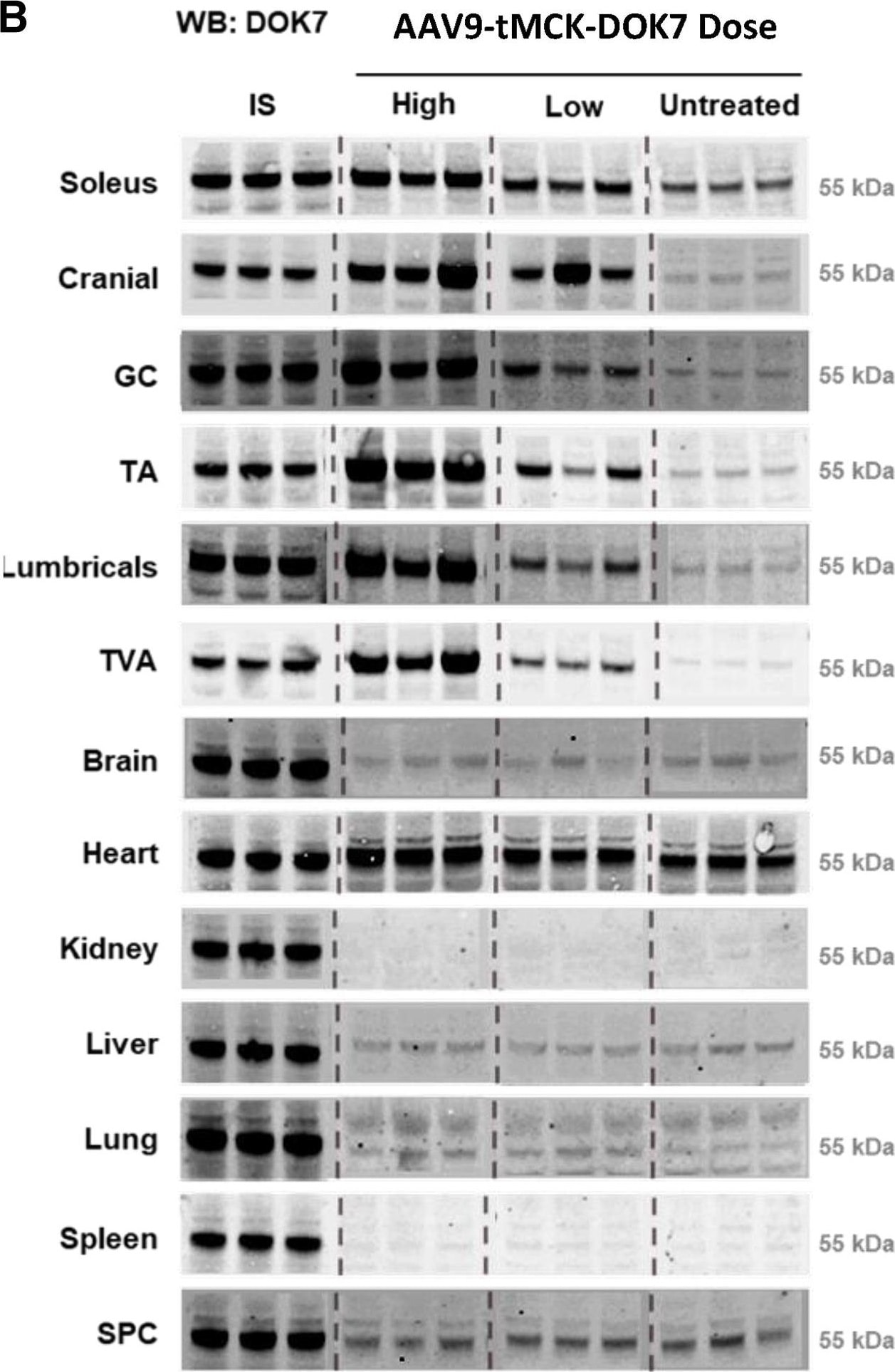
Detection of DOK7 by Western Blot
AAV9-tMCK-DOK7 increases DOK7 expression in skeletal muscle(A) Schematic of the AAV9-tMCK-DOK7 plasmid showing the skeletal muscle targeting tMCK promoter & DOK7 transgene.(B–D) DOK7 expression across a range of muscles & organs from 1-month-old mice treated with high dose (5e11 vg), low dose (1.25e11 vg), or untreated with AAV9-tMCK-DOK7. “IS” denotes internal standards run in triplicate used to allow comparison between blots. (B) Western blots where the molecular weight of DOK7 is indicated. Dotted lines illustrate where blot sections have been cropped together. (C) Bar graph of endogenous expression in skeletal muscle & tissue shown by quantified WBs. Values are normalized to the average of three DOK7 internal standards (ISs). Each dot represents a single mouse, & bars represent the mean (with SEM) (n = 3 per bar). (D) DOK7 expression in response to high-dose or low-dose treatments were compared by one-way ANOVA with Holm-Šídák’s multiple comparisons. Each bar represents an average of three animals (with SEM), normalized to internal standard (IS) & then normalized to endogenous protein levels for that tissue. Expression increased by 40x over endogenous levels in the GC (p = 0.0114), & the TA (p = 0.0242), hindlimb lumbricals (p = 0.0074), & TVA (p = 0.013) each showed a marked rise in DOK7. The soleus, which exhibited the highest endogenous levels of DOK7 in skeletal muscle, still expressed ∼4x as much DOK7 following high-dose treatment (p = 0.0032). There was also a small but significant increase in DOK7 expression in the heart following high-dose AAV9-tMCK-DOK7 treatment (p = 0.0018, n = 3 in all groups, one-way ANOVAs with Holm-Šídák’s comparisons). SPC, spinal cord; TVA, transverse abdominis; TA, tibialis anterior; GC, gastrocnemius; ∗p < 0.05, ∗∗p < 0.01. Image collected & cropped by CiteAb from the following open publication (https://pubmed.ncbi.nlm.nih.gov/37637210), licensed under a CC-BY license. Not internally tested by R&D Systems.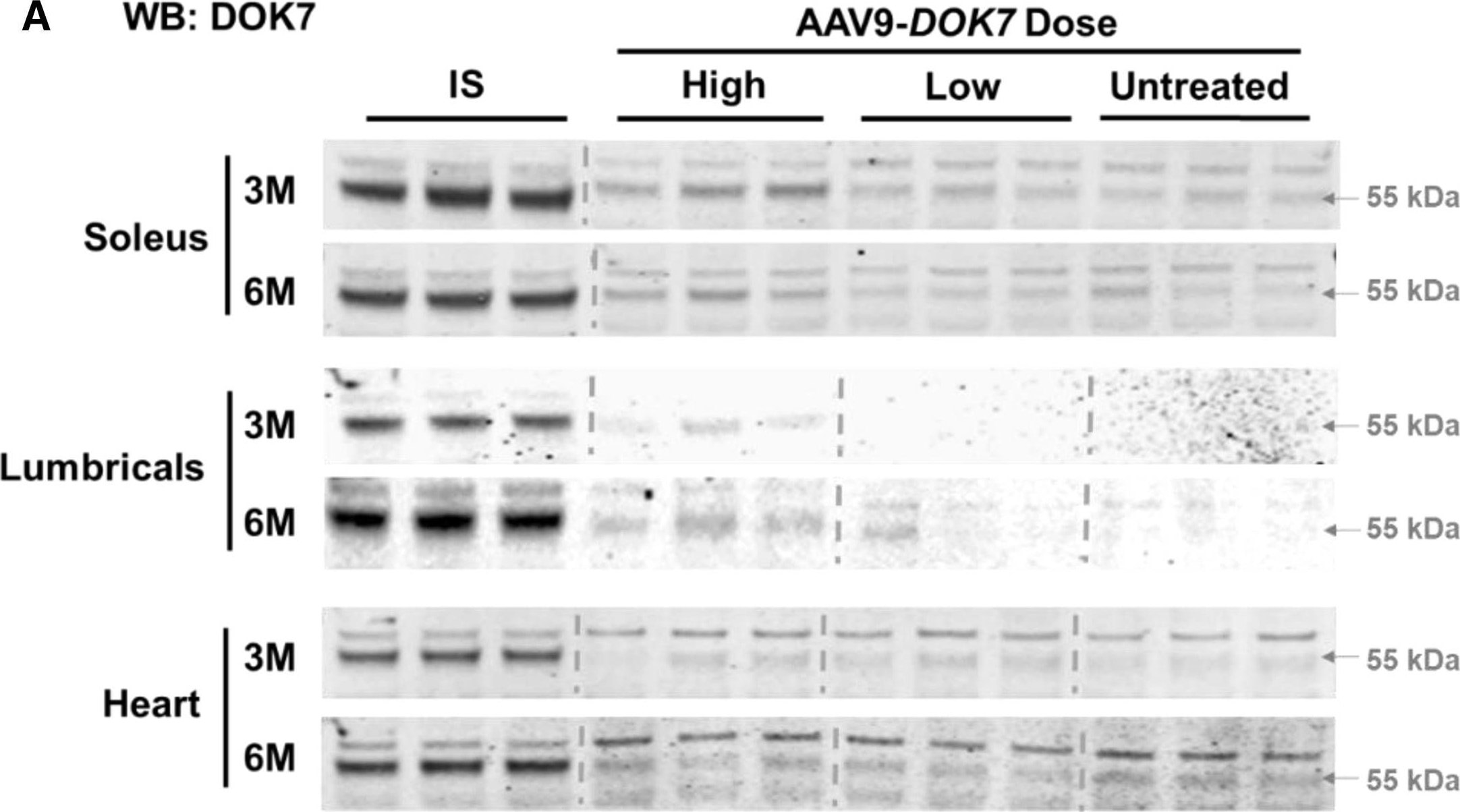
Detection of DOK7 by Western Blot
hDOK7 overexpression stimulates long-term elevation of DOK7 protein expression in mouse hindlimb muscles but not the heart(A) Western blots of tissue lysates probed with anti-DOK7 antibody shown at 55 kDa (middle band). Tissue from three mice each untreated or injected with high- or low-dose AAV9-tMCK-DOK7 was run alongside internal standards (ISs) produced in triplicate, enabling cross-gel comparison. Tissues were taken from mice at 3 months (M) and 6 months of age.(B–D) Bar charts comparing the effect of dose on tissue-specific DOK7 expression. Western blot data were quantified and normalized to the average value of three internal standards. DOK7 expression was significantly increased at 3 and 6 months following high-dose treatment in the hindlimb soleus muscle (B) and lumbricals (C) but not in heart tissue (D), when compared to untreated controls. Specifically, there was a 3.8-fold increase in DOK7 expression in the soleus 3 months following treatment and a 1.9-fold increase at 6 months (B; p < 0.0001 and p = 0.019), while in the lumbricals, there was a 4.7-fold increase in DOK7 expression at 3 months and a 4.6-fold increase at 6 months (C; p = 0.0009 and p = 0.0031) (one-way ANOVAs with Šídák’s multiple comparisons, means of n = 3 per group [with SEM], and each data point represents one animal). ∗p < 0.05, ∗∗p < 0.01, ∗∗∗p < 0.001, ∗∗∗∗p < 0.0001. Image collected and cropped by CiteAb from the following open publication (https://pubmed.ncbi.nlm.nih.gov/37637210), licensed under a CC-BY license. Not internally tested by R&D Systems.Applications for DOK7 Antibody
Application
Recommended Usage
Simple Western
5 µg/mL
Sample: MCF‑7 human breast cancer cell line and T47D human breast cancer cell line
Sample: MCF‑7 human breast cancer cell line and T47D human breast cancer cell line
Western Blot
0.5 µg/mL
Sample: MCF‑7 human breast cancer cell line and T47D human breast cancer cell line (untreated) and C2C12 mouse myoblast cell line and L6 rat myoblast cell line treated with horse serum
Sample: MCF‑7 human breast cancer cell line and T47D human breast cancer cell line (untreated) and C2C12 mouse myoblast cell line and L6 rat myoblast cell line treated with horse serum
Formulation, Preparation, and Storage
Purification
Antigen Affinity-purified
Reconstitution
Reconstitute at 0.2 mg/mL in sterile PBS. For liquid material, refer to CoA for concentration.
Loading...
Formulation
Lyophilized from a 0.2 μm filtered solution in PBS with Trehalose. *Small pack size (SP) is supplied either lyophilized or as a 0.2 µm filtered solution in PBS.
Shipping
Lyophilized product is shipped at ambient temperature. Liquid small pack size (-SP) is shipped with polar packs. Upon receipt, store immediately at the temperature recommended below.
Stability & Storage
Use a manual defrost freezer and avoid repeated freeze-thaw cycles.
- 12 months from date of receipt, -20 to -70 °C as supplied.
- 1 month, 2 to 8 °C under sterile conditions after reconstitution.
- 6 months, -20 to -70 °C under sterile conditions after reconstitution.
Calculators
Background: DOK7
Long Name
Downstream of Tyrosine Kinase 7
Alternate Names
C4orf25, CMS1B
Gene Symbol
DOK7
UniProt
Additional DOK7 Products
Product Documents for DOK7 Antibody
Certificate of Analysis
To download a Certificate of Analysis, please enter a lot or batch number in the search box below.
Note: Certificate of Analysis not available for kit components.
Product Specific Notices for DOK7 Antibody
For research use only
Related Research Areas
Citations for DOK7 Antibody
 Powered by Bioz
Customer Reviews for DOK7 Antibody
There are currently no reviews for this product. Be the first to review DOK7 Antibody and earn rewards!
Have you used DOK7 Antibody?
Submit a review and receive an Amazon gift card!
$25/€18/£15/$25CAN/¥2500 for a review with an image
$10/€7/£6/$10CAN/¥1110 for a review without an image
Submit a review
Protocols
Find general support by application which include: protocols, troubleshooting, illustrated assays, videos and webinars.
- Cellular Response to Hypoxia Protocols
- R&D Systems Quality Control Western Blot Protocol
- Troubleshooting Guide: Western Blot Figures
- Western Blot Conditions
- Western Blot Protocol
- Western Blot Protocol for Cell Lysates
- Western Blot Troubleshooting
- Western Blot Troubleshooting Guide
- View all Protocols, Troubleshooting, Illustrated assays and Webinars
Loading...