Human/Mouse/Rat VEGF-C Antibody Summary
Thr103-Arg227
Accession # P49767
Applications
Please Note: Optimal dilutions should be determined by each laboratory for each application. General Protocols are available in the Technical Information section on our website.
Scientific Data
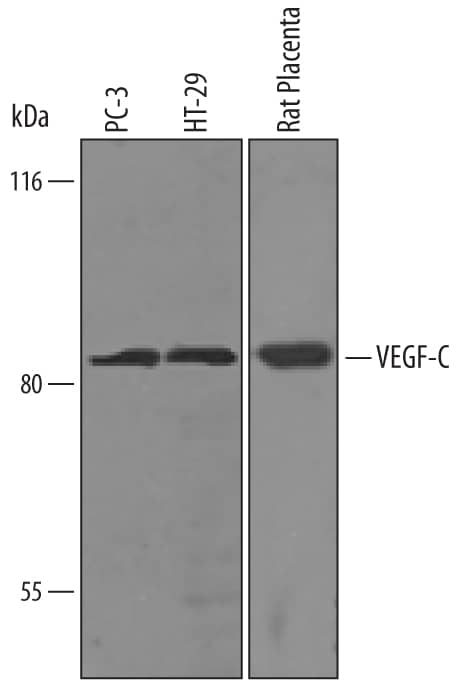 View Larger
Detection of Human and Rat VEGF‑C by Western Blot. Western blot shows lysates of PC-3 human prostate cancer cell line, HT-29 human colon adenocarcinoma cell line, and rat placenta tissue. PVDF Membrane was probed with 1 µg/mL of Human VEGF-C Antigen Affinity-purified Polyclonal Antibody (Catalog # AF2179) followed by HRP-conjugated Anti-Sheep IgG Secondary Antibody (Catalog # HAF016). A specific band was detected for VEGF-C at approximately 85 kDa (as indicated). This experiment was conducted under reducing conditions and using Immunoblot Buffer Group 8.
Reconstitution Calculator
Preparation and Storage
- 12 months from date of receipt, -20 to -70 °C as supplied.
- 1 month, 2 to 8 °C under sterile conditions after reconstitution.
- 6 months, -20 to -70 °C under sterile conditions after reconstitution.
Background: VEGF-C
Vascular endothelial growth factor C (VEGF-C) and VEGF-D constitute a VEGF sub-family that share the conserved VEGF homology domain (VHD) with other VEGF family members but are distinguished by their preferential formation of non-covalent homodimers. Both VEGF-C and -D have long N- and C-terminal propeptide extensions. The VEGF-C propeptide undergoes stepwise proteolytic processing to generate ligands with increasing affinity for VEGF-R3. However, only the fully processed VEGF-C containing just the VHD can bind VEGF-R2. None of the VEGF-C forms have appreciable affinity for VEGF-R1. VEGF-C is expressed in multiple adult human tissues, most prominently in lymph nodes, heart, placenta, ovary, and small intestine. Traces of VEGF-C are also detected in brain, liver, thymus, skeletal muscles, spleen, prostate, testis and colon. Unlike other VEGF family members, VEGF-C expression is not regulated by hypoxia. VEGF-C is a lymphangiogenic growth factor and the VEGF-C/VEGF-R3 signaling pathway has been shown to be crucial for lymphangiogenesis. VEGF-C and VEGF-R3 are usually co-expressed at sites with lymphatic vessel sprouting, in the embryo, and in various pathological conditions. VEGF-C stimulates lymphangiogenesis in the avian chorioallantoic membrane model. Over-expression of VEGF-C in breast cancer cells has been shown to increase intratumoral lymphangiogenesis, resulting in enhanced metastasis to regional lymph nodes and to the lungs. Mouse tumors expressing elevated levels of VEGF-C have increased lymphatic metastasis and increased lymphatic surface area in the tumor margin. VEGF-C is also associated with lymph node metastasis of colorectal carcinoma. Besides lymphangiogenesis, VEGF-C can have potent effects on physiological angiogenesis through its interaction with VEGF R2. The protein can stimulate migration and proliferation of endothelial cells in vitro and in vivo and has been shown to stimulate angiogenesis in the mouse cornea and in rabbit hind limb ischaemia (1‑10).
- Joukov, V. et al. (1996) EMBO J. 15:290.
- Joukov, V. et al. (1997) EMBO J. 16:3898.
- Lee, J. et al. (1996) Proc. Natl. Acad. Sci. USA 93:1988.
- Oh, S. et al. (1997) Dev. Biol. 188:96.
- Witzenbichler, B. et al. (1998) Am. J. Pathol. 153:381.
- Cao, Y. et al. (1998) Proc. Natl. Acad. Sci. 95:14389.
- Stacker, S and M. Achen (1999) Growth Factors 17:1.
- Akagi, K. et al. (2000) Br. J. Cancer 83:887.
- Skobe, M. et al. (2001) Nature Medicine 2:192.
- Padera, T.P. et al. (2002) Science 296:1883.
Product Datasheets
FAQs
No product specific FAQs exist for this product, however you may
View all Antibody FAQsReviews for Human/Mouse/Rat VEGF-C Antibody
There are currently no reviews for this product. Be the first to review Human/Mouse/Rat VEGF-C Antibody and earn rewards!
Have you used Human/Mouse/Rat VEGF-C Antibody?
Submit a review and receive an Amazon gift card.
$25/€18/£15/$25CAN/¥75 Yuan/¥2500 Yen for a review with an image
$10/€7/£6/$10 CAD/¥70 Yuan/¥1110 Yen for a review without an image
