

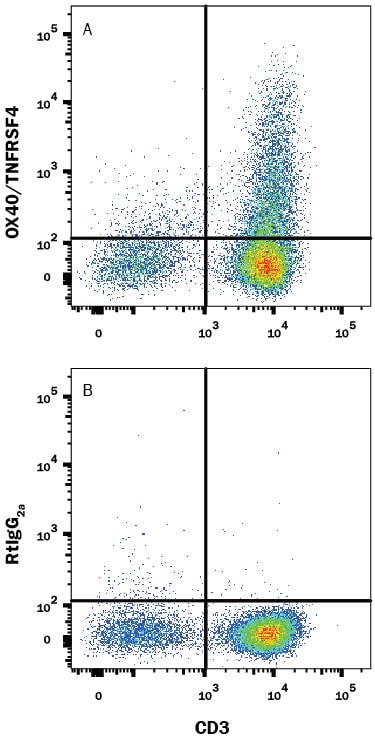

OX40 (CD134; TNFRSF4) is a T cell co‑stimulatory molecule of the TNF receptor superfamily that coordinates with other membrane-bound co‑stimulators such as CD28, CD40, CD30, CD27 and 4-1BB (1‑3). OX40 is expressed on naïve CD4+ T cells only after engagement of the TCR by antigen presenting cells (APC; dendritic and B cells), and co‑stimulation by CD40/CD40 ligand and CD28/B7. It is maximal at 2‑5 days post activation, or 4 hours post reactivation of memory T cells (3‑6). Human OX40 is a 48 kDa type I transmembrane glycoprotein with a 28 amino acid (aa) signal sequence, a 185 aa extracellular domain (ECD) that has four TNFR-Cys repeats and an O-glycosylated hinge region, a 20 aa transmembrane segment, and a 41 aa cytoplasmic domain (3). The ECD of human OX40 shows 71%, 68%, 67%, 64% and 64% aa identity with feline, canine, rabbit, mouse and rat OX40 ECD, respectively. Engagement of OX40 on activated CD4+ T cells by OX40 ligand on activated dendritic cells promotes T cell survival and proliferation, prolongs the immune response, and enhances the number of cells making the transition from effector to memory T cells (1‑6). OX40 signal transduction includes binding TNF receptor-associated factors (TRAFs), and activating NF kappa B and PI3 kinase to enhance expression of cytokines, antiapoptotic Bcl-2 family members, survivin and the chemokine receptor CXCR5 (5‑8). CXCR5 promotes T cell migration to germinal centers to deliver B cell help (5). Studies using knockout or transgenic mice, and agonistic or blocking antibodies, show that OX40/OX40L interaction is critical for establishing or reactivating memory T cells and breaking immune tolerance (9). Blockade of OX40 engagement is efficacious in animal models of allergic airway inflammation, graft-versus-host disease and autoimmune disease (10‑14).
 Powered by Bioz


