
Key Product Details

Species Reactivity

Validated:

Human

Cited:

Human

Applications

Validated:

Flow Cytometry

Cited:

Flow Cytometry

Label

Phycoerythrin (Excitation = 488 nm, Emission = 565-605 nm)

Antibody Source

Polyclonal Goat IgG
Loading...

Product Specifications

Immunogen

Mouse myeloma cell line NS0-derived recombinant human TGF‑ beta  RIII
Gly21-Asp781
Accession # AAA67061

Specificity

Detects human TGF-beta  RIII in direct ELISAs and Western blots. In direct ELISAs, approximately 25% cross-reactivity with recombinant mouse (rm) TGF-beta  RIII is observed, and less than 1% cross-reactivity with recombinant human (rh) TGF-beta  RI, rhTGF-beta  RII, rhTGF-beta  RIIB, and rmTGF-beta  RI  is observed.

Clonality

Polyclonal

Host

Goat

Isotype

IgG

Scientific Data Images for Human TGF‑ beta  RIII PE‑conjugated Antibody

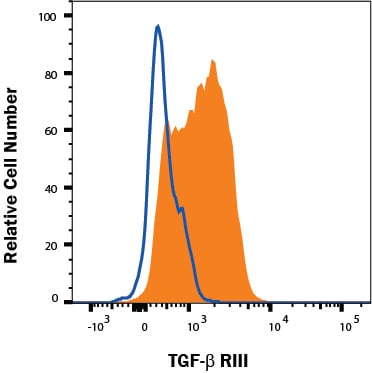
Detection of TGF-beta  RIII antibody in Human Blood Lymphocytes antibody by Flow Cytometry.

Detection of TGF‑ beta RIII in Human Blood Lymphocytes by Flow Cytometry.

Human peripheral blood lymphocytes were stained with Goat Anti-Human TGF-beta RIII PE-conjugated Antigen Affinity-purified Polyclonal Antibody (Catalog # FAB242P, filled histogram) or isotype control antibody (Catalog # IC108P, open histogram). View our protocol for Staining Membrane-associated Proteins.

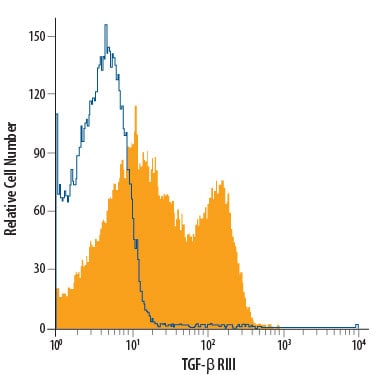
Detection of TGF‑ beta RIII in Human MCF-7 Cell Line by Flow Cytometry

MCF-7 human breast adenocarcinoma cell line was stained with Goat Anti-Human TGF-beta RIII PE-conjugated Antigen Affinity-purified Polyclonal Antibody (Catalog # FAB242P, filled histogram) or isotype control antibody (IC108P, open histogram). View our protocol for Staining Membrane-associated Proteins.

Applications for Human TGF‑ beta  RIII PE‑conjugated Antibody

Application
Recommended Usage

Flow Cytometry

10 µL/106 cells
Sample: Human MCF-7 breast adenocarcinoma cell line and peripheral blood lymphocytes

Spectra Viewer

Plan Your Experiments

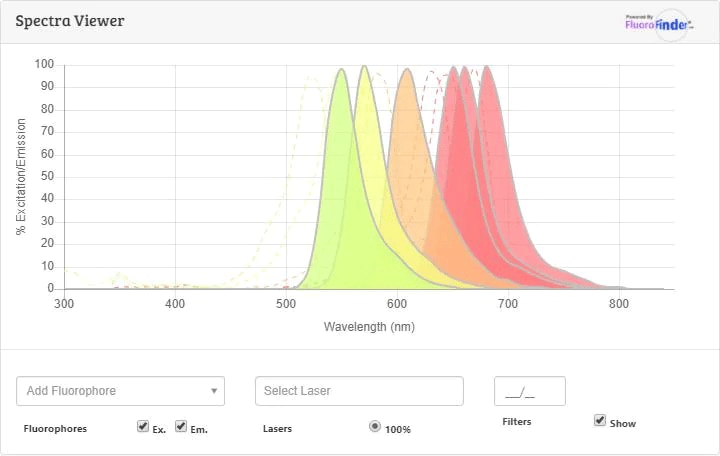
Use our spectra viewer to interactively plan your experiments, assessing multiplexing options. View the excitation and emission spectra for our fluorescent dye range and other commonly used dyes.

Spectra Viewer

Flow Cytometry Panel Builder

Bio-Techne Knows Flow Cytometry

Save time and reduce costly mistakes by quickly finding compatible reagents using the Panel Builder Tool.

Advanced Features

  • Spectra Viewer - Custom analysis of spectra from multiple fluorochromes
  • Spillover Popups - Visualize the spectra of individual fluorochromes
  • Antigen Density Selector - Match fluorochrome brightness with antigen density
Build Your Panel Now

Formulation, Preparation, and Storage

Purification

Antigen Affinity-purified

Formulation

Supplied in a saline solution containing BSA and Sodium Azide.

Shipping

The product is shipped with polar packs. Upon receipt, store it immediately at the temperature recommended below.

Stability & Storage

Protect from light. Do not freeze.
  • 12 months from date of receipt, 2 to 8 °C as supplied.

Background: TGF-beta RIII

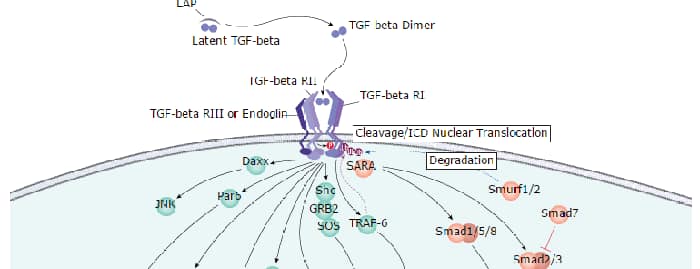
Most cell types express three sizes of receptors for TGF-beta. These are designated Type I (53 kDa), Type II (70-85 kDa), and Type III (250-350 kDa). The Type I receptor is a membrane-bound serine/threonine kinase that apparently requires the presence of the Type II receptor to bind TGF-beta. The Type II receptor is also a membrane-bound serine/threonine kinase that binds TGF-beta 1 and TGF-beta 3 with high affinity and TGF-beta 2 with a much lower affinity. The Type I and Type II receptors together form a heterodimeric signaling complex that is essential for the transduction of the anti-proliferative signals of TGF-beta.

The Type III receptor is a transmembrane proteoglycan with a large extracellular domain and a 43 amino acid residue cytoplasmic domain. The cytoplasmic domain of the Type III receptor lacks an obvious signaling motif and the receptor may not be involved directly in signal transduction. The Type III receptor binds TGF-beta 2 with the highest affinity. Other TGF-beta isoforms also bind the Type III receptor, but with lower affinities. Cellular responsiveness to TGF-beta 2 appears to be dependent on the presence of the Type III receptor which can interact with the signaling receptor complex. In addition to the transmembrane Type III receptor, a soluble form of the receptor is secreted by some cell types. The physiological role of this soluble receptor remains to be determined. The recombinant TGF-beta soluble receptor Type III binds the TGF-beta isoforms differentially in solution and exhibits TGF-beta antagonistic activities in vitro.

Long Name

Transforming Growth Factor beta Receptor III

Alternate Names

Betaglycan, BGCAN, TBRIII, TGF-bRIII, TGFbetaRIII, TGFBR3

Entrez Gene IDs

7049 (Human); 21814 (Mouse); 29610 (Rat)

Gene Symbol

TGFBR3

UniProt

Additional TGF-beta RIII Products

Product Documents for Human TGF‑ beta  RIII PE‑conjugated Antibody

Certificate of Analysis

To download a Certificate of Analysis, please enter a lot or batch number in the search box below.

Note: Certificate of Analysis not available for kit components.

Product Specific Notices for Human TGF‑ beta  RIII PE‑conjugated Antibody

For research use only

Citations for Human TGF‑ beta  RIII PE‑conjugated Antibody

Customer Reviews for Human TGF‑ beta  RIII PE‑conjugated Antibody

There are currently no reviews for this product. Be the first to review Human TGF‑ beta  RIII PE‑conjugated Antibody and earn rewards!

Have you used Human TGF‑ beta  RIII PE‑conjugated Antibody?

Submit a review and receive an Amazon gift card!

$25/€18/£15/$25CAN/¥2500 Yen for a review with an image

$10/€7/£6/$10CAN/¥1110 Yen for a review without an image

Submit a review
Amazon Gift Card

FAQs for Human TGF‑ beta  RIII PE‑conjugated Antibody

Showing  1 - 1 of 1 FAQ Showing All
  • Q: What epitope does this antibody detect?

    A: We have not done epitope mapping, but the antibody was raised against the extracellular domain of recombinant human TGF -beta RIII, Gly 21-Asp781, accession # AAA67061.  The antibody will react with the antigen in this region.

Showing  1 - 1 of 1 FAQ Showing All
View all FAQs for Antibodies