
Human TRAIL R4, also called decoy receptor 2 (DcR2) and TRUNND (TRAIL receptor with a truncated death domain), is a type 1, TNF R family membrane protein, which is a receptor for TRAIL (APO2 ligand). In the new TNF superfamily nomenclature, TRAIL R4 is referred to as TNFRSF10D. TRAIL R4 is unique among the TRAIL receptors in that its cytoplasmic domain contains a truncated consensus death domain motif. Binding of TRAIL R4 does not result in an apoptotic signal. Overexpression of TRAIL R4 can protect cells bearing TRAIL R1 and/or TRAIL R2 from TRAIL-mediated apoptosis. The human soluble TRAIL R4/Fc chimera neutralizes the ability of TRAIL to induce apoptosis.
Human TRAILR4/TNFRSF10D Antibody [Biotin]
R&D Systems | Catalog # BAF633

Scientific images may be resized, cropped, or adjusted for brightness or contrast for presentation purposes. These updates are limited to presentation and do not affect the underlying scientific interpretation of the data. Where available, additional source data may be provided upon request.
Key Product Details
Species Reactivity
Validated:
Human
Cited:
Human
Applications
Validated:
Western Blot, ELISA Detection (Matched Antibody Pair)
Cited:
Flow Cytometry
Label
Biotin
Antibody Source
Polyclonal Goat IgG
Loading...
Product Specifications
Immunogen
Mouse myeloma cell line NS0-derived recombinant human TRAIL R4/TNFRSF10D
Ala56-His211
Accession # Q9UBN6
Ala56-His211
Accession # Q9UBN6
Specificity
Detects human TRAIL R4/TNFRSF10D in ELISAs and Western blots. In sandwich immunoassays, less than 3.5% cross-reactivity with recombinant human (rh) TRAIL R3 is observed and less than 0.5% cross-reactivity with rhTRAIL R1, rhTRAIL R2, rhTRAIL, rhTNF-alpha, and rhTNF-beta is observed.
Clonality
Polyclonal
Host
Goat
Isotype
IgG
Scientific Data Images for Human TRAILR4/TNFRSF10D Antibody [Biotin]
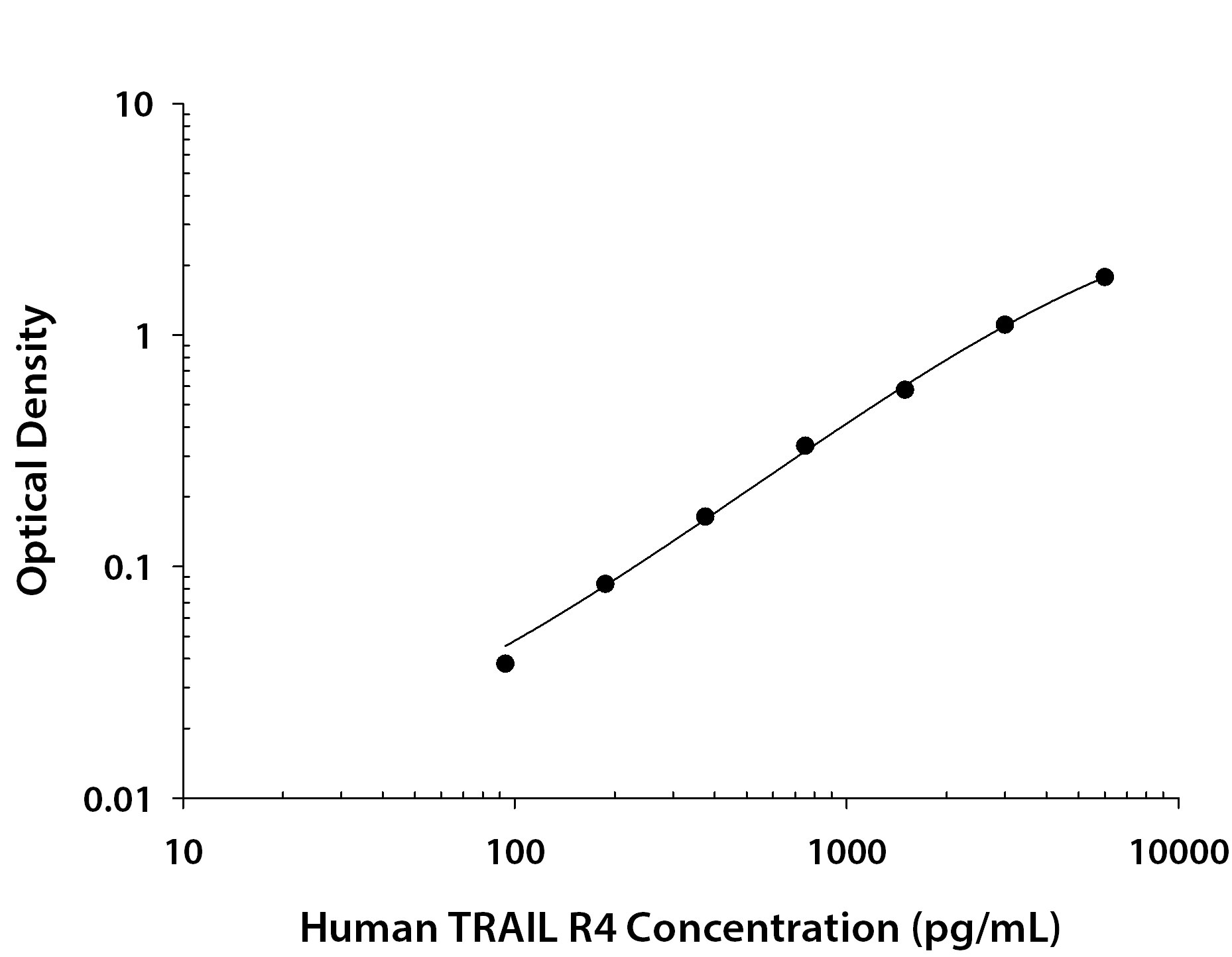
Human TRAILR4/TNFRSF10D ELISA Standard Curve.
Recombinant Human TRAILR4/TNFRSF10D protein was serially diluted 2-fold and captured by Mouse Anti-Human TRAILR4/TNFRSF10D Monoclonal Antibody Catalog # MAB633R) coated on a Clear Polystyrene Microplate (DY990). Goat Anti-Human TRAILR4/TNFRSF10D Biotinylated Antigen Affinity-purified Polyclonal Antibody(Catalog # BAF633) was incubated with the protein captured on the plate. Detection of the standard curve was achieved by incubating Streptavidin-HRP (DY998) followed by Substrate Solution (DY998) and stopping the enzymatic reaction with Stop Solution (DY994).Applications for Human TRAILR4/TNFRSF10D Antibody [Biotin]
Application
Recommended Usage
Western Blot
0.1 µg/mL
Sample: Recombinant Human TRAIL R4/TNFRSF10D Fc Chimera (Catalog # 633-TR)
Sample: Recombinant Human TRAIL R4/TNFRSF10D Fc Chimera (Catalog # 633-TR)
Human TRAIL R4/TNFRSF10D Sandwich Immunoassay
Please Note: Optimal dilutions of this antibody should be experimentally determined.
Formulation, Preparation, and Storage
Purification
Antigen Affinity-purified
Reconstitution
Reconstitute at 0.2 mg/mL in sterile PBS.
Loading...
Formulation
Lyophilized from a 0.2 μm filtered solution in PBS with BSA as a carrier protein.
Shipping
The product is shipped at ambient temperature. Upon receipt, store it immediately at the temperature recommended below.
Stability & Storage
Use a manual defrost freezer and avoid repeated freeze-thaw cycles.
- 12 months from date of receipt, -20 to -70 °C as supplied.
- 1 month, 2 to 8 °C under sterile conditions after reconstitution.
- 6 months, -20 to -70 °C under sterile conditions after reconstitution.
Calculators
Background: TRAILR4/TNFRSF10D
References
- Griffith, T.S. et al. (1998) Curr. Opin. Immunol. 10:559.
- Pan, G. et al. (1998) FEBS lett 424:41.
- Marsters, S.A. et al. (1997) Cur. Biol. 7:1003.
- Degli-Esposti, M.A. et al. (1997) Immunity 7:813.
Long Name
TRAIL Receptor 4
Alternate Names
CD264, DcR2, TNFRSF10D, TRAIL R4
Entrez Gene IDs
8793 (Human)
Gene Symbol
TNFRSF10D
UniProt
Additional TRAILR4/TNFRSF10D Products
Product Documents for Human TRAILR4/TNFRSF10D Antibody [Biotin]
Certificate of Analysis
To download a Certificate of Analysis, please enter a lot or batch number in the search box below.
Note: Certificate of Analysis not available for kit components.
Product Specific Notices for Human TRAILR4/TNFRSF10D Antibody [Biotin]
For research use only
Citations for Human TRAILR4/TNFRSF10D Antibody [Biotin]
 Powered by Bioz
Customer Reviews for Human TRAILR4/TNFRSF10D Antibody [Biotin]
There are currently no reviews for this product. Be the first to review Human TRAILR4/TNFRSF10D Antibody [Biotin] and earn rewards!
Have you used Human TRAILR4/TNFRSF10D Antibody [Biotin]?
Submit a review and receive an Amazon gift card!
$25/€18/£15/$25CAN/¥2500 for a review with an image
$10/€7/£6/$10CAN/¥1110 for a review without an image
Submit a review
Protocols
Find general support by application which include: protocols, troubleshooting, illustrated assays, videos and webinars.
- Cellular Response to Hypoxia Protocols
- R&D Systems Quality Control Western Blot Protocol
- Troubleshooting Guide: Western Blot Figures
- Western Blot Conditions
- Western Blot Protocol
- Western Blot Protocol for Cell Lysates
- Western Blot Troubleshooting
- Western Blot Troubleshooting Guide
- View all Protocols, Troubleshooting, Illustrated assays and Webinars
Loading...
Associated Pathways
