
Human Transferrin (Tf) is a single chain, 80 kDa member of the anion-binding superfamily of proteins (1-5). It is a bilobed molecule that is the product of an ancient gene duplication event (1, 6). Transferrin is synthesized as a 698 amino acid (aa) precursor that is divided into a 19 aa signal sequence plus a 679 aa mature segment that contains 19 intrachain disulfide bonds. The crystal structure of Tf reveals a protein with two flanking 340 aa globular domains. Each are composed of a beta -sheet surrounded by series of alpha -helices (1, 7). The N- and C-terminal flanking regions (or domains) will bind ferric iron through the interaction of an obligate anion (usually bicarbonate) and four amino acids (His, Asp, and two Tyr) (7, 8). Apotransferrin (or iron-free) will initially bind one atom of iron at the C-terminus, and this is followed by subsequent iron binding by the N-terminus to form holotransferrin (diferric Tf) (8, 9). Through its C-terminal iron-binding domain, holotransferrin will interact with the type I Tf receptor (TfR) on the surface of cells where it is internalized into acidified endosomes. Iron dissociates from the Tf molecule within these endosomes, and is transported into the cytosol as ferrous iron. At physiological pH, iron-free Apotransferrin is not bound by TfR. But at acidic pH, such as exists in the endosome, Apotransferrin has considerable affinity for TfR. Thus, it remains bound to TfR and is recycled back to the cell surface where a neutral pH environment dissociates ligand from receptor. Each Tf molecule recycles 100-150 times during its lifetime (8-11). In addition to TfR, transferrin is reported to bind to cubulin, IGFBP3, microbial iron-binding proteins and liver-specific TfR2 (7, 12, 13, 14). Transferrin is variably glycosylated and the degree of sfialylation is suggestive of certain clinical conditions (15). Finally, Tf is highly allelic and the gene codominant, with many single aa changes noted. Three general forms are known, based on standard electrophoretic mobility. Fast Tf is known as transferrin B, slow transferrin is transferrin D, and the middle migrating transferrin is type/variant C, the most common (16, 17). Mature human TF is 73% aa identical to both mouse and rat Tf, and 68% and 71% aa identical to bovine and equine Tf, respectively.
Human Transferrin Antibody
R&D Systems | Catalog # AF2914

Scientific images may be resized, cropped, or adjusted for brightness or contrast for presentation purposes. These updates are limited to presentation and do not affect the underlying scientific interpretation of the data. Where available, additional source data may be provided upon request.
Key Product Details
Species Reactivity
Validated:
Cited:
Applications
Validated:
Cited:
Label
Antibody Source
Product Specifications
Immunogen
Specificity
Clonality
Host
Isotype
Scientific Data Images for Human Transferrin Antibody
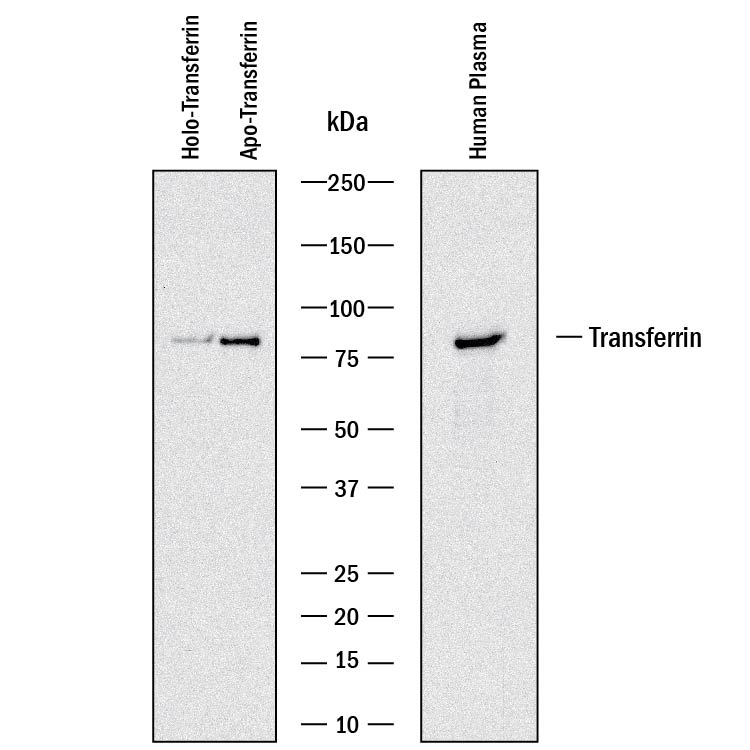
Detection of Human Transferrin and Human Apo-Transferrin by Western Blot.
Western blot shows purified holo-transferrin, purified apo-transferrin, and human plasma. PVDF membrane was probed with 0.1 µg/mL of Goat Anti-Human Transferrin Antigen Affinity-purified Polyclonal Antibody (Catalog # AF2914) followed by HRP-conjugated Anti-Goat IgG Secondary Antibody (Catalog # HAF017). A specific band was detected for Transferrin and Apo-Transferrin at approximately 75 kDa (as indicated). This experiment was conducted under reducing conditions and using Immunoblot Buffer Group 1.Applications for Human Transferrin Antibody
Western Blot
Sample: Purified Holo-Transferrin, Purified Apo-Transferrin, and Human Plasma
Formulation, Preparation, and Storage
Purification
Reconstitution
Reconstitute at 0.2 mg/mL in sterile PBS. For liquid material, refer to CoA for concentration.
Formulation
Shipping
Stability & Storage
- 12 months from date of receipt, -20 to -70 °C as supplied.
- 1 month, 2 to 8 °C under sterile conditions after reconstitution.
- 6 months, -20 to -70 °C under sterile conditions after reconstitution.
Calculators
Background: Transferrin
References
- Brus, C.M. et al. (2001) Nat. Struct. Biol. 4:919.
- Schaeffer, E. et al. (1987) Gene 56:109.
- MacGillivray, R.T.A. et al. (1983) J. Biol. Chem. 258:3543.
- Yang, F. et al. (1984) Proc. Natl. Acad. Sci. USA 81:2752.
- Uzan, G. et al. (1984) Biochem. Biophys. Res. Commun. 119:273.
- Zak, O. et al. (2002) Biochemistry 41:7416.
- Gomme, P.T. and K. B. McCann (2005) Drug Discov. Today 10:267.
- Liu, R. et al. (2003) Biochemistry 42:12447.
- Pakdaman, R. et al. (1999) J. Mol. Biol. 293:1273.
- Hemadi, M. et al. (2004) Biochemistry 43:1736.
- Aisen, P. et al. (2001) Int. J. Biochem. Cell Biol. 33:940.
- Kozyraki, R. et al. (2001) Proc. Natl. Acad. Sci. USA 98:12941.
- Boulton, I.C. et al. (1998) Biochem. J. 334:269.
- Robb, A. and M. Wessling-Resnick (2004) Blood 104:4294.
- Landberg, E. et al. (1995) Biochem. Biophys. Res. Commun. 210:267.
- Gorg, A. et al. (1983) Hum. Genet. 64:222.
- Bean, P. and J.B. Peter (1994) Clin. Chem. 40:2078.
Alternate Names
Entrez Gene IDs
Gene Symbol
Additional Transferrin Products
Product Documents for Human Transferrin Antibody
Certificate of Analysis
To download a Certificate of Analysis, please enter a lot or batch number in the search box below.
Note: Certificate of Analysis not available for kit components.
Product Specific Notices for Human Transferrin Antibody
For research use only
Citations for Human Transferrin Antibody
 Powered by Bioz
Customer Reviews for Human Transferrin Antibody
There are currently no reviews for this product. Be the first to review Human Transferrin Antibody and earn rewards!
Have you used Human Transferrin Antibody?
Submit a review and receive an Amazon gift card!
$25/€18/£15/$25CAN/¥2500 for a review with an image
$10/€7/£6/$10CAN/¥1110 for a review without an image
Submit a review
Protocols
Find general support by application which include: protocols, troubleshooting, illustrated assays, videos and webinars.
- Cellular Response to Hypoxia Protocols
- R&D Systems Quality Control Western Blot Protocol
- Troubleshooting Guide: Western Blot Figures
- Western Blot Conditions
- Western Blot Protocol
- Western Blot Protocol for Cell Lysates
- Western Blot Troubleshooting
- Western Blot Troubleshooting Guide
- View all Protocols, Troubleshooting, Illustrated assays and Webinars