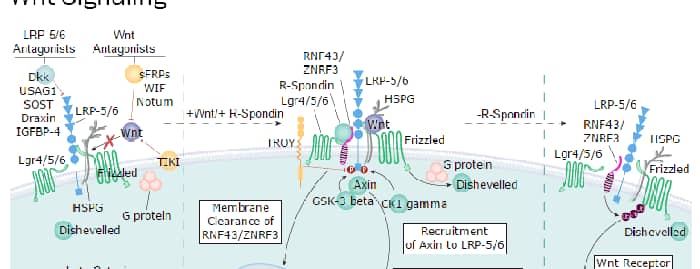
Wnt-4 is a 38‑42 kDa member of the Wnt family of secreted glycoproteins, which act as short-range signaling molecules via Frizzled receptors and a cascade of intracellular signals in vertebrate embryogenesis (1‑2). Human Wnt-4 is synthesized as a 351 amino acid (aa) precursor with a 22 aa signal sequence and a 329 aa mature chain. The mature chain contains two potential sites for N-linked glycosylation. Relative to other members of the Wnt family, Wnt-4 contains 83 conserved aa, including 21 cysteines (1). Mature human Wnt-4 shares 99%, 98% and 99% aa sequence identity with mature mouse, rat and canine Wnt-4, respectively. Wnt-4 has been shown to play a critical role in the development of the reproductive system and in the formation of the kidneys, adrenals, pituitary gland, and mammary tissues (3‑6). In the development of the reproductive system, Wnt-4 expression is down‑regulated in the developing gonad after E11.5, although it persists in the developing ovary (2, 6). Targeted deletion of Wnt-4 results in masculinization of XX mice, with rudimentary development of the masculine internal (Wolffian) ducts and degeneration of the female (Mullerian) reproductive tract (2, 6). In addition to its involvement in urogenital development, Wnt-4 is also expressed in the perichondrium of the long bones (7), and promotes osteoblast differentiation (8). Wnt-4 may also be associated with abnormal proliferation in human breast tissue (9). In humans, mutations in Wnt-4 are the cause of SERKAL syndrome, a syndrome consisting of female to male sex reversal, renal, adrenal, and lung dysgenesis, and developmental defects (3), and Rokitansky-Kuster-Hauser syndrome, which is characterized by utero-vaginal atresia in otherwise phenotypically normal females with normal 46, XX karyotype (10).
Human Wnt-4 Antibody [Alexa Fluor® 405]
R&D Systems | Catalog # AF6076V

![Human Wnt-4 Antibody [Alexa Fluor® 405]](https://resources.rndsystems.com/images/icons/RnD-Default-Product-Image_Antibodies-Icon.svg "Human Wnt-4 Antibody [Alexa Fluor® 405]")
Key Product Details
Species Reactivity
Applications
Label
Antibody Source
Product Specifications
Immunogen
Ser23-Arg351
Accession # P56705
Specificity
Clonality
Host
Isotype
Applications for Human Wnt-4 Antibody [Alexa Fluor® 405]
ELISA
Formulation, Preparation, and Storage
Purification
Formulation
Shipping
Stability & Storage
Background: Wnt-4
Long Name
Alternate Names
Gene Symbol
UniProt
Additional Wnt-4 Products
Product Documents for Human Wnt-4 Antibody [Alexa Fluor® 405]
Certificate of Analysis
To download a Certificate of Analysis, please enter a lot or batch number in the search box below.
Note: Certificate of Analysis not available for kit components.
Product Specific Notices for Human Wnt-4 Antibody [Alexa Fluor® 405]
This product is provided under an agreement between Life Technologies Corporation and R&D Systems, Inc, and the manufacture, use, sale or import of this product is subject to one or more US patents and corresponding non-US equivalents, owned by Life Technologies Corporation and its affiliates. The purchase of this product conveys to the buyer the non-transferable right to use the purchased amount of the product and components of the product only in research conducted by the buyer (whether the buyer is an academic or for-profit entity). The sale of this product is expressly conditioned on the buyer not using the product or its components (1) in manufacturing; (2) to provide a service, information, or data to an unaffiliated third party for payment; (3) for therapeutic, diagnostic or prophylactic purposes; (4) to resell, sell, or otherwise transfer this product or its components to any third party, or for any other commercial purpose. Life Technologies Corporation will not assert a claim against the buyer of the infringement of the above patents based on the manufacture, use or sale of a commercial product developed in research by the buyer in which this product or its components was employed, provided that neither this product nor any of its components was used in the manufacture of such product. For information on purchasing a license to this product for purposes other than research, contact Life Technologies Corporation, Cell Analysis Business Unit, Business Development, 29851 Willow Creek Road, Eugene, OR 97402, Tel: (541) 465-8300. Fax: (541) 335-0354.
For research use only
Related Research Areas
Customer Reviews for Human Wnt-4 Antibody [Alexa Fluor® 405]
There are currently no reviews for this product. Be the first to review Human Wnt-4 Antibody [Alexa Fluor® 405] and earn rewards!
Have you used Human Wnt-4 Antibody [Alexa Fluor® 405]?
Submit a review and receive an Amazon gift card!
$25/€18/£15/$25CAN/¥2500 for a review with an image
$10/€7/£6/$10CAN/¥1110 for a review without an image
Submit a review
Protocols
Find general support by application which include: protocols, troubleshooting, illustrated assays, videos and webinars.
- ELISA Sample Preparation & Collection Guide
- ELISA Troubleshooting Guide
- How to Run an R&D Systems DuoSet ELISA
- How to Run an R&D Systems Quantikine ELISA
- How to Run an R&D Systems Quantikine™ QuicKit™ ELISA
- Quantikine HS ELISA Kit Assay Principle, Alkaline Phosphatase
- Quantikine HS ELISA Kit Principle, Streptavidin-HRP Polymer
- Sandwich ELISA (Colorimetric) – Biotin/Streptavidin Detection Protocol
- Sandwich ELISA (Colorimetric) – Direct Detection Protocol
- Troubleshooting Guide: ELISA
- View all Protocols, Troubleshooting, Illustrated assays and Webinars