
Goat anti-Llama IgG (H+L) Secondary Antibody [HRP]
Novus Biologicals | Catalog # NB7242

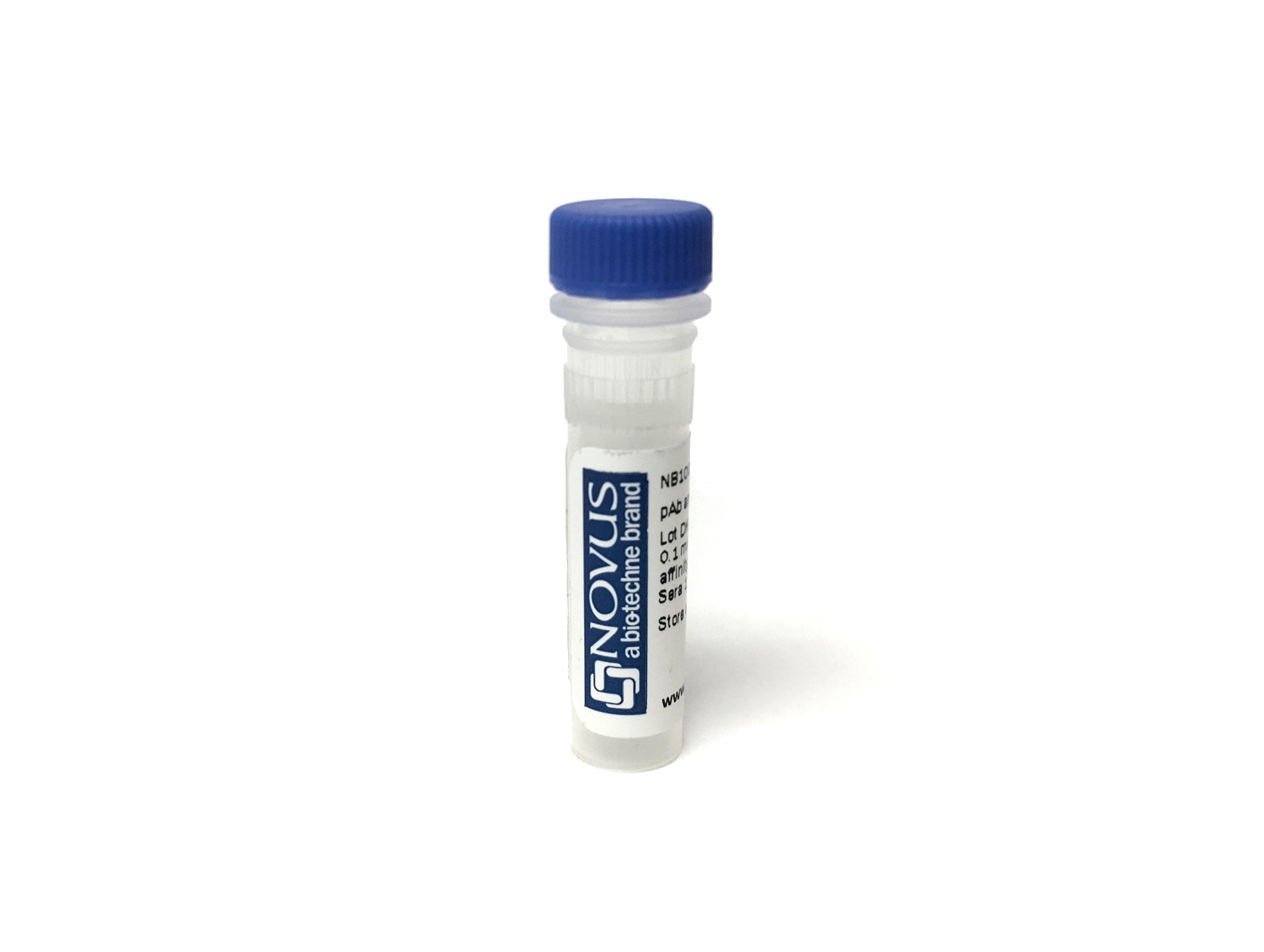
Key Product Details
Species Reactivity
Llama
Applications
Immunohistochemistry, Immunohistochemistry-Paraffin, Western Blot, ELISA, Immunocytochemistry/ Immunofluorescence
Label
HRP
Antibody Source
Polyclonal Goat IgG
Loading...
Product Specifications
Immunogen
This Goat anti-Llama IgG (H+L) Secondary Antibody [HRP] was developed against llama IgG-heavy and light chain.
Specificity
By immunoelectrophoresis and ELISA this Goat anti-Llama IgG (H+L) Secondary Antibody [HRP] reacts specifically with llama IgG and with light chains common to other llama immunoglobulins. No was detected against non-immunoglobulin serum proteins. This may cross react with IgG from other species.
Clonality
Polyclonal
Host
Goat
Isotype
IgG
Applications for Goat anti-Llama IgG (H+L) Secondary Antibody [HRP]
Application
Recommended Usage
ELISA
1:10000-1:100000
Immunocytochemistry/ Immunofluorescence
1:200 - 1:5000
Immunohistochemistry
1:200 - 1:5000
Immunohistochemistry-Paraffin
1:200-1:5000
Western Blot
1:5000 - 1:50000
Formulation, Preparation, and Storage
Purification
Immunogen affinity purified
Formulation
Phosphate Buffered Saline (PBS) containing 0.2%BSA
Preservative
0.05% Pro-Clean 400
Concentration
1.0 mg/ml
Shipping
The product is shipped with polar packs. Upon receipt, store it immediately at the temperature recommended below.
Stability & Storage
Store at 4C. Do not freeze.
Background: IgG (H+L)
The 4 IgG subclasses, sharing 95% amino acid identity, include IgG1, IgG2, IgG3, and IgG4 for humans and IgG1, IgG2a, IgG2b, and IgG3 for mice. The relative abundance of each human subclass is 60% for IgG1, 32% for IgG2, 4% for IgG3, and 4% for IgG4. In an IgG deficiency, there may be a shortage of one or more subclasses (4).
References
1. Painter RH. (1998) Encyclopedia of Immunology (Second Edition). Elsevier. 1208-1211
2. Chapter 9 - Antibodies. (2012) Immunology for Pharmacy. Mosby 70-78
3. Schroeder H, Cavacini, L. (2010) Structure and Function of Immunoglobulins. J Allergy Clin Immunol. 125(2 0 2): S41-S52. PMID: 20176268
4. Vidarsson G, Dekkers G, Rispens T. (2014) IgG subclasses and allotypes: from structure to effector functions. Front Immunol. 5:520. PMID: 25368619
Additional IgG (H+L) Products
Product Documents for Goat anti-Llama IgG (H+L) Secondary Antibody [HRP]
Certificate of Analysis
To download a Certificate of Analysis, please enter a lot or batch number in the search box below.
Product Specific Notices for Goat anti-Llama IgG (H+L) Secondary Antibody [HRP]
This product is for research use only and is not approved for use in humans or in clinical diagnosis. Secondary Antibodies are guaranteed for 1 year from date of receipt.
Citations for Goat anti-Llama IgG (H+L) Secondary Antibody [HRP]
 Powered by Bioz
Customer Reviews for Goat anti-Llama IgG (H+L) Secondary Antibody [HRP]
There are currently no reviews for this product. Be the first to review Goat anti-Llama IgG (H+L) Secondary Antibody [HRP] and earn rewards!
Have you used Goat anti-Llama IgG (H+L) Secondary Antibody [HRP]?
Submit a review and receive an Amazon gift card!
$25/€18/£15/$25CAN/¥2500 for a review with an image
$10/€7/£6/$10CAN/¥1110 for a review without an image
Submit a review
Protocols
Find general support by application which include: protocols, troubleshooting, illustrated assays, videos and webinars.
- Antigen Retrieval Protocol (PIER)
- Antigen Retrieval for Frozen Sections Protocol
- Appropriate Fixation of IHC/ICC Samples
- Cellular Response to Hypoxia Protocols
- Chromogenic IHC Staining of Formalin-Fixed Paraffin-Embedded (FFPE) Tissue Protocol
- Chromogenic Immunohistochemistry Staining of Frozen Tissue
- ClariTSA™ Fluorophore Kits
- Detection & Visualization of Antibody Binding
- ELISA Sample Preparation & Collection Guide
- ELISA Troubleshooting Guide
- Fluorescent IHC Staining of Frozen Tissue Protocol
- Graphic Protocol for Heat-induced Epitope Retrieval
- Graphic Protocol for the Preparation and Fluorescent IHC Staining of Frozen Tissue Sections
- Graphic Protocol for the Preparation and Fluorescent IHC Staining of Paraffin-embedded Tissue Sections
- Graphic Protocol for the Preparation of Gelatin-coated Slides for Histological Tissue Sections
- How to Run an R&D Systems DuoSet ELISA
- How to Run an R&D Systems Quantikine ELISA
- How to Run an R&D Systems Quantikine™ QuicKit™ ELISA
- ICC Cell Smear Protocol for Suspension Cells
- ICC Immunocytochemistry Protocol Videos
- ICC for Adherent Cells
- IHC Sample Preparation (Frozen sections vs Paraffin)
- Immunocytochemistry (ICC) Protocol
- Immunocytochemistry Troubleshooting
- Immunofluorescence of Organoids Embedded in Cultrex Basement Membrane Extract
- Immunofluorescent IHC Staining of Formalin-Fixed Paraffin-Embedded (FFPE) Tissue Protocol
- Immunohistochemistry (IHC) and Immunocytochemistry (ICC) Protocols
- Immunohistochemistry Frozen Troubleshooting
- Immunohistochemistry Paraffin Troubleshooting
- Preparing Samples for IHC/ICC Experiments
- Preventing Non-Specific Staining (Non-Specific Binding)
- Primary Antibody Selection & Optimization
- Protocol for Heat-Induced Epitope Retrieval (HIER)
- Protocol for Making a 4% Formaldehyde Solution in PBS
- Protocol for VisUCyte™ HRP Polymer Detection Reagent
- Protocol for the Fluorescent ICC Staining of Cell Smears - Graphic
- Protocol for the Fluorescent ICC Staining of Cultured Cells on Coverslips - Graphic
- Protocol for the Preparation & Fixation of Cells on Coverslips
- Protocol for the Preparation and Chromogenic IHC Staining of Frozen Tissue Sections
- Protocol for the Preparation and Chromogenic IHC Staining of Frozen Tissue Sections - Graphic
- Protocol for the Preparation and Chromogenic IHC Staining of Paraffin-embedded Tissue Sections
- Protocol for the Preparation and Chromogenic IHC Staining of Paraffin-embedded Tissue Sections - Graphic
- Protocol for the Preparation and Fluorescent ICC Staining of Cells on Coverslips
- Protocol for the Preparation and Fluorescent ICC Staining of Non-adherent Cells
- Protocol for the Preparation and Fluorescent ICC Staining of Stem Cells on Coverslips
- Protocol for the Preparation and Fluorescent IHC Staining of Frozen Tissue Sections
- Protocol for the Preparation and Fluorescent IHC Staining of Paraffin-embedded Tissue Sections
- Protocol for the Preparation of Gelatin-coated Slides for Histological Tissue Sections
- Protocol for the Preparation of a Cell Smear for Non-adherent Cell ICC - Graphic
- Quantikine HS ELISA Kit Assay Principle, Alkaline Phosphatase
- Quantikine HS ELISA Kit Principle, Streptavidin-HRP Polymer
- R&D Systems Quality Control Western Blot Protocol
- Sandwich ELISA (Colorimetric) – Biotin/Streptavidin Detection Protocol
- Sandwich ELISA (Colorimetric) – Direct Detection Protocol
- TUNEL and Active Caspase-3 Detection by IHC/ICC Protocol
- The Importance of IHC/ICC Controls
- Troubleshooting Guide: ELISA
- Troubleshooting Guide: Immunohistochemistry
- Troubleshooting Guide: Western Blot Figures
- Western Blot Conditions
- Western Blot Protocol
- Western Blot Protocol for Cell Lysates
- Western Blot Troubleshooting
- Western Blot Troubleshooting Guide
- View all Protocols, Troubleshooting, Illustrated assays and Webinars
FAQs for Goat anti-Llama IgG (H+L) Secondary Antibody [HRP]
Showing
1
-
2 of
2 FAQs
Showing All
-
Q: Just wondering if NB7242 anti-llama conjugate will cross react with camel species?
A: Our Goat anti-Llama [HRP] (NB7242) has not yet been tested against other species' IgG. This product may cross-react with other related species. Unfortunately, we do not have any specific data regarding this cross-reactivity. I apologize for the lack of information.
-
Q: We use the antibody at a very high dilution (1:50,000) which is great, and the 1mg/ml size means it would last for a large number of tests. My queries are: 1. Shelf-life of the product - am I correct in saying 6 months from receipt, or up to 1 year if kept at 4C (which it is)? 2. This is a polyclonal goat antibody. So could you tell me if it is a pool of different goats, or would I be reliant upon one single goat (which then increases my risk of the test being obsolete if a replacement good goat is never found again?). I am after some assurance of product continuity, batch testing of potential replacement goat antibody etc.
A: We only guarantee our products for 6 months, though yes, I am sure it will work for up to a year. The antibody is from a single goat. We have a large volume of serum from the goat that should last us greater than 10 years.
-
Q: Just wondering if NB7242 anti-llama conjugate will cross react with camel species?
A: Our Goat anti-Llama [HRP] (NB7242) has not yet been tested against other species' IgG. This product may cross-react with other related species. Unfortunately, we do not have any specific data regarding this cross-reactivity. I apologize for the lack of information.
-
Q: We use the antibody at a very high dilution (1:50,000) which is great, and the 1mg/ml size means it would last for a large number of tests. My queries are: 1. Shelf-life of the product - am I correct in saying 6 months from receipt, or up to 1 year if kept at 4C (which it is)? 2. This is a polyclonal goat antibody. So could you tell me if it is a pool of different goats, or would I be reliant upon one single goat (which then increases my risk of the test being obsolete if a replacement good goat is never found again?). I am after some assurance of product continuity, batch testing of potential replacement goat antibody etc.
A: We only guarantee our products for 6 months, though yes, I am sure it will work for up to a year. The antibody is from a single goat. We have a large volume of serum from the goat that should last us greater than 10 years.
Loading...