
Irisin/FNDC5 Antibody - BSA Free
Novus Biologicals | Catalog # NBP2-59680

![Western Blot: Irisin/FNDC5 AntibodyBSA Free [NBP2-59680]](https://resources.rndsystems.com/images/products/Irisin-FNDC5-Antibody-Western-Blot-NBP2-59680-img0003.jpg "Western Blot: Irisin/FNDC5 AntibodyBSA Free [NBP2-59680]")
Scientific images may be resized, cropped, or adjusted for brightness or contrast for presentation purposes. These updates are limited to presentation and do not affect the underlying scientific interpretation of the data. Where available, additional source data may be provided upon request.
Key Product Details
Species Reactivity
Validated:
Cited:
Applications
Validated:
Cited:
Label
Antibody Source
Format
Product Specifications
Immunogen
Reactivity Notes
Clonality
Host
Isotype
Scientific Data Images for Irisin/FNDC5 Antibody - BSA Free
Western Blot: Irisin/FNDC5 AntibodyBSA Free [NBP2-59680]
Western Blot: Irisin/FNDC5 Antibody [NBP2-59680] - Recombinant human Irisin protein was separated on a 4-20% gel by SDS-PAGE, transferred to PVDF membrane and blocked in 5% non-fat milk in TBST. The membrane was probed with 1.0 ug/ml anti-Irisin/FNDC5 in block buffer and detected with an anti-rabbit HRP secondary antibody using chemiluminescence.![Immunohistochemistry-Paraffin: Irisin/FNDC5 Antibody - BSA Free [NBP2-59680]](https://resources.rndsystems.com/images/products/Irisin-FNDC5-Antibody-Immunohistochemistry-Paraffin-NBP2-59680-img0002.jpg "Immunohistochemistry-Paraffin: Irisin/FNDC5 Antibody - BSA Free [NBP2-59680]")
Immunohistochemistry-Paraffin: Irisin/FNDC5 Antibody - BSA Free [NBP2-59680]
Immunohistochemistry-Paraffin: Irisin/FNDC5 Antibody [NBP2-59680] - IHC analysis of a formalin fixed and paraffin embedded human kidney tissue section (NBP1-78269) using 1:200 dilution of Irisin/FNDC5 antibody. The signal was developed with HRP-DAB detection and the sections were counterstained with hematoxylin. The antibody generated a membrane cytoplasmic staining in almost all of the cell types in the tested section.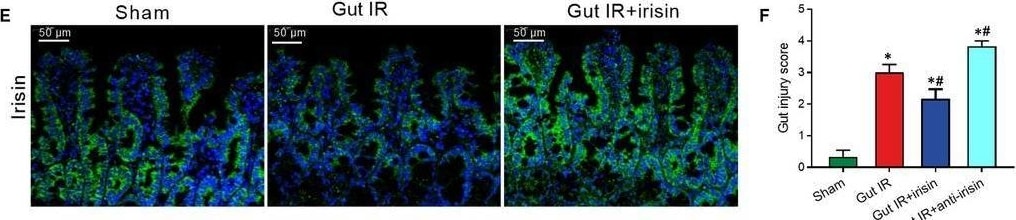
Immunocytochemistry/ Immunofluorescence: Irisin/FNDC5 Antibody - BSA Free [NBP2-59680] -
Exogenous irisin restores gut barrier function after gut IR. Irisin (250 μg/kg in 0.5 mL saline, a single dose, iv) was administered immediately after reperfusion. Anti‐irisin (4 mg/kg, Abcam) blocking antibodies were administered at 24 h before gut IR. Four hours after reperfusion, mice were sacrificed, and tissue samples were collected. A, Serum irisin levels; (B,C) Western blot analysis of irisin expression; (D,E) immunofluorescence staining of irisin (green) and the corresponding nuclear counterstaining (blue) in gut tissues; (F) gut injury score; (G) haematoxylin and eosin (H&E) staining; (H) water content of gut; (I) serum FITC‐dextran levels; (J,K) colony‐forming units (CFUs) from mesenteric lymph node (MLN) and lung tissues; (L,M) serum levels of LDH and lactate; and (N,O) serum TNF‐ alpha and CIRP levels. n = 6 per group, mean +/- SEM, *P <.05 vs the sham group, #P <.05 vs the gut IR group Image collected and cropped by CiteAb from the following open publication (https://pubmed.ncbi.nlm.nih.gov/31701659), licensed under a CC-BY license. Not internally tested by Novus Biologicals.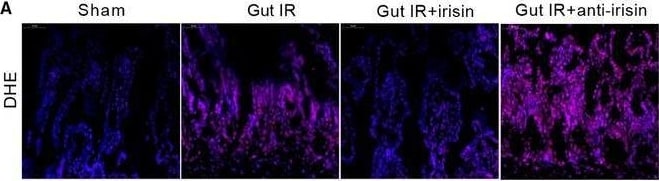
Immunocytochemistry/ Immunofluorescence: Irisin/FNDC5 Antibody - BSA Free [NBP2-59680] -
Irisin decreases the oxidative stress, calcium influx and ER stress after gut IR. Irisin (250 μg/kg in 0.5 mL saline, a single dose, iv) was administered immediately after reperfusion. Anti‐irisin (4 mg/kg, Abcam, USA) blocking antibody was administered at 24 h before gut IR. Four hours after reperfusion, mice were sacrificed, and tissue samples were collected. A,B, DHE fluorescence staining of gut tissues; (C‐G) levels of gut malonaldehyde (MDA), xanthine oxidase (XO), 4‐hydroxynonenal (4‐HNT), superoxide dismutase (SOD) and glutathione peroxidase activity (GSH‐PX), respectively; n = 6 per group, mean +/- SEM, *P <.05 vs the sham group, #P <.05 vs the gut IR group. Caco‐2 cells were exposed to hypoxia for 90 min, and 10 nmol/L irisin was added at the beginning of reoxygenation. (H,I) DHE fluorescence staining; (J,K) Fluo‐4 AM staining of Ca2+; (L,M) Western blot analysis of IRE1 and CHOP expression at 4 h after reoxygenation in Caco‐2 cells; n = 3 per group, mean +/- SEM, *P <.05 vs the sham group, #P <.05 vs the H/R group Image collected and cropped by CiteAb from the following open publication (https://pubmed.ncbi.nlm.nih.gov/31701659), licensed under a CC-BY license. Not internally tested by Novus Biologicals.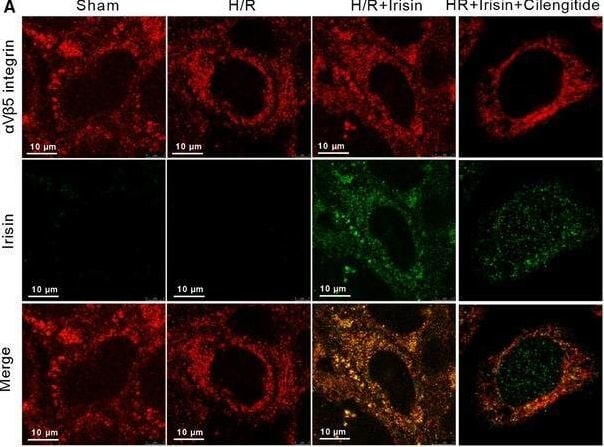
Immunocytochemistry/ Immunofluorescence: Irisin/FNDC5 Antibody - BSA Free [NBP2-59680] -
Irisin protects against gut IR injury via binding to integrin alpha v beta 5 receptor in enterocyte. Caco‐2 cells were exposed to hypoxia for 90 min, and 10 nmol/L irisin and 20 μmol/L cilengitide trifluoroacetate were added at the beginning of reoxygenation. A, Immunofluorescence staining of irisin (green), integrin alpha V beta 5 (red) and the corresponding nuclear counterstaining (blue) in Caco‐2 cells at 4 h after reoxygenation in Caco‐2 cells. Irisin (250 μg/kg, iv) and cilengitide trifluoroacetate (20 mg/kg, iv) were administered immediately after reperfusion. Four hours after reperfusion, mice were sacrificed, and tissue samples were collected. (B) CO‐IP of irisin and integrin alpha V beta 5; (C) serum FITC‐dextran levels; (D) colony‐forming units (CFUs) from mesenteric lymph node (MLN) tissues; (E) haematoxylin and eosin (H&E) staining; (F) gut injury score; n = 6 per group, mean +/- SEM, *P <.05 vs the gut IR group, #P <.05 vs the gut IR + irisin group. (G,H) Western blot analysis of claudin‐1 and occludin expression in Caco‐2 cells; and (I,J) immunofluorescence staining of JAM‐1 and ZO‐1 and the corresponding nuclear counterstaining (blue). * in the figure represents intercellular gap. n = 3 per group, mean +/- SEM, *P <.05 vs the sham group, #P <.05 vs the H/R group Image collected and cropped by CiteAb from the following open publication (https://pubmed.ncbi.nlm.nih.gov/31701659), licensed under a CC-BY license. Not internally tested by Novus Biologicals.Applications for Irisin/FNDC5 Antibody - BSA Free
Immunohistochemistry
Immunohistochemistry-Paraffin
Western Blot
Formulation, Preparation, and Storage
Purification
Formulation
Format
Preservative
Concentration
Shipping
Stability & Storage
Background: Irisin/FNDC5
Long Name
Alternate Names
Gene Symbol
Additional Irisin/FNDC5 Products
Product Documents for Irisin/FNDC5 Antibody - BSA Free
Certificate of Analysis
To download a Certificate of Analysis, please enter a lot or batch number in the search box below.
Product Specific Notices for Irisin/FNDC5 Antibody - BSA Free
This product is for research use only and is not approved for use in humans or in clinical diagnosis. Primary Antibodies are guaranteed for 1 year from date of receipt.
Citations for Irisin/FNDC5 Antibody - BSA Free
 Powered by Bioz
Customer Reviews for Irisin/FNDC5 Antibody - BSA Free
There are currently no reviews for this product. Be the first to review Irisin/FNDC5 Antibody - BSA Free and earn rewards!
Have you used Irisin/FNDC5 Antibody - BSA Free?
Submit a review and receive an Amazon gift card!
$25/€18/£15/$25CAN/¥2500 for a review with an image
$10/€7/£6/$10CAN/¥1110 for a review without an image
Submit a review
Protocols
View specific protocols for Irisin/FNDC5 Antibody - BSA Free (NBP2-59680):
Culture cells to appropriate density in 35 mm culture dishes or 6-well plates.
1. Remove culture medium and add 10% formalin to the dish. Fix at room temperature for 30 minutes.
2. Remove the formalin and add ice cold methanol. Incubate for 5-10 minutes.
3. Remove methanol and add washing solution (i.e. PBS). Be sure to not let the specimen dry out. Wash three times for 10 minutes.
4. To block nonspecific antibody binding incubate in 10% normal goat serum from 1 hour to overnight at room temperature.
5. Add primary antibody at appropriate dilution and incubate at room temperature from 2 hours to overnight at room temperature.
6. Remove primary antibody and replace with washing solution. Wash three times for 10 minutes.
7. Add secondary antibody at appropriate dilution. Incubate for 1 hour at room temperature.
8. Remove antibody and replace with wash solution, then wash for 10 minutes. Add Hoechst 33258 to wash solution at 1:25,0000 and incubate for 10 minutes. Wash a third time for 10 minutes.
9. Cells can be viewed directly after washing. The plates can also be stored in PBS containing Azide covered in Parafilm (TM). Cells can also be cover-slipped using Fluoromount, with appropriate sealing.
*The above information is only intended as a guide. The researcher should determine what protocol best meets their needs. Please follow safe laboratory procedures.
1. Perform SDS-PAGE on samples to be analyzed, loading 25 ug of total protein per lane.
2. Transfer proteins to membrane according to the instructions provided by the manufacturer of the membrane and transfer apparatus.
3. Stain according to standard Ponceau S procedure (or similar product) to assess transfer success, and mark molecular weight standards where appropriate.
4. Rinse the blot.
5. Block the membrane using standard blocking buffer for at least 1 hour.
6. Wash the membrane in wash buffer three times for 10 minutes each.
7. Dilute anti-Irisin/FNDC5 primary antibody in blocking buffer and incubate 1 hour at room temperature.
8. Wash the membrane in wash buffer three times for 10 minutes each.
9. Apply the diluted HRP conjugated secondary antibody in blocking buffer (as per manufacturers instructions) and incubate 1 hour at room temperature.
10. Wash the blot in wash buffer three times for 10 minutes each (this step can be repeated as required to reduce background).
11. Apply the detection reagent of choice in accordance with the manufacturers instructions.
Note: Tween-20 can be added to the blocking or antibody dilution buffer at a final concentration of 0.05-0.2%.
Find general support by application which include: protocols, troubleshooting, illustrated assays, videos and webinars.
- Antigen Retrieval Protocol (PIER)
- Antigen Retrieval for Frozen Sections Protocol
- Appropriate Fixation of IHC/ICC Samples
- Cellular Response to Hypoxia Protocols
- Chromogenic IHC Staining of Formalin-Fixed Paraffin-Embedded (FFPE) Tissue Protocol
- Chromogenic Immunohistochemistry Staining of Frozen Tissue
- ClariTSA™ Fluorophore Kits
- Detection & Visualization of Antibody Binding
- Fluorescent IHC Staining of Frozen Tissue Protocol
- Graphic Protocol for Heat-induced Epitope Retrieval
- Graphic Protocol for the Preparation and Fluorescent IHC Staining of Frozen Tissue Sections
- Graphic Protocol for the Preparation and Fluorescent IHC Staining of Paraffin-embedded Tissue Sections
- Graphic Protocol for the Preparation of Gelatin-coated Slides for Histological Tissue Sections
- IHC Sample Preparation (Frozen sections vs Paraffin)
- Immunofluorescent IHC Staining of Formalin-Fixed Paraffin-Embedded (FFPE) Tissue Protocol
- Immunohistochemistry (IHC) and Immunocytochemistry (ICC) Protocols
- Immunohistochemistry Frozen Troubleshooting
- Immunohistochemistry Paraffin Troubleshooting
- Preparing Samples for IHC/ICC Experiments
- Preventing Non-Specific Staining (Non-Specific Binding)
- Primary Antibody Selection & Optimization
- Protocol for Heat-Induced Epitope Retrieval (HIER)
- Protocol for Making a 4% Formaldehyde Solution in PBS
- Protocol for VisUCyte™ HRP Polymer Detection Reagent
- Protocol for the Preparation & Fixation of Cells on Coverslips
- Protocol for the Preparation and Chromogenic IHC Staining of Frozen Tissue Sections
- Protocol for the Preparation and Chromogenic IHC Staining of Frozen Tissue Sections - Graphic
- Protocol for the Preparation and Chromogenic IHC Staining of Paraffin-embedded Tissue Sections
- Protocol for the Preparation and Chromogenic IHC Staining of Paraffin-embedded Tissue Sections - Graphic
- Protocol for the Preparation and Fluorescent IHC Staining of Frozen Tissue Sections
- Protocol for the Preparation and Fluorescent IHC Staining of Paraffin-embedded Tissue Sections
- Protocol for the Preparation of Gelatin-coated Slides for Histological Tissue Sections
- R&D Systems Quality Control Western Blot Protocol
- TUNEL and Active Caspase-3 Detection by IHC/ICC Protocol
- The Importance of IHC/ICC Controls
- Troubleshooting Guide: Immunohistochemistry
- Troubleshooting Guide: Western Blot Figures
- Western Blot Conditions
- Western Blot Protocol
- Western Blot Protocol for Cell Lysates
- Western Blot Troubleshooting
- Western Blot Troubleshooting Guide
- View all Protocols, Troubleshooting, Illustrated assays and Webinars