
MKRN2 Antibody
Novus Biologicals | Catalog # NBP2-17301

![Western Blot: MKRN2 Antibody [NBP2-17301]](https://resources.rndsystems.com/images/products/MKRN2-Antibody-Western-Blot-NBP2-17301-img0001.jpg "Western Blot: MKRN2 Antibody [NBP2-17301]")
Loading...
Key Product Details
Species Reactivity
Validated:
Human
Cited:
Human
Applications
Validated:
Immunohistochemistry, Immunohistochemistry-Paraffin, Western Blot, Immunocytochemistry/ Immunofluorescence
Cited:
Western Blot, Immunocytochemistry/ Immunofluorescence
Label
Unconjugated
Antibody Source
Polyclonal Rabbit IgG
Loading...
Product Specifications
Immunogen
Recombinant protein encompassing a sequence within the center region of human MKRN2. The exact sequence is proprietary.
Clonality
Polyclonal
Host
Rabbit
Isotype
IgG
Theoretical MW
47 kDa.
Disclaimer note: The observed molecular weight of the protein may vary from the listed predicted molecular weight due to post translational modifications, post translation cleavages, relative charges, and other experimental factors.
Disclaimer note: The observed molecular weight of the protein may vary from the listed predicted molecular weight due to post translational modifications, post translation cleavages, relative charges, and other experimental factors.
Scientific Data Images for MKRN2 Antibody
Western Blot: MKRN2 Antibody [NBP2-17301]
Western Blot: MKRN2 Antibody [NBP2-17301] - Sample (30 ug of whole cell lysate) A: Jurkat 10% SDS PAGE gel, diluted at 1:1000.![Immunohistochemistry-Paraffin: MKRN2 Antibody [NBP2-17301]](https://resources.rndsystems.com/images/products/MKRN2-Antibody-Immunohistochemistry-Paraffin-NBP2-17301-img0002.jpg "Immunohistochemistry-Paraffin: MKRN2 Antibody [NBP2-17301]")
Immunohistochemistry-Paraffin: MKRN2 Antibody [NBP2-17301]
Immunohistochemistry-Paraffin: MKRN2 Antibody [NBP2-17301] - U373 xenograft, using MKRN2 antibody at 1:500 dilution.Antigen Retrieval: Trilogy™ (EDTA based, pH 8.0) buffer, 15min.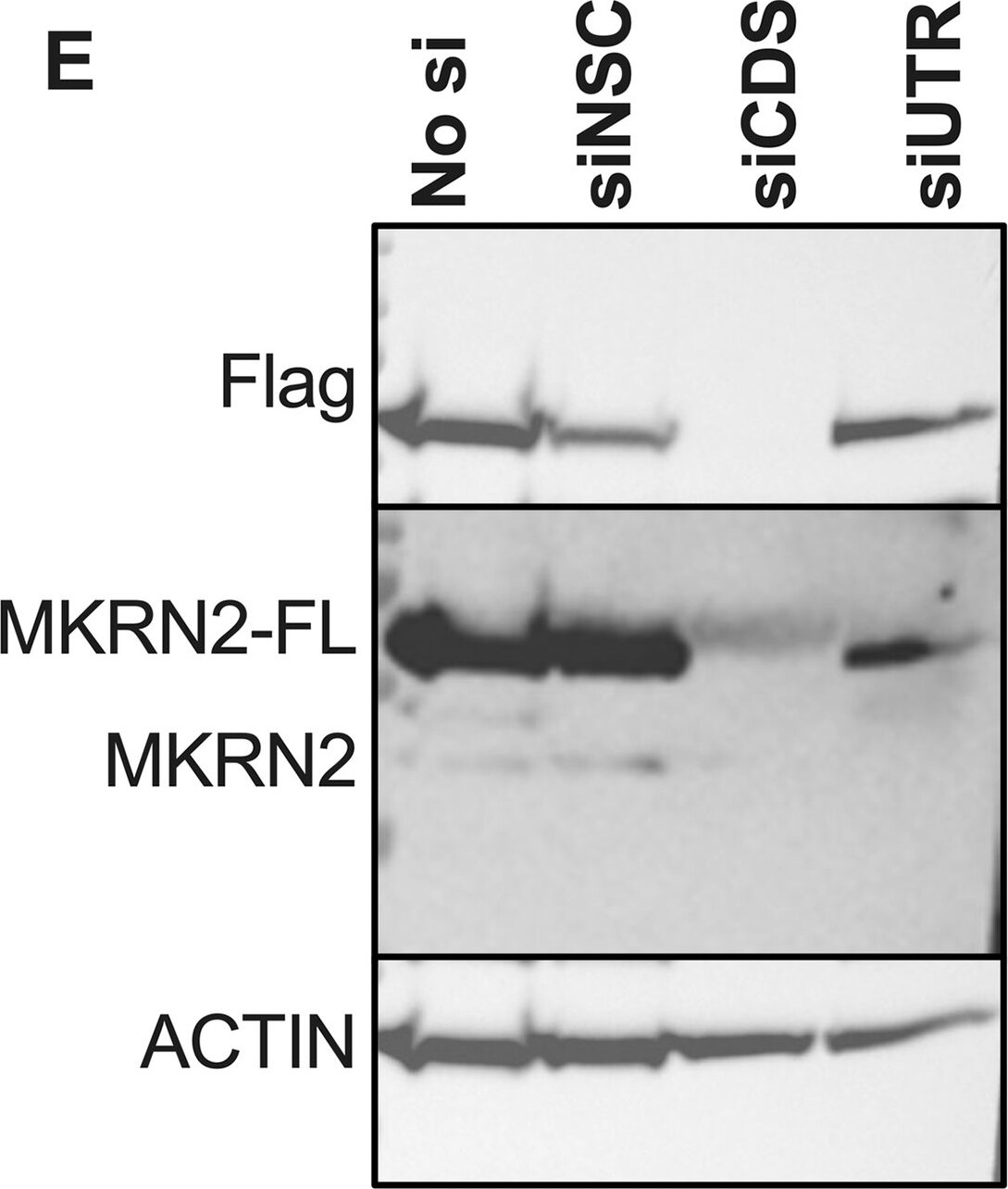
Western Blot: MKRN2 Antibody [NBP2-17301] -
Investigation of the phenotypic effect of MKRN2 depletion on IAV replication.(A) Demonstration by Western blotting that the MKRN2 siRNA pair reduce MKRN2 protein levels at 48 h post transfection. Knockdown of MKRN2 in A549 cells, followed by infection with A/WSN/33 (B), A/California/7/2009 (C) or A/Norway/466/2014 (D) significantly reduced virus output from these cells as measured by plaque assay. (E) Western blot demonstrating that the MKRN2 siRNA pair reduce expression of endogenous and lentiviral expressed MKRN2 in an overexpression A549 cell line, while an siRNA pair targeting the MKRN2 3’ UTR only reduce expression of the endogenous MKRN2 protein. (F) A/California/7/2009 titres from MKRN2 overexpression A549 cells demonstrate that while reducing all MKRN2 expression significantly reduced virus output, knocking down endogenous MKRN2 while expressing wild-type MKRN2 from a lentiviral cassette rescues this phenotype. (G) Early viral RNA dynamics in siMKRN2 treated cells were quantified by qPCR, revealing that a loss of MKRN2 significantly reduced viral NP mRNA levels early in infection. (H) Overall titres from low MOI infections (MOI 0.01) were measured at 6, 24 and 48 hpi for both conditions, (I) alongside NP mRNA, vRNA and MKRN2 mRNA levels at matching timepoints. (J) High MOI infections (MOI 3) were performed in similarly siRNA treated cells and total RNA was harvested at 0, 2, 4 and 6 hpi. Again NP mRNA, vRNA and MKRN2 mRNA levels were quantified in these sample, representing single round infection dynamics. Image collected and cropped by CiteAb from the following open publication (https://dx.plos.org/10.1371/journal.ppat.1012231), licensed under a CC-BY license. Not internally tested by Novus Biologicals.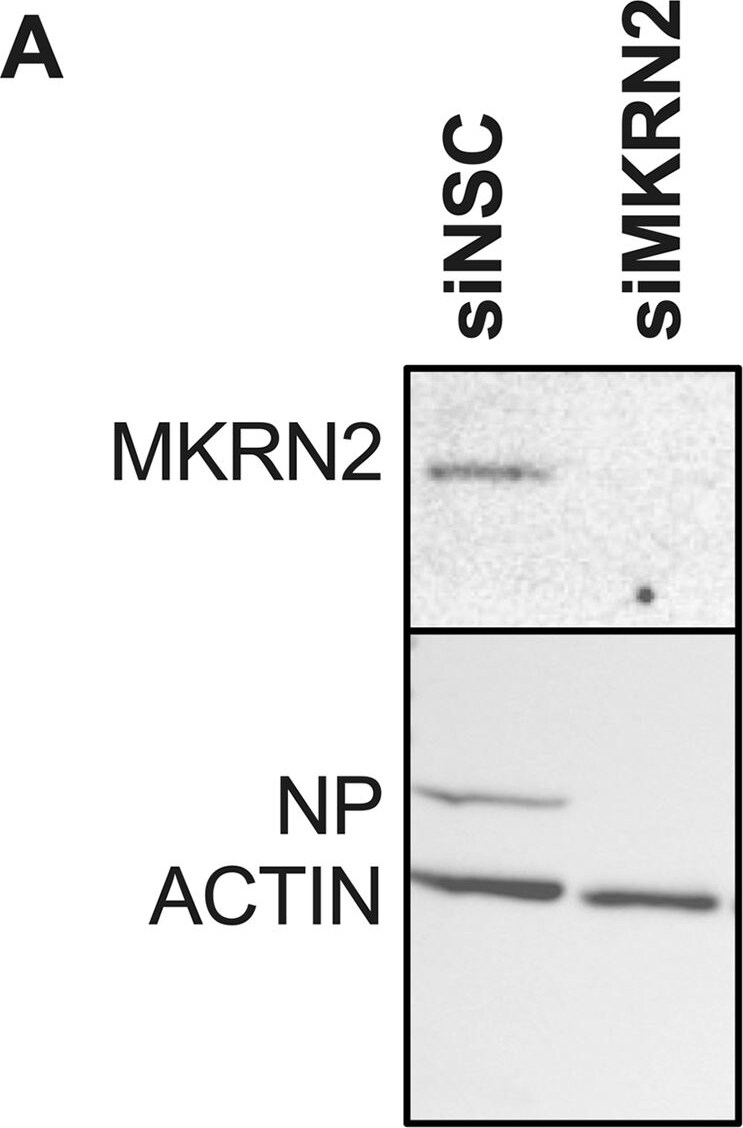
Western Blot: MKRN2 Antibody [NBP2-17301] -
Investigation of the phenotypic effect of MKRN2 depletion on IAV replication.(A) Demonstration by Western blotting that the MKRN2 siRNA pair reduce MKRN2 protein levels at 48 h post transfection. Knockdown of MKRN2 in A549 cells, followed by infection with A/WSN/33 (B), A/California/7/2009 (C) or A/Norway/466/2014 (D) significantly reduced virus output from these cells as measured by plaque assay. (E) Western blot demonstrating that the MKRN2 siRNA pair reduce expression of endogenous and lentiviral expressed MKRN2 in an overexpression A549 cell line, while an siRNA pair targeting the MKRN2 3’ UTR only reduce expression of the endogenous MKRN2 protein. (F) A/California/7/2009 titres from MKRN2 overexpression A549 cells demonstrate that while reducing all MKRN2 expression significantly reduced virus output, knocking down endogenous MKRN2 while expressing wild-type MKRN2 from a lentiviral cassette rescues this phenotype. (G) Early viral RNA dynamics in siMKRN2 treated cells were quantified by qPCR, revealing that a loss of MKRN2 significantly reduced viral NP mRNA levels early in infection. (H) Overall titres from low MOI infections (MOI 0.01) were measured at 6, 24 and 48 hpi for both conditions, (I) alongside NP mRNA, vRNA and MKRN2 mRNA levels at matching timepoints. (J) High MOI infections (MOI 3) were performed in similarly siRNA treated cells and total RNA was harvested at 0, 2, 4 and 6 hpi. Again NP mRNA, vRNA and MKRN2 mRNA levels were quantified in these sample, representing single round infection dynamics. Image collected and cropped by CiteAb from the following open publication (https://dx.plos.org/10.1371/journal.ppat.1012231), licensed under a CC-BY license. Not internally tested by Novus Biologicals.Applications for MKRN2 Antibody
Application
Recommended Usage
Immunocytochemistry/ Immunofluorescence
1:100-1:1000
Immunohistochemistry
1:100-1:1000
Immunohistochemistry-Paraffin
1:100-1:1000
Western Blot
1:500-1:3000
Formulation, Preparation, and Storage
Purification
Antigen Affinity-purified
Formulation
PBS, 1% BSA, 20% Glycerol
Preservative
0.01% Thimerosal
Concentration
Concentrations vary lot to lot. See vial label for concentration. If unlisted please contact technical services.
Shipping
The product is shipped with polar packs. Upon receipt, store it immediately at the temperature recommended below.
Stability & Storage
Aliquot and store at -20C or -80C. Avoid freeze-thaw cycles.
Background: MKRN2
Alternate Names
EC 6.3.2.-, HSPC070, makorin ring finger protein 2, probable E3 ubiquitin-protein ligase makorin-2, RNF62RING finger protein 62
Gene Symbol
MKRN2
UniProt
Additional MKRN2 Products
Product Documents for MKRN2 Antibody
Certificate of Analysis
To download a Certificate of Analysis, please enter a lot or batch number in the search box below.
Product Specific Notices for MKRN2 Antibody
This product is for research use only and is not approved for use in humans or in clinical diagnosis. Primary Antibodies are guaranteed for 1 year from date of receipt.
⚠ WARNING: This product can expose you to chemicals including mercury, which is known to the State of California to cause reproductive toxicity with developmental effects. For more information go to www.P65Warnings.ca.gov.Citations for MKRN2 Antibody
 Powered by Bioz
Customer Reviews for MKRN2 Antibody
There are currently no reviews for this product. Be the first to review MKRN2 Antibody and earn rewards!
Have you used MKRN2 Antibody?
Submit a review and receive an Amazon gift card!
$25/€18/£15/$25CAN/¥2500 Yen for a review with an image
$10/€7/£6/$10CAN/¥1110 Yen for a review without an image
Submit a review
Protocols
Find general support by application which include: protocols, troubleshooting, illustrated assays, videos and webinars.
- Antigen Retrieval Protocol (PIER)
- Antigen Retrieval for Frozen Sections Protocol
- Appropriate Fixation of IHC/ICC Samples
- Cellular Response to Hypoxia Protocols
- Chromogenic IHC Staining of Formalin-Fixed Paraffin-Embedded (FFPE) Tissue Protocol
- Chromogenic Immunohistochemistry Staining of Frozen Tissue
- ClariTSA™ Fluorophore Kits
- Detection & Visualization of Antibody Binding
- Fluorescent IHC Staining of Frozen Tissue Protocol
- Graphic Protocol for Heat-induced Epitope Retrieval
- Graphic Protocol for the Preparation and Fluorescent IHC Staining of Frozen Tissue Sections
- Graphic Protocol for the Preparation and Fluorescent IHC Staining of Paraffin-embedded Tissue Sections
- Graphic Protocol for the Preparation of Gelatin-coated Slides for Histological Tissue Sections
- ICC Cell Smear Protocol for Suspension Cells
- ICC Immunocytochemistry Protocol Videos
- ICC for Adherent Cells
- IHC Sample Preparation (Frozen sections vs Paraffin)
- Immunocytochemistry (ICC) Protocol
- Immunocytochemistry Troubleshooting
- Immunofluorescence of Organoids Embedded in Cultrex Basement Membrane Extract
- Immunofluorescent IHC Staining of Formalin-Fixed Paraffin-Embedded (FFPE) Tissue Protocol
- Immunohistochemistry (IHC) and Immunocytochemistry (ICC) Protocols
- Immunohistochemistry Frozen Troubleshooting
- Immunohistochemistry Paraffin Troubleshooting
- Preparing Samples for IHC/ICC Experiments
- Preventing Non-Specific Staining (Non-Specific Binding)
- Primary Antibody Selection & Optimization
- Protocol for Heat-Induced Epitope Retrieval (HIER)
- Protocol for Making a 4% Formaldehyde Solution in PBS
- Protocol for VisUCyte™ HRP Polymer Detection Reagent
- Protocol for the Fluorescent ICC Staining of Cell Smears - Graphic
- Protocol for the Fluorescent ICC Staining of Cultured Cells on Coverslips - Graphic
- Protocol for the Preparation & Fixation of Cells on Coverslips
- Protocol for the Preparation and Chromogenic IHC Staining of Frozen Tissue Sections
- Protocol for the Preparation and Chromogenic IHC Staining of Frozen Tissue Sections - Graphic
- Protocol for the Preparation and Chromogenic IHC Staining of Paraffin-embedded Tissue Sections
- Protocol for the Preparation and Chromogenic IHC Staining of Paraffin-embedded Tissue Sections - Graphic
- Protocol for the Preparation and Fluorescent ICC Staining of Cells on Coverslips
- Protocol for the Preparation and Fluorescent ICC Staining of Non-adherent Cells
- Protocol for the Preparation and Fluorescent ICC Staining of Stem Cells on Coverslips
- Protocol for the Preparation and Fluorescent IHC Staining of Frozen Tissue Sections
- Protocol for the Preparation and Fluorescent IHC Staining of Paraffin-embedded Tissue Sections
- Protocol for the Preparation of Gelatin-coated Slides for Histological Tissue Sections
- Protocol for the Preparation of a Cell Smear for Non-adherent Cell ICC - Graphic
- R&D Systems Quality Control Western Blot Protocol
- TUNEL and Active Caspase-3 Detection by IHC/ICC Protocol
- The Importance of IHC/ICC Controls
- Troubleshooting Guide: Immunohistochemistry
- Troubleshooting Guide: Western Blot Figures
- Western Blot Conditions
- Western Blot Protocol
- Western Blot Protocol for Cell Lysates
- Western Blot Troubleshooting
- Western Blot Troubleshooting Guide
- View all Protocols, Troubleshooting, Illustrated assays and Webinars
Loading...