
ADAM10 (also known as Kuzbanian, mammalian disintegrin metalloprotease, myelin-associated metalloproteinase) is a member of the ADAM family that contains a disintegrin and metalloprotease-like domain (1, 2). Like other membrane-anchored ADAMs, ADAM10 consists of the following domains, pro with a cysteine switch and furin cleavage sequence, catalytic with the zinc-binding site and Met-turn expected for reprolysins, disintegrin-like, cysteine-rich, EGF-like, transmembrane, and cytoplasmic. ADAM10 is highly conserved, with 97% amino acid identity between mouse, rat, bovine and human and 45% identity between mouse and Drosophila. The active enzyme processes notch, notch ligand delta, and amyloid protein precursor at the alpha site, playing an important role in neurogenesis (3, 4). It also processes the 26 kDa membrane-anchored pro-tumor necrosis factor-alpha (TNF-alpha ) to the 17 kDa mature TNF-alpha (5). It cleaves myelin basic protein and type IV collagen (6, 7). ADAM10 is widely expressed in tissues and resides both on the cell surface and in the cell (8, 9).
Mouse ADAM10 Ectodomain Antibody (139712)
R&D Systems | Catalog # MAB946

Scientific images may be resized, cropped, or adjusted for brightness or contrast for presentation purposes. These updates are limited to presentation and do not affect the underlying scientific interpretation of the data. Where available, additional source data may be provided upon request.
Key Product Details
Validated by
Species Reactivity
Validated:
Cited:
Applications
Validated:
Cited:
Label
Antibody Source
Product Specifications
Immunogen
Thr215-Glu673
Accession # O35598
Specificity
Clonality
Host
Isotype
Scientific Data Images for Mouse ADAM10 Ectodomain Antibody (139712)
Detection of Mouse ADAM10 by Western Blot
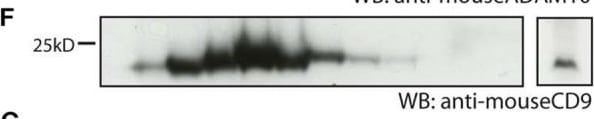
Cre mRNA is present in the blood plasma of Vav-iCre mice and contained in EVs including exosomes.(A) Cre mRNA can be detected in vesicle preparations enriched for exosomes from the blood plasma of Vav-iCre mice by RT-PCR. Each lane represents a result from an individual animal. For detection of Cre mRNA, nested primer PCR was used. The PCR product at 100 bp represents the signal after the second round of amplification. (B) Cre mRNA is localized in the pellet but not in the supernatant after ultracentrifugation of conditioned medium from primary Vav-iCre–positive hematopoietic cells after stimulation by LPS in vitro. Cre mRNA was resistant to RNaseA treatment in all experiments. (C) After treatment with Triton-X to lyse EVs in combination with RNaseA digestion, Cre mRNA is no longer detectable in contrast to RNaseA treatment alone. (D) Vesicular structures between 50 and 100 nm in size were visualized in electron micrographs from Vav-iCre hematopoietic-cell-derived vesicle preparations (scale bar, 50 nm). (E and F) Secreted membrane vesicle subspecies can be separated by density by sucrose gradient ultracentrifugation. Exosomal identity was confirmed by blotting against the specific protein markers ADAM10 and CD9 for all subfractions. (G) Cre protein could not be detected in any of the fractions. Positive controls for all antibodies are shown in boxes to the right. (H) Cre mRNA is present in the exosomal fractions 2–7. The nonexosomal vesicles fractions or apoptotic bodies are characterized by their variability of positive subfractions to complete absence of Cre mRNA. In this experiment, subfractions 9 and 10 are positive, whereas 8, 11, and 12 do not contain any Cre RNA. Image collected and cropped by CiteAb from the following publication (https://pubmed.ncbi.nlm.nih.gov/24893313), licensed under a CC-BY license. Not internally tested by R&D Systems.Applications for Mouse ADAM10 Ectodomain Antibody (139712)
CyTOF-ready
Flow Cytometry
Sample: Mouse splenocytes
Western Blot
Sample: Recombinant Mouse ADAM10 (Catalog # 946-AD) under non-reducing conditions only
Reviewed Applications
Read 1 review rated 4 using MAB946 in the following applications:
Flow Cytometry Panel Builder
Bio-Techne Knows Flow Cytometry
Save time and reduce costly mistakes by quickly finding compatible reagents using the Panel Builder Tool.
Advanced Features
- Spectra Viewer - Custom analysis of spectra from multiple fluorochromes
- Spillover Popups - Visualize the spectra of individual fluorochromes
- Antigen Density Selector - Match fluorochrome brightness with antigen density

Formulation, Preparation, and Storage
Purification
Reconstitution
Reconstitute at 0.5 mg/mL in sterile PBS. For liquid material, refer to CoA for concentration.
Formulation
Shipping
Stability & Storage
- 12 months from date of receipt, -20 to -70 °C as supplied.
- 1 month, 2 to 8 °C under sterile conditions after reconstitution.
- 6 months, -20 to -70 °C under sterile conditions after reconstitution.
Calculators
Background: ADAM10
References
- Rooke, J. et al. (1996) Science 273:1227.
- Pan, D. and Rubin, G.M. (1997) Cell 90:271.
- Qi, H. et al. (1999) Science 283:91.
- Lammich, S. et al. (1999) Proc. Natl. Acad. Sci. USA 96:3922.
- Rosendahl, M.S. et al. (1997) J. Biol. Chem. 272:24588.
- Chantry, A. et al. (1989) J. Biol. Chem. 264:21603.
- Millichip, M.I. et al. (1998) Biochem. Biophys. Res. Comm. 245:594.
- Chantry, A. and Glynn, P. (1990) Biochem. J. 268:245.
- Fahrenholz, F.S. et al. (2000) Ann. N.Y. Acad. Sci. 920:215.
Long Name
Alternate Names
Gene Symbol
UniProt
Additional ADAM10 Products
Product Documents for Mouse ADAM10 Ectodomain Antibody (139712)
Certificate of Analysis
To download a Certificate of Analysis, please enter a lot or batch number in the search box below.
Note: Certificate of Analysis not available for kit components.
Product Specific Notices for Mouse ADAM10 Ectodomain Antibody (139712)
For research use only
Related Research Areas
Citations for Mouse ADAM10 Ectodomain Antibody (139712)
 Powered by Bioz
Customer Reviews for Mouse ADAM10 Ectodomain Antibody (139712) (1)
Have you used Mouse ADAM10 Ectodomain Antibody (139712)?
Submit a review and receive an Amazon gift card!
$25/€18/£15/$25CAN/¥2500 for a review with an image
$10/€7/£6/$10CAN/¥1110 for a review without an image
Submit a review
-
Application: Western BlotSample Tested: 4T1.2 mouse mammary carcinoma cellsSpecies: MouseVerified Customer | Posted 10/26/2015Buffer: TBST<br />Dilution: 1/200
There are no reviews that match your criteria.
Protocols
Find general support by application which include: protocols, troubleshooting, illustrated assays, videos and webinars.
- 7-Amino Actinomycin D (7-AAD) Cell Viability Flow Cytometry Protocol
- Cellular Response to Hypoxia Protocols
- Extracellular Membrane Flow Cytometry Protocol
- Flow Cytometry Protocol for Cell Surface Markers
- Flow Cytometry Protocol for Staining Membrane Associated Proteins
- Flow Cytometry Staining Protocols
- Flow Cytometry Troubleshooting Guide
- Intracellular Flow Cytometry Protocol Using Alcohol (Methanol)
- Intracellular Flow Cytometry Protocol Using Detergents
- Intracellular Nuclear Staining Flow Cytometry Protocol Using Detergents
- Intracellular Staining Flow Cytometry Protocol Using Alcohol Permeabilization
- Intracellular Staining Flow Cytometry Protocol Using Detergents to Permeabilize Cells
- Propidium Iodide Cell Viability Flow Cytometry Protocol
- Protocol for Liperfluo
- Protocol for the Characterization of Human Th22 Cells
- Protocol for the Characterization of Human Th9 Cells
- Protocol: Annexin V and PI Staining by Flow Cytometry
- Protocol: Annexin V and PI Staining for Apoptosis by Flow Cytometry
- R&D Systems Quality Control Western Blot Protocol
- Troubleshooting Guide: Fluorokine Flow Cytometry Kits
- Troubleshooting Guide: Western Blot Figures
- Western Blot Conditions
- Western Blot Protocol
- Western Blot Protocol for Cell Lysates
- Western Blot Troubleshooting
- Western Blot Troubleshooting Guide
- View all Protocols, Troubleshooting, Illustrated assays and Webinars
Associated Pathways
