
CCL20, also known as MIP-3 alpha, LARC, and Exodus, is a beta chemokine. Mouse CCL20 cDNA encodes a 97 amino acid precursor protein with a 27 aa putative signal peptide that is predicted to be cleaved to form the 70 aa mature secreted protein. CCL20 is distantly related to other beta chemokines (20‑28% aa sequence identity). Mouse CCL20 shares approximately 71 and 63% amino acid sequence homology with rat and human CCL20, respectively. CCL20 has been shown to be expressed predominantly in lymph nodes, appendix, PBL, fetal liver, fetal lung, and epithelial cells of intestinal tissues. The expression of CCL20 is strongly upregulated by inflammatory signals and downregulated by the anti-inflammatory cytokine IL-10. CCL20 has been shown to be chemotactic for lymphocytes and dendritic cells, and inhibits proliferation of myeloid progenitors in colony formation assays. CCL20 is a functional ligand for CCR6 (previously referred to as GPR-CY4, CKR-L3, or STRL22 orphan receptor), a chemokine receptor that is selectively and highly expressed in human dendritic cells derived from CD34+ cord blood precursors.
Mouse CCL20/MIP-3 alpha Antibody (114906)
R&D Systems | Catalog # MAB760

Scientific images may be resized, cropped, or adjusted for brightness or contrast for presentation purposes. These updates are limited to presentation and do not affect the underlying scientific interpretation of the data. Where available, additional source data may be provided upon request.
Key Product Details
Species Reactivity
Validated:
Cited:
Applications
Validated:
Cited:
Label
Antibody Source
Product Specifications
Immunogen
Ala28-Met97
Accession # O89093
Specificity
Clonality
Host
Isotype
Scientific Data Images for Mouse CCL20/MIP-3 alpha Antibody (114906)
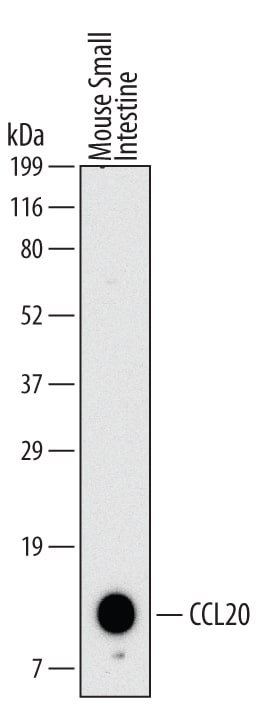
Detection of Mouse CCL20 by Western Blot.
Western blot shows lysates of mouse small intestine. PVDF membrane was probed with 2 µg/mL of Mouse CCL20/MIP-3a Monoclonal Antibody (Catalog # MAB760) followed by HRP-conjugated Anti-Rat IgG Secondary Antibody (Catalog # HAF005). A specific band was detected for CCL20 at approximately 10 kDa (as indicated). This experiment was conducted under reducing conditions and using Immunoblot Buffer Group 1.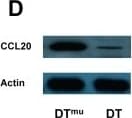
Detection of Mouse CCL20/MIP-3 alpha by Western Blot
Conditional macrophage ablation disrupted Treg-cell recruitment and inhibited the growth of CRC in mice.(A, B) Flow cytometric analysis of TAMs derived from grafted CRC in CD11b-DTR mice injected with DTmu or DT. (C) CCL20 mRNA levels in grafted CRC in CD11b-DTR mice injected with DTmu or DT (data from 5 mice of each group were pooled together). (D) Lysates of grafted CRC from CD11b-DTR mice injected with DTmu or DT were subjected to western blotting for CCL20 expression. Actin - loading control. (E) Immunofluorescence staining with anti-mouse CCL20 was performed on cryosections of GFP+ CMT93 grafted tumor mass derived from CD11b-DTR mice injected with DTmu or DT for 14 days. (F) Flow cytometric analysis of CCR6 expression for GFP+ CMT93 cells before grafting (left panel), and CCR6 staining on cryosections of GFP+ CMT93 grafted tumor mass derived from CD11b-DTR mice injected with DTmu or DT for 14 days (middle and right panel). (G, H) Number of tumor-infiltrating FoxP3+ Treg-cells in grafted CRC in CD11b-DTR mice injected with DTmu or DT. (I) CRC grafted in CD11b-DTR mice injected with DTmu or DT for 14 days. (J) Tumor weight of CRC grafted in CD11b-DTR mice injected with DTmu or DT for 14 days. Representative data are shown which had been reproduced in 2 independent experiments. Image collected and cropped by CiteAb from the following publication (https://dx.plos.org/10.1371/journal.pone.0019495), licensed under a CC-BY license. Not internally tested by R&D Systems.Applications for Mouse CCL20/MIP-3 alpha Antibody (114906)
Western Blot
Sample: Mouse small intestine
Reviewed Applications
Read 1 review rated 5 using MAB760 in the following applications:
Formulation, Preparation, and Storage
Purification
Reconstitution
Reconstitute at 0.5 mg/mL in sterile PBS. For liquid material, refer to CoA for concentration.
Formulation
Shipping
Stability & Storage
- 12 months from date of receipt, -20 to -70 °C as supplied.
- 1 month, 2 to 8 °C under sterile conditions after reconstitution.
- 6 months, -20 to -70 °C under sterile conditions after reconstitution.
Calculators
Background: CCL20/MIP-3 alpha
References
- Baba, M. et al. (1997) J. Biol. Chem. 272:14893.
- Hromas, R. et al. (1997) Blood 89:3315.
- Greaves, D. R. et al. (1997) J. Exp. Med. 186: 857.
- Tanaka, Y. et al. (1999) Eur. J. Immunol. 29:633.
Alternate Names
Gene Symbol
UniProt
Additional CCL20/MIP-3 alpha Products
Product Documents for Mouse CCL20/MIP-3 alpha Antibody (114906)
Certificate of Analysis
To download a Certificate of Analysis, please enter a lot or batch number in the search box below.
Note: Certificate of Analysis not available for kit components.
Product Specific Notices for Mouse CCL20/MIP-3 alpha Antibody (114906)
For research use only
Related Research Areas
Citations for Mouse CCL20/MIP-3 alpha Antibody (114906)
 Powered by Bioz
Customer Reviews for Mouse CCL20/MIP-3 alpha Antibody (114906) (1)
Have you used Mouse CCL20/MIP-3 alpha Antibody (114906)?
Submit a review and receive an Amazon gift card!
$25/€18/£15/$25CAN/¥2500 for a review with an image
$10/€7/£6/$10CAN/¥1110 for a review without an image
Submit a review
Customer Images

-
Application: Western BlotSample Tested: Small intestine tissueSpecies: MouseVerified Customer | Posted 02/03/2022

There are no reviews that match your criteria.
Protocols
Find general support by application which include: protocols, troubleshooting, illustrated assays, videos and webinars.
- Cellular Response to Hypoxia Protocols
- R&D Systems Quality Control Western Blot Protocol
- Troubleshooting Guide: Western Blot Figures
- Western Blot Conditions
- Western Blot Protocol
- Western Blot Protocol for Cell Lysates
- Western Blot Troubleshooting
- Western Blot Troubleshooting Guide
- View all Protocols, Troubleshooting, Illustrated assays and Webinars
Associated Pathways
