


Key Product Details

Species Reactivity

Validated:

Mouse

Cited:

Mouse

Applications

Validated:

Intracellular Staining by Flow Cytometry

Cited:

Flow Cytometry

Label

Phycoerythrin (Excitation = 488 nm, Emission = 565-605 nm)

Antibody Source

Monoclonal Rat IgG2A Clone # 39624
Loading...

Product Specifications

Immunogen

E. coli-derived recombinant mouse CCL3/MIP-1 alpha
Ala24-Ala92
Accession # P10855

Specificity

Detects mouse CCL3/MIP‑1 alpha in Western blots. In Western blots, approximately 25% cross-reactivity with recombinant mouse CCL4/MIP‑1 beta  is observed and no cross-reactivity with recombinant human CCL1, 2, 3, 5, 7, 8, 11, 13, 14, 15, 16, 17, 18, 21, 22, 23, 24, 25, 28, recombinant mouse CCL1, 2, 6, 7, 9/10/MIP-1 gamma, 11, 12, 19, 21, 22, 25, 28, recombinant rat CCL2 or CCL20 is observed. Neutralizes the biological activity of recombinant mouse CCL3 and will not block the biological activity of recombinant human CCL3.

Clonality

Monoclonal

Host

Rat

Isotype

IgG2A

Scientific Data Images for Mouse CCL3/MIP‑1 alpha PE‑conjugated Antibody

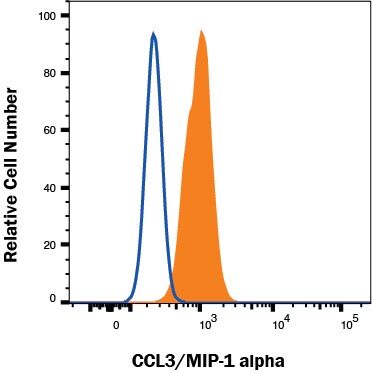
Detection of CCL3/MIP‑1 alpha in J774A.1 cells treated with 1µg/mL LPS and monensin for 5 hrs by Flow Cytometry

J774A.1 cells treated with 1µg/mL LPS and monensin for 5 hrs (filled histogram) and resting J774A.1 cells (open histogram) were stained with Rat Anti-Mouse CCL3/MIP‑1 alpha PE‑conjugated Monoclonal Antibody (Catalog # IC450P). To facilitate intracellular staining, cells were fixed with Flow Cytometry Fixation Buffer (Catalog # FC004) and permeabilized with Flow Cytometry Permeabilization/Wash Buffer I (Catalog # FC005). View our protocol for Staining Intracellular Molecules.

Applications for Mouse CCL3/MIP‑1 alpha PE‑conjugated Antibody

Application
Recommended Usage

Intracellular Staining by Flow Cytometry

10 µL/106 cells
Sample: J774A.1 cells treated with 1ug/mL LPS and monensin for 5 hrs

Spectra Viewer

Plan Your Experiments

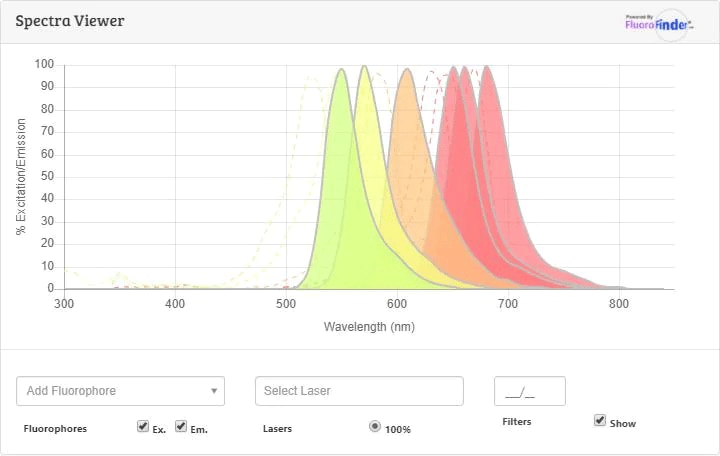
Use our spectra viewer to interactively plan your experiments, assessing multiplexing options. View the excitation and emission spectra for our fluorescent dye range and other commonly used dyes.

Spectra Viewer

Flow Cytometry Panel Builder

Bio-Techne Knows Flow Cytometry

Save time and reduce costly mistakes by quickly finding compatible reagents using the Panel Builder Tool.

Advanced Features

  • Spectra Viewer - Custom analysis of spectra from multiple fluorochromes
  • Spillover Popups - Visualize the spectra of individual fluorochromes
  • Antigen Density Selector - Match fluorochrome brightness with antigen density
Build Your Panel Now

Formulation, Preparation, and Storage

Purification

Protein A or G purified from hybridoma culture supernatant

Formulation

Supplied in a saline solution containing BSA and Sodium Azide.

Shipping

The product is shipped with polar packs. Upon receipt, store it immediately at the temperature recommended below.

Stability & Storage

Store the unopened product at 2 - 8° C. Do not use past expiration date. Protect from light.

Background: CCL3/MIP-1 alpha

The macrophage inflammatory proteins 1 alpha and 1 beta, two closely related but distinct proteins, were originally co-purified from medium conditioned by a LPS-stimulated murine macrophage cell line. Mature mouse CCL3/MIP-1 alpha shares approximately 77% and 70% amino acid identity with human CCL3/MIP-1 alpha and mouse CCL4/MIP-1 beta, respectively. MIP‑1 proteins are expressed primarily in T cells, B cells, and monocytes after antigen or mitogen stimulation. The MIP‑1 proteins are members of the beta  (C‑C) subfamily of chemokines.

Both CCL3 and CCL4 are monocyte chemoattractants in vitro. Additionally, the MIP‑1 proteins have been reported to have chemoattractant and adhesive effects on lymphocytes, with CCL3 and CCL4 preferentially attracting CD8+ and CD4+ T cells, respectively. CCL3 has also been shown to attract B cells as well as eosinophils. MIP‑1 proteins have been reported to have multiple effects on hematopoietic precursor cells, and CCL3 has been identified as a stem cell inhibitory factor that can inhibit the proliferation of hematopoietic stem cells in vitro as well as in vivo. In the same assays, CCL4 was reported to be much less active. The functional receptor for CCL3 has been identified as CCR1 and CCR5.

References

  1. Menten, P. et al. (2002) Cytokine Growth Factor Rev. 13:455.

Alternate Names

G0S19-1, LD78a, MIP-1 alpha, MIP1 alpha, MIP1A, PAT 464.1, SCYA3, SIS-beta

Entrez Gene IDs

6348 (Human); 20302 (Mouse); 25542 (Rat); 448787 (Canine); 102136134 (Cynomolgus Monkey)

Gene Symbol

CCL3

UniProt

Additional CCL3/MIP-1 alpha Products

Product Documents for Mouse CCL3/MIP‑1 alpha PE‑conjugated Antibody

Certificate of Analysis

To download a Certificate of Analysis, please enter a lot or batch number in the search box below.

Note: Certificate of Analysis not available for kit components.

Product Specific Notices for Mouse CCL3/MIP‑1 alpha PE‑conjugated Antibody

For research use only

Citations for Mouse CCL3/MIP‑1 alpha PE‑conjugated Antibody

Customer Reviews for Mouse CCL3/MIP‑1 alpha PE‑conjugated Antibody

There are currently no reviews for this product. Be the first to review Mouse CCL3/MIP‑1 alpha PE‑conjugated Antibody and earn rewards!

Have you used Mouse CCL3/MIP‑1 alpha PE‑conjugated Antibody?

Submit a review and receive an Amazon gift card!

$25/€18/£15/$25CAN/¥2500 Yen for a review with an image

$10/€7/£6/$10CAN/¥1110 Yen for a review without an image

Submit a review
Amazon Gift Card

FAQs

No product specific FAQs exist for this product.

View all FAQs for Antibodies
