
CD109 (also CPAMD7, p180, r150, Gov antigen and GPI-anchored alpha 2-macroglobulin-related protein) is a 170-180 kDa member of the I39 protease inhibitor/ alpha 2-macroglobulin family of thioester-containing proteins. It is expressed by endothelium, activated platelets and T cells, megakaryocyte lineage stem cells, myoepithalial cells, fibroblasts and keratinocytes. On keratinocytes, it is suggested to be a critical component of the TGF-beta receptor (T beta R) complex. Here it has been shown to specifically interact with both TGF-beta 1 and T beta RI, and generally with T beta RII and betaglycan. These interactions are inhibitory to TGF-beta signaling, likely the result of CD109's ability to promote internalization and degradation of the T beta R complex via caveolar endosomes. In human, mature CD109 is proposed to arise from a 205 kDa precursor that is cleaved intracellularly into an N-terminal 180 kDa mature molecule, and a C-terminal 25 kDa GPI-linked fragment. This occurs at an Arg tetrapeptide motif that is also conserved in mouse. On the cell surface, the 180 and 25 kDa molecules either stay "associated", or the 180 kDa mature molecule dissociates from the fragment, resulting in its solubilization. In either case, 180 kDa CD109 has the potential to be "activated" by proteolytic cleavage, generating either a 150 or 120 kDa form that may participate in covalent binding to immediately adjacent targets. Mouse CD109 is synthesized as a 1442 amino acid (aa) precursor. It contains a 21 aa signal sequence, a C-terminal prosegment (aa 1420-1442), and a 1398 aa intervening region (aa 22-1419) that possesses a potential furin processing site over aa 1271-1274. The definitive mature molecule (aa 22-1270) contains an MG2 domain (aa 129-220), a Cys thioester bond (Cys923-Gln926), and an alpha 2-macroglobulin-like region (aa 961-1197). Over aa 22-1269, mouse CD109 shares 73% and 81% aa sequence identity with human and rat CD109, respectively.

Scientific images may be resized, cropped, or adjusted for brightness or contrast for presentation purposes. These updates are limited to presentation and do not affect the underlying scientific interpretation of the data. Where available, additional source data may be provided upon request.
Key Product Details
Species Reactivity
Validated:
Cited:
Applications
Validated:
Cited:
Label
Antibody Source
Product Specifications
Immunogen
Ala22-Ser1269
Accession # Q8R422
Specificity
Clonality
Host
Isotype
Scientific Data Images for Mouse CD109 Antibody
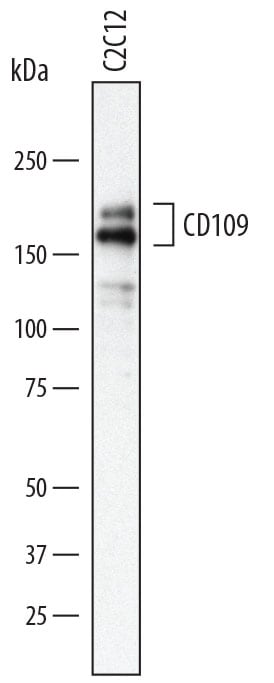
Detection of Mouse CD109 by Western Blot.
Western blot shows lysates of C2C12 mouse myoblast cell line. PVDF membrane was probed with 0.1 µg/mL of Sheep Anti-Mouse CD109 Antigen Affinity-purified Polyclonal Antibody (Catalog # AF7717) followed by HRP-conjugated Anti-Sheep IgG Secondary Antibody (Catalog # HAF016). Specific bands were detected for CD109 at approximately 170 and 180 kDa (as indicated). This experiment was conducted under reducing conditions and using Immunoblot Buffer Group 1.Applications for Mouse CD109 Antibody
Western Blot
Sample: C2C12 mouse myoblast cell line
Formulation, Preparation, and Storage
Purification
Reconstitution
Sterile PBS to a final concentration of 0.2 mg/mL. For liquid material, refer to CoA for concentration.
Formulation
Shipping
Stability & Storage
- 12 months from date of receipt, -20 to -70 °C as supplied.
- 1 month, 2 to 8 °C under sterile conditions after reconstitution.
- 6 months, -20 to -70 °C under sterile conditions after reconstitution.
Calculators
Background: CD109
Alternate Names
Gene Symbol
UniProt
Additional CD109 Products
Product Documents for Mouse CD109 Antibody
Certificate of Analysis
To download a Certificate of Analysis, please enter a lot or batch number in the search box below.
Note: Certificate of Analysis not available for kit components.
Product Specific Notices for Mouse CD109 Antibody
For research use only
Related Research Areas
Citations for Mouse CD109 Antibody
 Powered by Bioz
Customer Reviews for Mouse CD109 Antibody
There are currently no reviews for this product. Be the first to review Mouse CD109 Antibody and earn rewards!
Have you used Mouse CD109 Antibody?
Submit a review and receive an Amazon gift card!
$25/€18/£15/$25CAN/¥2500 for a review with an image
$10/€7/£6/$10CAN/¥1110 for a review without an image
Submit a review
Protocols
Find general support by application which include: protocols, troubleshooting, illustrated assays, videos and webinars.
- Cellular Response to Hypoxia Protocols
- R&D Systems Quality Control Western Blot Protocol
- Troubleshooting Guide: Western Blot Figures
- Western Blot Conditions
- Western Blot Protocol
- Western Blot Protocol for Cell Lysates
- Western Blot Troubleshooting
- Western Blot Troubleshooting Guide
- View all Protocols, Troubleshooting, Illustrated assays and Webinars