
Chitotriosidase, encoded by the mouse CHIT1 gene, is a typical member of the chitinase family (1). It is distinct from another member known as acidic mammalian chitinase (AMC), encoded by the CHIA gene, in several aspects. AMC/CHIA is expressed mainly in alveolar macrophages and in both the mouse and human gastrointestinal tract (2). CHIT1, however, is expressed exclusively by phagocytes in humans and in the gastrointestinal tract, tongue, fore-stomach, and Paneth cells of the small intestine in mice (2). Both CHIA and CHIT1 are secreted as 50 kDa proteins. In contrast to CHIA, CHIT1 is not stable under acidic pH and can be processed into a C-terminally truncated 39 kDa form (2‑4). Human CHIT1 is the best of three biomarkers in the monitoring of Gaucher disease (5). The other two commonly used markers include acid phosphatase and angiotensin-converting enzyme (ACE) (5). Human CHIT1 is also a specific marker of macrophage activation in acute ischemic stroke (6).
Mouse Chitotriosidase/CHIT1 Antibody
R&D Systems | Catalog # AF5325

Scientific images may be resized, cropped, or adjusted for brightness or contrast for presentation purposes. These updates are limited to presentation and do not affect the underlying scientific interpretation of the data. Where available, additional source data may be provided upon request.
Key Product Details
Species Reactivity
Applications
Label
Antibody Source
Product Specifications
Immunogen
Ala22-Ser464
Accession # Q9D7Q1
Specificity
Clonality
Host
Isotype
Scientific Data Images for Mouse Chitotriosidase/CHIT1 Antibody
Detection of Mouse Chitotriosidase/CHIT1 by Western Blot
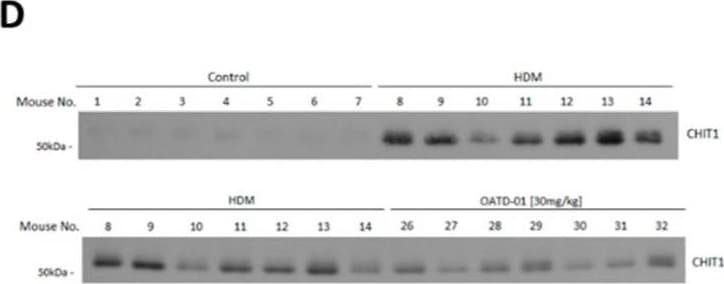
OATD-01 ameliorates TGF beta 1, IL-13, and CHIT1 in chronic HDM model in a dose-dependent fashion. (A) mRNA expression of Il13 in the lungs and (B) active TGF beta 1 levels in BAL fluid in mice with chronic HDM (7 week) treated with OATD-01 (3 and 30 mg/kg; PO; single dose) or vehicle control. (C) Number of macrophages in BAL fluid in mice with chronic HDM (7-week-long) treated with OATD-01 (3 and 30 mg/kg; PO; single dose) or vehicle control. The level of CHIT1 protein in BAL fluid of control and HDM-instilled mice treated with vehicle or OATD-01 (30 mg/kg) in chronic airway inflammation model as evaluated by (D) Western blot and (E) corresponding densitometry analysis. Data presented as mean ± s.e.m. p-values < 0.05 were considered as statistically significant and presented as * for p < 0.05, ** for p < 0.01, *** for p < 0.001, and **** for p < 0.0001. Image collected and cropped by CiteAb from the following open publication (https://pubmed.ncbi.nlm.nih.gov/36902148), licensed under a CC-BY license. Not internally tested by R&D Systems.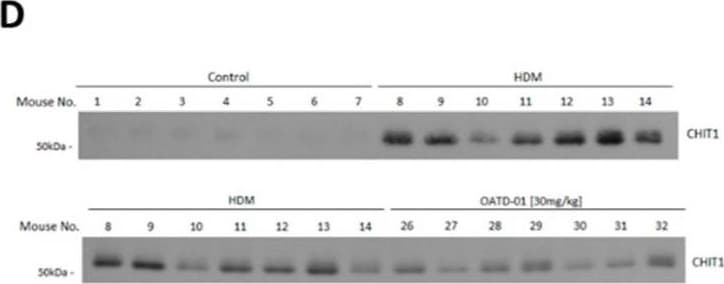
Detection of Mouse Chitotriosidase/CHIT1 by Western Blot
OATD-01 ameliorates TGF beta 1, IL-13, and CHIT1 in chronic HDM model in a dose-dependent fashion. (A) mRNA expression of Il13 in the lungs and (B) active TGF beta 1 levels in BAL fluid in mice with chronic HDM (7 week) treated with OATD-01 (3 and 30 mg/kg; PO; single dose) or vehicle control. (C) Number of macrophages in BAL fluid in mice with chronic HDM (7-week-long) treated with OATD-01 (3 and 30 mg/kg; PO; single dose) or vehicle control. The level of CHIT1 protein in BAL fluid of control and HDM-instilled mice treated with vehicle or OATD-01 (30 mg/kg) in chronic airway inflammation model as evaluated by (D) Western blot and (E) corresponding densitometry analysis. Data presented as mean ± s.e.m. p-values < 0.05 were considered as statistically significant and presented as * for p < 0.05, ** for p < 0.01, *** for p < 0.001, and **** for p < 0.0001. Image collected and cropped by CiteAb from the following open publication (https://pubmed.ncbi.nlm.nih.gov/36902148), licensed under a CC-BY license. Not internally tested by R&D Systems.Applications for Mouse Chitotriosidase/CHIT1 Antibody
Immunoprecipitation
Sample: Conditioned cell culture medium spiked with Recombinant Mouse Chitotriosidase/CHIT1 (Catalog # 5325-GH), see our available Western blot detection antibodies
Western Blot
Sample: Recombinant Mouse Chitotriosidase/CHIT1 (Catalog # 5325-GH)
Formulation, Preparation, and Storage
Purification
Reconstitution
Reconstitute at 0.2 mg/mL in sterile PBS. For liquid material, refer to CoA for concentration.
Formulation
Shipping
Stability & Storage
- 12 months from date of receipt, -20 to -70 °C as supplied.
- 1 month, 2 to 8 °C under sterile conditions after reconstitution.
- 6 months, -20 to -70 °C under sterile conditions after reconstitution.
Calculators
Background: Chitotriosidase/CHIT1
References
- Zheng, T. et al. (2005) Gene 357:37.
- Boot, R.G. et al. (2006) J. Histochem. Cytochem. 53:1283.
- Boot, R.G. et al. (2001) J. Biol. Chem. 276:6770.
- Renkema, G.H. et al. (1997) Eur. J. Biochem. 244:279.
- Vellodi, A. et al. (2005) J. Inherit. Metab. Dis. 28:585.
- Sotgiu, S. et al. (2005) Eur. Neurol. 54:149.
Alternate Names
Entrez Gene IDs
Gene Symbol
UniProt
Additional Chitotriosidase/CHIT1 Products
Product Documents for Mouse Chitotriosidase/CHIT1 Antibody
Certificate of Analysis
To download a Certificate of Analysis, please enter a lot or batch number in the search box below.
Note: Certificate of Analysis not available for kit components.
Product Specific Notices for Mouse Chitotriosidase/CHIT1 Antibody
For research use only
Related Research Areas
Citations for Mouse Chitotriosidase/CHIT1 Antibody
 Powered by Bioz
Customer Reviews for Mouse Chitotriosidase/CHIT1 Antibody
There are currently no reviews for this product. Be the first to review Mouse Chitotriosidase/CHIT1 Antibody and earn rewards!
Have you used Mouse Chitotriosidase/CHIT1 Antibody?
Submit a review and receive an Amazon gift card!
$25/€18/£15/$25CAN/¥2500 for a review with an image
$10/€7/£6/$10CAN/¥1110 for a review without an image
Submit a review
Protocols
Find general support by application which include: protocols, troubleshooting, illustrated assays, videos and webinars.
- Cellular Response to Hypoxia Protocols
- Immunoprecipitation Protocol
- R&D Systems Quality Control Western Blot Protocol
- Troubleshooting Guide: Western Blot Figures
- Western Blot Conditions
- Western Blot Protocol
- Western Blot Protocol for Cell Lysates
- Western Blot Troubleshooting
- Western Blot Troubleshooting Guide
- View all Protocols, Troubleshooting, Illustrated assays and Webinars