
Death receptor 3 (DR3), also known as TNFRSF25, LARD, WSL-1, APO3, TRAMP, and TR3, is a 55 kDa TNF receptor superfamily protein that is predominantly expressed by lymphocytes. TNF receptor superfamily members have varying numbers of extracellular cysteine-rich domains (CRDs) with conserved cysteine spacing (1, 2). DR3 contains four CRDs and one cytoplasmic death domain (3, 4). Alternative splicing of mouse DR3 generates an isoform that lacks the fourth CRD and a secreted isoform that consisits of only the extracellular domain (ECD) (3). Human DR3 exists in at least eleven alternate splice forms (5). Within the ECD, mouse and human DR3 share 59% amino acid (aa) sequence identity. DR3 shares 20-28% aa sequence identity with the ECD of death domain receptors DR5, DR6, EDAR, Fas, NGF R, and TNF RI. Naïve B and T cells preferentially express truncated soluble isoforms of DR3, whereas stimulated lymphocytes preferentially express transmembrane DR3 (5). TL1A/TNFSF15, a high affinity DR3 ligand which also exists in membrane bound and soluble forms, is expressed by activated endothelial cells and T cells (6, 7). TL1A additionally binds to DcR3/TNFRSF6B, a soluble decoy receptor that interferes with DR3 activation (8). DR3 signaling triggers either apoptosis or NF kappa B-induced anti-apoptotic effects depending on the cellular setting (9). Apoptosis is partially impaired during negative selection of thymocytes in DR3-null mice (10). TL1A interactions with DR3 augment T cell proliferation and pro‑inflammatory cytokine secretion (6, 7, 11, 12). DR3 is upregulated by inflammatory stimulation of CCR9+ T cells, a T cell subset important in mucosal immunity (11). T cell and macrophage DR3 expression is prominent in several inflammatory disorders such as Crohn’s disease, inflammatory bowel disease, and atherosclerosis (7, 11-15). DR3 activation on IFN-gamma treated THP-1 cells induces the production of TNF‑ alpha, CXCL8, CCL2, MMP-1, -9, and -13 (14, 15).
Mouse DR3/TNFRSF25 Antibody
R&D Systems | Catalog # AF2437

Scientific images may be resized, cropped, or adjusted for brightness or contrast for presentation purposes. These updates are limited to presentation and do not affect the underlying scientific interpretation of the data. Where available, additional source data may be provided upon request.
Key Product Details
Species Reactivity
Validated:
Cited:
Applications
Validated:
Cited:
Label
Antibody Source
Product Specifications
Immunogen
Gln31-Phe199
Accession # AAK11256
Specificity
Clonality
Host
Isotype
Scientific Data Images for Mouse DR3/TNFRSF25 Antibody
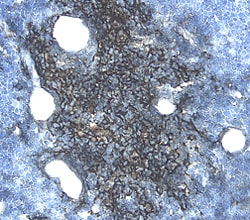
DR3/TNFRSF25 in Mouse Thymus.
DR3/TNFRSF25 was detected in perfusion fixed frozen sections of mouse thymus using 5 µg/mL Goat Anti-Mouse DR3/TNFRSF25 Antigen Affinity-purified Polyclonal Antibody (Catalog # AF2437) overnight at 4 °C. Tissue was stained with the Anti-Goat HRP-DAB Cell & Tissue Staining Kit (brown; Catalog # CTS008) and counterstained with hematoxylin (blue). View our protocol for Chromogenic IHC Staining of Frozen Tissue Sections.Applications for Mouse DR3/TNFRSF25 Antibody
Immunohistochemistry
Sample: Perfusion fixed frozen sections of mouse thymus
Western Blot
Sample: Recombinant Mouse DR3/TNFRSF25 Fc Chimera (Catalog # 2437-D3)
Formulation, Preparation, and Storage
Purification
Reconstitution
Reconstitute at 0.2 mg/mL in sterile PBS. For liquid material, refer to CoA for concentration.
Formulation
Shipping
Stability & Storage
- 12 months from date of receipt, -20 to -70 °C as supplied.
- 1 month, 2 to 8 °C under sterile conditions after reconstitution.
- 6 months, -20 to -70 °C under sterile conditions after reconstitution.
Calculators
Background: DR3/TNFRSF25
References
- Fas, S.C. et al. (2006) Curr. Dir. Autoimmun. 9:1.
- Aggarwal, B.B. (2003) Nat. Rev. Immunol. 3:745.
- Wang, E.C.Y. et al. (2001) Immunogenetics 53:59.
- Borysenko, C.W. et al. (2005) Biochem. Biophys. Res. Commun. 328:794.
- Screaton, G.R. et al. (1997) Proc. Natl. Acad. Sci. USA 94:4615.
- Migone, T.S. et al. (2002) Immunity 16:479.
- Prehn, J.L. et al. (2004) Clin. Immunol. 112:66.
- Yang, C-R. et al. (2004) Cancer Res. 64:1122.
- Wen, L. et al. (2003) J. Biol. Chem. 278:39251.
- Wang, E.C.Y. et al. (2001) Mol. Cell. Biol. 21:3451.
- Papadakis, K.A. et al. (2005) J. Immunol. 174:4985.
- Papadakis, K.A. et al. (2004) J. Immunol. 172:7002.
- Bamias, G. et al. (2003) J. Immunol. 171:4868.
- Kim, S-H. et al. (2001) Jpn. Circ. J. 65:136.
- Kang, Y-J. et al. (2005) Cytokine 29:229.
Long Name
Alternate Names
Gene Symbol
UniProt
Additional DR3/TNFRSF25 Products
Product Documents for Mouse DR3/TNFRSF25 Antibody
Certificate of Analysis
To download a Certificate of Analysis, please enter a lot or batch number in the search box below.
Note: Certificate of Analysis not available for kit components.
Product Specific Notices for Mouse DR3/TNFRSF25 Antibody
For research use only
Citations for Mouse DR3/TNFRSF25 Antibody
 Powered by Bioz
Customer Reviews for Mouse DR3/TNFRSF25 Antibody
There are currently no reviews for this product. Be the first to review Mouse DR3/TNFRSF25 Antibody and earn rewards!
Have you used Mouse DR3/TNFRSF25 Antibody?
Submit a review and receive an Amazon gift card!
$25/€18/£15/$25CAN/¥2500 for a review with an image
$10/€7/£6/$10CAN/¥1110 for a review without an image
Submit a review
Protocols
Find general support by application which include: protocols, troubleshooting, illustrated assays, videos and webinars.
- Antigen Retrieval Protocol (PIER)
- Antigen Retrieval for Frozen Sections Protocol
- Appropriate Fixation of IHC/ICC Samples
- Cellular Response to Hypoxia Protocols
- Chromogenic IHC Staining of Formalin-Fixed Paraffin-Embedded (FFPE) Tissue Protocol
- Chromogenic Immunohistochemistry Staining of Frozen Tissue
- ClariTSA™ Fluorophore Kits
- Detection & Visualization of Antibody Binding
- Fluorescent IHC Staining of Frozen Tissue Protocol
- Graphic Protocol for Heat-induced Epitope Retrieval
- Graphic Protocol for the Preparation and Fluorescent IHC Staining of Frozen Tissue Sections
- Graphic Protocol for the Preparation and Fluorescent IHC Staining of Paraffin-embedded Tissue Sections
- Graphic Protocol for the Preparation of Gelatin-coated Slides for Histological Tissue Sections
- IHC Sample Preparation (Frozen sections vs Paraffin)
- Immunofluorescent IHC Staining of Formalin-Fixed Paraffin-Embedded (FFPE) Tissue Protocol
- Immunohistochemistry (IHC) and Immunocytochemistry (ICC) Protocols
- Immunohistochemistry Frozen Troubleshooting
- Immunohistochemistry Paraffin Troubleshooting
- Preparing Samples for IHC/ICC Experiments
- Preventing Non-Specific Staining (Non-Specific Binding)
- Primary Antibody Selection & Optimization
- Protocol for Heat-Induced Epitope Retrieval (HIER)
- Protocol for Making a 4% Formaldehyde Solution in PBS
- Protocol for VisUCyte™ HRP Polymer Detection Reagent
- Protocol for the Preparation & Fixation of Cells on Coverslips
- Protocol for the Preparation and Chromogenic IHC Staining of Frozen Tissue Sections
- Protocol for the Preparation and Chromogenic IHC Staining of Frozen Tissue Sections - Graphic
- Protocol for the Preparation and Chromogenic IHC Staining of Paraffin-embedded Tissue Sections
- Protocol for the Preparation and Chromogenic IHC Staining of Paraffin-embedded Tissue Sections - Graphic
- Protocol for the Preparation and Fluorescent IHC Staining of Frozen Tissue Sections
- Protocol for the Preparation and Fluorescent IHC Staining of Paraffin-embedded Tissue Sections
- Protocol for the Preparation of Gelatin-coated Slides for Histological Tissue Sections
- R&D Systems Quality Control Western Blot Protocol
- TUNEL and Active Caspase-3 Detection by IHC/ICC Protocol
- The Importance of IHC/ICC Controls
- Troubleshooting Guide: Immunohistochemistry
- Troubleshooting Guide: Western Blot Figures
- Western Blot Conditions
- Western Blot Protocol
- Western Blot Protocol for Cell Lysates
- Western Blot Troubleshooting
- Western Blot Troubleshooting Guide
- View all Protocols, Troubleshooting, Illustrated assays and Webinars
Associated Pathways

