
Epiregulin is a member of the EGF family of growth factors which includes, among others, epidermal growth factor (EGF), transforming growth factor (TGF)-alpha, amphiregulin (ARG), HB (heparin-binding)-EGF, betacellulin, and the various heregulins. They are all synthesized as transmembrane precursors and converted to soluble forms by proteolytic cleavage. Epiregulin was originally purified from the mouse fibroblast-derived tumor cell line NIH3T3/T7 (1). The mouse Epiregulin cDNA encodes for a 162 amino acid (aa) transmembrane precursor, with the mature soluble form comprising aa 56‑101 (2). The mode of action of Epiregulin is similar to other EGF family members in that it binds to and activates the tyrosine-kinase, ErbB-family receptors (ErbB1 through B4) (3). Although it stimulates phosphorylation of all four receptors, it appears to interact primarily with ErbB1 and ErbB4. Epiregulin has the broadest specificity of the EGF-like ligands but seems to preferentially activate heterodimeric receptor complexes (4). Epiregulin exhibits a variety of biological effects. It was originally shown to both inhibit growth of several epithelial tumor cells and stimulate growth of fibroblasts and other types of cells (1). Epiregulin expression is upregulated in a number of carcinoma cell lines. It has also been shown to be an autocrine growth factor in human epidermal keratinocytes (5). Epiregulin has also been shown to play a role in the early steps of pregnancy, regulating attachment of the blastocyst to the uterine epithelium during the implantation process (6).
Mouse Epiregulin Antibody (189611)
R&D Systems | Catalog # MAB1068

Scientific images may be resized, cropped, or adjusted for brightness or contrast for presentation purposes. These updates are limited to presentation and do not affect the underlying scientific interpretation of the data. Where available, additional source data may be provided upon request.
Key Product Details
Species Reactivity
Validated:
Cited:
Applications
Validated:
Cited:
Label
Antibody Source
Product Specifications
Immunogen
Val56-Leu101
Accession # Q61521
Specificity
Clonality
Host
Isotype
Endotoxin Level
Scientific Data Images for Mouse Epiregulin Antibody (189611)
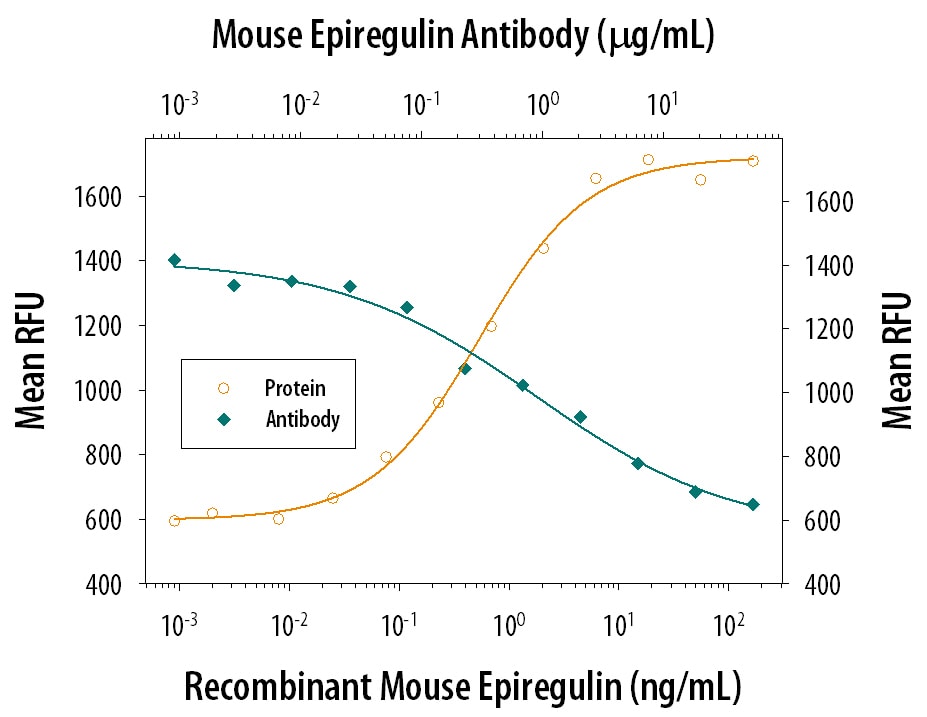
Cell Proliferation Induced by Epiregulin and Neutralization by Mouse Epiregulin Antibody.
Recombinant Mouse Epiregulin (Catalog # 1068-EP) stimulates proliferation in the Balb/3T3 mouse embryonic fibroblast cell line in a dose-dependent manner (orange line). Proliferation elicited by Recombinant Mouse Epiregulin (3 ng/mL) is neutralized (green line) by increasing concentrations of Rat Anti-Mouse Epiregulin Monoclonal Antibody (Catalog # MAB1068). The ND50 is typically 0.2-1 µg/mL.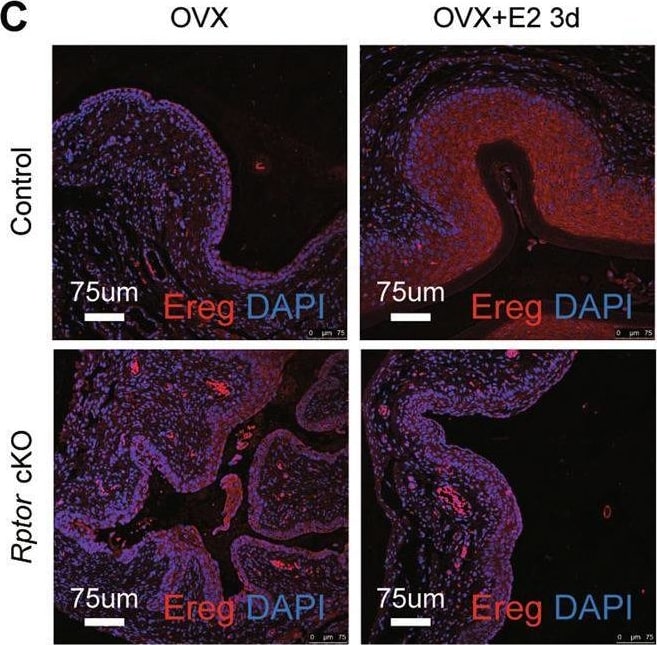
Detection of Epiregulin by Immunohistochemistry
EREG acts as a potential factor for vaginal epithelial cell proliferation and differentiation. A Heatmap of the expression levels of ErbB signaling pathway signature genes in the vagina of control and Rptor cKO mice in the presence or absence of E2 administration. B qPCR was performed to verify the genes in the frame in A. n = 7 (OVX control mice), n = 5 (OVX Rptor cKO mice), n = 6 (OVX control mice treated with E2), n = 5 (OVX Rptor cKO mice treated with E2). Values are expressed as the mean ± SEM. C Representative images of the immunofluorescence staining of EREG in the vagina in OVX control and Rptor cKO mice administrated with or without E2. Nuclei were stained with DAPI. Microscopy with magnification ×20. Scale bars: 75 μm. D OVX control and Rptor cKO mice were administrated with E2 and/or EREG. The vaginas were harvested for PAS staining, Ki67 immunofluorescence staining, and TUNEL staining. In PAS staining, nuclei were stained with hematoxylin. Scale bars: 50 μm. In Ki67 immunofluorescence staining and TUNEL staining, nuclei were stained with DAPI. Microscopy with magnification ×20. Scale bars: 75 μm. E Expression levels of Krt6a, Krt6b, Krt10, Krt13, Krt16 in the vagina of the mice were quantified using qPCR. n = 6 (OVX control mice treated with E2), n = 5 (OVX Rptor cKO mice treated with E2), n = 4 (OVX Rptor cKO mice treated with E2 and EREG). Values are expressed as the mean ± SEM. F The vaginas as indicated in D were harvested for immunofluorescence staining of YAP1, nuclei were stained with DAPI. n = 6 (OVX control mice treated with E2), n = 5 (OVX Rptor cKO mice treated with E2), n = 4 (OVX Rptor cKO mice treated with E2 and EREG). The experiments were repeated three times. Microscopy with magnification ×20. Scale bars: 75 μm. Image collected and cropped by CiteAb from the following open publication (https://pubmed.ncbi.nlm.nih.gov/36220823), licensed under a CC-BY license. Not internally tested by R&D Systems.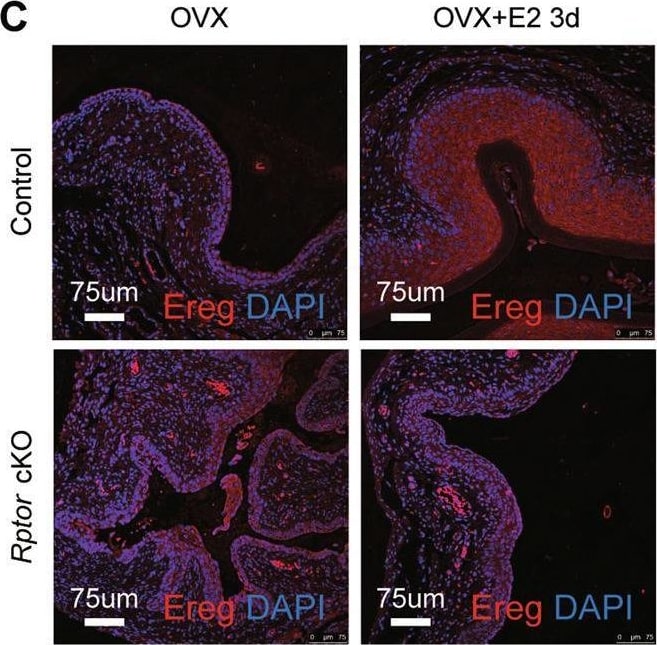
Detection of Epiregulin by Immunohistochemistry
EREG acts as a potential factor for vaginal epithelial cell proliferation and differentiation. A Heatmap of the expression levels of ErbB signaling pathway signature genes in the vagina of control and Rptor cKO mice in the presence or absence of E2 administration. B qPCR was performed to verify the genes in the frame in A. n = 7 (OVX control mice), n = 5 (OVX Rptor cKO mice), n = 6 (OVX control mice treated with E2), n = 5 (OVX Rptor cKO mice treated with E2). Values are expressed as the mean ± SEM. C Representative images of the immunofluorescence staining of EREG in the vagina in OVX control and Rptor cKO mice administrated with or without E2. Nuclei were stained with DAPI. Microscopy with magnification ×20. Scale bars: 75 μm. D OVX control and Rptor cKO mice were administrated with E2 and/or EREG. The vaginas were harvested for PAS staining, Ki67 immunofluorescence staining, and TUNEL staining. In PAS staining, nuclei were stained with hematoxylin. Scale bars: 50 μm. In Ki67 immunofluorescence staining and TUNEL staining, nuclei were stained with DAPI. Microscopy with magnification ×20. Scale bars: 75 μm. E Expression levels of Krt6a, Krt6b, Krt10, Krt13, Krt16 in the vagina of the mice were quantified using qPCR. n = 6 (OVX control mice treated with E2), n = 5 (OVX Rptor cKO mice treated with E2), n = 4 (OVX Rptor cKO mice treated with E2 and EREG). Values are expressed as the mean ± SEM. F The vaginas as indicated in D were harvested for immunofluorescence staining of YAP1, nuclei were stained with DAPI. n = 6 (OVX control mice treated with E2), n = 5 (OVX Rptor cKO mice treated with E2), n = 4 (OVX Rptor cKO mice treated with E2 and EREG). The experiments were repeated three times. Microscopy with magnification ×20. Scale bars: 75 μm. Image collected and cropped by CiteAb from the following open publication (https://pubmed.ncbi.nlm.nih.gov/36220823), licensed under a CC-BY license. Not internally tested by R&D Systems.
Mouse Epiregulin ELISA Standard Curve
Recombinant Mouse Epiregulin (Catalog # 1068-EP) was serially diluted and captured by Rat Anti-Mouse Epiregulin Monoclonal Antibody (Catalog # MAB1068) coated on a Clear Polystyrene Microplate (Catalog # DY990). Goat Anti-Mouse Epiregulin Antigen Affinity-purified Polyclonal Antibody (Catalog # AF1068) was biotinylated and incubated with the protein captured on the plate. Detection of the standard curve was achieved by incubating Streptavidin-HRP (Catalog # DY998)Applications for Mouse Epiregulin Antibody (189611)
Neutralization
Mouse Epiregulin Sandwich Immunoassay
Reviewed Applications
Read 1 review rated 5 using MAB1068 in the following applications:
Formulation, Preparation, and Storage
Purification
Reconstitution
Reconstitute at 0.5 mg/mL in sterile PBS. For liquid material, refer to CoA for concentration.
Formulation
Shipping
Stability & Storage
- 12 months from date of receipt, -20 to -70 °C as supplied.
- 1 month, 2 to 8 °C under sterile conditions after reconstitution.
- 6 months, -20 to -70 °C under sterile conditions after reconstitution.
Calculators
Background: Epiregulin
References
- Toyoda, H. et al. (1995) J. Biol. Chem. 270:7495.
- Toyoda, H. et al. (1995) FEBS Lett. 377:403.
- Komurasaki, T. et al. (1997) Oncogene 15:2841.
- Shelly, M. et al. (1998) J. Biol. Chem. 273:10496.
- Shirakata, Y. et al. (2000) J. Biol. Chem. 275:5748.
- Das, S.K. et al. (1997) Dev. Biol. 190:178.
Alternate Names
Gene Symbol
UniProt
Additional Epiregulin Products
Product Documents for Mouse Epiregulin Antibody (189611)
Certificate of Analysis
To download a Certificate of Analysis, please enter a lot or batch number in the search box below.
Note: Certificate of Analysis not available for kit components.
Product Specific Notices for Mouse Epiregulin Antibody (189611)
For research use only
Related Research Areas
Citations for Mouse Epiregulin Antibody (189611)
 Powered by Bioz
Customer Reviews for Mouse Epiregulin Antibody (189611) (1)
Have you used Mouse Epiregulin Antibody (189611)?
Submit a review and receive an Amazon gift card!
$25/€18/£15/$25CAN/¥2500 for a review with an image
$10/€7/£6/$10CAN/¥1110 for a review without an image
Submit a review
Customer Images
-
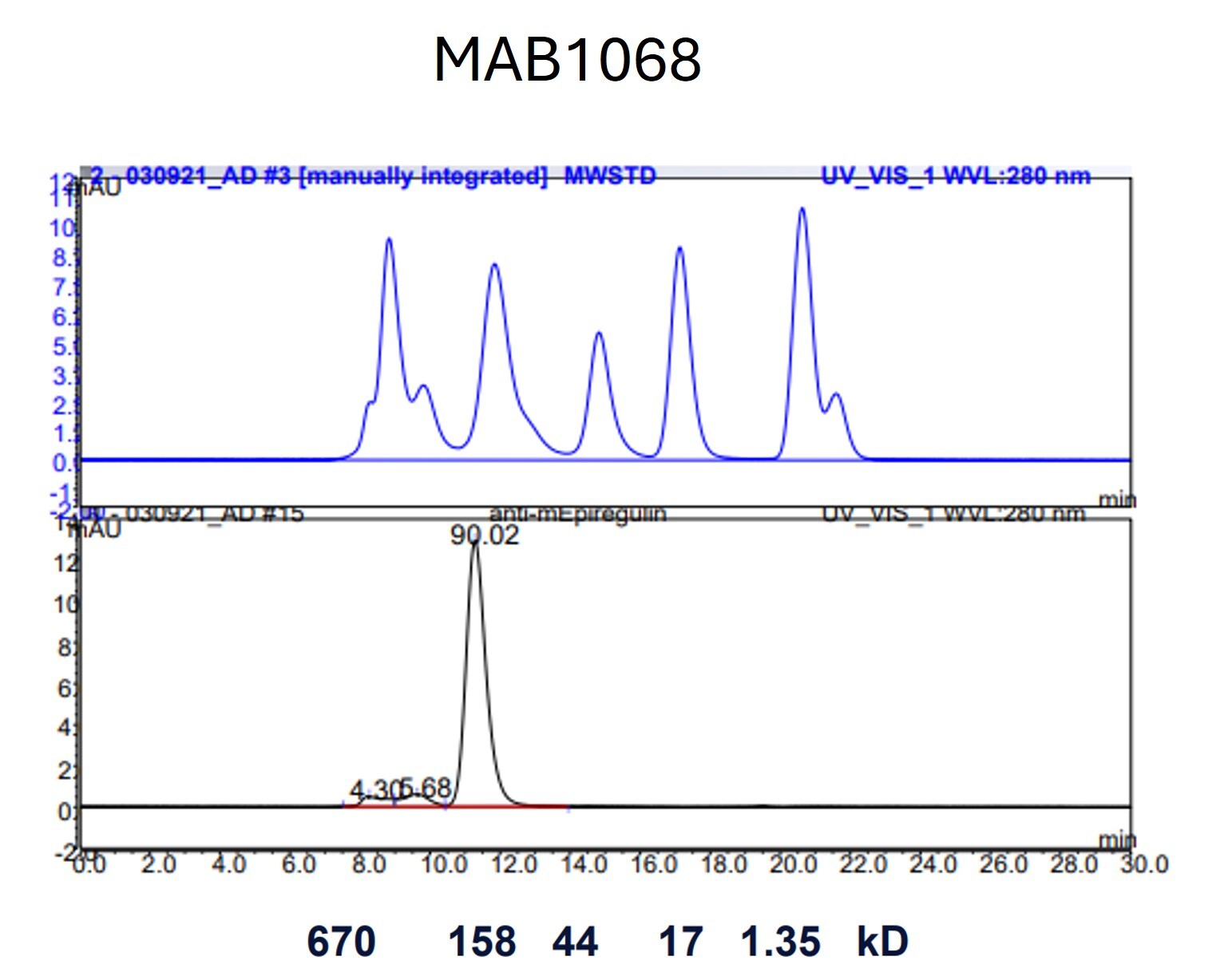
Application: characterize prior to use. 90% monomer.Sample Tested: Recombinant proteinSpecies: MouseVerified Customer | Posted 08/15/2025

There are no reviews that match your criteria.