
PEAR1 (Platelet Endothelial Aggregation Receptor 1; Also Jedi/Jagged and Delta protein and MEGF12) is a 140-160 kDa member of the MEGF/Multiple Epidermal Growth Factor domain family of molecules.It has restricted expression, being found on megakaryocytes/platelets, vascular endothelial cells, early hematopoietic stem cells and dorsal root ganglia satellite glial cells. PEAR1 has an extracellular domain (ECD) similar to Jagged1, and soluble PEAR1 is known to be an inhibitor of notch signaling. Thus, it likely participates in blood cell differentiation. It also is reported to bind to apoptotic neurons, facilitating clearance during development. Mature mouse PEAR1 is a 1016 amino acid (aa) type I transmembrane protein. It possesses a 736 aa ECD (aa 19-754) plus a 259 aa cytoplasmic region (aa 776-1034). The ECD contains one EMI (Emilin) domain (aa 25-137), followed by 9 EGF-like repeats (aa 181-691). There are at least three utilized phosphorylation sites in the cytoplasmic tail. Three isoform variants exist. One shows a deletion of aa 375-404, a second contains an 11 aa substitution for aa 737-747, and a third utilizes an alternative start site at Met137. Over aa 19-754, mouse PEAR1 shares 94% and 85% aa sequence identity with rat and human PEAR1, respectively.

Key Product Details
Species Reactivity
Validated:
Mouse
Cited:
Mouse
Applications
Validated:
Western Blot, Flow Cytometry, CyTOF-ready
Cited:
Immunohistochemistry
Label
Unconjugated
Antibody Source
Polyclonal Sheep IgG
Loading...
Product Specifications
Immunogen
Chinese hamster ovary cell line CHO-derived recombinant mouse PEAR1
Leu19-Leu754
Accession # Q8VIK5
Leu19-Leu754
Accession # Q8VIK5
Specificity
Detects mouse PEAR1 in direct ELISAs and Western blots. In direct ELISAs, approximately 15% cross-reactivity with recombinant human PEAR1 is observed.
Clonality
Polyclonal
Host
Sheep
Isotype
IgG
Scientific Data Images for Mouse PEAR1 Antibody
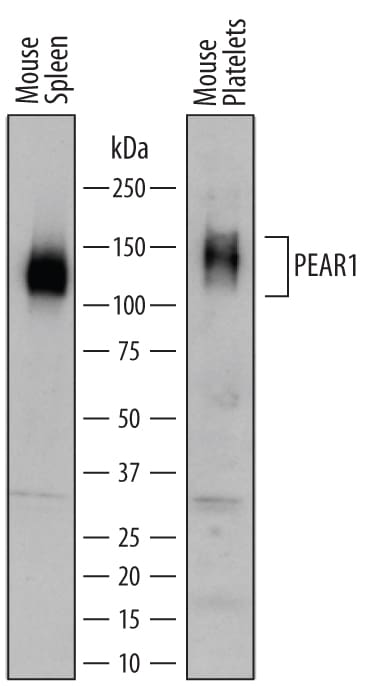
Detection of Mouse PEAR1 by Western Blot.
Western blot shows lysates of mouse spleen tissue and mouse platelets. PVDF membrane was probed with 1 µg/mL of Sheep Anti-Mouse PEAR1 Antigen Affinity-purified Polyclonal Antibody (Catalog # AF7607) followed by HRP-conjugated Anti-Sheep IgG Secondary Antibody (Catalog # HAF016). A specific band was detected for PEAR1 at approximately 120-150 kDa (as indicated). This experiment was conducted under reducing conditions and using Immunoblot Buffer Group 1.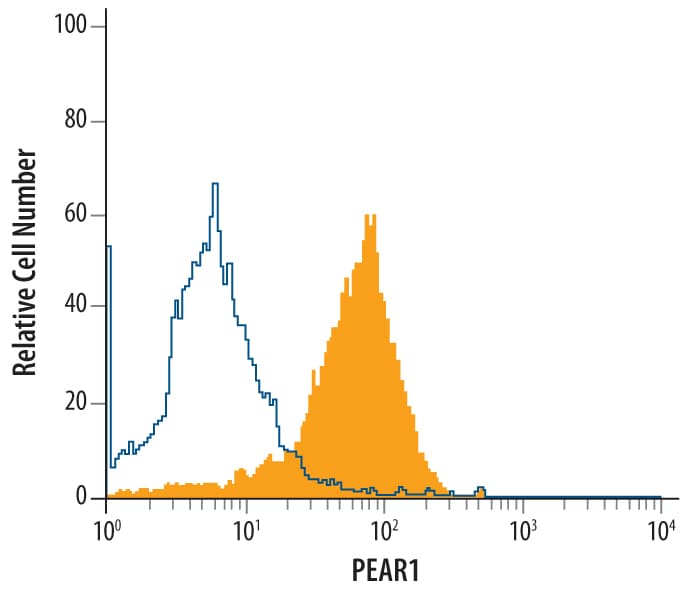
Detection of PEAR1 in bEnd.3 Mouse Cell Line by Flow Cytometry.
bEnd.3 mouse endo-thelioma cell line was stained with Sheep Anti-Mouse PEAR1 Antigen Affinity-purified Polyclonal Antibody (Catalog # AF7607, filled histogram) or isotype control antibody (Catalog # 5-001-A, open histogram), followed by Phycoerythrin-conjugated Anti-Sheep IgG Secondary Antibody (Catalog # F0126).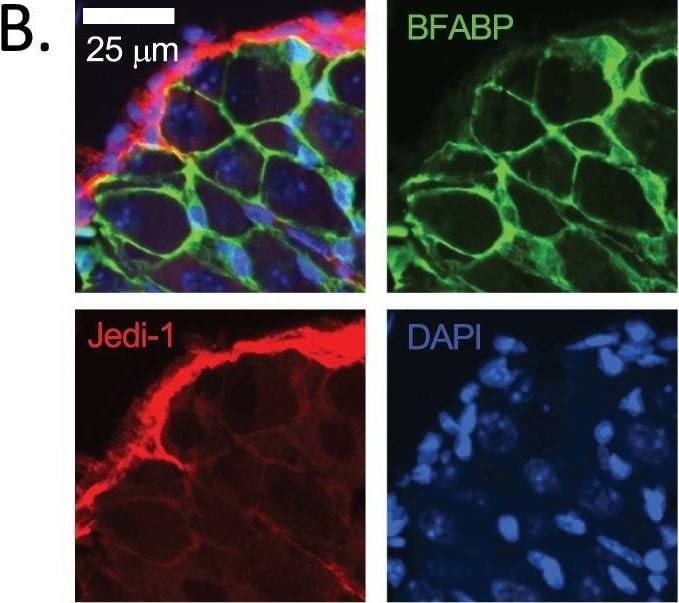
Detection of Mouse PEAR1 by Immunohistochemistry
Jedi is expressed in peripheral glia and endothelium. (A) Cross section of adult (8–12 weeks old) WT sciatic nerve stained for Jedi-1 (magenta) and DAPI (blue). Insets 1 and 2 show Jedi expression in blood vessels. See Supplementary Fig. S2 for validation of Jedi-1 expression in perineurial glial cells. (B) WT P0 DRG co-stained for Jedi-1 (red), satellite glial marker BFABP (green), and DAPI (blue). (C) WT DRG co-stained for Jedi-1 (red) and PGP9.5 (green) and TOPRO3 (blue). Right shows inset. (D) Right: Primary WT DRG cultures stained for neurons using Tuj1 (green) and Jedi-1 (red). Left: HeLa cells overexpressing mouse Jedi-1 were used as a positive control for Jedi-1 immunocytochemistry in vitro. All images were analyzed in ImageJ version 2.0.0-rc-69/1.52p. Image collected and cropped by CiteAb from the following publication (https://pubmed.ncbi.nlm.nih.gov/31992767), licensed under a CC-BY license. Not internally tested by R&D Systems.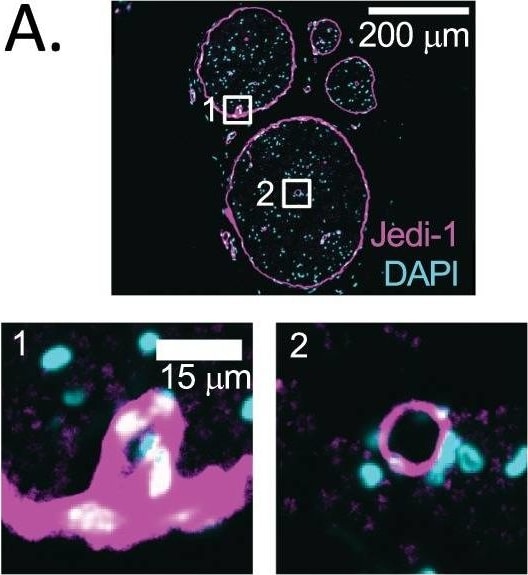
Detection of Mouse PEAR1 by Immunohistochemistry
Jedi is expressed in peripheral glia and endothelium. (A) Cross section of adult (8–12 weeks old) WT sciatic nerve stained for Jedi-1 (magenta) and DAPI (blue). Insets 1 and 2 show Jedi expression in blood vessels. See Supplementary Fig. S2 for validation of Jedi-1 expression in perineurial glial cells. (B) WT P0 DRG co-stained for Jedi-1 (red), satellite glial marker BFABP (green), and DAPI (blue). (C) WT DRG co-stained for Jedi-1 (red) and PGP9.5 (green) and TOPRO3 (blue). Right shows inset. (D) Right: Primary WT DRG cultures stained for neurons using Tuj1 (green) and Jedi-1 (red). Left: HeLa cells overexpressing mouse Jedi-1 were used as a positive control for Jedi-1 immunocytochemistry in vitro. All images were analyzed in ImageJ version 2.0.0-rc-69/1.52p. Image collected and cropped by CiteAb from the following publication (https://pubmed.ncbi.nlm.nih.gov/31992767), licensed under a CC-BY license. Not internally tested by R&D Systems.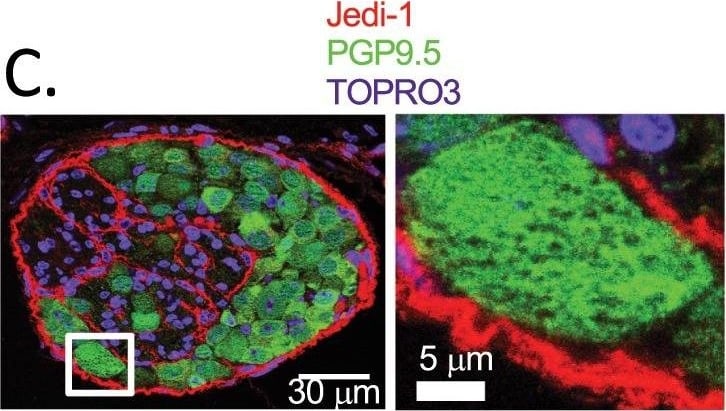
Detection of Mouse PEAR1 by Immunohistochemistry
Jedi is expressed in peripheral glia and endothelium. (A) Cross section of adult (8–12 weeks old) WT sciatic nerve stained for Jedi-1 (magenta) and DAPI (blue). Insets 1 and 2 show Jedi expression in blood vessels. See Supplementary Fig. S2 for validation of Jedi-1 expression in perineurial glial cells. (B) WT P0 DRG co-stained for Jedi-1 (red), satellite glial marker BFABP (green), and DAPI (blue). (C) WT DRG co-stained for Jedi-1 (red) and PGP9.5 (green) and TOPRO3 (blue). Right shows inset. (D) Right: Primary WT DRG cultures stained for neurons using Tuj1 (green) and Jedi-1 (red). Left: HeLa cells overexpressing mouse Jedi-1 were used as a positive control for Jedi-1 immunocytochemistry in vitro. All images were analyzed in ImageJ version 2.0.0-rc-69/1.52p. Image collected and cropped by CiteAb from the following publication (https://pubmed.ncbi.nlm.nih.gov/31992767), licensed under a CC-BY license. Not internally tested by R&D Systems.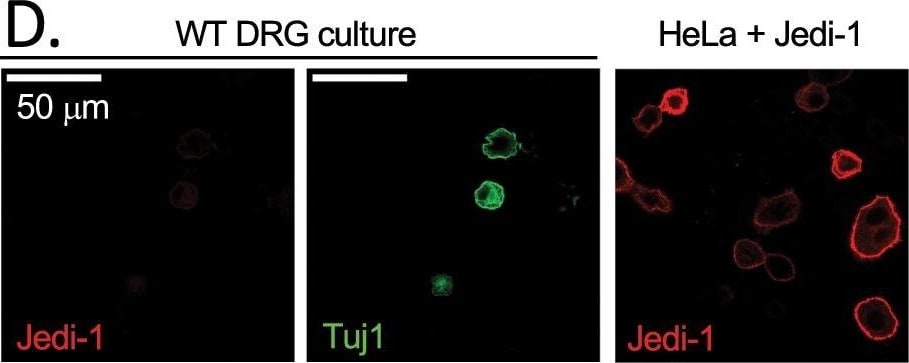
Detection of Mouse PEAR1 by Immunocytochemistry/Immunofluorescence
Jedi is expressed in peripheral glia and endothelium. (A) Cross section of adult (8–12 weeks old) WT sciatic nerve stained for Jedi-1 (magenta) and DAPI (blue). Insets 1 and 2 show Jedi expression in blood vessels. See Supplementary Fig. S2 for validation of Jedi-1 expression in perineurial glial cells. (B) WT P0 DRG co-stained for Jedi-1 (red), satellite glial marker BFABP (green), and DAPI (blue). (C) WT DRG co-stained for Jedi-1 (red) and PGP9.5 (green) and TOPRO3 (blue). Right shows inset. (D) Right: Primary WT DRG cultures stained for neurons using Tuj1 (green) and Jedi-1 (red). Left: HeLa cells overexpressing mouse Jedi-1 were used as a positive control for Jedi-1 immunocytochemistry in vitro. All images were analyzed in ImageJ version 2.0.0-rc-69/1.52p. Image collected and cropped by CiteAb from the following publication (https://pubmed.ncbi.nlm.nih.gov/31992767), licensed under a CC-BY license. Not internally tested by R&D Systems.Applications for Mouse PEAR1 Antibody
Application
Recommended Usage
CyTOF-ready
Ready to be labeled using established conjugation methods. No BSA or other carrier proteins that could interfere with conjugation.
Flow Cytometry
2.5 µg/106 cells
Sample: bEnd.3 mouse endothelioma cell line
Sample: bEnd.3 mouse endothelioma cell line
Western Blot
1 µg/mL
Sample: Mouse spleen tissue and mouse platelets
Sample: Mouse spleen tissue and mouse platelets
Flow Cytometry Panel Builder
Bio-Techne Knows Flow Cytometry
Save time and reduce costly mistakes by quickly finding compatible reagents using the Panel Builder Tool.
Advanced Features
- Spectra Viewer - Custom analysis of spectra from multiple fluorochromes
- Spillover Popups - Visualize the spectra of individual fluorochromes
- Antigen Density Selector - Match fluorochrome brightness with antigen density

Formulation, Preparation, and Storage
Purification
Antigen Affinity-purified
Reconstitution
Sterile PBS to a final concentration of 0.2 mg/mL. For liquid material, refer to CoA for concentration.
Loading...
Formulation
Lyophilized from a 0.2 μm filtered solution in PBS with Trehalose. *Small pack size (SP) is supplied either lyophilized or as a 0.2 µm filtered solution in PBS.
Shipping
Lyophilized product is shipped at ambient temperature. Liquid small pack size (-SP) is shipped with polar packs. Upon receipt, store immediately at the temperature recommended below.
Stability & Storage
Use a manual defrost freezer and avoid repeated freeze-thaw cycles.
- 12 months from date of receipt, -20 to -70 °C as supplied.
- 1 month, 2 to 8 °C under sterile conditions after reconstitution.
- 6 months, -20 to -70 °C under sterile conditions after reconstitution.
Calculators
Background: PEAR1
Long Name
Platelet endothelial aggregation receptor 1
Alternate Names
Jedi
Gene Symbol
PEAR1
UniProt
Additional PEAR1 Products
Product Documents for Mouse PEAR1 Antibody
Certificate of Analysis
To download a Certificate of Analysis, please enter a lot or batch number in the search box below.
Note: Certificate of Analysis not available for kit components.
Product Specific Notices for Mouse PEAR1 Antibody
For research use only
Related Research Areas
Citations for Mouse PEAR1 Antibody
 Powered by Bioz
Customer Reviews for Mouse PEAR1 Antibody
There are currently no reviews for this product. Be the first to review Mouse PEAR1 Antibody and earn rewards!
Have you used Mouse PEAR1 Antibody?
Submit a review and receive an Amazon gift card!
$25/€18/£15/$25CAN/¥2500 for a review with an image
$10/€7/£6/$10CAN/¥1110 for a review without an image
Submit a review
Protocols
Find general support by application which include: protocols, troubleshooting, illustrated assays, videos and webinars.
- 7-Amino Actinomycin D (7-AAD) Cell Viability Flow Cytometry Protocol
- Cellular Response to Hypoxia Protocols
- Extracellular Membrane Flow Cytometry Protocol
- Flow Cytometry Protocol for Cell Surface Markers
- Flow Cytometry Protocol for Staining Membrane Associated Proteins
- Flow Cytometry Staining Protocols
- Flow Cytometry Troubleshooting Guide
- Intracellular Flow Cytometry Protocol Using Alcohol (Methanol)
- Intracellular Flow Cytometry Protocol Using Detergents
- Intracellular Nuclear Staining Flow Cytometry Protocol Using Detergents
- Intracellular Staining Flow Cytometry Protocol Using Alcohol Permeabilization
- Intracellular Staining Flow Cytometry Protocol Using Detergents to Permeabilize Cells
- Propidium Iodide Cell Viability Flow Cytometry Protocol
- Protocol for Liperfluo
- Protocol for the Characterization of Human Th22 Cells
- Protocol for the Characterization of Human Th9 Cells
- Protocol: Annexin V and PI Staining by Flow Cytometry
- Protocol: Annexin V and PI Staining for Apoptosis by Flow Cytometry
- R&D Systems Quality Control Western Blot Protocol
- Troubleshooting Guide: Fluorokine Flow Cytometry Kits
- Troubleshooting Guide: Western Blot Figures
- Western Blot Conditions
- Western Blot Protocol
- Western Blot Protocol for Cell Lysates
- Western Blot Troubleshooting
- Western Blot Troubleshooting Guide
- View all Protocols, Troubleshooting, Illustrated assays and Webinars
Loading...
Associated Pathways
