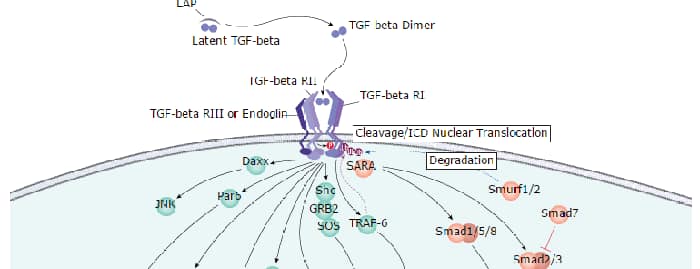
Transforming growth factor beta receptor III (TGF-beta RIII; also betaglycan) is a ubiquitously expressed, 280 kDa type I transmembrane proteoglycan member of the TGF-beta superfamily of proteins (1). Mouse TGF-beta RIII is synthesized as an 850 amino acid (aa) precursor that consists of a 22 aa signal sequence, a 763 extracellular domain (ECD), a 23 aa transmembrane region, and a 42 aa cytoplasmic tail. The large ECD contains heparan sulfate and chondroitin sulfate glycosaminoglycans, five potential N-linked glycosylation sites, and a zona pellucida-like domain from residues 454‑731 (1, 2). The short cytoplasmic domain is rich in serine and threonine, but has no discernible signaling structure typical of receptor kinases (2). Proteolysis at one of two potential juxtamembrane cleavage sites (Lys743Lys and Leu750AlaValVal) allows cells to release TGF-beta RIII in a soluble form (1, 2). Mouse TGF-beta RIII shares 94%, 82%, 80%, and 67% aa sequence identity with rat, human, porcine, and chicken TGF-beta RIII, respectively (2). In all of these species, TGF beta RIII contains 17 cysteines that are 100% conserved (2). TGF-beta RIII binds with high affinity to TGF-beta 1, TGF-beta 2, and TGF-beta 3 isoforms (1). TGF-beta RIII functions by binding, and then "presenting" ligand to TGF-beta type II receptors (1, 3). It also functions to limit ligand availability to the receptor via proteolysis which releases the soluble form of TGF beta RIII along with any bound factors, making them inaccessible to cell-surface receptors (1, 3). TGF-beta RIII can therefore enhance or inhibit cell signaling. TGF-beta RIII has been shown to play an essential role in the formation of the atrioventricular cushion and coronary vessels during development of the heart (4‑6). TGF beta RIII also plays a role in many cancers. Increased expression of TGF beta RIII is found in higher grade lymphomas, and reduced expression of TGF beta RIII is found with advanced stage neuroblastomas and ovarian carcinomas (4, 7‑9). Low TGF-beta RIII expression also correlates with higher grade among a cohort of breast cancers (4, 10). Additionally, overexpression of TGF-beta RIII in MDA-231 human breast cancer cells and DU145 prostate cancer cells results in decreased tumor invasion in vitro and in vivo (4, 11, 12).
Mouse TGF-beta RIII Antibody [Biotin]
R&D Systems | Catalog # BAF5034

![Mouse TGF-beta RIII Antibody [Biotin]](https://resources.rndsystems.com/images/icons/RnD-Default-Product-Image_Antibodies-Icon.svg "Mouse TGF-beta RIII Antibody [Biotin]")
Key Product Details
Species Reactivity
Mouse
Applications
Western Blot
Label
Biotin
Antibody Source
Polyclonal Goat IgG
Loading...
Product Specifications
Immunogen
Mouse myeloma cell line NS0-derived recombinant mouse TGF‑ beta RIII
Gly23-Thr785
Accession # NP_035708
Gly23-Thr785
Accession # NP_035708
Specificity
Detects mouse TGF-beta RIII in Western blots. In Western blots, less than 5% cross-reactivity with recombinant human TGF-beta sRII and recombinant mouse TGF-beta RII is observed.
Clonality
Polyclonal
Host
Goat
Isotype
IgG
Applications for Mouse TGF-beta RIII Antibody [Biotin]
Application
Recommended Usage
Western Blot
0.1 µg/mL
Sample: Recombinant Mouse TGF-beta RIII (Catalog # 5034-R3)
Sample: Recombinant Mouse TGF-beta RIII (Catalog # 5034-R3)
Formulation, Preparation, and Storage
Purification
Antigen Affinity-purified
Reconstitution
Reconstitute at 0.2 mg/mL in sterile PBS.
Loading...
Formulation
Lyophilized from a 0.2 μm filtered solution in PBS with BSA as a carrier protein.
Shipping
The product is shipped at ambient temperature. Upon receipt, store it immediately at the temperature recommended below.
Stability & Storage
Use a manual defrost freezer and avoid repeated freeze-thaw cycles.
- 12 months from date of receipt, -20 to -70 °C as supplied.
- 1 month, 2 to 8 °C under sterile conditions after reconstitution.
- 6 months, -20 to -70 °C under sterile conditions after reconstitution.
Calculators
Background: TGF-beta RIII
References
- Kolodziejczyk, S.M. and B.K. Hall (1996) Biochem. Cell Biol. 74:299.
- Ponce-Castaneda, M.V. et al. (1998) Biochim. Biophys. Acta 1384:189.
- Lopez-Casillas, F. et al. (1993) Cell 73:1435.
- Criswell, T.L. and C.L. Arteaga (2007) J. Biol. Chem. 282:32491.
- Brown, C.B. et al. (1999) Science 283:2080.
- Compton, L.A. et al. (2007) Circ. Res. 101:784.
- Woszczyk, D. et al. (2004) Med. Sci. Monit. 10:CRIII3.
- Bristow, R.E. et al. (1999) Cancer 85:658.
- Iolascon, A. et al. (2000) Br. J. Cancer 82:1171.
- Dong, M. et al. (2007) J. Clin. Invest. 117:206.
- Turley, R.S. et al. (2007) Cancer Res. 67:1090.
- Sun, L. and C. Chen (1997) J. Biol. Chem. 272:25367.
Long Name
Transforming Growth Factor beta Receptor III
Alternate Names
Betaglycan, BGCAN, TBRIII, TGF-bRIII, TGFbetaRIII, TGFBR3
Gene Symbol
TGFBR3
UniProt
Additional TGF-beta RIII Products
Product Documents for Mouse TGF-beta RIII Antibody [Biotin]
Certificate of Analysis
To download a Certificate of Analysis, please enter a lot or batch number in the search box below.
Note: Certificate of Analysis not available for kit components.
Product Specific Notices for Mouse TGF-beta RIII Antibody [Biotin]
For research use only
Customer Reviews for Mouse TGF-beta RIII Antibody [Biotin]
There are currently no reviews for this product. Be the first to review Mouse TGF-beta RIII Antibody [Biotin] and earn rewards!
Have you used Mouse TGF-beta RIII Antibody [Biotin]?
Submit a review and receive an Amazon gift card!
$25/€18/£15/$25CAN/¥2500 for a review with an image
$10/€7/£6/$10CAN/¥1110 for a review without an image
Submit a review
Protocols
Find general support by application which include: protocols, troubleshooting, illustrated assays, videos and webinars.
- Cellular Response to Hypoxia Protocols
- R&D Systems Quality Control Western Blot Protocol
- Troubleshooting Guide: Western Blot Figures
- Western Blot Conditions
- Western Blot Protocol
- Western Blot Protocol for Cell Lysates
- Western Blot Troubleshooting
- Western Blot Troubleshooting Guide
- View all Protocols, Troubleshooting, Illustrated assays and Webinars