
Stromal Lymphopoietin (TSLP) was originally identified from the conditioned medium of a mouse thymic stromal cell line as a protein that promoted the development of B cells. The activity of mouse TSLP overlaps with, but is distinct from, that of mouse IL-7 (1). Mouse TSLP cDNA encodes a 140 amino acid (aa) residue precursor protein with a 19 aa signal sequence. Within the mature region, there are three potential N-glycosylation sites. The Sf 21 cell expressed rmTSLP is likely to be glycosylated at all three sites, as three major glycoforms were visible on SDS-PAGE (Figure 1). Insect cells are known to express relatively simple and homogeneous N-glycans that mainly belong to the high mannose type (2). This recombinant protein was found to be an excellent substrate for N-specific glycosidases such as Endo F3 (Figure 1). The majority of the glycans on rmTSLP can be readily removed by Endo F3. However, a small percentage of the glycans is somewhat resistant to Endo F3 digestion, possibly lacking core fucose, as it is known that core fucosylated N-glycans are strongly preferred substrates for Endo F3 digestion (3).


Scientific images may be resized, cropped, or adjusted for brightness or contrast for presentation purposes. These updates are limited to presentation and do not affect the underlying scientific interpretation of the data. Where available, additional source data may be provided upon request.
Key Product Details
Species Reactivity
Validated:
Cited:
Applications
Validated:
Cited:
Label
Antibody Source
Product Specifications
Immunogen
Tyr20-Glu140
Accession # Q9JIE6
Specificity
Clonality
Host
Isotype
Endotoxin Level
Scientific Data Images for Mouse TSLP Antibody
Cell Proliferation Induced by TSLP and Neutralization by Mouse TSLP Antibody.
Recombinant Mouse TSLP (555-TS) stimulates proliferation in the BaF3 mouse pro‑B cell line transfected with mouse IL‑7 Ra/CD127 in a dose-dependent manner (orange line). Proliferation elicited by Recombinant Mouse TSLP (7.5 ng/mL) is neutralized (green line) by increasing concentrations of Goat Anti-Mouse TSLP Antigen Affinity-purified Polyclonal Antibody (Catalog # AF555). The ND50 is typically ≤0.4 µg/mL.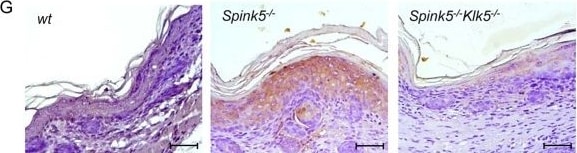
Detection of Mouse TSLP by Immunohistochemistry-Paraffin
Klk5 deletion results in remarkable suppression of the inflammatory phenotype of NS.(A-E). Results show remarkable abrogation of pro-allergic and pro-inflammatory cytokines quantified by RT-qPCR. (A) Il-1 beta, Tslp, Tnf-alpha ; (B) Il-6, Il-18, the type 17 promoting cytokine Il-23p19; (C) Ifn-gamma, Il-4, Il-17A, Il-22; (D) Th17 regulated genes Defb4, Slpi, Cxcl1 and Ccl20; (E) Th17/22 regulated genes s100a7, s100a8, s100a9. Data are shown as the mean ± s.e.m. of triplicate amplification for at least five mice per genotype. Results are normalized to wt mean (set as 1.0). *p<0.05, **p<0.005, ***p<0.001 (Mann-Whitney U test). (F) Quantification of mast cells based on toluidine blue staining of skin tissue (mast cells stain purple). An increased number of mast cells was detected in Spink5-/- dermis; (G) IHC analysis shows abolishment of Tslp expression in Spink5-/-Klk5-/- skin as compared to Spink5-/-; Scale bar: 50μm. Image collected and cropped by CiteAb from the following open publication (https://pubmed.ncbi.nlm.nih.gov/26390218), licensed under a CC-BY license. Not internally tested by R&D Systems.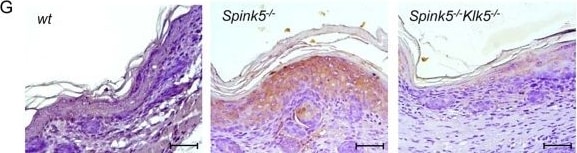
Detection of Mouse TSLP by Immunohistochemistry-Paraffin
Klk5 deletion results in remarkable suppression of the inflammatory phenotype of NS.(A-E). Results show remarkable abrogation of pro-allergic and pro-inflammatory cytokines quantified by RT-qPCR. (A) Il-1 beta, Tslp, Tnf-alpha ; (B) Il-6, Il-18, the type 17 promoting cytokine Il-23p19; (C) Ifn-gamma, Il-4, Il-17A, Il-22; (D) Th17 regulated genes Defb4, Slpi, Cxcl1 and Ccl20; (E) Th17/22 regulated genes s100a7, s100a8, s100a9. Data are shown as the mean ± s.e.m. of triplicate amplification for at least five mice per genotype. Results are normalized to wt mean (set as 1.0). *p<0.05, **p<0.005, ***p<0.001 (Mann-Whitney U test). (F) Quantification of mast cells based on toluidine blue staining of skin tissue (mast cells stain purple). An increased number of mast cells was detected in Spink5-/- dermis; (G) IHC analysis shows abolishment of Tslp expression in Spink5-/-Klk5-/- skin as compared to Spink5-/-; Scale bar: 50μm. Image collected and cropped by CiteAb from the following open publication (https://pubmed.ncbi.nlm.nih.gov/26390218), licensed under a CC-BY license. Not internally tested by R&D Systems.
Mouse TSLP ELISA Standard Curve
Recombinant Mouse TSLP (Catalog # 555-TS) was serially diluted and captured by Rat Anti-Mouse TSLP Monoclonal Antibody (Catalog # MAB5551) coated on a Clear Polystyrene Microplate (Catalog # DY990). Goat Anti-Mouse TSLP Antigen Affinity-purified Polyclonal Antibody (Catalog # AF555) was biotinylated and incubated with the protein captured on the plate. Detection of the standard curve was achieved by incubating Streptavidin-HRP (Catalog # DY998)Applications for Mouse TSLP Antibody
Western Blot
Sample: Recombinant Mouse TSLP (Catalog # 555-TS)
Neutralization
Formulation, Preparation, and Storage
Purification
Reconstitution
Reconstitute at 0.2 mg/mL in sterile PBS. For liquid material, refer to CoA for concentration.
Formulation
Shipping
Stability & Storage
- 12 months from date of receipt, -20 to -70 °C as supplied.
- 1 month, 2 to 8 °C under sterile conditions after reconstitution.
- 6 months, -20 to -70 °C under sterile conditions after reconstitution.
Calculators
Background: TSLP
References
- Sims, J.E. et al. (2000) J. Exp. Med. 192:671.
- Staudacher, E. et al. (1992) Eur. J. Biochem. 207:987.
- Tarentino, A.L. and T.H. Jr. Plummer (1994) Glycobiology 4: 771.
Long Name
Alternate Names
Gene Symbol
UniProt
Additional TSLP Products
Product Documents for Mouse TSLP Antibody
Certificate of Analysis
To download a Certificate of Analysis, please enter a lot or batch number in the search box below.
Note: Certificate of Analysis not available for kit components.
Product Specific Notices for Mouse TSLP Antibody
For research use only
Citations for Mouse TSLP Antibody
 Powered by Bioz
Customer Reviews for Mouse TSLP Antibody
There are currently no reviews for this product. Be the first to review Mouse TSLP Antibody and earn rewards!
Have you used Mouse TSLP Antibody?
Submit a review and receive an Amazon gift card!
$25/€18/£15/$25CAN/¥2500 for a review with an image
$10/€7/£6/$10CAN/¥1110 for a review without an image
Submit a review
Protocols
Find general support by application which include: protocols, troubleshooting, illustrated assays, videos and webinars.
- Cellular Response to Hypoxia Protocols
- R&D Systems Quality Control Western Blot Protocol
- Troubleshooting Guide: Western Blot Figures
- Western Blot Conditions
- Western Blot Protocol
- Western Blot Protocol for Cell Lysates
- Western Blot Troubleshooting
- Western Blot Troubleshooting Guide
- View all Protocols, Troubleshooting, Illustrated assays and Webinars
Associated Pathways
