Mouse VEGF Quantikine ELISA Kit

R&D Systems | Catalog # MMV00

R&D Systems
Loading...

Key Product Details

Assay Length

4.5 hours

Sample Type & Volume Required Per Well

Cell Culture Supernates (50 µL), Tissue Homogenates (50 µL), Serum (10 µL), EDTA Plasma (10 µL), Heparin Plasma (10 µL)

Sensitivity

3 pg/mL

Assay Range

7.8-500 pg/mL (Cell Culture Supernates, Tissue Homogenates, Serum, EDTA Plasma)
Loading...

Product Summary for Mouse VEGF Quantikine ELISA Kit

The Quantikine Mouse VEGF Immunoassay is a 4.5 hour solid phase ELISA designed to measure mouse VEGF in cell culture supernates, tissue homogenates, mouse serum, and plasma. It contains Sf 21-expressed mouse VEGF and antibodies raised against the recombinant factor. This immunoassay has been shown to quantitate the recombinant mouse VEGF accurately. Results obtained using natural mouse VEGF showed dose-response curves that were parallel to the standard curves obtained using the recombinant Quantikine kit standards. These results indicate that this kit can be used to determine relative mass values for natural mouse VEGF.

Product Specifications

Assay Type

Solid Phase Sandwich ELISA

Format

96-well strip plate

Measurement

Quantitative ELISA

Detection Method

Colorimetric - 450nm (TMB)

Conjugate

HRP

Species

Mouse

Specificity

This kit recognizes both the 164 and 120 amino acid residue forms of mouse VEGF

Cross-reactivity

< 0.5% cross-reactivity observed with available related molecules. < 50% cross-species reactivity observed with species tested.

Interference

Interference observed with 1 or more available related molecules.

Precision

Intra-Assay Precision (Precision within an assay) Three samples of known concentration were tested on one plate to assess intra-assay precision.

Inter-Assay Precision (Precision between assays) Three samples of known concentration were tested in separate assays to assess inter-assay precision.

Cell Culture Supernates, EDTA Plasma, Serum, Tissue Homogenates

Intra-Assay Precision Inter-Assay Precision
Sample 1 2 3 1 2 3
n 20 20 20 20 20 20
Mean (pg/mL) 37.7 144 277 38.3 138 291
Standard Deviation 3.1 6.2 12.9 3.2 7.8 18.5
CV% 8.2 4.3 4.7 8.4 5.7 6.4

Recovery for Mouse VEGF Quantikine ELISA Kit

The recovery of mouse VEGF spiked to three levels throughout the range of the assay in various matrices was evaluated.

Sample Type Average % Recovery Range %
Cell Culture Supernates (n=9) 103 95-114
EDTA Plasma (n=5) 91 82-103
Heparin Plasma (n=4) 89 87-94
Serum (n=9) 101 83-115
Tissue Homogenates (n=3) 91 76-107

Linearity

To assess the linearity of the assay, samples containing and/or spiked with various concentrations of mouse VEGF in each matrix were diluted with Calibrator Diluent and then assayed.

Mouse VEGF ELISA Linearity

Scientific Data Images for Mouse VEGF Quantikine ELISA Kit

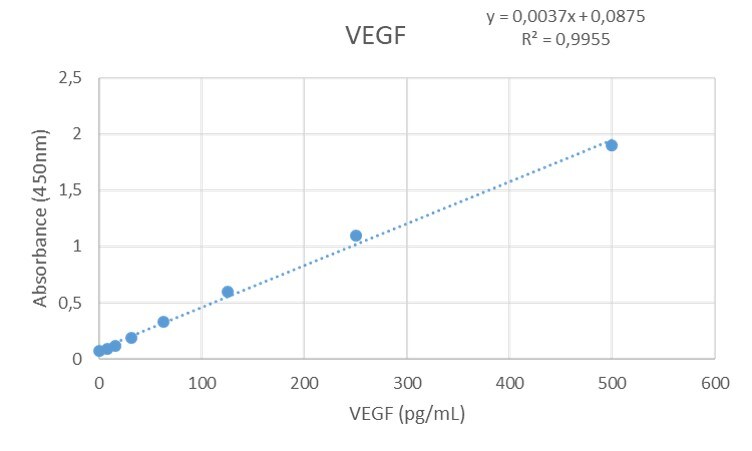
Mouse VEGF ELISA Standard Curve

Mouse VEGF ELISA Standard Curve

Mouse VEGF Quantikine ELISA Kit

Mouse VEGF Quantikine ELISA Kit

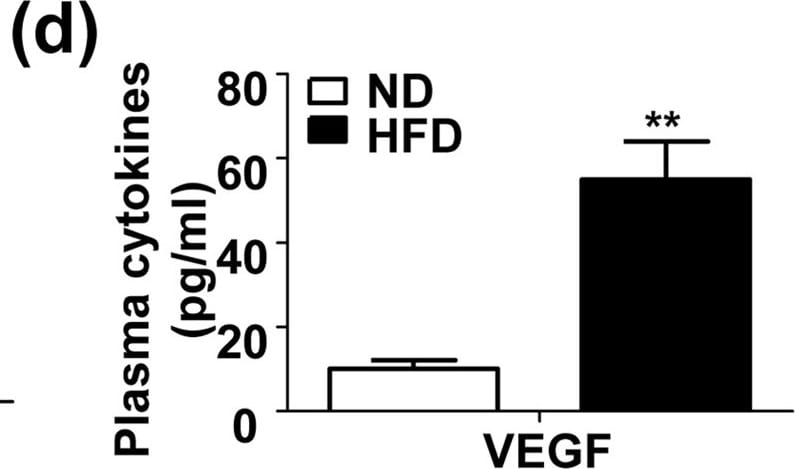
Increased production of proinflammatory cytokines and VEGF in the plasma and chondrocytes in high fat diet (HFD)-feeding mice.(a~d) levels of plasma IL-6 (a), TNF-alpha (b), IL-1 beta (c) and VEGF (d) in the C57BL/6 male mice fed with a normal diet (ND) or HFD for 8 weeks. (n = 5, **P < 0.01). (e~h) Relative mRNA expression of IL-6 (e), TNF-alpha (f), IL-1 beta (g) and VEGF (h) in the chondrocytes isolated from the 8-week ND or HFD-feeding mice. (n = 5, **P < 0.01). Image collected and cropped by CiteAb from the following open publication (https://pubmed.ncbi.nlm.nih.gov/26271607), licensed under a CC-BY license. Not internally tested by R&D Systems.
Detection of Mouse VEGF

Detection of Mouse VEGF

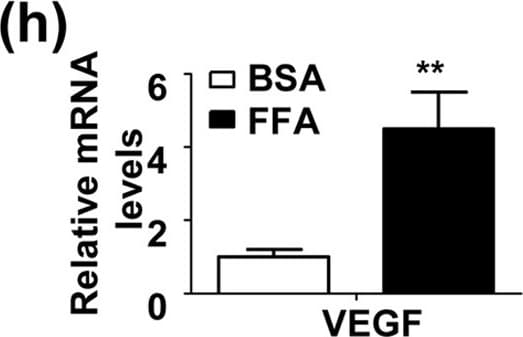
HFD-induced plasma saturated free fatty acid (FFA) and lactate trigger production of proinflammatory cytokines and VEGF in mouse chondrocytes.(a~d) Relative mRNA levels of IL-6 (a), TNF-alpha (b), IL-1 beta (c) and VEGF (d) in the mouse primary chondrocytes treated with full or fractionated (>3 KD or <3 KD) serum from the 8-week ND or HFD-feeding mice. (n = 3, *P < 0.05, **P < 0.01 and ***P < 0.005). (e~h) Relative mRNA levels of IL-6 (e), TNF-alpha (f), IL-1 beta (g) and VEGF (h) in the mouse primary chondrocytes treated with BSA (5%) or BSA-linked FFA (18:0, 200 μM) for 24 h. (n = 3, *P < 0.05 and **P < 0.01). (i~l) Relative mRNA expression of IL-6 (i), TNF-alpha (j), IL-1 beta (k) and VEGF (l) in the mouse primary chondrocytes treated with lactate (25 mM) or vehicle control for 24 h. (n = 3, *P < 0.05 and **P < 0.01). Image collected and cropped by CiteAb from the following open publication (https://pubmed.ncbi.nlm.nih.gov/26271607), licensed under a CC-BY license. Not internally tested by R&D Systems.
Detection of Mouse VEGF

Detection of Mouse VEGF

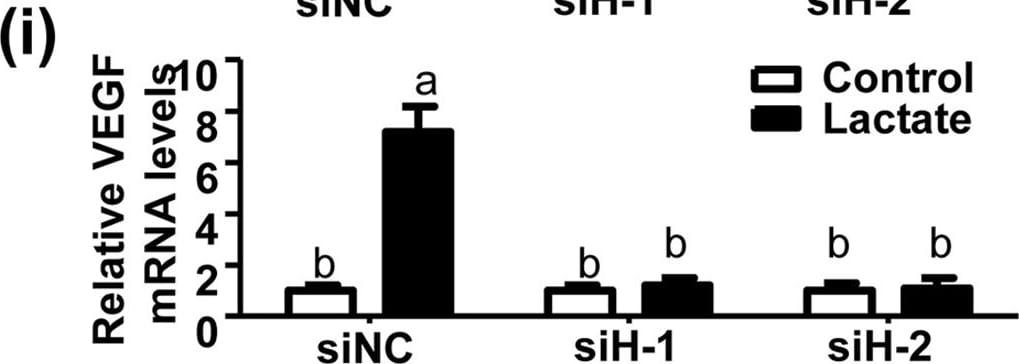
FFA and lactate enhance production of proinflammatory cytokines and VEGF via HIF1 alpha in mouse chondrocytes.(a) Immunoblotting assay of HIF1 alpha in primary chondrocytes transfected with a scramble siRNA (siNC, 20 nM), a mouse HIF1 alpha specific siRNA1 (siH-1, 20 nM) or siRNA2 (siH-2, 20 nM) for 36 h. (b~e) Relative mRNA levels of IL-6 (b), TNF-alpha (c), IL-1 beta (d) and VEGF (e) in the mouse primary chondrocytes transfected with siNC (20 nM), siH-1 (20 nM) or siH-2 (20 nM)for 12 h plus additional treatment with BSA (5%) or FFA (200 μM) for 24 h. Values not sharing a common superscript letter differ significantly. (n = 3, P < 0.05). (f~i) Relative mRNA levels of IL-6 (f), TNF-alpha (g), IL-1 beta (h) and VEGF (i) in the mouse primary chondrocytes transfected with siNC (20 nM), siH-1 (20 nM) or siH-2 (20 nM) for 12 h plus additional treatment with lactate (25 mM) or vehicle control for 24 h. Values not sharing a common superscript letter differ significantly. (n = 3, P < 0.05). Image collected and cropped by CiteAb from the following open publication (https://pubmed.ncbi.nlm.nih.gov/26271607), licensed under a CC-BY license. Not internally tested by R&D Systems.

Preparation and Storage

Shipping

The product is shipped at ambient temperature. Upon receipt, store it immediately at the temperature recommended below.

Stability & Storage

Store the unopened product at 2 - 8 °C. Do not use past expiration date.

Background: VEGF

Vascular endothelial growth factor (VEGF or VEGF-A), also known as vascular permeability factor (VPF), is a potent mediator of both angiogenesis and vasculogenesis in the fetus and in adults (1-3). It is a member of the PDGF family that is characterized by the presence of eight conserved cysteine residues in a cystine knot structure and the formation of anti-parallel disulfide-linked dimers (4). Alternately spliced isoforms of 120, 164 and 188 amino acids (aa) have been found in mice, while 121, 145, 165, 183, 189, and 206 aa isoforms have been identified in humans (2, 4). In humans, VEGF165 appears to be the most abundant and potent isoform, followed by VEGF121 and VEGF189 (3, 4). The same pattern may exist in mice. Isoforms other than VEGF120 and VEGF121 contain basic heparin-binding regions and are not freely diffusible (4). Mouse VEGF164 shares 97% aa sequence identity with corresponding regions of rat VEGF. It also shares 89% aa sequence identity with human and porcine VEGF, 88% with bovine VEGF, and 90% with feline, equine, and canine VEGF. VEGF is expressed in multiple cells and tissues including skeletal and cardiac muscle (5, 6), hepatocytes (7), osteoblasts (8), neutrophils (9), macrophages (10), keratinocytes (11), brown adipose tissue (12), CD34+ stem cells (13), endothelial cells (14), fibroblasts, and vascular smooth muscle cells (15). VEGF expression is induced by hypoxia and cytokines such as IL-1, IL-6, IL-8, Oncostatin M, and TNF-alpha (3, 4, 9, 16). The isoforms are differentially expressed during development and in the adult (3). 
VEGF dimers bind to two related receptor tyrosine kinases, VEGF R1 (also called Flt-1) and VEGF R2 (Flk-1/KDR), and induce their homodimerization and autophosphorylation (3, 4, 7, 17, 18). These receptors have seven extracellular immunoglobulin-like domains and an intracellular split tyrosine kinase domain. They are expressed on vascular endothelial cells and a range of non-endothelial cells. Although VEGF affinity is highest for binding to VEGF R1, VEGF R2 appears to be the primary mediator of VEGF angiogenic activity (3, 4). VEGF165 also binds the semaphorin receptor, neuropilin-1, which promotes complex formation with VEGF R2 (19). 
VEGF is best known for its role in vasculogenesis. During embryogenesis, VEGF regulates the proliferation, migration, and survival of endothelial cells (3, 4), thus regulating blood vessel density and size but playing no role in determining vascular patterns. VEGF promotes bone formation through osteoblast and chondroblast recruitment and is also a monocyte chemoattractant (20-22). In postnatal life, VEGF maintains endothelial cell integrity and is a potent mitogen for micro- and macro-vascular endothelial cells. In adults, VEGF functions mainly in wound healing and the female reproductive cycle (3). In diseased tissues, VEGF promotes vascular permeability. It is thus thought to contribute to tumor metastasis by promoting both extravasation and tumor angiogenesis (23, 24). Various strategies have been employed therapeutically to antagonize VEGF-mediated tumor angiogenesis (25). Circulating VEGF levels correlate with disease activity in autoimmune diseases such as rheumatoid arthritis, multiple sclerosis, and systemic lupus erythematosus (26).

Long Name

Vascular Endothelial Growth Factor

Alternate Names

MVCD1, VAS, Vasculotropin, VEGF-A, VEGFA, VPF

Entrez Gene IDs

7422 (Human); 22339 (Mouse); 83785 (Rat); 281572 (Bovine); 403802 (Canine); 493845 (Feline); 30682 (Zebrafish)

Gene Symbol

VEGFA

Additional VEGF Products

Product Documents for Mouse VEGF Quantikine ELISA Kit

Certificate of Analysis

To download a Certificate of Analysis, please enter a lot or batch number in the search box below.

Note: Certificate of Analysis not available for kit components.

Product Specific Notices for Mouse VEGF Quantikine ELISA Kit

For research use only

⚠ WARNING: This product can expose you to chemicals including N,N-Dimethylforamide, which is known to the State of California to cause cancer. For more information, go to www.P65Warnings.ca.gov.

Citations for Mouse VEGF Quantikine ELISA Kit

Customer Reviews for Mouse VEGF Quantikine ELISA Kit (7)

4.6 out of 5
7 Customer Ratings
5 Stars
57%
4 Stars
43%
3 Stars
0%
2 Stars
0%
1 Stars
0%

Have you used Mouse VEGF Quantikine ELISA Kit?

Submit a review and receive an Amazon gift card!

$25/€18/£15/$25CAN/¥2500 Yen for a review with an image

$10/€7/£6/$10CAN/¥1110 Yen for a review without an image

Submit a review
Amazon Gift Card

Customer Images


Showing  1 - 5 of 7 reviews Showing All
Filter By:
  • Mouse VEGF Quantikine ELISA Kit
    Name: Anonymous
    Sample Tested: Serum
    Verified Customer | Posted 10/23/2023
    Mouse VEGF Quantikine ELISA Kit MMV00
  • Mouse VEGF Quantikine ELISA Kit
    Name: Andres Ocampo Carrillo
    Sample Tested: Plasma
    Verified Customer | Posted 03/04/2023
    Mouse VEGF was used to quantify this protein in mouse plasma subjected to pro-inflammatory factors (TNF-a, IL-1b, LPS). Results showed a consistent VEGF production that could be quantified.
    Mouse VEGF Quantikine ELISA Kit MMV00
  • Mouse VEGF Quantikine ELISA Kit
    Name: Anonymous
    Sample Tested: Cell Lysates
    Verified Customer | Posted 07/20/2022
    Mouse VEGF Quantikine ELISA Kit MMV00
  • Mouse VEGF Quantikine ELISA Kit
    Name: Rahul Mallick
    Sample Tested: c166
    Verified Customer | Posted 08/26/2020
  • Mouse VEGF Quantikine ELISA Kit
    Name: Anonymous
    Sample Tested: Cell Culture Media
    Verified Customer | Posted 07/18/2018
  • Name: Anonymous
    Sample Tested: Serum
    Verified Customer | Posted 06/12/2018
  • Mouse VEGF Quantikine ELISA Kit
    Name: Adam Guess
    Verified Customer | Posted 11/10/2016
    Mouse VEGF Quantikine ELISA Kit MMV00

There are no reviews that match your criteria.

Showing  1 - 5 of 7 reviews Showing All

Protocols

View specific protocols for Mouse VEGF Quantikine ELISA Kit (MMV00):

Refer to the product for complete assay procedure.

Bring all reagents and samples to room temperature before use. It is recommended that all samples, standards, and controls be assayed in duplicate.
  1.   Prepare all reagents, standard dilutions, and samples as directed in the product insert.
  2.   Remove excess microplate strips from the plate frame, return them to the foil pouch containing the desiccant pack, and reseal.

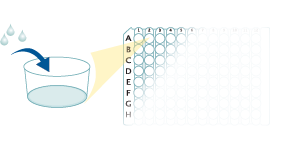
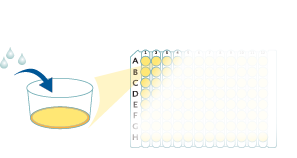
  3. 50 µL Assay Diluent
  4.   Add 50 µL of Assay Diluent to each well.

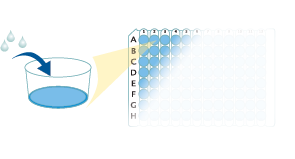
  5. 50 µL Standard, Control, or Sample
  6.   Add 50 µL of Standard, Control, or sample to each well. Cover with a plate sealer, and incubate at room temperature for 2 hours.
  7.   Aspirate each well and wash, repeating the process 4 times for a total of 5 washes.

  8. 100 µL Conjugate
  9.   Add 100 µL of Conjugate to each well. Cover with a new plate sealer, and incubate at room temperature for 2 hours.
  10.   Aspirate and wash 5 times.

  11. 100 µL Substrate Solution
  12.   Add 100 µL Substrate Solution to each well. Incubate at room temperature for 30 minutes. PROTECT FROM LIGHT.

  13. 100 µL Stop Solution
  14.   Add 100 µL of Stop Solution to each well. Read at 450 nm within 30 minutes. Set wavelength correction to 540 nm or 570 nm.

Find general support by application which include: protocols, troubleshooting, illustrated assays, videos and webinars.

FAQs

No product specific FAQs exist for this product.

View all FAQs for ELISA Kits