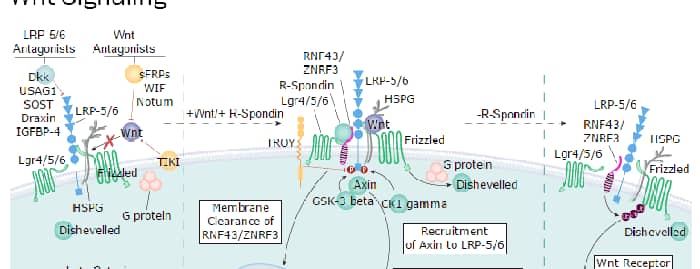
Wnt proteins are secreted glycoproteins with a conserved pattern of 23-24 cysteine residues that play critical roles in both carcinogenesis and embryonic development. Wnts bind to receptors of the Frizzled family, sometimes in conjunction with other membrane-associated proteins such as LRPs or proteoglycans. Downstream effects of Wnt signaling occur through different intracellular components, depending on which pathway is activated. Three pathways have been characterized: the canonical Wnt/ beta -catenin pathway, the Wnt/Ca2+ pathway, and the planar cell polarity (1-3). Wnt-5b is a 49 kDa glycoprotein of the subgroup of Wnts that is implicated in the Wnt/Ca2+ pathway (3-6). It is not axis-inducing in Xenopus embryos and only weakly transforms C57MG mammary epithelial cells. The non-canonical Wnt pathway can inhibit canonical Wnt/ beta -catenin signaling (3). Mouse Wnt-5b is synthesized as a 359 amino acid (aa) precursor that contains a 17 aa signal sequence and a 342 aa mature region. It is ubiquitously expressed at low but increasing levels throughout embryonic development (4, 5, 7). In adult mice, Wnt-5b is expressed in heart, liver, brain, lung, testes, kidney, and pancreas (4, 8). Wnt-5b appears to promote adipogenesis. It is upregulated in early adipogenesis. Also, Wnt-5b overexpression in 3T3-L1 cells partially inhibits canonical Wnt suppression of adipogenesis (9, 10). Human Wnt-5b polymorphisms have been associated with Type II diabetes (9). Although Wnt-5a and Wnt-5b share 83% aa identity, they show differential expression and regulation of cyclin D1 and p130 during endochondral bone development. Together, they appear to coordinate chondrocyte proliferation and differentiation (11). Mature mouse Wnt-5b shows 94%, 98%, 90%, and 88% aa sequence identity with mature human, rat, chick, and Xenopus Wnt-5b, respectively.
Mouse Wnt‑5b Alexa Fluor™ Plus 647‑conjugated Antibody
R&D Systems | Catalog # FAB3006AFP647


Key Product Details
Species Reactivity
Applications
Label
Antibody Source
Product Specifications
Specificity
Clonality
Host
Isotype
Applications for Mouse Wnt‑5b Alexa Fluor™ Plus 647‑conjugated Antibody
Immunocytochemistry
Formulation, Preparation, and Storage
Formulation
Shipping
Stability & Storage
Background: Wnt-5b
References
- Miller, J.R. (2002) Genome Biol. 3:3001.
- Roelink, H. and R. Nusse (1991) Genes Dev. 5:381.
- Veeman, M.T. et al. (2003) Developmental Cell 5:367.
- Gavin, B. J. et al. (1990) Genes Dev. 4:2319.
- Nusse, R. and H.E. Varmus (1992) Cell 69:1073.
- Wong, G.T. et al. (1994) Mol. Cell. Biol. 14:6278.
- Kemp, C. et al. (2005) Dev. Dyn. 233:1064.
- Heller, R.S. et al. (2002) Dev. Dyn. 225:260.
- Kanazawa, A. et al. (2004) Am. J. Hum. Genet. 75:832.
- Kanazawa, A. et al. (2005) Biochem. Biophys. Res. Com. 330:505.
- Yang, Y. et al. (2003) Development 130:1003.
Long Name
Alternate Names
Gene Symbol
UniProt
Additional Wnt-5b Products
Product Documents for Mouse Wnt‑5b Alexa Fluor™ Plus 647‑conjugated Antibody
Certificate of Analysis
To download a Certificate of Analysis, please enter a lot or batch number in the search box below.
Note: Certificate of Analysis not available for kit components.
Product Specific Notices for Mouse Wnt‑5b Alexa Fluor™ Plus 647‑conjugated Antibody
This product is provided under an intellectual property license from Life Technologies Corporation. The transfer of this product is conditioned on the buyer using the purchased product solely in research conducted by the buyer, excluding contract research or any fee for service research, and the buyer must not (1) use this product or its components for (a) diagnostic, therapeutic or prophylactic purposes; (b) testing, analysis or screening services, or information in return for compensation on a per-test basis; or (c) manufacturing or quality assurance or quality control, and/or (2) sell or transfer this product or its components for resale, whether or not resold for use in research. For information on purchasing a license to this product for purposes other than as described above, contact Life Technologies Corporation, 5781 Van Allen Way, Carlsbad, CA 92008 USA or outlicensing@thermofisher.com.
For research use only
Related Research Areas
Customer Reviews
There are currently no reviews for this product. Be the first to review Mouse Wnt‑5b Alexa Fluor™ Plus 647‑conjugated Antibody and earn rewards!
Have you used Mouse Wnt‑5b Alexa Fluor™ Plus 647‑conjugated Antibody?
Submit a review and receive an Amazon gift card!
$25/€18/£15/$25CAN/¥2500 Yen for a review with an image
$10/€7/£6/$10CAN/¥1110 Yen for a review without an image
Submit a review
Protocols
Find general support by application which include: protocols, troubleshooting, illustrated assays, videos and webinars.
- Appropriate Fixation of IHC/ICC Samples
- Cellular Response to Hypoxia Protocols
- ClariTSA™ Fluorophore Kits
- Detection & Visualization of Antibody Binding
- ICC Cell Smear Protocol for Suspension Cells
- ICC Immunocytochemistry Protocol Videos
- ICC for Adherent Cells
- Immunocytochemistry (ICC) Protocol
- Immunocytochemistry Troubleshooting
- Immunofluorescence of Organoids Embedded in Cultrex Basement Membrane Extract
- Immunohistochemistry (IHC) and Immunocytochemistry (ICC) Protocols
- Preparing Samples for IHC/ICC Experiments
- Preventing Non-Specific Staining (Non-Specific Binding)
- Primary Antibody Selection & Optimization
- Protocol for VisUCyte™ HRP Polymer Detection Reagent
- Protocol for the Fluorescent ICC Staining of Cell Smears - Graphic
- Protocol for the Fluorescent ICC Staining of Cultured Cells on Coverslips - Graphic
- Protocol for the Preparation and Fluorescent ICC Staining of Cells on Coverslips
- Protocol for the Preparation and Fluorescent ICC Staining of Non-adherent Cells
- Protocol for the Preparation and Fluorescent ICC Staining of Stem Cells on Coverslips
- Protocol for the Preparation of a Cell Smear for Non-adherent Cell ICC - Graphic
- TUNEL and Active Caspase-3 Detection by IHC/ICC Protocol
- The Importance of IHC/ICC Controls
- View all Protocols, Troubleshooting, Illustrated assays and Webinars