MyD88 Inhibitor Peptide Set
Novus Biologicals | Catalog # NBP2-29328


Key Product Details
Species
Applications
Product Specifications
Specificity
Applications
ELISA (1:100 - 1:2000. Use reported in scientific literature (PMID 23469306))
Binding Inhibition (reported in scientific literature (PMID 28302163))
Block/Neutralize (reported in scientific literature (PMID 24886588))
Flow Cytometry (reported in scientific literature (PMID 27870876))
In vitro assay (reported in scientific literature (PMID 25810567))
In vivo assay (reported in scientific literature (PMID 24755282))
Functional (Inhibition) (reported in multiple pieces of scientific literature)
Application Notes
Inhibitory peptide at 100 uM concentration may be a starting point. However, useful concentration of peptide may vary depending on experimental condition and cell type. Incubate cells for 24 hr with peptides before stimulating with ligands.
Reactivity Notes
Inhibitor Content
2 x 1.0mg: Antennapedia Control peptide (lyophilized) DRQIKIWFQNRRMKWKK. Molecular weight: 2361
5mg size will contain 5mg of each peptide (MyD88 Homodimerization Inhibitor peptide and Antennapedia Control peptide).
Formulation, Preparation, and Storage
Preparation Method
PBS* is added directly to the vials to prepare the stock solutions. Note: Bring the solution to room temperature and quick spin the tubes before opening the caps.
MyD88 Homodimerization Inhibitor Peptide: 1 mg of DRQIKIWFQNRRMKWKKRDVLPGT
Add 64.4 ul of PBS* to the vial to make a 5 mM stock solution. Mix by vortexing. Aliquot and store at -20C or -80C. Avoid repeated freeze thawing.
Control Peptide: 1 mg of DRQIKIWFQNRRMKWKK
Add 84.8 ul PBS* to the vial. Mix by vortexing. Aliquot and store at -20C or -80C. Avoid repeated freeze thawing
*Recipe for 1X PBS:
1. Dissolve the following in 800ml distilled H2O.
- 8g of NaCl
- 0.2g of KCl
- 1.44g of Na2HPO4
- 0.24g of KH2PO4
2. Adjust pH to 7.5 with HCl.
3. Adjust volume to 1L with additional distilled H2O.
4. Sterilize by autoclaving
Please contact technical support for detailed reconstitution instructions.
Formulation
Concentration
Shipping
Storage
Background: MyD88
Long Name
Alternate Names
Gene Symbol
Additional MyD88 Products
Product Documents for MyD88 Inhibitor Peptide Set
Certificate of Analysis
To download a Certificate of Analysis, please enter a lot or batch number in the search box below.
Product Specific Notices for MyD88 Inhibitor Peptide Set
This product is for research use only and is not approved for use in humans or in clinical diagnosis. Inhibitors are guaranteed for 1 year from date of receipt.
Related Research Areas
Citations for MyD88 Inhibitor Peptide Set
 Powered by Bioz
Customer Reviews for MyD88 Inhibitor Peptide Set (3)
Have you used MyD88 Inhibitor Peptide Set?
Submit a review and receive an Amazon gift card!
$25/€18/£15/$25CAN/¥2500 for a review with an image
$10/€7/£6/$10CAN/¥1110 for a review without an image
Submit a review
-
Verified Customer | Posted 05/12/2017
-
Verified Customer | Posted 04/28/2017
-
Verified Customer | Posted 04/19/2017
There are no reviews that match your criteria.
Protocols
View specific protocols for MyD88 Inhibitor Peptide Set (NBP2-29328):
Hazard Information
Chemical Name: Non hazardous products
Chemical Formula: N/A
CAS Number: N/A
EEC-No: N/A
Hazard Identification
None
First Aid Measures
Eye Contact: None
Skin Contact: None
Inhalation: None
Ingestion: None
Accidental Release Measures
This product either does not contain hazardous constituents or the concentration of all chemical constituents are below the regulatory threshold limits described by Occupational Safety Health Administration Hazard Communication Standard 29 CFR 1910.1200 and the European Directive 91/155/EEC. 88/379/EEC, and 67/546/EEC.
Handling and Storage
Exposure Controls / Personal Protection
Other Precautions: None
Physical and Chemical Properties
Form: N/A
Color: N/A
Odor: N/A
Melting Point: N/A
Boiling Temperature: N/A
Density: N/A
Vapor Pressure: N/A
Solubility in Water: N/A
Flash Point: N/A
Explosion limits: N/A
Ignition Temperature: N/A
Find general support by application which include: protocols, troubleshooting, illustrated assays, videos and webinars.
- 7-Amino Actinomycin D (7-AAD) Cell Viability Flow Cytometry Protocol
- Antigen Retrieval Protocol (PIER)
- Antigen Retrieval for Frozen Sections Protocol
- Appropriate Fixation of IHC/ICC Samples
- Cellular Response to Hypoxia Protocols
- Chromogenic IHC Staining of Formalin-Fixed Paraffin-Embedded (FFPE) Tissue Protocol
- Chromogenic Immunohistochemistry Staining of Frozen Tissue
- ClariTSA™ Fluorophore Kits
- Detection & Visualization of Antibody Binding
- ELISA Sample Preparation & Collection Guide
- ELISA Troubleshooting Guide
- Extracellular Membrane Flow Cytometry Protocol
- Flow Cytometry Protocol for Cell Surface Markers
- Flow Cytometry Protocol for Staining Membrane Associated Proteins
- Flow Cytometry Staining Protocols
- Flow Cytometry Troubleshooting Guide
- Fluorescent IHC Staining of Frozen Tissue Protocol
- Graphic Protocol for Heat-induced Epitope Retrieval
- Graphic Protocol for the Preparation and Fluorescent IHC Staining of Frozen Tissue Sections
- Graphic Protocol for the Preparation and Fluorescent IHC Staining of Paraffin-embedded Tissue Sections
- Graphic Protocol for the Preparation of Gelatin-coated Slides for Histological Tissue Sections
- How to Run an R&D Systems DuoSet ELISA
- How to Run an R&D Systems Quantikine ELISA
- How to Run an R&D Systems Quantikine™ QuicKit™ ELISA
- IHC Sample Preparation (Frozen sections vs Paraffin)
- Immunofluorescent IHC Staining of Formalin-Fixed Paraffin-Embedded (FFPE) Tissue Protocol
- Immunohistochemistry (IHC) and Immunocytochemistry (ICC) Protocols
- Immunohistochemistry Frozen Troubleshooting
- Immunohistochemistry Paraffin Troubleshooting
- Intracellular Flow Cytometry Protocol Using Alcohol (Methanol)
- Intracellular Flow Cytometry Protocol Using Detergents
- Intracellular Nuclear Staining Flow Cytometry Protocol Using Detergents
- Intracellular Staining Flow Cytometry Protocol Using Alcohol Permeabilization
- Intracellular Staining Flow Cytometry Protocol Using Detergents to Permeabilize Cells
- Preparing Samples for IHC/ICC Experiments
- Preventing Non-Specific Staining (Non-Specific Binding)
- Primary Antibody Selection & Optimization
- Propidium Iodide Cell Viability Flow Cytometry Protocol
- Protocol for Heat-Induced Epitope Retrieval (HIER)
- Protocol for Liperfluo
- Protocol for Making a 4% Formaldehyde Solution in PBS
- Protocol for VisUCyte™ HRP Polymer Detection Reagent
- Protocol for the Characterization of Human Th22 Cells
- Protocol for the Characterization of Human Th9 Cells
- Protocol for the Preparation & Fixation of Cells on Coverslips
- Protocol for the Preparation and Chromogenic IHC Staining of Frozen Tissue Sections
- Protocol for the Preparation and Chromogenic IHC Staining of Frozen Tissue Sections - Graphic
- Protocol for the Preparation and Chromogenic IHC Staining of Paraffin-embedded Tissue Sections
- Protocol for the Preparation and Chromogenic IHC Staining of Paraffin-embedded Tissue Sections - Graphic
- Protocol for the Preparation and Fluorescent IHC Staining of Frozen Tissue Sections
- Protocol for the Preparation and Fluorescent IHC Staining of Paraffin-embedded Tissue Sections
- Protocol for the Preparation of Gelatin-coated Slides for Histological Tissue Sections
- Protocol: Annexin V and PI Staining by Flow Cytometry
- Protocol: Annexin V and PI Staining for Apoptosis by Flow Cytometry
- Quantikine HS ELISA Kit Assay Principle, Alkaline Phosphatase
- Quantikine HS ELISA Kit Principle, Streptavidin-HRP Polymer
- Sandwich ELISA (Colorimetric) – Biotin/Streptavidin Detection Protocol
- Sandwich ELISA (Colorimetric) – Direct Detection Protocol
- TUNEL and Active Caspase-3 Detection by IHC/ICC Protocol
- The Importance of IHC/ICC Controls
- Troubleshooting Guide: ELISA
- Troubleshooting Guide: Fluorokine Flow Cytometry Kits
- Troubleshooting Guide: Immunohistochemistry
- View all Protocols, Troubleshooting, Illustrated assays and Webinars
FAQs for MyD88 Inhibitor Peptide Set
-
Q: I have a question regarding the product NBP2-29328 and want to know how the inhibitory peptide passes through the cell wall?
A:
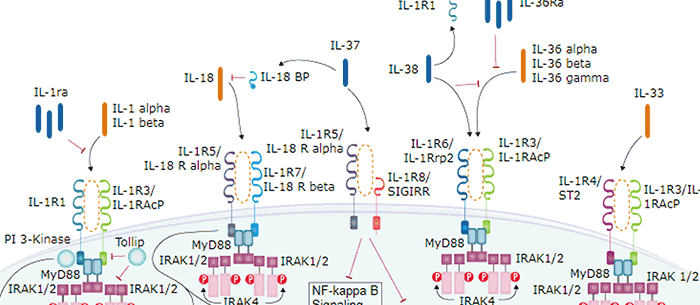
The MyD88 inhibitory peptide contains a protein transduction (PTD) sequence derived from antennapedia which renders the PTD sequence renders the peptide cell permeable. The antennapedia technology was first described by Derossi et al, The third helix of the Antennapedia homeodomain translocates through biological membranes and is used in a number of our inhibitory peptides. The MyD88 inhibitory peptide also contains a sequence from the MyD88 TIR homodimerization domain (Loiarro et al, Peptide-mediated interference of TIR domain dimerization in MyD88 inhibits interleukin-1-dependent activation of NF-{kappa}B). The control peptide consists of only the PTD sequence. The Derossi and Loiarro technology references are attached for additional background information. Please also follow this link to representative publications citing the MyD88 inhibitory peptide.
-
Q: I was wondering whether NBP2-29328-5mg has biological activity.
A: Our MyD88 Inhibitor Peptide Set does have biological activity.
-
Q: I'm looking into purchasing NBP2-29328 for use and I am wondering if you can give me more information. Specifically, I would like to inject this drug ICM (directly into the CNS) using a rat model, and I am wondering what information you can provide about
A: Unfortunately, I do not see any in-vivo data for this product on our internal records. Most of the information that we have on our records for this product may be seen at its online datasheets
-
Q: Is this the same as ST2825 compound described by Loiarro et al, 2007?
A: ST2825 is the heptapeptide only, whereas the inhibitor peptide from NBP2-29328 corresponds to the association between the hexapeptide + the PTD sequence from antennapedia. In that case, this would suggest that the product used in Loiarro et al. is not the same as NBP2-29328.
-
Q: I have a question regarding the product NBP2-29328 and want to know how the inhibitory peptide passes through the cell wall?
A:
The MyD88 inhibitory peptide contains a protein transduction (PTD) sequence derived from antennapedia which renders the PTD sequence renders the peptide cell permeable. The antennapedia technology was first described by Derossi et al, The third helix of the Antennapedia homeodomain translocates through biological membranes and is used in a number of our inhibitory peptides. The MyD88 inhibitory peptide also contains a sequence from the MyD88 TIR homodimerization domain (Loiarro et al, Peptide-mediated interference of TIR domain dimerization in MyD88 inhibits interleukin-1-dependent activation of NF-{kappa}B). The control peptide consists of only the PTD sequence. The Derossi and Loiarro technology references are attached for additional background information. Please also follow this link to representative publications citing the MyD88 inhibitory peptide.
-
Q: I was wondering whether NBP2-29328-5mg has biological activity.
A: Our MyD88 Inhibitor Peptide Set does have biological activity.
-
Q: I'm looking into purchasing NBP2-29328 for use and I am wondering if you can give me more information. Specifically, I would like to inject this drug ICM (directly into the CNS) using a rat model, and I am wondering what information you can provide about
A: Unfortunately, I do not see any in-vivo data for this product on our internal records. Most of the information that we have on our records for this product may be seen at its online datasheets
-
Q: Is this the same as ST2825 compound described by Loiarro et al, 2007?
A: ST2825 is the heptapeptide only, whereas the inhibitor peptide from NBP2-29328 corresponds to the association between the hexapeptide + the PTD sequence from antennapedia. In that case, this would suggest that the product used in Loiarro et al. is not the same as NBP2-29328.
-
Q: I have a question regarding the product NBP2-29328 and want to know how the inhibitory peptide passes through the cell wall?
A:
The MyD88 inhibitory peptide contains a protein transduction (PTD) sequence derived from antennapedia which renders the PTD sequence renders the peptide cell permeable. The antennapedia technology was first described by Derossi et al, The third helix of the Antennapedia homeodomain translocates through biological membranes and is used in a number of our inhibitory peptides. The MyD88 inhibitory peptide also contains a sequence from the MyD88 TIR homodimerization domain (Loiarro et al, Peptide-mediated interference of TIR domain dimerization in MyD88 inhibits interleukin-1-dependent activation of NF-{kappa}B). The control peptide consists of only the PTD sequence. The Derossi and Loiarro technology references are attached for additional background information. Please also follow this link to representative publications citing the MyD88 inhibitory peptide.
-
Q: I was wondering whether NBP2-29328-5mg has biological activity.
A: Our MyD88 Inhibitor Peptide Set does have biological activity.
-
Q: I'm looking into purchasing NBP2-29328 for use and I am wondering if you can give me more information. Specifically, I would like to inject this drug ICM (directly into the CNS) using a rat model, and I am wondering what information you can provide about
A: Unfortunately, I do not see any in-vivo data for this product on our internal records. Most of the information that we have on our records for this product may be seen at its online datasheets
-
Q: Is this the same as ST2825 compound described by Loiarro et al, 2007?
A: ST2825 is the heptapeptide only, whereas the inhibitor peptide from NBP2-29328 corresponds to the association between the hexapeptide + the PTD sequence from antennapedia. In that case, this would suggest that the product used in Loiarro et al. is not the same as NBP2-29328.
-
Q: I have a question regarding the product NBP2-29328 and want to know how the inhibitory peptide passes through the cell wall?
A:
The MyD88 inhibitory peptide contains a protein transduction (PTD) sequence derived from antennapedia which renders the PTD sequence renders the peptide cell permeable. The antennapedia technology was first described by Derossi et al, The third helix of the Antennapedia homeodomain translocates through biological membranes and is used in a number of our inhibitory peptides. The MyD88 inhibitory peptide also contains a sequence from the MyD88 TIR homodimerization domain (Loiarro et al, Peptide-mediated interference of TIR domain dimerization in MyD88 inhibits interleukin-1-dependent activation of NF-{kappa}B). The control peptide consists of only the PTD sequence. The Derossi and Loiarro technology references are attached for additional background information. Please also follow this link to representative publications citing the MyD88 inhibitory peptide.
-
Q: I was wondering whether NBP2-29328-5mg has biological activity.
A: Our MyD88 Inhibitor Peptide Set does have biological activity.
-
Q: I'm looking into purchasing NBP2-29328 for use and I am wondering if you can give me more information. Specifically, I would like to inject this drug ICM (directly into the CNS) using a rat model, and I am wondering what information you can provide about
A: Unfortunately, I do not see any in-vivo data for this product on our internal records. Most of the information that we have on our records for this product may be seen at its online datasheets
-
Q: Is this the same as ST2825 compound described by Loiarro et al, 2007?
A: ST2825 is the heptapeptide only, whereas the inhibitor peptide from NBP2-29328 corresponds to the association between the hexapeptide + the PTD sequence from antennapedia. In that case, this would suggest that the product used in Loiarro et al. is not the same as NBP2-29328.