
NuMA Antibody - BSA Free
Novus Biologicals | Catalog # NB500-174

![Western Blot: NuMA Antibody [NB500-174]](https://resources.rndsystems.com/images/products/NuMA-Antibody-Western-Blot-NB500-174-img0001.jpg "Western Blot: NuMA Antibody [NB500-174]")
Scientific images may be resized, cropped, or adjusted for brightness or contrast for presentation purposes. These updates are limited to presentation and do not affect the underlying scientific interpretation of the data. Where available, additional source data may be provided upon request.
Key Product Details
Species Reactivity
Validated:
Cited:
Applications
Validated:
Cited:
Label
Antibody Source
Format
Product Specifications
Immunogen
Reactivity Notes
Clonality
Host
Isotype
Scientific Data Images for NuMA Antibody - BSA Free
Western Blot: NuMA Antibody [NB500-174]
Western Blot: NuMA Antibody [NB500-174] - Analysis of NuMA expression in Cos7 whole cell lysate.![Immunocytochemistry/ Immunofluorescence: NuMA Antibody [NB500-174]](https://resources.rndsystems.com/images/products/NuMA-Antibody-Immunocytochemistry-Immunofluorescence-NB500-174-img0003.jpg "Immunocytochemistry/ Immunofluorescence: NuMA Antibody [NB500-174]")
Immunocytochemistry/ Immunofluorescence: NuMA Antibody [NB500-174]
Immunocytochemistry/Immunofluorescence: NuMA Antibody [NB500-174] - Human HeLa cells fixed with 3.5% formaldehyde and stained with NB500-174 at 1:1000. The staining pattern shows the typical pattern for NuMA in the cell nucleus during interphase and on spindles during mitosis.![Immunohistochemistry-Paraffin: NuMA Antibody [NB500-174]](https://resources.rndsystems.com/images/products/NuMA-Antibody-Immunohistochemistry-Paraffin-NB500-174-img0013.jpg "Immunohistochemistry-Paraffin: NuMA Antibody [NB500-174]")
Immunohistochemistry-Paraffin: NuMA Antibody [NB500-174]
Immunohistochemistry-Paraffin: NuMA Antibody [NB500-174] - Analysis of FFPE tissue section of human placenta using rabbit polyclonal NuMA antibody (NB500-174) at 5 ug/mL. Strong nuclear with moderate cytoplasmic immuno-reactivity of NuMA was observed in syncytiotrophoblast, cytiotrophoblasts, Hofbauer cells and the endothelial cells of chorionic villi capillaries. 10X Magnification.![Immunocytochemistry/ Immunofluorescence: NuMA Antibody [NB500-174]](https://resources.rndsystems.com/images/products/NuMA-Antibody-Immunocytochemistry-Immunofluorescence-NB500-174-img0005.jpg "Immunocytochemistry/ Immunofluorescence: NuMA Antibody [NB500-174]")
Immunocytochemistry/ Immunofluorescence: NuMA Antibody [NB500-174]
Immunocytochemistry/Immunofluorescence: NuMA Antibody [NB500-174] - NuMA antibody was tested in HeLa cells with DyLight 488 (green). Nuclei and alpha-tubulin were counterstained with DAPI (blue) and DyLight 550 (red).![Immunocytochemistry/ Immunofluorescence: NuMA Antibody [NB500-174]](https://resources.rndsystems.com/images/products/NuMA-Antibody-Immunocytochemistry-Immunofluorescence-NB500-174-img0006.jpg "Immunocytochemistry/ Immunofluorescence: NuMA Antibody [NB500-174]")
Immunocytochemistry/ Immunofluorescence: NuMA Antibody [NB500-174]
Immunocytochemistry/Immunofluorescence: NuMA Antibody [NB500-174] - NuMA antibody was tested in HeLa cells with DyLight 488 (green). Nuclei and alpha-tubulin were counterstained with DAPI (blue) and DyLight 550 (red).![Immunocytochemistry/ Immunofluorescence: NuMA Antibody [NB500-174]](https://resources.rndsystems.com/images/products/NuMA-Antibody-Immunocytochemistry-Immunofluorescence-NB500-174-img0024.jpg "Immunocytochemistry/ Immunofluorescence: NuMA Antibody [NB500-174]")
Immunocytochemistry/ Immunofluorescence: NuMA Antibody [NB500-174]
NuMA-Antibody-Immunocytochemistry-Immunofluorescence-NB500-174-img0024.jpg![Immunohistochemistry-Paraffin: NuMA Antibody [NB500-174]](https://resources.rndsystems.com/images/products/NuMA-Antibody-Immunohistochemistry-Paraffin-NB500-174-img0007.jpg "Immunohistochemistry-Paraffin: NuMA Antibody [NB500-174]")
Immunohistochemistry-Paraffin: NuMA Antibody [NB500-174]
Immunohistochemistry-Paraffin: NuMA Antibody [NB500-174] - Analysis of FFPE tissue section of human normal breast using rabbit polyclonal NuMA antibody (NB500-174) at 5 ug/mL. The breast ductal/acinar epithelial cells, the myoepithelial cells and some cells in the surrounding connective tissue depicted a strong nuclear along with moderate cytoplasmic immuno-positivity for NuMA protein. The intra-lobular and the surrounding connective tissue also developed weak/potentially non-specific staining. 10X Magnification.![Immunohistochemistry-Paraffin: NuMA Antibody [NB500-174]](https://resources.rndsystems.com/images/products/NuMA-Antibody-Immunohistochemistry-Paraffin-NB500-174-img0008.jpg "Immunohistochemistry-Paraffin: NuMA Antibody [NB500-174]")
Immunohistochemistry-Paraffin: NuMA Antibody [NB500-174]
Immunohistochemistry-Paraffin: NuMA Antibody [NB500-174] - Analysis of FFPE tissue section of human normal spleen using rabbit polyclonal NuMA antibody (NB500-174) at 5 ug/mL. Most of the cells developed a strong nuclear along with moderate cytoplasmic immuno-positivity for NuMA protein. 10X Magnification.![Immunohistochemistry-Paraffin: NuMA Antibody [NB500-174]](https://resources.rndsystems.com/images/products/NuMA-Antibody-Immunohistochemistry-Paraffin-NB500-174-img0009.jpg "Immunohistochemistry-Paraffin: NuMA Antibody [NB500-174]")
Immunohistochemistry-Paraffin: NuMA Antibody [NB500-174]
Immunohistochemistry-Paraffin: NuMA Antibody [NB500-174] - Analysis of FFPE tissue section of human normal skin using rabbit polyclonal NuMA antibody (NB500-174) at 5 ug/mL. Almost all the cells in the epidermal layer and the cells in the connective tissue of dermal layer depicted very strong nuclear along with moderate cytoplasmic immuno-positivity for NuMA protein. 10X Magnification.![Immunohistochemistry-Paraffin: NuMA Antibody [NB500-174]](https://resources.rndsystems.com/images/products/NuMA-Antibody-Immunohistochemistry-Paraffin-NB500-174-img0010.jpg "Immunohistochemistry-Paraffin: NuMA Antibody [NB500-174]")
Immunohistochemistry-Paraffin: NuMA Antibody [NB500-174]
Immunohistochemistry-Paraffin: NuMA Antibody [NB500-174] - Analysis of FFPE tissue section of human normal brain using rabbit polyclonal NuMA antibody (NB500-174) at 5 ug/mL. The cells in the brain tissue depicted strong specific nuclear along with weak cytoplasmic immuno-positivity for NuMA protein. 10X Magnification.![Immunohistochemistry-Paraffin: NuMA Antibody [NB500-174]](https://resources.rndsystems.com/images/products/NuMA-Antibody-Immunohistochemistry-Paraffin-NB500-174-img0011.jpg "Immunohistochemistry-Paraffin: NuMA Antibody [NB500-174]")
Immunohistochemistry-Paraffin: NuMA Antibody [NB500-174]
Immunohistochemistry-Paraffin: NuMA Antibody [NB500-174] - Analysis of FFPE tissue section of human normal kidney using rabbit polyclonal NuMA antibody (NB500-174) at 5 ug/mL. The cells of various tubules/ducts and Bowman's capsule in the renal tissue depicted strong nuclear along with relatively weak cytoplasmic immuno-positivity for NuMA protein. 10X Magnification.![Immunohistochemistry-Paraffin: NuMA Antibody [NB500-174]](https://resources.rndsystems.com/images/products/NuMA-Antibody-Immunohistochemistry-Paraffin-NB500-174-img0012.jpg "Immunohistochemistry-Paraffin: NuMA Antibody [NB500-174]")
Immunohistochemistry-Paraffin: NuMA Antibody [NB500-174]
Immunohistochemistry-Paraffin: NuMA Antibody [NB500-174] - Analysis of FFPE tissue section of human normal prostate using rabbit polyclonal NuMA antibody (NB500-174) at 5 ug/mL. The prostatic alveolar glandular epithelium as well as the surrounding fibromuscular stroma cells showed a strong nuclear immuno-reactivity for NuMA protein. Almost all the cells developed some cytoplasmic staining also. 10X Magnification.![Simple Western: NuMA Antibody [NB500-174]](https://resources.rndsystems.com/images/products/NuMA-Antibody-Simple-Western-NB500-174-img0023.jpg "Simple Western: NuMA Antibody [NB500-174]")
Simple Western: NuMA Antibody [NB500-174]
Simple Western: NuMA Antibody [NB500-174] - Image shows a specific band for NuMA in 0.2 mg/mL of HeLa lysate. This experiment was performed under reducing conditions using the 66-440 kDa separation system.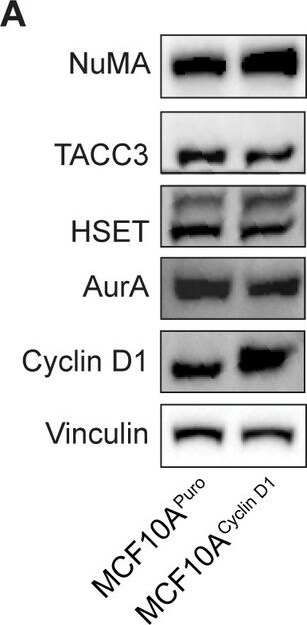
Western Blot: NuMA Antibody - BSA Free [NB500-174] -
NuMA, but not HSET, Aurora A kinase, or TACC3, is upregulated in cyclin D1-overexpressing cells.(A) Western blot of NuMA, TACC3, HSET, Aurora A kinase, and cyclin D1 levels in MCF10APuro (control) and MCF10ACyclin D1 cell lines. The overexpressed cyclin D1 is HA-tagged. Vinculin is shown as a loading control. (B-C) Quantification of NuMA, cyclin D1 (B), HSET, Aurora A kinase, and TACC3 levels (C) normalized to vinculin levels. Lines show mean +/- standard deviation of three independent replicates. Image collected and cropped by CiteAb from the following open publication (https://dx.plos.org/10.1371/journal.pone.0296779), licensed under a CC-BY license. Not internally tested by Novus Biologicals.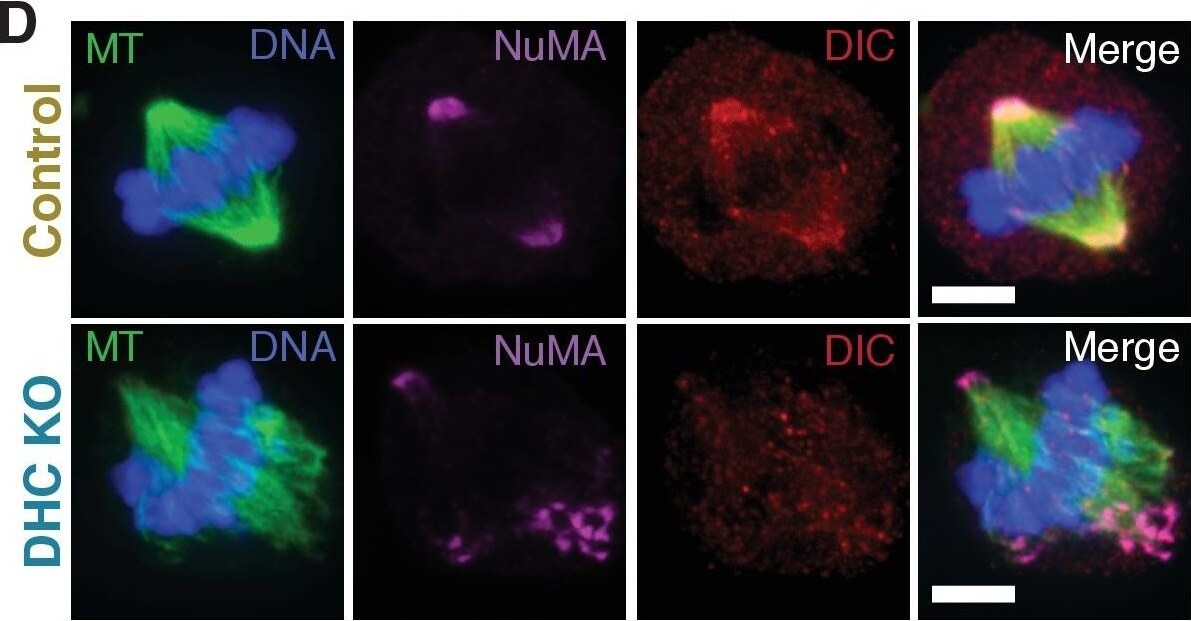
Immunocytochemistry/ Immunofluorescence: NuMA Antibody - BSA Free [NB500-174] -
NuMA localizes to minus-ends despite dynein inhibition or knockout.(A) Live images of GFP-alpha -tubulin immediately before and after k-fiber ablation at targeted sites (red ‘X’s) in a PtK2 cell in which dynein cargo-binding is inhibited by transfection of the dominant-negative p150-CC1 fragment (Quintyne and Schroer, 2002). Scale bar, 5 μm. (B) Immunofluorescence image of NuMA (magenta) and alpha -tubulin (yellow) in cell from (A), fixed after ablation. NuMA (arrowheads) localizes to new minus ends. Scale bar, 5 μm. (C) Western blot showing >65% depletion (normalized to alpha -tubulin) of dynein intermediate chain (DIC) protein at the cell population level after dynein heavy chain (DHC) depletion using inducible-Cas9 DHC-knockout HeLa cells (McKinley and Cheeseman, 2017). DIC depletion has been shown to correlate with DHC depletion (Levy and Holzbaur, 2008). Because knockout was heterogeneous across the population, dynein loss within individual cells chosen for analysis was always verified by immunofluorescence, as in (D), or by spindle phenotype. (D) Immunofluorescence images of inducible DHC-knockout HeLa cells show robust localization of NuMA at minus-ends after DHC knockout, in the absence of dynein (dynein intermediate chain; DIC). Scale bar, 5 μm. (E) Plot of mean normalized GFP-NuMA intensity and SEM (shading) over time at ablation-created minus-ends in HeLa cells with and without dynein deletion (DHC KO). Time = 0 s at the first frame following ablation (‘X’). n = 12 ablations, 7 cells for control; n = 10 ablations, 8 cells for DHC KO. (F) Time from ablation to half maximum GFP-NuMA intensity, calculated for each individual ablation (see Methods) and then averaged for data in (E). Error bars show SEM. Image collected and cropped by CiteAb from the following open publication (https://pubmed.ncbi.nlm.nih.gov/29185983), licensed under a CC-BY license. Not internally tested by Novus Biologicals.Applications for NuMA Antibody - BSA Free
Immunocytochemistry/ Immunofluorescence
Immunohistochemistry
Immunohistochemistry-Frozen
Immunohistochemistry-Paraffin
Immunoprecipitation
Simple Western
Western Blot
In Simple Western only 10 - 15 uL of the recommended dilution is used per data point.
See Simple Western Antibody Database for Simple Western validation: Tested in HeLa lysate 0.2 mg/mL, separated by Size, antibody dilution of 1:500. Separated by Size-Wes, Sally Sue/Peggy Sue.
Formulation, Preparation, and Storage
Purification
Formulation
Format
Preservative
Concentration
Shipping
Stability & Storage
Background: NuMA
Long Name
Alternate Names
Entrez Gene IDs
Gene Symbol
UniProt
Additional NuMA Products
Product Documents for NuMA Antibody - BSA Free
Certificate of Analysis
To download a Certificate of Analysis, please enter a lot or batch number in the search box below.
Product Specific Notices for NuMA Antibody - BSA Free
This product is for research use only and is not approved for use in humans or in clinical diagnosis. Primary Antibodies are guaranteed for 1 year from date of receipt.
Citations for NuMA Antibody - BSA Free
 Powered by Bioz
Customer Reviews for NuMA Antibody - BSA Free
There are currently no reviews for this product. Be the first to review NuMA Antibody - BSA Free and earn rewards!
Have you used NuMA Antibody - BSA Free?
Submit a review and receive an Amazon gift card!
$25/€18/£15/$25CAN/¥2500 for a review with an image
$10/€7/£6/$10CAN/¥1110 for a review without an image
Submit a review
Protocols
Find general support by application which include: protocols, troubleshooting, illustrated assays, videos and webinars.
- Antigen Retrieval Protocol (PIER)
- Antigen Retrieval for Frozen Sections Protocol
- Appropriate Fixation of IHC/ICC Samples
- Cellular Response to Hypoxia Protocols
- Chromogenic IHC Staining of Formalin-Fixed Paraffin-Embedded (FFPE) Tissue Protocol
- Chromogenic Immunohistochemistry Staining of Frozen Tissue
- ClariTSA™ Fluorophore Kits
- Detection & Visualization of Antibody Binding
- Fluorescent IHC Staining of Frozen Tissue Protocol
- Graphic Protocol for Heat-induced Epitope Retrieval
- Graphic Protocol for the Preparation and Fluorescent IHC Staining of Frozen Tissue Sections
- Graphic Protocol for the Preparation and Fluorescent IHC Staining of Paraffin-embedded Tissue Sections
- Graphic Protocol for the Preparation of Gelatin-coated Slides for Histological Tissue Sections
- ICC Cell Smear Protocol for Suspension Cells
- ICC Immunocytochemistry Protocol Videos
- ICC for Adherent Cells
- IHC Sample Preparation (Frozen sections vs Paraffin)
- Immunocytochemistry (ICC) Protocol
- Immunocytochemistry Troubleshooting
- Immunofluorescence of Organoids Embedded in Cultrex Basement Membrane Extract
- Immunofluorescent IHC Staining of Formalin-Fixed Paraffin-Embedded (FFPE) Tissue Protocol
- Immunohistochemistry (IHC) and Immunocytochemistry (ICC) Protocols
- Immunohistochemistry Frozen Troubleshooting
- Immunohistochemistry Paraffin Troubleshooting
- Immunoprecipitation Protocol
- Preparing Samples for IHC/ICC Experiments
- Preventing Non-Specific Staining (Non-Specific Binding)
- Primary Antibody Selection & Optimization
- Protocol for Heat-Induced Epitope Retrieval (HIER)
- Protocol for Making a 4% Formaldehyde Solution in PBS
- Protocol for VisUCyte™ HRP Polymer Detection Reagent
- Protocol for the Fluorescent ICC Staining of Cell Smears - Graphic
- Protocol for the Fluorescent ICC Staining of Cultured Cells on Coverslips - Graphic
- Protocol for the Preparation & Fixation of Cells on Coverslips
- Protocol for the Preparation and Chromogenic IHC Staining of Frozen Tissue Sections
- Protocol for the Preparation and Chromogenic IHC Staining of Frozen Tissue Sections - Graphic
- Protocol for the Preparation and Chromogenic IHC Staining of Paraffin-embedded Tissue Sections
- Protocol for the Preparation and Chromogenic IHC Staining of Paraffin-embedded Tissue Sections - Graphic
- Protocol for the Preparation and Fluorescent ICC Staining of Cells on Coverslips
- Protocol for the Preparation and Fluorescent ICC Staining of Non-adherent Cells
- Protocol for the Preparation and Fluorescent ICC Staining of Stem Cells on Coverslips
- Protocol for the Preparation and Fluorescent IHC Staining of Frozen Tissue Sections
- Protocol for the Preparation and Fluorescent IHC Staining of Paraffin-embedded Tissue Sections
- Protocol for the Preparation of Gelatin-coated Slides for Histological Tissue Sections
- Protocol for the Preparation of a Cell Smear for Non-adherent Cell ICC - Graphic
- R&D Systems Quality Control Western Blot Protocol
- TUNEL and Active Caspase-3 Detection by IHC/ICC Protocol
- The Importance of IHC/ICC Controls
- Troubleshooting Guide: Immunohistochemistry
- Troubleshooting Guide: Western Blot Figures
- Western Blot Conditions
- Western Blot Protocol
- Western Blot Protocol for Cell Lysates
- Western Blot Troubleshooting
- Western Blot Troubleshooting Guide
- View all Protocols, Troubleshooting, Illustrated assays and Webinars
FAQs for NuMA Antibody - BSA Free
-
Q: Is this antibody raised against full-length recombinant NuMA expressed in Sf9 cells?
A: With regard to the immunogen used for this antibody, I was able to verify that the product was generated against the full length protein. The antibody immunization is described in the following paper (page 695): NCBI site