

![Western Blot: OS9 Antibody [BC100-520]](https://resources.rndsystems.com/images/products/OS9-Antibody-Western-Blot-BC100-520-img0004.jpg "Western Blot: OS9 Antibody [BC100-520]")
Scientific images may be resized, cropped, or adjusted for brightness or contrast for presentation purposes. These updates are limited to presentation and do not affect the underlying scientific interpretation of the data. Where available, additional source data may be provided upon request.
Key Product Details
Species Reactivity
Validated:
Cited:
Applications
Validated:
Cited:
Label
Antibody Source
Format
Product Specifications
Immunogen
Clonality
Host
Isotype
Theoretical MW
Disclaimer note: The observed molecular weight of the protein may vary from the listed predicted molecular weight due to post translational modifications, post translation cleavages, relative charges, and other experimental factors.
Scientific Data Images for OS9 Antibody - BSA Free
Western Blot: OS9 Antibody [BC100-520]
OS9-Antibody-Western-Blot-BC100-520-img0004.jpg![Immunocytochemistry/ Immunofluorescence: OS9 Antibody [BC100-520]](https://resources.rndsystems.com/images/products/OS9-Antibody-Immunocytochemistry-Immunofluorescence-BC100-520-img0002.jpg "Immunocytochemistry/ Immunofluorescence: OS9 Antibody [BC100-520]")
Immunocytochemistry/ Immunofluorescence: OS9 Antibody [BC100-520]
Immunocytochemistry/Immunofluorescence: OS9 Antibody [BC100-520] - OS9 antibody was tested in HeLa cells with FITC (green). Nuclei and alpha-tubulin were counterstained with Dapi (blue) and Dylight 550 (red).![Western Blot: OS9 Antibody [BC100-520]](https://resources.rndsystems.com/images/products/OS9-Antibody-Western-Blot-BC100-520-img0001.jpg "Western Blot: OS9 Antibody [BC100-520]")
Western Blot: OS9 Antibody [BC100-520]
Western Blot: OS9 Antibody [BC100-520] - WB analysis of OS9 in 1. A431 cell lysate, 2. HepG2 cell lysate, 3. MCF7 cell lysate and 4. 3T3 cell lysate.![Simple Western: OS9 Antibody [BC100-520]](https://resources.rndsystems.com/images/products/OS9-Antibody-Simple-Western-BC100-520-img0003.jpg "Simple Western: OS9 Antibody [BC100-520]")
Simple Western: OS9 Antibody [BC100-520]
Simple Western: OS9 Antibody [BC100-520] - Simple Western lane view shows a specific band for OS9 in 0.5 mg/ml of HepG2 lysate. This experiment was performed under reducing conditions using the 12-230 kDa separation system.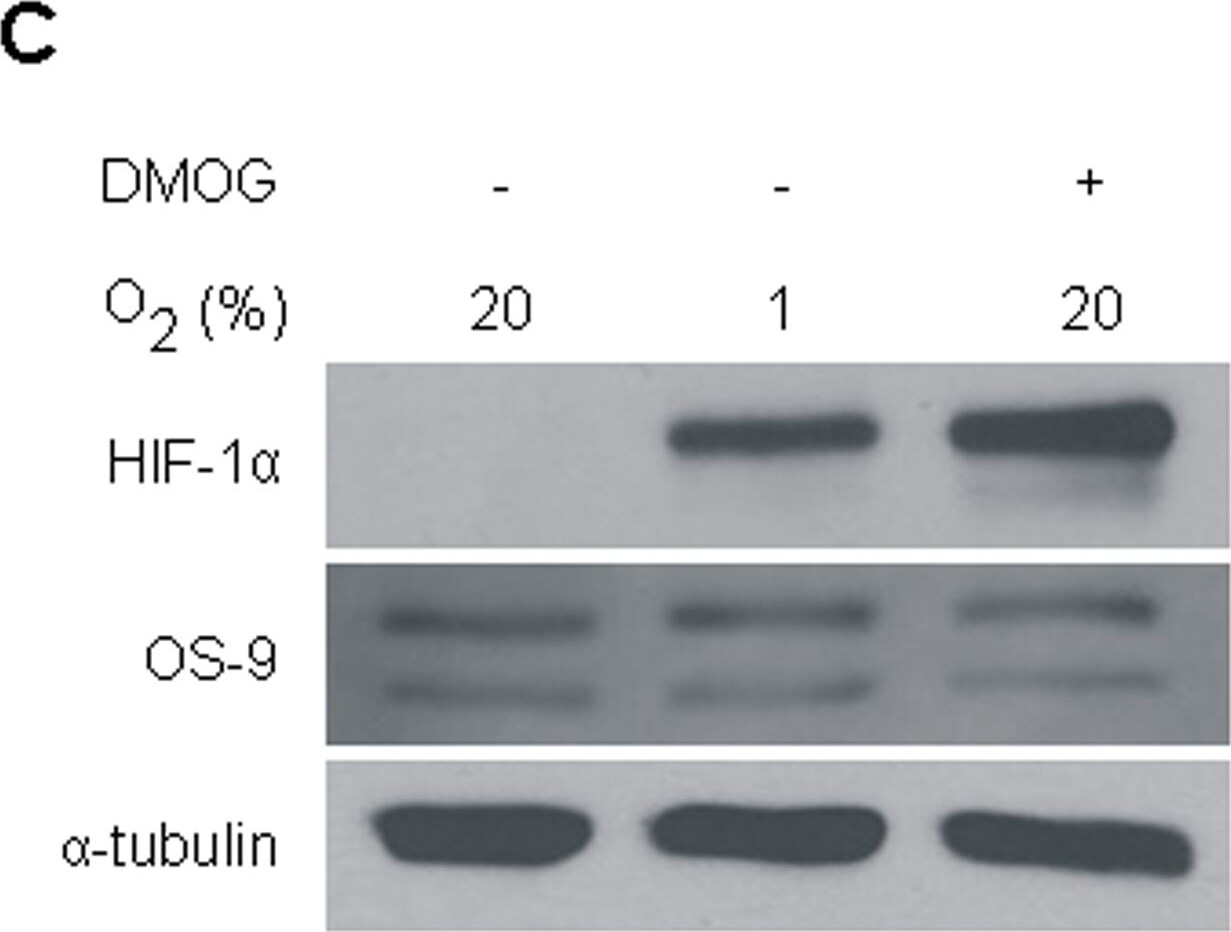
Western Blot: OS9 Antibody [BC100-520] -
Western Blot: OS9 Antibody [BC100-520] - Initial characterization of the OS-9 protein.(A) OS-9 expression in various human cell lines. Equal protein amounts of total cell lysates were used for SDS-PAGE & subsequent Western blotting. For each cell line, two independent samples are shown. Endogenous OS-9 was detected with a polyclonal antibody raised against a peptide corresponding to amino acids 600–667 of isoform 1 of OS-9. (B) Protein stability assay of endogenous OS-9. U2OS cells were treated with the translational inhibitor cycloheximide (100 µM). At indicated time points, whole cell lysates were analysed by immunoblotting. (C) Effect of hypoxia on OS-9 expression. For hypoxia, UT-7 cells were exposed to 1% O2 for 24 h prior to Western blot analysis. To determine any influence of HIF-1 alpha on OS-9 expression under normoxia, cells were incubated with the prolyl hydroxylase inhibitor DMOG (0.5 mM) for 24 h. (D) Protein interaction between OS-9 & PHD2 in vitro. For co-immunoprecipitation, U2OS cells were transiently co-transfected with the plasmids pOS-9-V5 & pPHD2-His, lysed in NP40 buffer, & subjected to immunoisolation with anti-V5 antibody recognizing OS-9 by its V5-tag. OS-9 & its associated proteins were separated by SDS-PAGE & analyzed by Western blot (lane 2). As controls, samples of untransfected (lane 1) cells or cells transfected with a single plasmid (lanes 3–4) were loaded. Representative Western blots are shown for each subfigure. Image collected & cropped by CiteAb from the following publication (https://pubmed.ncbi.nlm.nih.gov/21559462), licensed under a CC-BY license. Not internally tested by Novus Biologicals.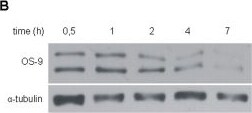
Western Blot: OS9 Antibody [BC100-520] -
Western Blot: OS9 Antibody [BC100-520] - Initial characterization of the OS-9 protein.(A) OS-9 expression in various human cell lines. Equal protein amounts of total cell lysates were used for SDS-PAGE & subsequent Western blotting. For each cell line, two independent samples are shown. Endogenous OS-9 was detected with a polyclonal antibody raised against a peptide corresponding to amino acids 600–667 of isoform 1 of OS-9. (B) Protein stability assay of endogenous OS-9. U2OS cells were treated with the translational inhibitor cycloheximide (100 µM). At indicated time points, whole cell lysates were analysed by immunoblotting. (C) Effect of hypoxia on OS-9 expression. For hypoxia, UT-7 cells were exposed to 1% O2 for 24 h prior to Western blot analysis. To determine any influence of HIF-1 alpha on OS-9 expression under normoxia, cells were incubated with the prolyl hydroxylase inhibitor DMOG (0.5 mM) for 24 h. (D) Protein interaction between OS-9 & PHD2 in vitro. For co-immunoprecipitation, U2OS cells were transiently co-transfected with the plasmids pOS-9-V5 & pPHD2-His, lysed in NP40 buffer, & subjected to immunoisolation with anti-V5 antibody recognizing OS-9 by its V5-tag. OS-9 & its associated proteins were separated by SDS-PAGE & analyzed by Western blot (lane 2). As controls, samples of untransfected (lane 1) cells or cells transfected with a single plasmid (lanes 3–4) were loaded. Representative Western blots are shown for each subfigure. Image collected & cropped by CiteAb from the following publication (https://pubmed.ncbi.nlm.nih.gov/21559462), licensed under a CC-BY license. Not internally tested by Novus Biologicals.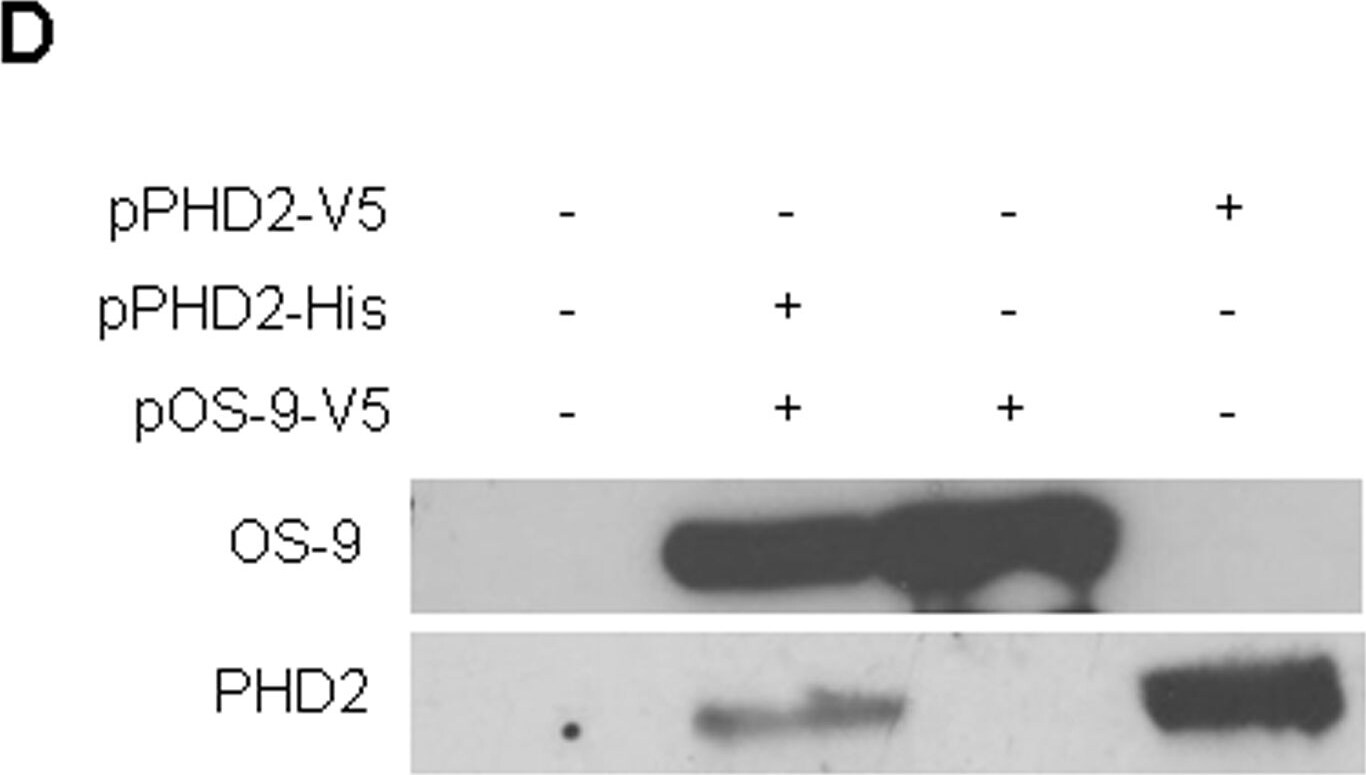
Western Blot: OS9 Antibody [BC100-520] -
Western Blot: OS9 Antibody [BC100-520] - Initial characterization of the OS-9 protein.(A) OS-9 expression in various human cell lines. Equal protein amounts of total cell lysates were used for SDS-PAGE & subsequent Western blotting. For each cell line, two independent samples are shown. Endogenous OS-9 was detected with a polyclonal antibody raised against a peptide corresponding to amino acids 600–667 of isoform 1 of OS-9. (B) Protein stability assay of endogenous OS-9. U2OS cells were treated with the translational inhibitor cycloheximide (100 µM). At indicated time points, whole cell lysates were analysed by immunoblotting. (C) Effect of hypoxia on OS-9 expression. For hypoxia, UT-7 cells were exposed to 1% O2 for 24 h prior to Western blot analysis. To determine any influence of HIF-1 alpha on OS-9 expression under normoxia, cells were incubated with the prolyl hydroxylase inhibitor DMOG (0.5 mM) for 24 h. (D) Protein interaction between OS-9 & PHD2 in vitro. For co-immunoprecipitation, U2OS cells were transiently co-transfected with the plasmids pOS-9-V5 & pPHD2-His, lysed in NP40 buffer, & subjected to immunoisolation with anti-V5 antibody recognizing OS-9 by its V5-tag. OS-9 & its associated proteins were separated by SDS-PAGE & analyzed by Western blot (lane 2). As controls, samples of untransfected (lane 1) cells or cells transfected with a single plasmid (lanes 3–4) were loaded. Representative Western blots are shown for each subfigure. Image collected & cropped by CiteAb from the following publication (https://pubmed.ncbi.nlm.nih.gov/21559462), licensed under a CC-BY license. Not internally tested by Novus Biologicals.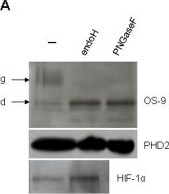
Western Blot: OS9 Antibody [BC100-520] -
Western Blot: OS9 Antibody [BC100-520] - Cellular localization of OS-9 & PHD2.(A) A lectin gel-shift assay was conducted to test for glycosylated proteins. Total cell lysates of U2OS cells were incubated in the presence or absence of the endoglycosidases EndoH & PNGaseF for 6 h at 37°C. Digest products were separated on a reducing 10% SDS-PAGE gel which contained concanavalin A co-polymerized in the top layer of the separating gel to retard mobility of glycosylated proteins [56]. Glycosylated OS-9 is indicated as ‘g’, deglycosylated OS-9 as ‘d’. (B) Detection of OS-9 & PHD2 in the nuclear fraction. HEK293 cells with & without transfection of the plasmid pcDNA3-OS-9 were separated into nuclear fraction (N) & postnuclear supernatant (PS), the latter containing cytoplasm & organelles. Western blot analysis included BiP, GAPDH & lamin A as typical marker proteins for the ER, the cytoplasm & the nucleus, respectively. (C) Detection of OS-9 & PHD2 in the cytoplasm. HEK293 cells were co-transfected with pcDNA3-OS-9 & pPHD2-V5. For hypoxia, cells were exposed to 3% O2 for 4 h. Cells were treated with 50 µg/ml digitonin & centrifuged to obtain a cytoplasmic (C) & an organelle fraction (O) & subjected to immunoblotting. (D) Isolation of cellular endomembranes. HEK293 cells were lysed mechanically by several passages through a 30½G needle. The postnuclear supernatant was processed further by ultra-centrifugation to separate the organelles (O) from the cytosol (C). High salt treatment (1 M KCl) of the organelle fraction produced a wash fraction (W) that contained dissociated peripheral membrane proteins. For immunoblot analysis of subcellular fractionations, cell aliquots were normalized for cell number prior to loading (B–D). Representative Western blots are shown for each subfigure. Image collected & cropped by CiteAb from the following publication (https://pubmed.ncbi.nlm.nih.gov/21559462), licensed under a CC-BY license. Not internally tested by Novus Biologicals.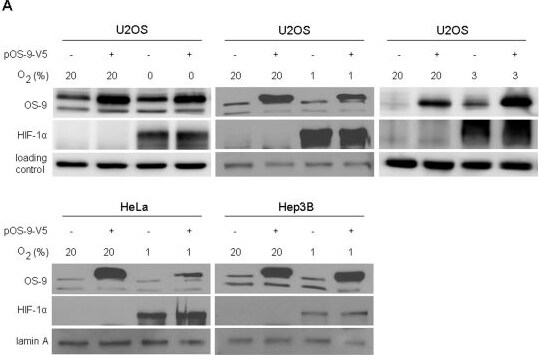
Western Blot: OS9 Antibody [BC100-520] -
Western Blot: OS9 Antibody [BC100-520] - OS-9 shows no effect on regulation of HIF-1 alpha.Total cell lysates were used for SDS-PAGE & subsequent Western blotting. To generate nearly anoxic conditions, cells were exposed to an oxygen consuming chemical system or to 1% or 3% O2 for 4 h to generate hypoxia. (A) U2OS, HeLa & Hep3B cells were transiently transfected with the plasmid pOS-9-V5 48 h prior to the experiment. Lamin A & actin were used as loading controls. (B) U2OS cells were subjected to ER stress by incubation either with tunicamycin (1 µg/ml) or thapsigargin (0.5 µg/ml) for 20 h. To detect HIF-1 alpha under normoxia, cells were treated with DMOG (1 mM) for 4 h. A sample of DMSO-only treated cells was loaded to exclude unspecific side effects of the solvent. (C) U2OS cells were transduced with lentiviral construct pLKO.1-shRNA-OS-9 (shOS-9) mediating a stable knockdown of OS-9 expression. Control cells (c) were transduced with plasmid pLKO.1-puro. Representative Western blots are shown for each subfigure. Image collected & cropped by CiteAb from the following publication (https://pubmed.ncbi.nlm.nih.gov/21559462), licensed under a CC-BY license. Not internally tested by Novus Biologicals.Applications for OS9 Antibody - BSA Free
Immunocytochemistry/ Immunofluorescence
Simple Western
Western Blot
In Simple Western only 10 - 15 uL of the recommended dilution is used per data point.
See Simple Western Antibody Database for Simple Western validation: Tested in HepG2 lysate 0.5 mg/mL, separated by Size, antibody dilution of 1:100, apparent MW was 25 kDa. Separated by Size-Wes, Sally Sue/Peggy Sue.
The observed molecular weight of the protein may vary from the listed predicted molecular weight due to post translational modifications, post translation cleavages, relative charges, and other experimental factors.
Reviewed Applications
Read 1 review rated 4 using BC100-520 in the following applications:
Formulation, Preparation, and Storage
Purification
Formulation
Format
Preservative
Concentration
Shipping
Stability & Storage
Background: OS9
Alternate Names
Entrez Gene IDs
Gene Symbol
UniProt
Additional OS9 Products
Product Documents for OS9 Antibody - BSA Free
Certificate of Analysis
To download a Certificate of Analysis, please enter a lot or batch number in the search box below.
Product Specific Notices for OS9 Antibody - BSA Free
This product is for research use only and is not approved for use in humans or in clinical diagnosis. Primary Antibodies are guaranteed for 1 year from date of receipt.
Citations for OS9 Antibody - BSA Free
 Powered by Bioz
Customer Reviews for OS9 Antibody - BSA Free (1)
Have you used OS9 Antibody - BSA Free?
Submit a review and receive an Amazon gift card!
$25/€18/£15/$25CAN/¥2500 for a review with an image
$10/€7/£6/$10CAN/¥1110 for a review without an image
Submit a review
-
Application: Western BlotVerified Customer | Posted 07/04/2012
There are no reviews that match your criteria.
Protocols
Find general support by application which include: protocols, troubleshooting, illustrated assays, videos and webinars.
- Appropriate Fixation of IHC/ICC Samples
- Cellular Response to Hypoxia Protocols
- ClariTSA™ Fluorophore Kits
- Detection & Visualization of Antibody Binding
- ICC Cell Smear Protocol for Suspension Cells
- ICC Immunocytochemistry Protocol Videos
- ICC for Adherent Cells
- Immunocytochemistry (ICC) Protocol
- Immunocytochemistry Troubleshooting
- Immunofluorescence of Organoids Embedded in Cultrex Basement Membrane Extract
- Immunohistochemistry (IHC) and Immunocytochemistry (ICC) Protocols
- Preparing Samples for IHC/ICC Experiments
- Preventing Non-Specific Staining (Non-Specific Binding)
- Primary Antibody Selection & Optimization
- Protocol for VisUCyte™ HRP Polymer Detection Reagent
- Protocol for the Fluorescent ICC Staining of Cell Smears - Graphic
- Protocol for the Fluorescent ICC Staining of Cultured Cells on Coverslips - Graphic
- Protocol for the Preparation and Fluorescent ICC Staining of Cells on Coverslips
- Protocol for the Preparation and Fluorescent ICC Staining of Non-adherent Cells
- Protocol for the Preparation and Fluorescent ICC Staining of Stem Cells on Coverslips
- Protocol for the Preparation of a Cell Smear for Non-adherent Cell ICC - Graphic
- R&D Systems Quality Control Western Blot Protocol
- TUNEL and Active Caspase-3 Detection by IHC/ICC Protocol
- The Importance of IHC/ICC Controls
- Troubleshooting Guide: Western Blot Figures
- Western Blot Conditions
- Western Blot Protocol
- Western Blot Protocol for Cell Lysates
- Western Blot Troubleshooting
- Western Blot Troubleshooting Guide
- View all Protocols, Troubleshooting, Illustrated assays and Webinars